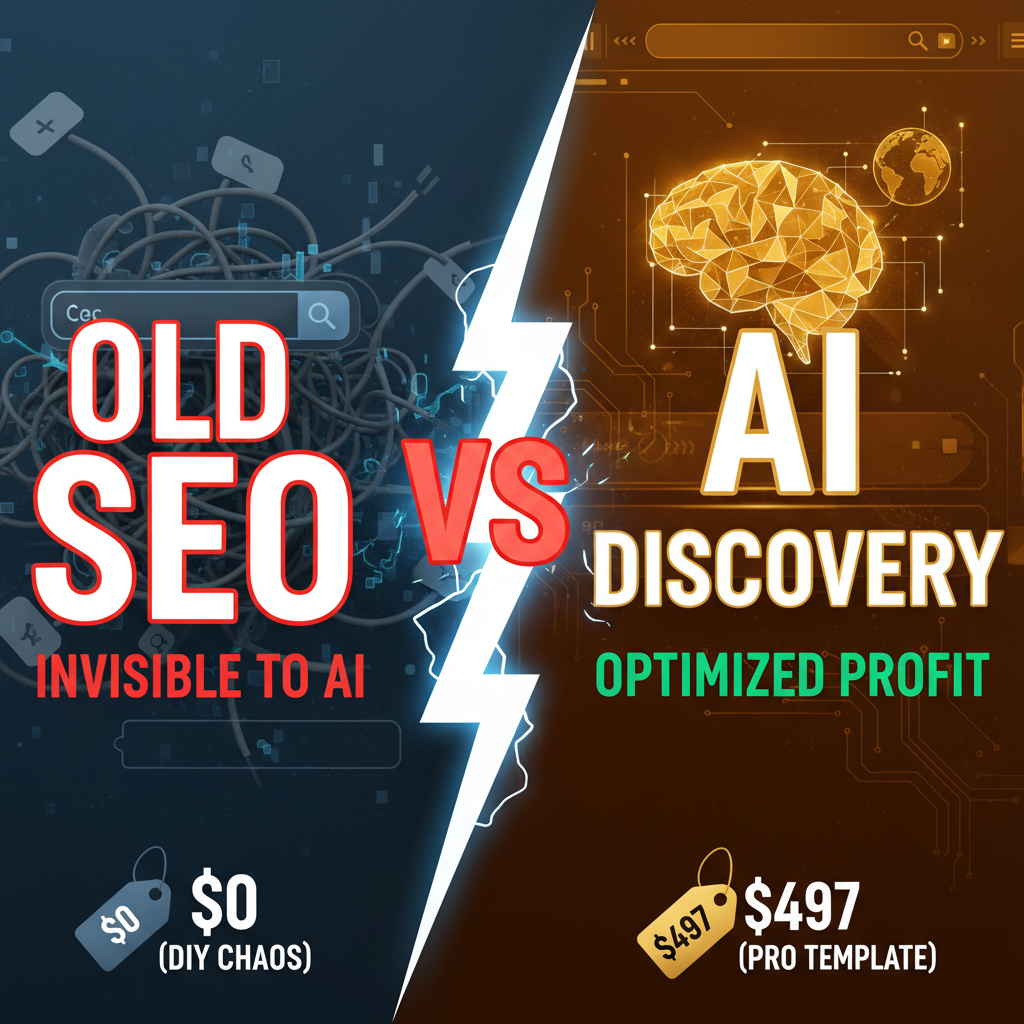
B2B buyers are already using AI chatbots to build shortlists — and if your product data isn't machine-readable, your company simply doesn't exist in those conversations. For Taiwan's industrial hardware manufacturers, that invisible exclusion is already costing pipeline.
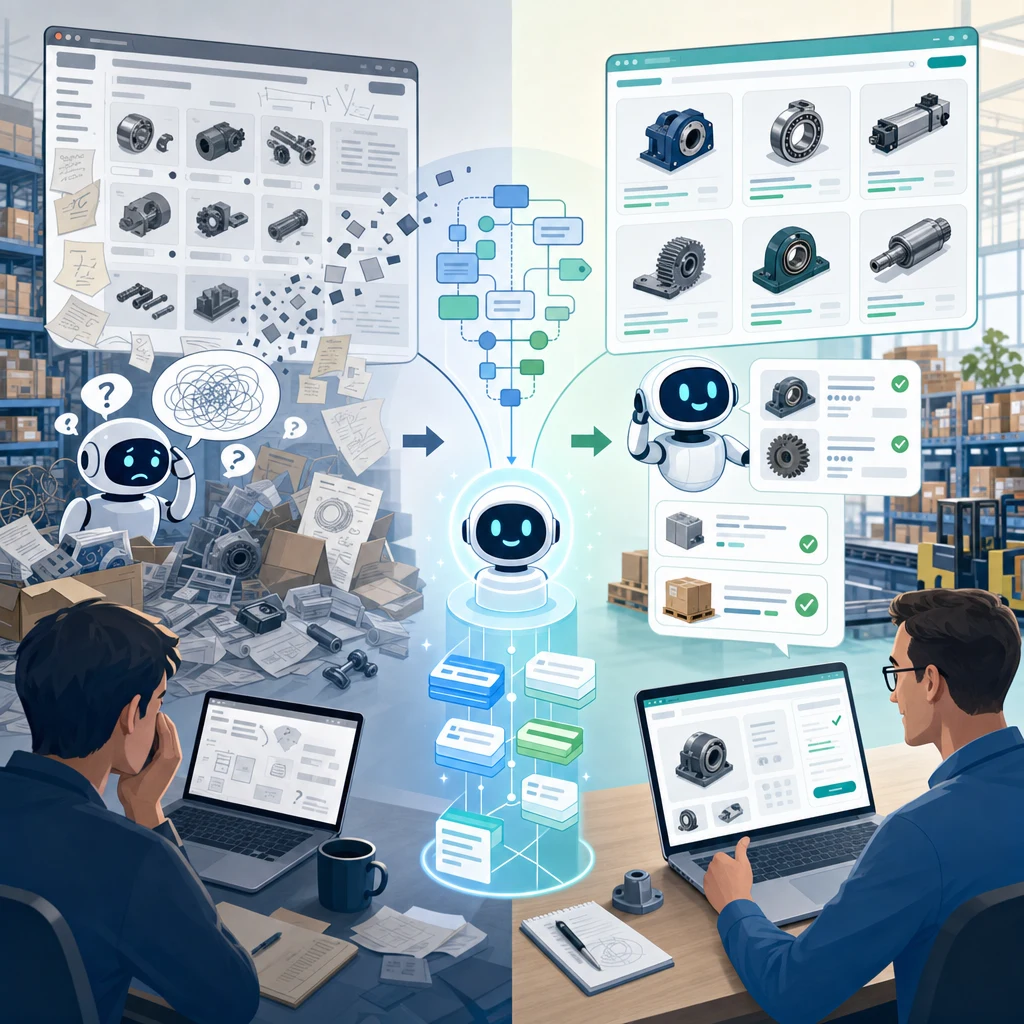
The Buyer Journey Has Moved Inside AI
G2's The Answer Economy report (April 2026), based on 1,076 B2B software buyers across North America, EMEA, and APAC, found that 51% now start their research in an AI chatbot rather than Google. Twelve months earlier that figure was 29%. ChatGPT alone holds 63% share of B2B AI chatbot research. More striking: 69% of buyers say AI guidance led them to a different vendor than they originally planned, and one in three bought from a company they had never heard of before AI surfaced it.
Forrester's 2026 B2B Predictions report adds that 94% of B2B decision-makers used at least one large language model during their 2025 purchase process. 6sense's 2026 Buyer Experience Report estimates buyers complete roughly 70% of their decision journey before ever filling out a vendor form. That 70% used to happen across vendor websites, review sites, and analyst reports — channels you could measure and influence. Now it happens inside ChatGPT, Claude, and Perplexity, where you have no analytics visibility and often no presence at all.
The age curve confirms this is permanent, not cyclical. Magenta Associates surveyed 300 UK senior decision-makers in 2025: among buyers aged 25–34, 85% use AI tools to research and evaluate suppliers; among buyers aged 55–64, only 23% do. The 25-to-34 cohort is exactly who is being promoted into procurement manager, senior buyer, and director-of-supply-chain roles right now. Gartner projects that by 2028, 90% of B2B buying will be agent-intermediated, with $15 trillion in B2B spend flowing through AI agent exchanges. The transition window is short.
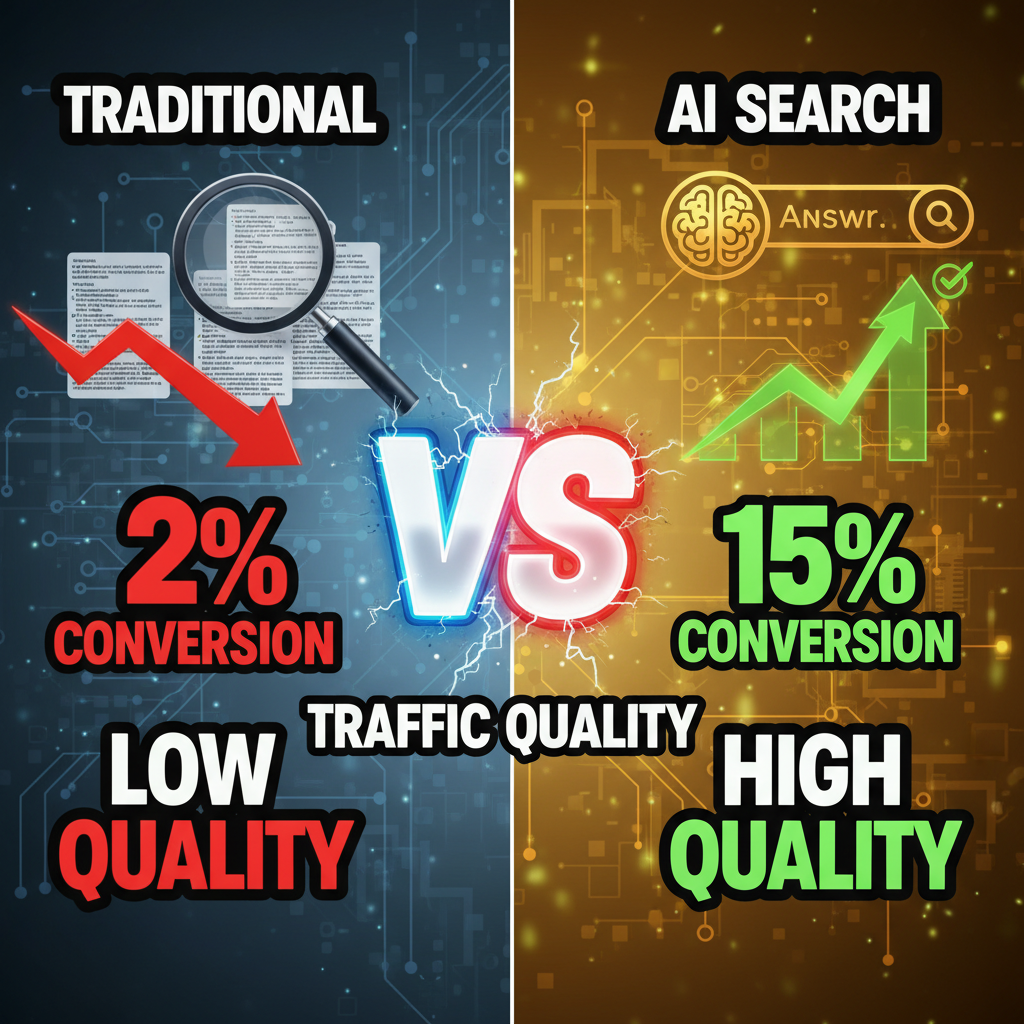
There is also a conversion math argument that rarely gets the attention it deserves. Loganix synthesized six independent studies in April 2026 — including Averi's analysis of 680 million AI citations, Exposure Ninja's conversion benchmark, and SparkToro's 2,961 controlled research sessions. AI search traffic converts at 14.2% on average versus 2.8% for Google organic. Claude users convert at 16.8%, ChatGPT at 14.2%, Perplexity at 12.4%. That roughly 5x conversion advantage exists because AI-referred traffic arrives pre-qualified: the buyer has already validated you as an option, run a comparison, and decided to look closer. Vercel publicly reported that ChatGPT now drives 10% of new signups — a SaaS data point, but the structural logic applies directly to industrial hardware.
Why PDF Datasheets Break the AI Pipeline
Taiwan's IPC vendors have spent thirty years optimizing for the engineer's PDF download. Datasheets are dense, accurate, and contain exactly what engineering buyers need: I/O specs, operating temperature ranges, MTBF numbers, certification badges, and ordering guides. The problem is that AI systems cannot use them.
AI search engines build their answers from search engine indexes — Google Knowledge Graph for AI Overviews, Bing's index for Copilot, web-search APIs for ChatGPT and Perplexity. ZipTie's March 2026 analysis traces the path: Schema → Google Index → Knowledge Graph → AI Overview citation. Schema markup doesn't talk to the AI directly; it populates the database the AI consults. Microsoft's Fabrice Canel confirmed in March 2025 that schema helps Bing Copilot understand content. Google's Search team confirmed in April 2025 that structured data provides advantages in search results. The path runs through the index, not through real-time PDF parsing.
Most Taiwan IPC datasheets fail at three specific points:
- Flat image exports. Many PDFs are scanned or image-exported, so even the text isn't extractable by any crawler.
- No HTML spec equivalent. Product pages link to a PDF download but contain no schema-tagged HTML spec table, so the AI sees a download link and nothing machine-readable.
- No JSON-LD in the PDF itself. A line like "Intel Atom x6425E, 4 GB DDR4, IP65" is plain text without semantic context. It cannot help an AI generate a comparison table when a procurement manager in Stuttgart asks: "Find me fanless industrial PCs with -40°C operating temperature, IATF 16949 automotive certification, and dual GbE LAN."
Schema.org's ProductModel type was built for exactly this case. The official specification is unambiguous: use ProductModel when describing a product datasheet rather than an actual product instance — precisely the manufacturer's specification page scenario. The spec further recommends providing gtin13, gtin14, gtin8, and mpn identifiers linked to the manufacturer property, so search engines can use your data to enrich offers found elsewhere on the web. For a SKU like Advantech's ARK-2250L, the mpn field carrying that exact part number is what lets AI distinguish it from neighboring products in the same catalog.
The Competitive Stakes for Taiwan Vendors
This matters more for Taiwan than for most other regions because of how concentrated the industrial hardware supply chain is here. Advantech's own corporate page reports 41% global market share in industrial PCs. Six of the top eight global IPC vendors are Taiwanese: Advantech, AAEON, ADLINK, IEI, Avalue, and NEXCOM. Add DFI and Portwell and the Taiwanese share approaches 70% of the world's industrial computing supply.
That position is not safe by default. Semiconductor Insight's January 2026 SBC market report shows the top three Taiwan vendors hold a combined 28%, meaning roughly 70% of the market is fragmented across 25+ smaller players competing on price. The sub-$200 SBC segment is brutal. Mid-tier Taiwan IPC vendors with NT$1B–NT$5B annual revenue (approximately $30M–$150M USD) sit in the most exposed position: not large enough to dominate global brand awareness like Advantech, but unable to compete on Shenzhen prices either.
Now they face AI recommendation systems that are quietly consolidating citation slots around whichever vendors built structured data infrastructure first. BrightEdge and Amsive's 2025 joint research found that AI platforms cite an average of 3–4 brands per response, and the top 20 domains capture 66% of all AI citations in their tracked categories. Once an LLM associates "ruggedized industrial PC for AI inference at the edge" with three specific vendors, breaking into that citation slot becomes harder than breaking into a Google top-three ranking. AI models reinforce what they already learned, and that learning is happening through the second half of 2026.
Five Structured Data Investments That Actually Move the Needle
The following priorities are ordered by impact-to-effort ratio for a typical Taiwan IPC vendor.
1. Organization Schema With a Complete sameAs Graph
This is your brand entity in every AI's knowledge layer. Stackmatix's March 2026 research found sites with complete Tier 1 schema saw up to 40% more AI Overview appearances. Organization schema needs name, url, logo, address, contactPoint, description, plus sameAs linking to LinkedIn, Crunchbase, Bloomberg profile, Wikipedia (if applicable), and a Wikidata Q-number. For Advantech-scale companies, the Wikipedia entry exists but is rarely linked from the corporate site. For mid-market IPC vendors, the Wikidata entry usually doesn't exist at all — meaning there is no anchored entity in the AI's knowledge graph.
2. Full ProductModel Schema for Every SKU
Each product page needs name, mpn, gtin (if applicable), manufacturer, image, description, additionalProperty (for operating temperature, power consumption, I/O ports, certifications), and offers (even for B2B-only RFQ pricing, use PriceSpecification). Add isAccessoryOrSparePartFor to map accessories to host systems. A vendor with 200 SKUs needs roughly 200 hours of one-time schema engineering and a CMS template that auto-generates the JSON-LD from the product database. The payoff compounds: once Google indexes the schema, AI Overviews and ChatGPT searches start surfacing your specific SKUs in capability-matched comparisons.
3. FAQPage Schema on Every Product Page
Stackmatix's same study found FAQPage schema raised AI citation rates by 30% on average. For IPC products, the natural FAQs cover operating environment limits, OS compatibility, certification details, PoE budgets, and integration questions. Your application engineers answer these on customer calls every day. Migrate the answers from internal Confluence pages to public product pages, wrap them in FAQPage JSON-LD with proper <script type="application/ld+json"> tags, and keep each answer to 40–60 words. Engineering pushback is typically low because the content already exists.
4. Convert PDF Datasheets to HTML-Plus-Schema
The current architecture is: product page → download datasheet PDF. The new architecture is: product page contains the full spec table in HTML with PropertyValue schema for every spec, application diagrams in HTML with HowTo schema, certifications as schema entities, and a PDF download for offline use. This is genuinely 2–4 hours per SKU when accounting for proofreading the HTML version against the PDF. Most IPC vendors have CMS systems that can template this, but the data migration is real engineering work — typically 8–12 weeks for a 200-SKU catalog.
5. Article Schema With Full Author E-E-A-T Signals
AI recommendation engines weight source authorship heavily. Every white paper, application note, and technical blog post needs Article schema linking to a Person schema with jobTitle, affiliation, sameAs LinkedIn URL, and knowsAbout properties listing the engineer's domain expertise. This runs against Asian B2B publishing conventions where technical content is often anonymous or attributed to "Engineering Team," but AI models prefer verifiable individual authors. Establishing a Chief Technologist persona, building out their LinkedIn presence, and attaching their schema-tagged identity to all technical publications takes 6–12 months to show measurable lift in AI citation rates. Once built, it is a defensible asset.
A Realistic 90-Day Rollout
For a Taiwan IPC vendor in the $30M–$300M revenue range with 50–500 SKUs, focused execution over 90 days looks like this:
- Weeks 1–2: Schema audit on existing site using Rich Results Test and Schema Markup Validator (digital marketing or external consultant).
- Weeks 3–4: Organization schema and sameAs graph deployed; submit
llms.txtto Google Search Console (IT + marketing). - Weeks 5–8: Top 20 SKUs receive full
ProductModelschema; HTML datasheet conversion begins (engineering docs + web dev). - Weeks 9–10:
FAQPageschema added to each top SKU with proper script tags (technical support compiles Q&A). - Weeks 11–12:
Articleschema andPersonschema for technical leads; AI citation baseline measurement established (marketing + PR).
External consultant fees plus internal labor for this scope typically run $50K–$150K USD — less than a single major trade show booth with international travel. The leading indicator (AI citation frequency) typically moves within 6–12 weeks of first schema deployment. The lagging indicator (AI-referred traffic converting into RFQs) takes 3–6 months. Given that AI-referred traffic converts at roughly 5x the rate of Google organic, the ROI math is about per-inquiry value rather than total traffic volume. A single AI-referred RFQ for a $50K industrial system carries the same revenue impact as 30+ standard organic inquiries.
A Note on llms.txt
The llms.txt file has been heavily promoted as a GEO must-have. The actual data is mixed. OtterlyAI ran a 90-day test on a properly implemented llms.txt and found that out of 62,100 AI bot requests, exactly 84 went to the file (0.1%). Search Engine Land tested llms.txt on its own site from August to October 2025 and recorded zero visits from Google-Extended, GPTBot, PerplexityBot, or ClaudeBot. Google's John Mueller has publicly compared llms.txt to the keywords meta tag — a self-controlled signal that search engines learned to ignore. However, one counterexample is instructive: a developer submitted their llms.txt directly through Google Search Console's URL inspection tool and Google crawled it the same day; within 18 days the file was being cited as an authoritative identity layer across multiple AI platforms. The takeaway: llms.txt is a low-cost addition worth doing correctly, not the centerpiece of a GEO strategy.
Key Takeaways
- More than half of B2B buyers now start research in an AI chatbot, and that share is growing fast as younger buyers move into purchasing roles.
- AI-referred traffic converts at roughly 5x the rate of Google organic — but only if AI can find and understand your product data in the first place.
- PDF datasheets are invisible to AI indexing pipelines. The fix is not to eliminate PDFs but to make HTML-plus-schema the primary form of product data, with the PDF as a human-download artifact.
- The five highest-leverage investments are: Organization schema with a complete sameAs graph,
ProductModelschema for every SKU,FAQPageschema on product pages, HTML datasheet conversion, andArticle/Personschema for technical authors. - For mid-tier Taiwan IPC vendors, the window to establish citation authority before AI models reinforce existing associations is narrow — competitors who started in early 2026 already have a meaningful head start.
- Schema does not talk to LLMs directly. The correct mental model is: schema → well-defined entity in Knowledge Graph → AI draws on that data when generating answers → citation rate rises. The path is indirect but durable.