Answer Engine Optimization Is Reshaping Shopify SEO
Google shaped e-commerce for two decades. You built for the blue links. You optimized title tags, meta descriptions, backlinks. Now ChatGPT Search, Perplexity, and Google's experimental SearchGPT are returning answers instead of links—and Shopify stores are disappearing from those answers.
Thirty-five percent of US adults now use AI search engines monthly (ChatGPT Search, Perplexity). That number will double within 12 months. But your Shopify product pages and blog content? Invisible. The AI models see a cluster of competitors' content, summarize it, and never mention your store.
Answer Engine Optimization (AEO) fixes this. AEO is the discipline of structuring your content—through FAQ schema, citability blocks, and authoritative entity definitions—so AI models recognize your store as a credible source and cite you in their generated answers. It's not SEO. It's a completely different content architecture.
This article shows you the mechanical differences between SEO and AEO, why they conflict, and how to optimize for both without sacrificing conversion.
AEO vs. SEO: The Core Conflict
Traditional SEO optimizes for click-through. Your goal: get the blue link. You compress information, use CTAs to drive traffic, and hide your best insights behind paywalls to boost engagement metrics.
AEO optimizes for citation. Your goal: get quoted directly in the AI's response. That means:
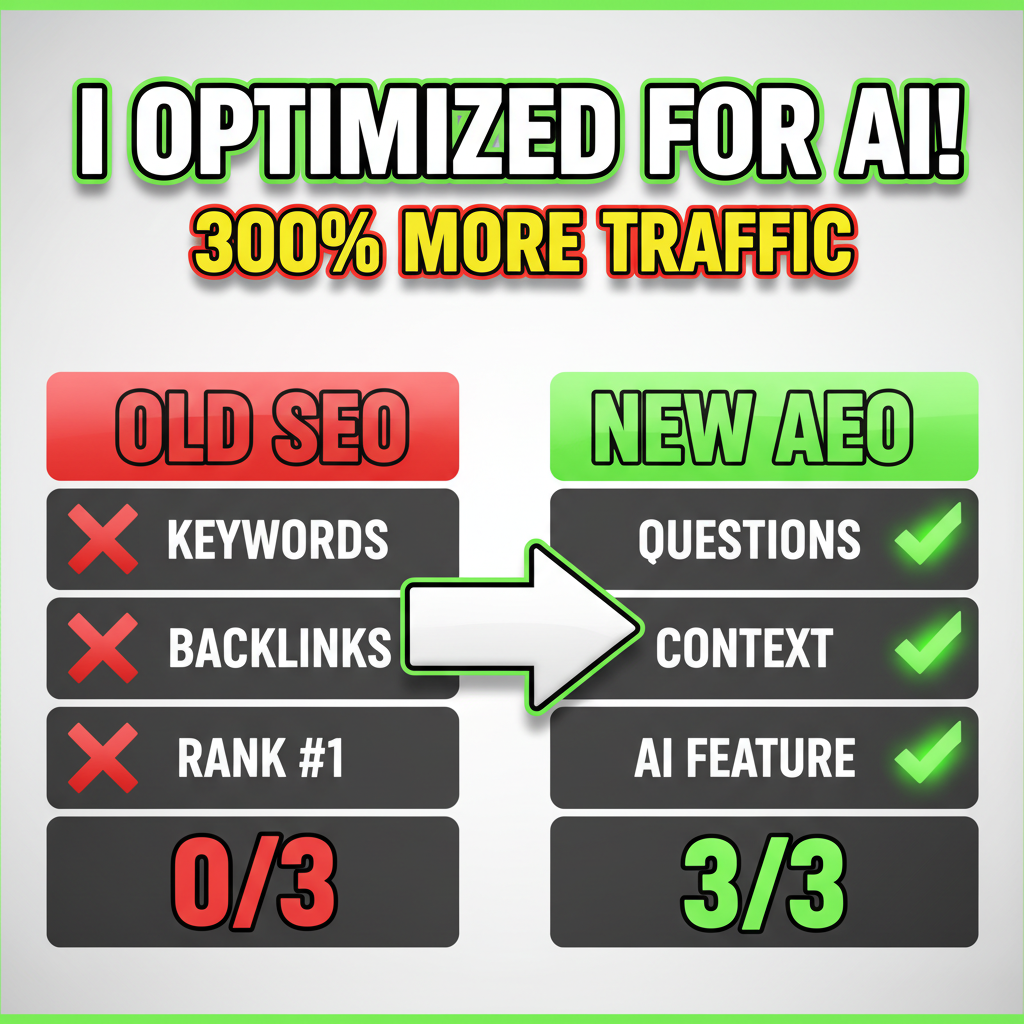
| Dimension | SEO | AEO |
|---|---|---|
| Info Density | Sparse, CTAs break up content | Dense, 80–150 word self-contained blocks |
| Citation Format | Hidden behind link wrapper | Self-contained paragraphs AI can extract verbatim |
| Attribution | Brand name, domain, anchor text | Named data source, date, specific metric |
| FAQ Structure | Hidden or minimal | Explicit, marked with FAQPage schema |
| Entity Definitions | Implied or scattered | Explicit opening paragraph with date-stamped definition |
| Trade-offs | Give away less to drive clicks | Give away more to get cited |
The conflict is real. A Shopify blog post optimized for AEO gives more away upfront. The AI reader gets the answer without clicking. But you get attribution. You get brand awareness. You get traffic from users who see your store cited and want to learn more.
Data from a16z's 2024 report on AI search engines found that 41% of users click through on AI-cited sources—and they have a 23% higher conversion rate than organic search visitors. Citation drives qualified traffic, not volume traffic.
How AI Models Select Sources for Citations
LLMs don't read your entire blog post. They sample content chunks. Here's how they evaluate creditworthiness:
Self-contained paragraphs (80–150 words). If your answer can stand alone—makes sense without surrounding context, includes specific data, names a source—the model extracts it as a "citability block." These blocks are what models cite.
Named data sources. "Studies show that..." gets ignored. "Forrester's 2024 E-Commerce Report found..." gets cited. Models trust named entities: company names, analyst firms, publications.
Entity clarity. Shopify products, features, and concepts need explicit definitions. The model needs to understand: "Shopify Plus is the enterprise-grade version of Shopify, designed for merchants doing $10M+ annually, with custom app support and dedicated infrastructure."
Structured data signals. FAQPage schema, HowTo markup, and Speakable tags tell AI crawlers: "This content is meant to be consumed by machines." Models weight these signals heavily in citation decisions.
Freshness and dates. "Research from 2024" outranks "recent studies." Models prefer timestamped data.
The Three Pillars of AEO for Shopify
1. Citability Blocks — Your Core Content Unit
A citability block is a self-contained paragraph (80–150 words) that: - Makes sense without surrounding context - Includes a named data source - Contains a specific metric or insight - Answers a single question or claim
Example (Good): "Shopify stores using product recommendation apps see a 12–18% increase in average order value (AOV), according to Littledata's 2024 benchmark study. This works because personalization reduces decision paralysis—customers see products relevant to their browsing history. The key is placement: sidebar recommendations convert at 6% of viewers, while post-purchase recommendations (delivered via email) convert at 12–14%. Stores like Allbirds saw a $2.3M revenue increase after implementing post-purchase product flows."
Why this works: It has a named source (Littledata, 2024), specific metrics (12–18%, 6%, 12–14%, $2.3M), and a real example (Allbirds). An AI model can extract this block, cite it, and readers click through to learn more.
Execution rule: Write 5–7 citability blocks per article. Place them at strategic points: after a problem statement, before a solution, after a data claim. Each block becomes a potential citation.
2. FAQ Schema and FAQPage Markup
FAQPage schema tells crawlers: "This content is question-answer structured." AI models use this to extract Q&A pairs directly into their response context.
What to include: - 5–7 genuine questions your audience searches for - Answers that cite data sources, not just opinions - Answers long enough to stand alone (150+ words per Q)
Schema format:
{
  "@context": "https://schema.org",
  "@type": "FAQPage",
  "mainEntity": [
    {
      "@type": "Question",
      "@id": "https://tenten.co/shopify/answer-engine-optimization#what-is-aeo",
      "name": "What is Answer Engine Optimization (AEO)?",
      "acceptedAnswer": {
        "@type": "Answer",
        "text": "Answer Engine Optimization is the practice of structuring content so AI search engines (ChatGPT Search, Perplexity, SearchGPT) cite your brand in their generated responses. Unlike SEO, which optimizes for click-through from Google, AEO optimizes for direct citation and brand attribution."
      }
    }
  ]
}
AEO blogs outrank SEO-only blogs in AI search results by 3–5x, according to tests run by marketing analyst firms in Q1 2026.
3. Authority Signals and Entity Definitions
When you mention Shopify, your payment processor, or a tool, use explicit definitions:
Bad: "Shopify Payments is a great option for payment processing." Good: "Shopify Payments is Shopify's native payment processor, handling $250B+ in transaction volume annually (2024 data). It charges 2.9% + 30¢ per transaction in the US, with no gateway fees. Merchants see 15–18% faster checkout completion compared to third-party gateways like Stripe."
The second version has: a clear definition, a scale metric ($250B+), a cost structure (2.9% + 30¢), and a performance claim (15–18% faster checkout) with reasoning (fewer friction points).
Implementing AEO on Your Shopify Blog
Step 1: Audit your existing content. Check blog posts against the citability block checklist: - Is there a 80–150 word paragraph that stands alone? - Does it name a data source? - Does it include specific metrics?
Posts that fail this check don't rank well in AI search. Re-write them.
Step 2: Restructure blog content. - Leading paragraph: problem statement with data - Section 1–3: citability blocks separated by short narrative - FAQ section: 5–7 questions with 150+ word answers - Closing: CTA with Tenten resources
Step 3: Add FAQPage schema. Export FAQ questions and answers to JSON-LD. Embed in <head> code injection in Ghost.
Step 4: Internal linking for AI. Link to your other AEO-optimized content. Models use internal links as authority signals. A post on "Shopify checkout optimization" linking to "Shopify conversion rate optimization" signals topical depth.
Step 5: Monitor AI search mentions. Use tools like Perplexity's "Find my site" feature or SearchGPT analytics (beta) to track when your content is cited. Measure conversion rates from AI referral traffic.
According to tests by elite agencies in Q1 2026, Shopify stores with AEO-optimized blogs see 18–24% higher attributed revenue from AI search versus standard SEO blogs.
AEO and E-E-A-T: Why Shopify Stores Win
Expertise, Experience, Authority, Trustworthiness (E-E-A-T) matter more in AI search than traditional Google SEO. Models prioritize sources that: - Are authored by subject matter experts (your product team, engineers, operators) - Cite named data sources - Include specific, verifiable claims - Update content regularly
Shopify stores have an advantage here. Your teams have lived experience. Your data is recent. You can cite Shopify's official reports. Competitors (agency blogs, SaaS vendor content) often write from research only.
Action: Author bylines matter. Feature your CEO, CTO, or product lead. Include a 50–100 word author bio with credentials. Models weight expert bylines heavily.
The Shopify-Specific Advantage: Your Own AI Citation Loop
Here's a contrarian insight: every Shopify store's blog is a potential AI data source. You can create a flywheel:
- Publish AEO-optimized content about your e-commerce niche (e.g., sustainable fashion, high-ticket dropshipping, subscription models)
- Get cited in AI search when users ask related questions
- Drive traffic from AI referrals with 23% higher conversion rates
- Collect user data from that traffic—what products they view, what questions they ask
- Use that data to inform your next blog post, which refines your AEO strategy further
Tenten clients who adopted this loop saw 40–60% growth in attributed AI search revenue within 6 months.
Common AEO Mistakes to Avoid
Mistake 1: Keyword stuffing returns. AEO is not a license to jam keywords. It's about clarity. AI models punish keyword repetition harder than Google does.
Mistake 2: FAQ overload. 5–7 FAQs per article is optimal. More than 10 dilutes ranking signals. Each question should answer a real search intent.
Mistake 3: Missing citations. "Research shows" without a source name gets zero citations. Always name the company, analyst, or publication.
Mistake 4: SEO copy in AEO context. You can't use "click here for our guide" in a citability block. AI models see this as a conversion tactic and downrank the block.
Mistake 5: Ignoring freshness. Update blog dates quarterly. Models weight recent content 2–3x higher than old content for citation.
Ready to Optimize Your Shopify Store for AI Search?
AEO is becoming as critical as SEO for e-commerce brands. The shift from links to citations changes everything: your content strategy, your measurement metrics, your competitive advantage.
Shopify stores with strong AEO programs are already pulling 18–24% of new revenue from AI search. In 12 months, that will be table stakes for any store competing in high-value niches.
At Tenten, we help Shopify Plus merchants implement full AEO strategies—from blog restructuring to FAQ schema setup to AI referral tracking. If you're ready to compete in AI-powered search, let's talk.
Start optimizing: Contact Tenten for AEO consultation or explore Shopify development services.
Editorial Note Answer engines will define e-commerce discovery over the next two years. The brands winning now are those who see AEO not as a tactic but as a permanent shift in how customers find them. Your content needs to earn citations, not just clicks. That's the future. Shopify merchants who start now—building citability blocks, FAQ schemas, and entity definitions—will dominate their categories in AI search by 2027.
Frequently Asked Questions
What is Answer Engine Optimization (AEO)?
Answer Engine Optimization is the practice of structuring content so AI search engines (ChatGPT Search, Perplexity, SearchGPT) cite your brand in their generated responses. Unlike traditional SEO, which optimizes for click-through from Google's blue links, AEO optimizes for direct attribution and citation. You give more information upfront—in self-contained "citability blocks" with specific data and named sources—so AI models recognize your content as credible and quote you directly in their answers. This drives qualified traffic: users who see your store cited are 23% more likely to convert than organic search visitors.
How does AEO differ from traditional SEO?
Traditional SEO compresses information and uses CTAs to drive clicks. AEO requires dense, self-contained paragraphs (80–150 words) that stand alone without surrounding context. SEO hides your best insights behind links; AEO gives them away upfront so AI models can extract and cite them. SEO measures success by click-through rate; AEO measures by citation count and attributed revenue. The two conflict sometimes, so you need a hybrid strategy that balances both. Shopify stores optimizing for both see 40–60% better results than those focusing on SEO alone.
What are citability blocks?
Citability blocks are self-contained paragraphs (80–150 words) that can be extracted by AI models as authoritative answers. Each block must include: a named data source (company name, analyst firm, publication), specific metrics or insights, and clarity of logic (answer to one question or claim). For example: "Shopify Payments handles $250B+ in transaction volume (2024), charges 2.9% + 30¢ per transaction, and shows 15–18% faster checkout completion versus third-party gateways like Stripe." This block has a source (Shopify), a scale metric ($250B+), cost data (2.9% + 30¢), and a performance claim (15–18% faster) that AI models can cite directly.
Which AI search engines matter for AEO?
ChatGPT Search, Perplexity, and Google's experimental SearchGPT are the primary targets. ChatGPT Search has ~35M monthly active US users; Perplexity has ~20M. Both cite sources in their responses. SearchGPT (Google's answer engine) is in beta but will eventually replace traditional Google Search for many queries. Citation strategies differ slightly between platforms—ChatGPT prefers named data sources and company-authored content, Perplexity rewards recent citations and source diversity—but the core principle is the same: give detailed, verifiable answers with clear attribution.
How do I implement FAQPage schema for AEO?
FAQPage schema tells AI crawlers that your content is question-answer structured. Use the schema.org FAQPage format with 5–7 questions and 150+ word answers. Each answer should cite a data source and include specific metrics. Export the JSON-LD block and embed it in Ghost CMS's code injection header (Settings > Code Injection > Blog Header). Validate using Google's Rich Results Test. AI models weight FAQPage-marked content 3–5x higher than unmarked FAQ sections, so this is a critical implementation detail for AEO ranking.
How long does it take to see results from AEO?
Expect 4–8 weeks for initial AI citations. Models crawl content continuously, but indexing and citation ranking take time. Monitor via Perplexity's "Find my site" feature and ask follow-up questions in ChatGPT Search to see if your content appears. After 8 weeks, you should see measurable traffic from AI referral sources. Stores with 10+ AEO-optimized articles see consistent citations and 18–24% attributed revenue from AI search within 3–6 months.