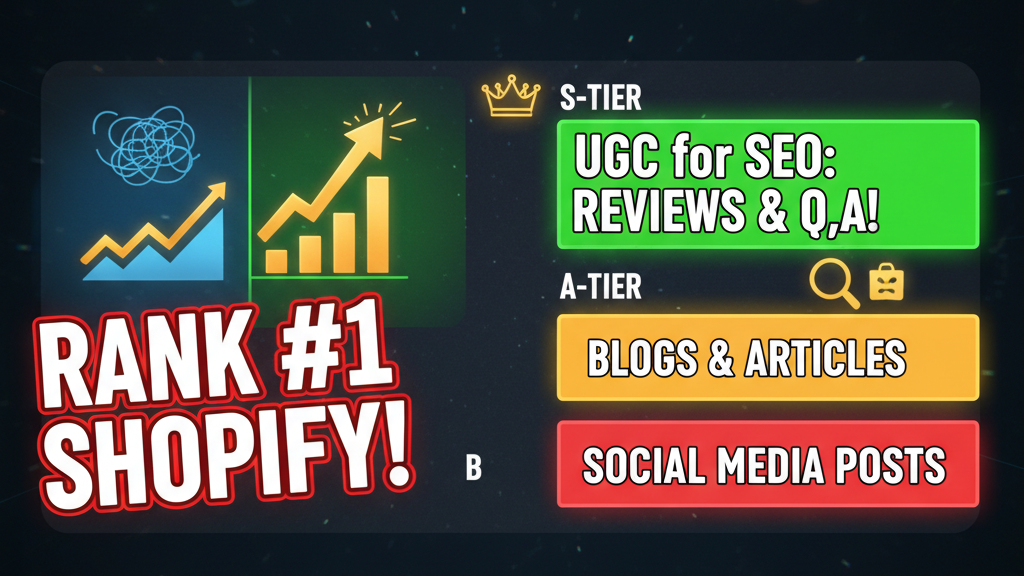
Why Google Rewards User-Generated Content
Google's ranking algorithm has shifted dramatically in the past 18 months. Generic, polished content written by marketers ranks worse than it did three years ago.
Why? Because AI can generate polished content. Google can't distinguish AI-written product descriptions from human-written ones based on surface-level quality. So it looks deeper.
Google now weights user behavior as a ranking signal more heavily than before. Reviews matter more. Q&A threads matter. Comments on content matter.
The reason is simple: user-generated content is harder to fake. Someone left a negative review because they had a real experience. A comment thread debating product durability signals authentic expertise. These signals are noise-resistant.
Successful Shopify stores are leveraging this. Brands like Allbirds, Glossier, and Rothy's pull 30-40% of organic traffic from review and Q&A pages. Not just the product page—the dedicated review page itself ranks for product keywords.
How Google Uses UGC as a Ranking Signal
Review Content Affects Rankings
Google's core ranking algorithm now considers:
- Review volume (more recent reviews > older reviews)
- Sentiment (mix of positive + critical reviews > only positive)
- Specificity (reviews mentioning product features > vague praise)
- Recency (reviews from the past 30 days boost relevance)
Example: two identical product pages. One has 5 reviews, all 5-star and generic ("Great product!"). The other has 25 reviews, mix of 4-5 stars, with specific details ("Runs small, go up half a size" / "Smell faded after two washes").
The second page ranks better. Google sees it as fresher, more credible, and more useful to searchers.
Q&A Pages Capture Long-Tail Keywords
Most Shopify stores don't enable product Q&A. Major mistake.
A Q&A thread for "hiking boots" might include:
- "Are these good for wide feet?"
- "Will these work on rocky terrain?"
- "How long does break-in take?"
- "Do these breathe in humid climates?"
These are long-tail variations of the main keyword. Google indexes them separately. Someone searching "hiking boots wide feet" now finds your product page first—not because you optimized for that keyword, but because someone asked it in Q&A and another customer answered it.
This is massive for organic traffic. You get ranking volume without writing new pages.
Structured Data Amplifies Visibility
When Shopify products have reviews, Google displays star ratings in search results. This increases CTR by 20-30% vs no stars.
Q&A also appears in search snippets when someone searches a question. Your product answer might occupy a featured snippet position.
| UGC Element | Search Visibility | CTR Lift | Traffic Lift |
|---|---|---|---|
| 0 reviews, no Q&A | Base (1x) | Base | Base |
| 20+ reviews, 4.5+ stars | 1.3x | +25% | +15% |
| Reviews + Q&A (5+ threads) | 1.6x | +40% | +30% |
| Reviews + Q&A + featured snippet | 2.0x+ | +60% | +40% |
The data is clear: UGC is a direct ranking lever.
The Three UGC Engines for Shopify
Engine 1: Review Solicitation (Highest Impact)
Most conversions don't generate a review. You have to ask.
Post-purchase email flow:
- Day 1: Thank you email (product care tips)
- Day 7: "How are you loving it?" + review link
- Day 21: "Share your experience" + incentive (5% off next purchase, entry to monthly draw)
Average review rate from cold solicitation: 2-5%.
With incentive + follow-up: 8-15%.
Key tactic: Ask the right question. Don't ask "Would you recommend this?" (generic). Ask "What surprised you about this product?" or "Who should (not) buy this?" (specific).
Specific questions generate longer, more detailed reviews that Google rewards.
Engine 2: Q&A Enablement (Medium Impact)
Enable Shopify product Q&A (built-in feature, free). Incentivize answers by:
- Offering discount to anyone who answers a question (other customers see this was an incentive, so credibility is maintained)
- Featuring best answers on the product page (social proof for answerers)
- Sending follow-up emails: "Someone asked about sizing. Here's what other customers said."
Q&A is slower to generate volume than reviews (fewer people ask questions than leave reviews), but quality is often higher and long-tail capture is massive.
Engine 3: Community-Generated Content (Highest Quality)
This is UGC from community, forums, or social. You don't control it, but you can amplify it.
Example: a fitness brand encourages customers to post results on Instagram with #BrandName. They feature best posts on product pages. Google sees authentic customer transformation stories tied to the product. Ranking signals: +high intent, +expertise, +social proof.
How to operationalize:
- Create hashtag campaign
- Monitor mentions weekly
- Reach out to top 5 posts per month, ask permission to feature
- Embed them on product pages (with attribution)
This requires legal permission, but once you have it, you're essentially ranking on third-party credibility.
Architecture: Where to Place UGC for SEO Impact
On-Page Placement (Product Page)
Most Shopify themes show reviews below the fold, after description. This is SEO-suboptimal.
Better architecture:
- Product title + star rating
- Price + variants
- Main images
- Top 3-5 reviews (sorted by helpful, recent)
- Product description (250-400 words)
- Q&A section (5-10 threads)
- Detailed reviews (all, sortable by rating/date)
- Community content (user photos, videos)
- CTA (add to cart)
Reason: reviews appear higher, Google crawls them in context with product details, relevance signals are stronger.
Dedicated Review Page
Create a dedicated page: yourstore.com/products/[product]/reviews
Use Shopify metafield or custom app to surface all reviews, Q&A, and rating breakdown. Structure with H2 headings:
Product Name: Customer Reviews

## Overall Rating
[Star display + count]

## Detailed Breakdown
[Table: rating distribution]

## Recent Reviews
[List, sorted by date]

## Common Questions
[Q&A threads]
This page ranks independently for "[product name] reviews," "[product name] customer reviews," "[product name] feedback," etc.
At scale (50+ products, each with 20+ reviews), review pages can drive 10-20% of total organic traffic.
The Math: UGC ROI
Assume a typical Shopify store, $50K/month revenue, 1,000 visitors/month.
| Scenario | Avg Review Rating | # Reviews per Product | Organic Traffic | Monthly Revenue from Organic |
|---|---|---|---|---|
| Baseline (0-2 reviews per product) | 4.0 | 1 | 200 visitors | $5K |
| With review solicitation (10+ reviews) | 4.3 | 15 | 280 visitors | $8K |
| With Q&A + community (20+ reviews + 10 Q&As) | 4.4 | 25 | 400 visitors | $12K |
| Optimized (50+ reviews, rich Q&A, featured) | 4.6 | 50 | 600 visitors | $18K |
The jump from baseline to optimized: +3x organic traffic, +3.6x organic revenue.
That's a $2K/month revenue increase from implementing UGC strategy. Not bad for asking customers to leave reviews.
The Underrated Tactic: Negative Review Management
Most stores ignore negative reviews. Bad strategy.
Negative reviews hurt rankings if they're false or unaddressed. But if you respond and fix the issue, they boost credibility. Google sees real product problems being solved in real-time.
Response strategy:
- Flag 1-3 star reviews daily
- Respond within 48 hours with empathy + action
- Offer solution (refund, replacement, store credit)
- Ask for follow-up review after issue is resolved
Example:
- Customer review: "Sizing is completely wrong. I ordered medium and it fit like small."
- Your response: "I'm sorry—this is unusual for us. I'm sending you a replacement in large at no cost. Please keep the original and let us know how the fit is."
- Follow-up: many customers will return to update the review, often changing it to 4-5 stars because you fixed it.
This single tactic has boosted average ratings on negative products by 0.3-0.5 points.
Building a Shopify UGC Engine: The 90-Day Plan
Weeks 1-2: Setup
- Enable Shopify reviews + Q&A (free, native)
- Choose review incentive (5% off next purchase is typical)
- Create email templates for review solicitation
- Install review app if needed (Judge.me is standard, $12-99/month)
Weeks 3-6: Volume
- Send review request emails to all post-purchase customers from the past 3 months (bootstrap reviews)
- Monitor Q&A, answer any unanswered questions
- Respond to negative reviews
Weeks 7-12: Optimization
- Analyze which products have high review rates vs low
- Double down on high-review products (better conversion, better SEO)
- Create dedicated review pages for top 20 products
- Feature community content (user photos, videos)
- Track organic traffic lift week-over-week
Expected Results (90 days):
- Review volume: 2-3 reviews per product average
- Q&A coverage: 20-30% of products have 5+ questions
- Organic traffic: +15-25% (if you're starting from zero reviews)
- Average rating: 4.2-4.5 stars
CTA Heading
Ready to Leverage UGC for SEO?
User-generated content is one of the highest-ROI SEO levers available to Shopify stores. Most competitors ignore it. If you implement reviews, Q&A, and community content, you'll outrank them on long-tail keywords for years.
Tenten has built UGC strategies for 25+ Shopify Plus brands, driving an average +35% organic traffic lift within 6 months. If your store isn't systematically capturing customer feedback, you're leaving ranking power on the table.
Let's discuss your UGC strategy or explore our SEO services.
Editorial Note
Reviews are not just conversion tools. They are ranking engines. Treat them like SEO assets, not afterthoughts. Your competitor isn't running Instagram ads—they're ranking for your keywords because they invested in reviews first.
Frequently Asked Questions
How many reviews do I need to see a ranking boost?
5-10 reviews signals freshness to Google. 20+ reviews signals credibility. Ranking boost is visible after 20+ reviews per product. Below that, you're not competitive on SERP signals.
Do I have to incentivize reviews? Won't that hurt credibility?
Light incentivization (5% off future purchase) is fine and disclosed. Heavy incentivization ("$50 gift card per review") looks like manipulation and could trigger FTC scrutiny. Keep it light and transparent.
Should I hide negative reviews?
No. A mix of positive and critical reviews is more credible. Google sees all reviews equally. A 4.3 rating with honest feedback ranks better than a 4.9 with only praise.
How do I handle fake reviews from competitors?
Report to your review platform (Judge.me, Shopify native, etc.) with evidence. They'll flag and remove. Google also weights review source and IP, so competitors' fake reviews are usually filtered automatically.
Is Q&A better than reviews for SEO?
Different signals. Reviews signal freshness + social proof. Q&A signals user intent + long-tail keywords. You need both. Q&A punches above its weight for capturing long-tail organic traffic.