
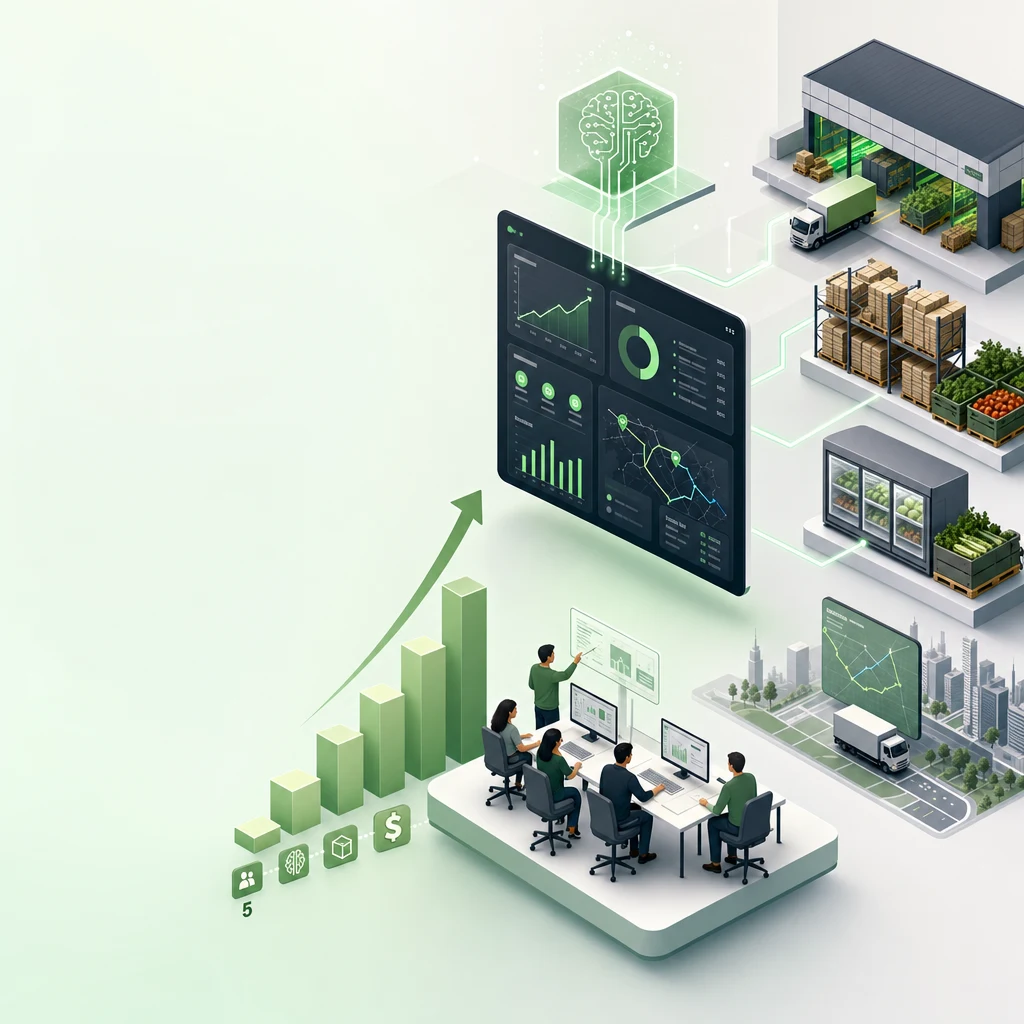
Vertical AI is generating its most compelling returns not in consumer apps or SaaS copilots, but inside industries that still run on fax machines — and food distribution is the clearest proof point available right now.
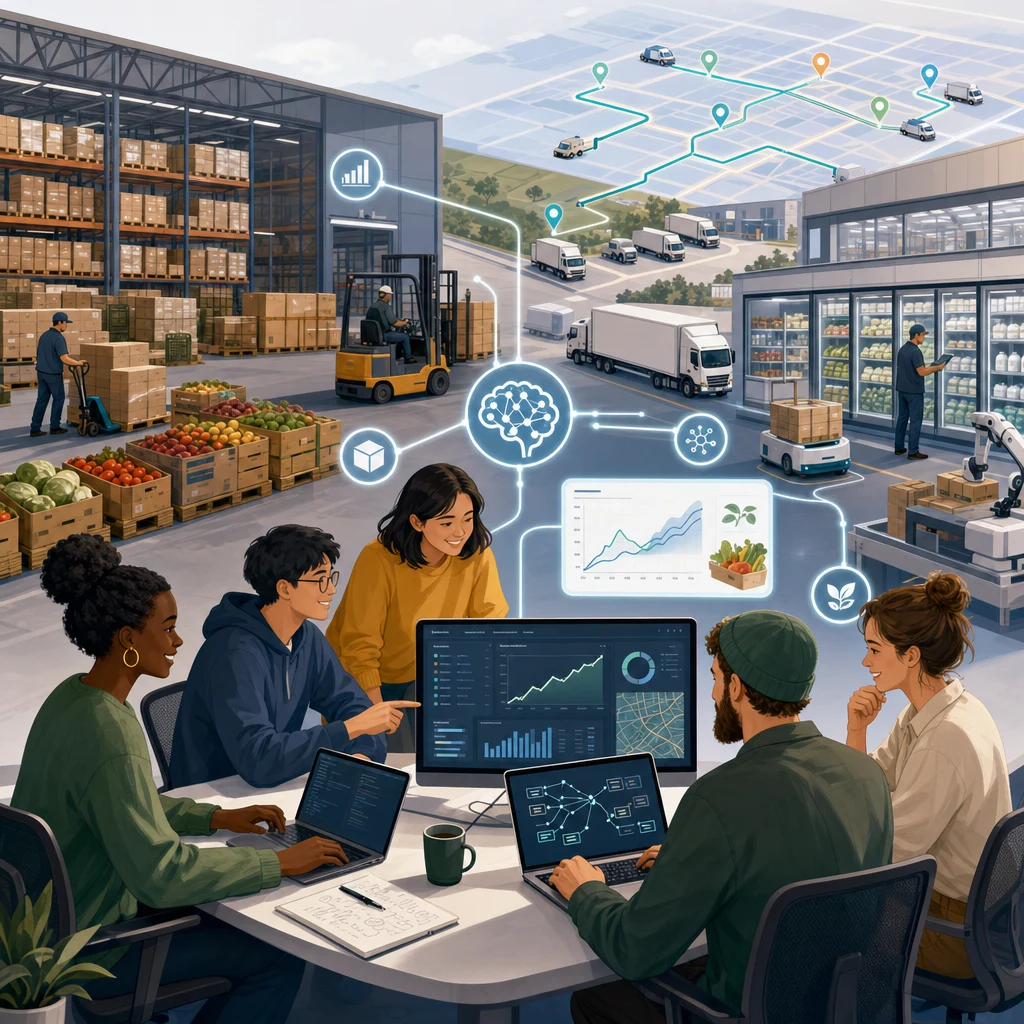
Why Food Distribution Is the Ideal Vertical AI Target
The US foodservice distribution market is a $400 billion industry, according to the International Foodservice Distributors Association. The global foodservice market that companies like Choco operate in is roughly $6 trillion. The remarkable detail is that most transactions inside this market still move through phone calls, handwritten notes, WhatsApp messages, and manually keyed spreadsheets.
IFDA's 2025 Technology Benchmarking Report, surveying 32 US distributors, found that integration compatibility with existing systems and budget constraints remain the top blockers for technology adoption. The industry hasn't been meaningfully digitized, which means AI agents are entering a market that is structurally unprepared to compete with leaner operators.
Three structural properties make food distribution unusually well-suited for vertical AI:
Demand Is Recurring by Physics, Not Marketing
A restaurant uses eggs every day. A seafood buyer orders fish at least weekly. There is no free-tier-to-paid conversion funnel. Once a restaurant becomes a customer, repeat purchases happen by default. Compare that to consumer AI tools, where the vast majority of signups never return after the first session.
Every Order Carries Real Gross Margin
Distributors don't operate on negative-margin growth loops. The price the restaurant pays minus the price the distributor paid is real money on every line item, from day one.
The Market Is Hyperlocal and Structurally Fragmented
A meat wholesaler in Manhattan doesn't compete with one in Los Angeles. Chef's Warehouse, a $5 billion publicly traded distributor, hasn't consolidated the market. Tens of thousands of regional distributors still operate across the US alone. Winner-take-all dynamics don't apply, and there is room for new entrants in virtually every city and product category.
What AI Actually Replaces — and the Numbers Behind It
A traditional mid-size food distributor runs on roughly 25–30 people across procurement, warehouse management, route planning, account management, and finance. AI doesn't trim 10% from the org chart. It eats four of the five core functions.
Order Intake
This is the largest savings center. Traditional order intake arrives through phone calls, faxes, WhatsApp, SMS, voicemails, and handwritten notes — all manually typed into ERP systems by an order desk team. Choco's OrderAgent, built on OpenAI APIs, ingests all of these formats simultaneously and converts them into structured ERP orders. The system resolves colloquial phrasing like "more steak" or "same as last time, five units" by matching against each customer's purchase history.
Production performance numbers: up to 97% accuracy on order extraction, with customer onboarding completing in 2–4 weeks. Order processing time drops from roughly 8 minutes to under 30 seconds per order. Lynas Foodservice, a UK distributor, reported that a team of four people handling 240 customers per week scaled to over 1,000 customers per week with just two people on the order desk — the other two redeployed to telesales.
Choco's VoiceAgent, a sibling product built on OpenAI's Realtime API, handles live phone orders with sub-second latency.
Procurement Decisions
Which supplier to buy from, in what quantity, on which day. This is a bounded optimization problem that responds well to LLM-augmented decision systems pulling from inventory levels, historical consumption patterns, and live price feeds. Anchr, a New York-based vertical AI startup that closed a $5.8M seed round in March 2026 led by a16z Speedrun with OpenAI leadership participating personally, has published concrete early customer data: one distributor reduced aged inventory write-offs by $30,000 in a single month using AI-driven demand signals to inform purchasing decisions.
Route Planning
Vehicle routing problems have been computationally solvable for over a decade. Google OR-Tools and similar open-source libraries handle most mid-scale routing scenarios. The novelty isn't the algorithm — it's that AI-native distributors are deploying this in production from day one instead of treating dispatch as a manual function.
Reconciliation and Inventory Forecasting
Automated invoice generation and demand forecasting based on historical patterns. For thin-margin food distributors, this is less about labor savings and more about cash flow visibility. Accurate inventory forecasting reduces capital tied up in perishable stock, which matters enormously when your product spoils.
Add those four functions together and you've replaced 60–70% of headcount at a traditional distributor. That is the math behind Singapore-based Farmio — a five-person startup that booked $6M in revenue over the past 12 months, automating 55,000+ orders and serving 1,600+ restaurant clients without a single dispatcher, route planner, or warehouse manager. Founded in 2023 by Paco Chan and Andrian Kanta with $125K in seed funding from Antler and GreenBridge Venture, Farmio averages roughly 150 automated orders per business day at approximately $109 per order.
The Two Playbooks: Platform vs. Player
There are two distinct routes into this market, and choosing the wrong one can cost 18 months and significant capital.
The Platform Play (Choco Model)
Sell SaaS to existing distributors. Don't touch inventory, don't manage cold chain, don't acquire import licenses. Choco was founded in 2018 by Daniel Khachab and Julian Hammer (with co-founder Rogerio Da Silva Yokomizo) and has raised $301M to date at a $1.2B valuation set in April 2022. The company now processes 8.8 million orders annually across 21,000 distributors and 100,000 buyers in the US, UK, Europe, and the GCC, backed by Bessemer, Coatue, and Insight Partners.
The wedge: enter through the supplier side, not the restaurant side. Convince one large supplier to onboard and their hundreds of restaurant customers come along automatically. Restaurants pay nothing; suppliers get core functionality free and pay for AI modules.
The trade-off: margins are SaaS-thin, and the technical moat compresses as foundation LLMs improve. OrderAgent's capabilities were nearly proprietary infrastructure when Choco started in 2018. Today, similar systems can be assembled in weeks using OpenAI or Anthropic APIs.
The Player Play (Farmio Model)
Become the distributor. Buy product, sell product, deliver product. AI runs the back office. Player-mode unit economics are dramatically better than platform-mode — revenue is product gross margin plus the labor savings from running on five people instead of thirty. The long-term moat is also deeper, because supply chain relationships, import licenses, and cold-chain partnerships aren't replicable by a well-funded competitor in 90 days.
The difficulty: food supply runs on trust. Restaurant owners have years-long relationships with existing suppliers, established credit terms, and reliability data. Nobody switches suppliers to save a few cents per case. The proven acquisition approach is to become the backup supplier first, prove reliability over 60–90 days, then earn primary status. New restaurant openings in any metro are a lower-friction wedge — they have no incumbent supplier relationships and are actively shopping for distributors.
Side-by-Side Comparison
| Dimension | Platform (Choco) | Player (Farmio) |
|---|---|---|
| Role | SaaS vendor | Actual distributor |
| Cold-start difficulty | Medium | High |
| Unit economics | SaaS subscription, thin margins | Product margin + labor savings, thick margins |
| Customer acquisition wedge | Supplier-led network effect | Backup supplier → primary supplier |
| Moat | Product depth, integrations | Licenses, supply chain, cold chain |
| Capital to launch | $3M–$10M | $300K–$500K |
Technical founders without industry relationships should default to the platform model. Operators with a decade inside food supply chains have a structural advantage on the player side that no amount of venture funding can replicate.
The Concrete Path In
Pick a Small, Dense Market and a High-Frequency Category
Singapore is 280 square miles. New York City, the SF Bay Area, and dense urban cores of major metros all qualify. The wrong choice is "the Northeast" or "Southern California" — too sparse, too much driving, unit economics break before you reach scale.
Pick a category that is high-frequency, standardized, and used by every restaurant. Farmio picked eggs because purchase frequency is high, individual order sizes are small, and repeat behavior is near-automatic. Once the customer relationship is established, expanding into cooking oil, rice, and condiments carries near-zero marginal acquisition cost. Farmio is already executing this horizontal expansion.
Solve Supply Chain and Licensing First
This is the real moat. In Singapore, egg imports require an SFA import license, SFA-inspected cold storage, and supplier relationships with farms in one of the 42 countries and regions accredited by SFA to export poultry, meat, or eggs. In the US, the equivalent involves FDA-registered facilities, state-level cold-chain licensing, and direct relationships with USDA-inspected suppliers. These requirements are simultaneously your barrier to entry and your competitive protection once cleared.
Farmio's approach: don't own trucks, don't own warehouses — partner with existing cold-chain infrastructure. Asset-light is the only rational starting point.
Build the AI Stack Incrementally
You don't need to build from scratch. WhatsApp Business API plus a foundation LLM handles order intake. Google OR-Tools handles routing. Inventory forecasting can start in spreadsheets with lightweight Python scripts before graduating to a proper forecasting layer.
The hard part isn't model selection — it's integration glue. Getting a WhatsApp message that says "same as last time, 30 cases" to correctly trigger an order against the right customer's specific SKU, auto-route a delivery, and flag exceptions for human review takes months of iteration, not weeks. Choco reached 97% accuracy after years of building ground-truth datasets, evaluation infrastructure, and A/B testing harnesses.
On model choice: OpenAI's GPT family currently leads on multimodal input — voice, images, PDFs — which is why both Choco and Anchr selected OpenAI as their primary provider. Anthropic's Claude has comparative advantages on long-context reasoning and tool calling, making it well-suited for procurement-decision and forecasting agents that synthesize across multiple data sources. A multi-model stack is usually the right call rather than a single-vendor commitment.
Budget Realistically
The "five people, $125K seed, $6M revenue" framing makes this sound more accessible than it is. The realistic capital requirement to get from launch to stable operations is closer to $300K–$500K, accounting for working capital, cold-chain partnerships, system development, and early customer acquisition subsidies. Farmio was founded in 2023 and reached its $6M revenue run rate over roughly 24 months. Supply chain trust is not an asset you can buy faster by deploying more capital.
Key Takeaways
The Farmio and Choco stories share a common lesson: the highest-return AI deployments right now are not in new technology categories — they are in old industries where labor cost dominates operating expense and where digitization has barely started.
For Shopify merchants and D2C operators adjacent to food, beverage, or physical goods distribution, the implications are direct. AI agents plugged into order intake, procurement, routing, and reconciliation workflows can compress back-office headcount requirements substantially — not as a future possibility, but as a demonstrated outcome in production environments today.
The question for any operator in a physical goods vertical is not whether AI will reshape your cost structure. It is whether you will be the incumbent that AI-native operators disrupt, or the operator who deploys AI first.