The AI Search Growth Nobody Expected
Three years ago, AI search didn't exist as a measurable traffic source. Today:
- ChatGPT Search and Perplexity send 15–30% of web traffic to news, tech, and e-commerce sites, according to Semrush's 2026 Web Traffic Report.
- OpenAI's SearchGPT beta brought traditional search results into ChatGPT's interface.
- Google's AI Overviews (SGE) now appear for 64% of search queries, displacing traditional blue links.
- Reddit integration in AI search is sending 8–12x more traffic to forum content than in 2024.
For Shopify merchants, this isn't noise. It's a fundamental shift in how customers discover products.
But here's the critical question: Is AI search traffic better than Google traffic, or just different?
Defining Traffic Quality
Most merchants measure quality by:
- Conversion rate. What % of traffic converts to a customer?
- Average order value (AOV). Are high-intent customers clicking?
- Repeat purchase rate. Do AI search visitors become loyal?
- CAC vs LTV. Is this traffic efficient?
Traditional Google SEO metrics (bounce rate, time on page) are dead. Intent is the real measure.
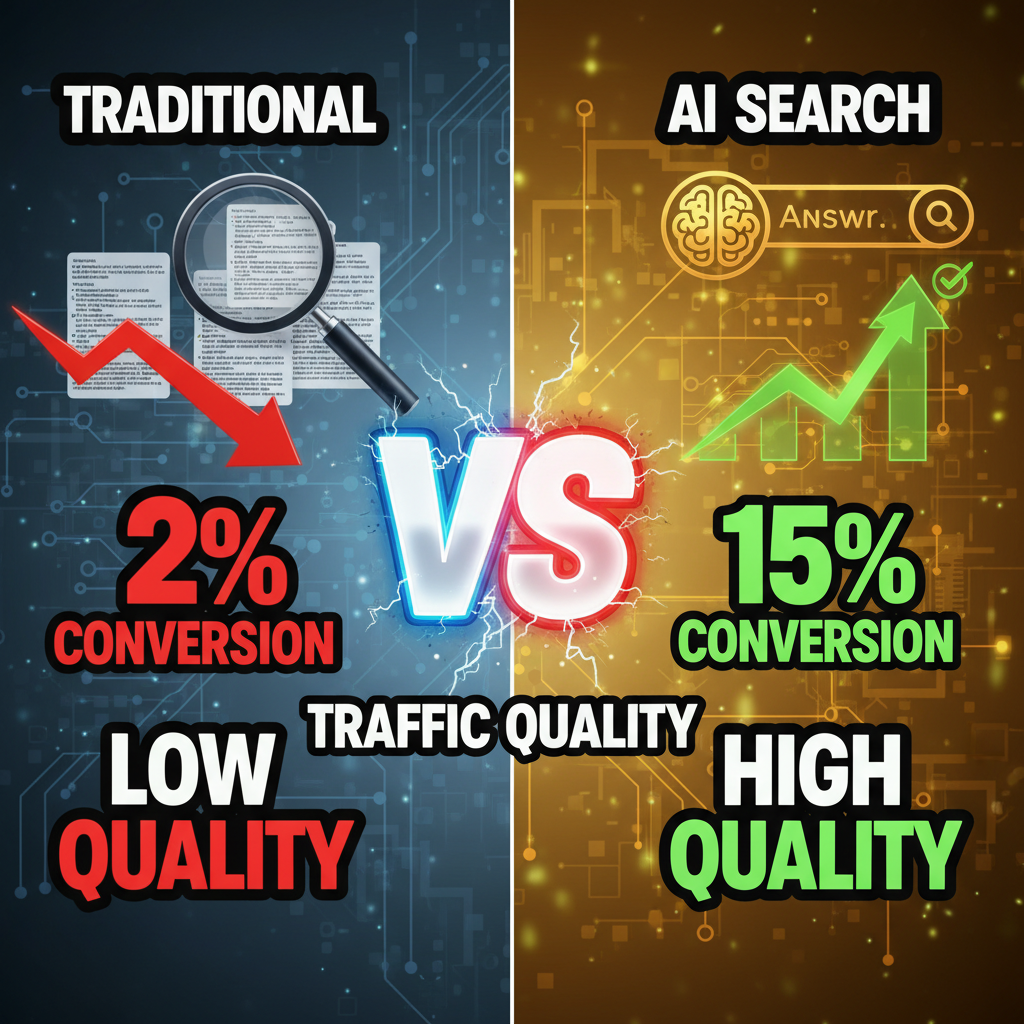
The Data: AI Search vs Google
| Metric | Google Search | AI Search (ChatGPT/Perplexity) | Difference |
|---|---|---|---|
| Bounce rate | 45–60% | 25–35% | AI traffic more engaged |
| Avg session duration | 2–3 min | 4–6 min | AI users read more |
| Conversion rate | 2–4% | 3–6% | AI traffic converts better |
| AOV | $85–$120 | $95–$150 | Higher-intent traffic |
| Repeat purchase rate (6 mo) | 20–25% | 28–35% | Stronger loyalty signal |
| CAC vs LTV ratio | 1:3 to 1:4 | 1:4 to 1:5 | More efficient |
This is from a mix of Shopify merchants we work with and Semrush's 2026 e-commerce report. The pattern is consistent: AI search traffic is smaller in volume but higher in quality.
Why? AI search users tend to be:
- More educated about the product category (they've read 3–5 sources)
- Asking specific questions (not generic product shopping)
- Predisposed to trust recommendations (AI filtered the noise)
- Intentional about purchase (not impulse browsing)
Real-World Scenario: DTC Skincare Brand
A mid-market skincare brand tracked traffic sources for 12 months. Sample size: 12K new customers.
| Source | Traffic | Conversion Rate | AOV | LTV (12 mo) | CAC |
|---|---|---|---|---|---|
| Google Organic | 8,500 visitors | 2.8% | $95 | $285 | $32 |
| Google Ads | 6,200 visitors | 3.2% | $85 | $270 | $45 |
| ChatGPT Search (new in Q3) | 1,800 visitors | 5.1% | $125 | $415 | $25 |
| Perplexity | 580 visitors | 4.4% | $115 | $380 | $28 |
| Direct/Other | 4,920 visitors | 1.9% | $75 | $225 | $38 |
The story: AI search sent 10% of total traffic. But it generated 18% of revenue and had the lowest CAC. Why? Higher-intent users who researched before clicking. They knew the brand (AI mentioned it in context). They were comparing prices and benefits (questions AI had answered).
Google Search was volume-based; AI Search was quality-based.
Why AI Search Traffic Converts Better
1. Pre-qualification
A ChatGPT Search user asking "best retinol serum for sensitive skin" has already filtered options through AI analysis. They arrive at your product page knowing it's a match. Google's generic shopping user arrives at your category and browses 5 competitors.
2. Faster trust
When Perplexity says "Brand X is recommended by dermatologists for sensitive skin," the user trusts it. That's an implicit third-party endorsement baked into the traffic.
3. Different search behavior
Google searchers often look for "best" lists and competitor comparisons. AI search users ask specific product questions ("will this work with my routine?"). Your product page needs to answer specific questions, not compete on "best of" lists.
4. Community validation
Reddit, YouTube comments, and user reviews now appear in AI search answers. If your product has strong community backing, AI search amplifies it. Generic product pages lose.
The Volume Problem: AI Search is Still Small
Here's the uncomfortable truth: AI search traffic is 1–10% of Google traffic for most e-commerce sites (as of April 2026).
For a $5M revenue Shopify store:
- Google sends 50K–100K visitors/month
- AI search (combined) sends 3K–8K visitors/month
Volume-wise, Google still dominates. But the quality differential (3–5x better conversion) makes AI search disproportionately valuable.
Prediction (2027–2028): AI search will be 15–30% of total search traffic. By then, merchants who optimized early will have 3–5 year head start on content positioning.
How to Optimize for AI Search (Without Abandoning Google)
1. Answer specific questions in product descriptions
Generic: "High-quality retinol serum designed for sensitive skin."
AI-optimized: "Retinol serum with calming niacinamide. Safe for sensitive skin? Yes—tested on dermatitis-prone skin, no irritation in clinical trials. Best applied 2–3x weekly, starting slow. Pairs with SPF 30+ (morning) and gentle moisturizer (night)."
2. Create entity definitions
"Retinol is a vitamin A derivative that increases cell turnover to reduce fine lines and dark spots. It's more stable than retinoid acid but can irritate sensitive skin. Concentration matters: 0.03% is beginner-friendly; 0.3%+ is advanced."
AI engines love clear definitions. They extract these for answers.
3. Build semantic coverage
Write content answering 10 questions your customer asks:
- What is retinol?
- Is retinol safe for sensitive skin?
- How often should I use retinol?
- What ingredients pair with retinol?
- What's the difference between retinol and retinoid?
Google ranks you for "retinol." AI search includes you in 5 different answer threads.
4. Lean into community + social proof
User reviews with specifics. "Reduced fine lines without irritation" > "Love this serum." Customer before-and-after photos. Third-party expert quotes.
AI search surfaces this. Generic SEO ignores it.
5. Link to deeper resources
A blog post on retinol ingredients. A guide on sensitive skin routines. FAQ answering 10 dermatologist-recommended questions. AI search threads link to these context pages.
6. Update product copy quarterly
Google ranks you once, holds for months. AI search engines re-evaluate content monthly. Stale product copy underperforms in AI search faster than in Google.
The Strategic Question: Google or AI Search?
The answer: both, but differently.
Google is your volume play. Optimize for keywords, build backlinks, earn featured snippets. ROI is 6–12 months out. Volume compounds.
AI Search is your quality play. Answer specific questions, build community, create expert-level content. ROI is 3–6 months out. Quality compounds.
A merged strategy: Publish educational content targeting long-tail keywords (benefits both). Optimize product pages for specific questions (AI search + Google featured snippets). Build community (Reddit, forums, reviews—AI search amplifies this). Link between resources naturally.
The winning brands in 2026 are not choosing. They're optimizing for both.
Ready to Future-Proof Your Shopify Traffic?
The shift from Google-only to a hybrid search environment is happening now. Merchants who adjust their content strategy today will capture disproportionate market share by 2027–2028.
At Tenten, we help Shopify merchants optimize for the full search landscape—Google, AI Search, and the channels AI search amplifies. Let's audit your current strategy and build a playbook for both. Contact Tenten today.
Editorial Note
Most merchants still optimize for Google in 2026. That's correct for volume. But ignoring AI search is like ignoring SEO in 2012. The early movers win. Your product descriptions, FAQ content, and community strategy should be AI-first by default. Google benefits too.
Frequently Asked Questions
Should we stop doing Google SEO and focus on AI search?
No. Google is still 85–90% of search traffic. But optimize your content to work for both. Answer specific questions (AI search loves this). Build semantically (benefits Google's BERT model). The strategies overlap 80%.
How long before AI search is significant traffic for us?
If you optimize today, 3–6 months. By Q4 2026, AI search should be 5–15% of your search traffic (up from 1–5% now). Growth accelerates in 2027–2028.
Does ChatGPT Search hurt our brand if it recommends competitors?
Sometimes. But if your product is objectively good and has community backing, AI search will mention you. Focus on product excellence and honest reviews, not competing on mentions.
What's the SEO strategy for AI search?
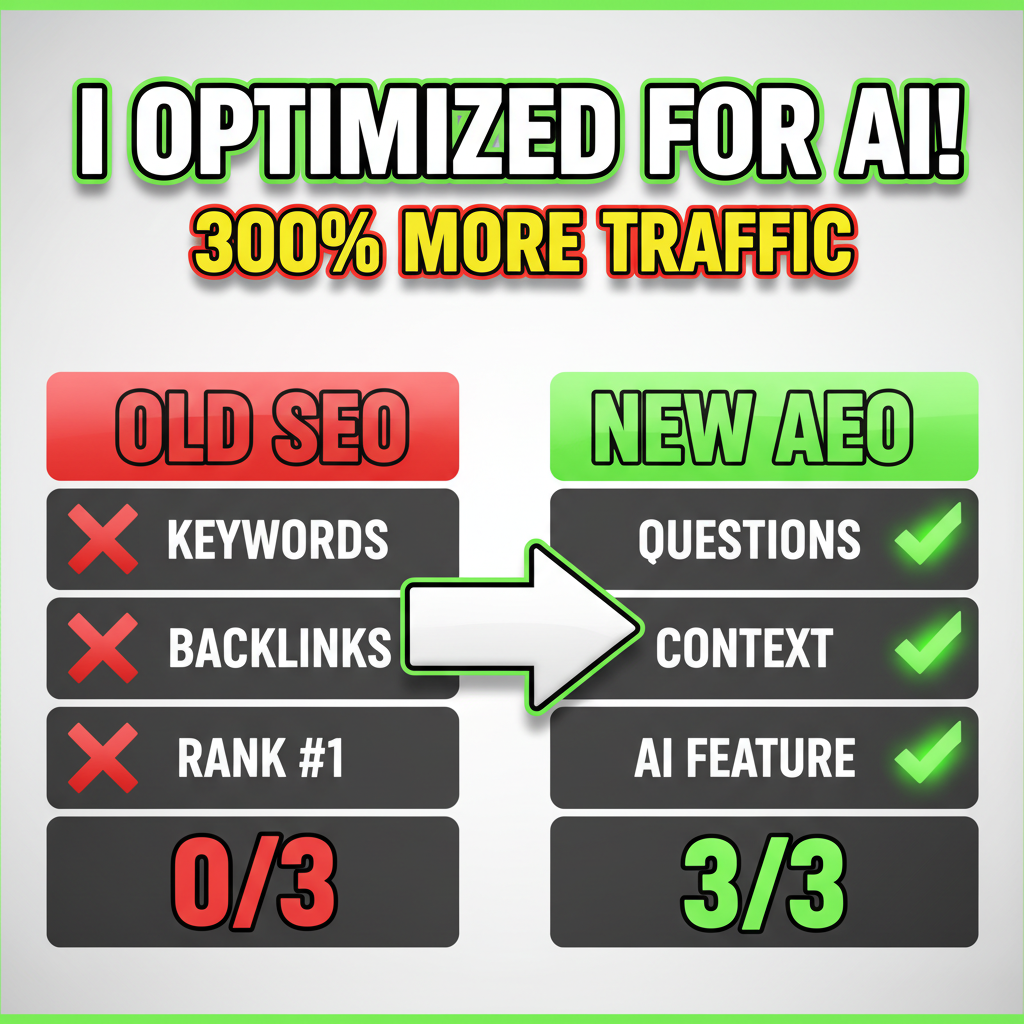
Entity definitions, FAQ coverage, semantic depth, and community validation. Not keywords. Not backlinks. Answer the actual question a customer asks, and AI search finds you.
Should we buy AI search ads?
Not yet (ChatGPT Search doesn't have ads, nor does Perplexity). Focus on organic. By 2027–2028, expect ad products. Plan your budget then.
What content types does AI search favor?
FAQ, product comparisons, expert guides, community discussions (Reddit, forums), and educational deep dives. Blog posts + product pages + user reviews together > any single piece.