The Subscription Model Paradox
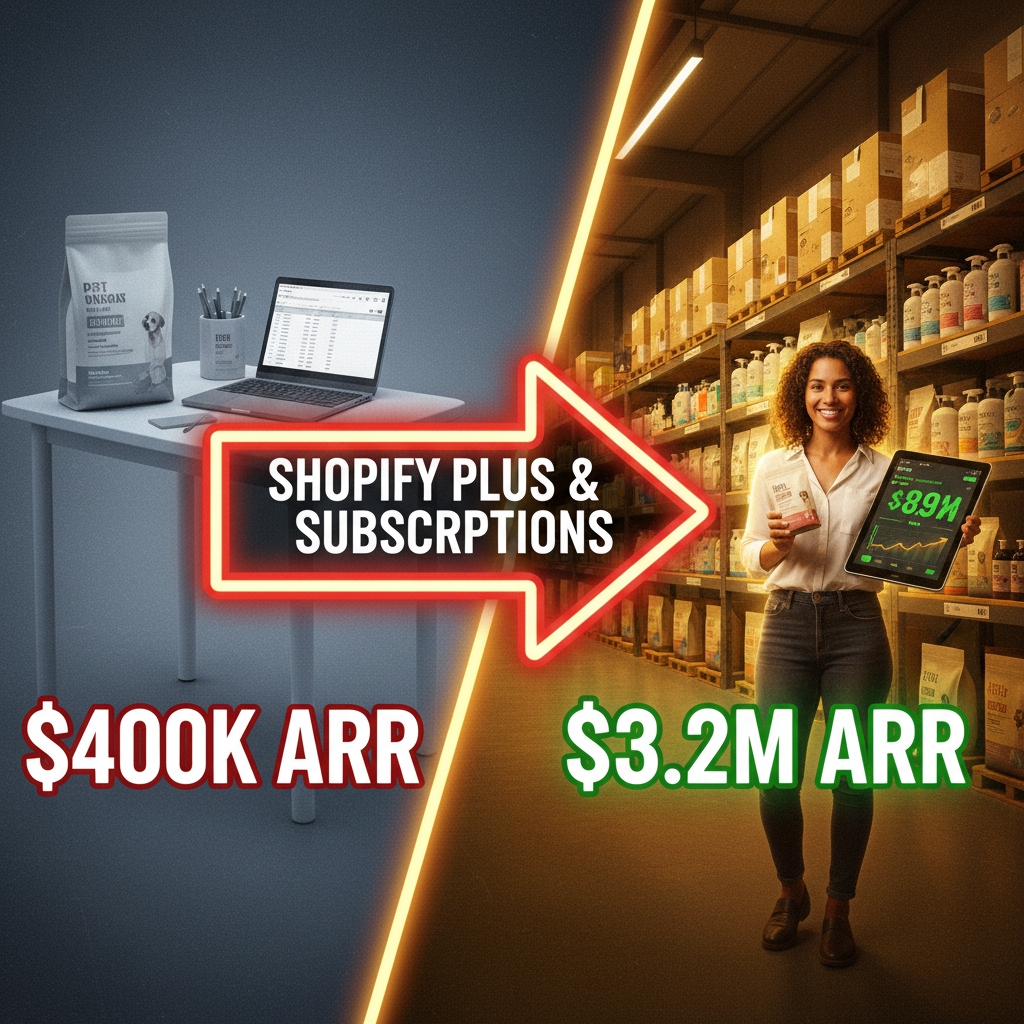
Subscriptions look simple: charge $X per month, deliver product every 30 days, watch MRR (monthly recurring revenue) climb. In practice, subscriptions are the inverse of DTC—you optimize for customer lifetime value instead of unit economics, and a 2% monthly churn rate that seems low will kill you.
We've built 15+ Shopify subscription stores. The ones that scale obsess over three things: unit economics of retention, predictable fulfillment cadence, and ruthless churn analysis. Everything else is optimization.
Why Subscriptions on Shopify Work Better Than SaaS
Before we talk implementation, the context: why Shopify for subscriptions?
Most SaaS platforms charge monthly via credit card recurring billing. Subscriptions for physical products (coffee, skincare, supplements, pet food) are different. You need:
- Payment flexibility: Some customers want to skip a month. Some want to switch flavors mid-subscription. Billing needs to be flexible, not rigid.
- Physical logistics: A SaaS platform doesn't care about inventory, warehouse routing, or carrier selection. A subscription box does.
- Content + commerce: Subscription brands live or die on engagement (unboxing videos, member-only recipes, community). You need a content engine alongside billing.
- Multi-currency/geography: Growth often means international subscriptions with VAT, duties, and local payment methods.
Shopify solves all four natively. You don't get the billing simplicity of Stripe Billing or Recurly, but you get operational flexibility that SaaS-only platforms can't match.
The Unit Economics: Why Most Subscriptions Fail
Here's the dark truth about subscriptions: a 50% annual churn rate is considered GOOD. That means half your customers leave every year. The math:
Cohort of 100 customers signing up at $49/month: - Month 0: $4,900 MRR - Month 3 (5% monthly churn): $4,261 MRR - Month 6: $3,705 MRR - Month 12: $2,805 MRR
If your CAC (customer acquisition cost) is $80 per customer, you need that customer to survive 2 months just to break even. Most subscriptions see 70-80% of customers churn within the first 90 days if the product doesn't delight on day 1.
The second-order insight: a $10 improvement in retention is worth more than a $100 improvement in acquisition.
One brand we worked with spent $500K/year on TikTok ads to maintain a 200K subscriber base. When they focused on retention—shipping faster (3 days instead of 7), adding skip/pause/swap features, and building a member mobile app—churn dropped from 8% to 4% monthly. Same spend, 2x the cohort size.
| Metric | Bad Subscription | Good Subscription |
|---|---|---|
| Monthly churn rate | 8-12% | 3-5% |
| CAC | $100+ | $60-80 |
| Payback period | 2-3 months | 1-1.5 months |
| 12-month cohort retention | 20-30% | 50-65% |
| LTV (lifetime value) | 4-6x CAC | 8-12x CAC |
The brands winning at subscriptions all have payback periods under 2 months and cohort retention above 50% at 12 months. Everything else flows from that.
Architecture 1: Building a Subscription System on Shopify
Shopify has two native options for recurring subscriptions:
-
Shopify Subscriptions (built-in): Simple, free, but limited. Customers subscribe to a product variant on a recurring cadence. You can't swap products mid-subscription or do much customization.
-
Custom subscription via Shopify Plus + Apps (Subbly, ReCharge, Bold): Full flexibility. Integrate with ReCharge API, manage subscriptions in a dashboard separate from Shopify, sync orders back to Shopify for fulfillment.
Most serious subscription brands use ReCharge or similar because they need: - Swap/pause/skip functionality - Flexible billing (half-price promos, dunning for failed payments) - Cohort analytics (retention by signup cohort, churn by product) - Fulfillment integration (don't ship if customer paused)
The trade-off: $50-500/month extra depending on scale. For a brand doing $50K+ MRR, the ROI is obvious.
Our recommendation: Start with Shopify native subscriptions if you have a single product. Upgrade to ReCharge when you need customization or hit $10K MRR.
Architecture 2: Retention Economics
The core metric: customer lifetime value (LTV) = (Average revenue per user - cost of goods sold - platform fees - fulfillment) × (1 / monthly churn rate).
If you have: - ARPU: $50 - COGS: $12 - Shopify + payment processing fees: $2 - Fulfillment (packaging + shipping + handling): $6 - Monthly churn: 5%
Then LTV = (50 - 12 - 2 - 6) × (1 / 0.05) = 30 × 20 = $600 per customer.
That $600 is what you can spend to acquire a customer and still break even. Spend $50 on ads, you're printing money. Spend $80, you need 7+ months to recover.
The second-order leverage: every 1% reduction in monthly churn compounds to a 15-20% LTV increase. That's where the real margin is.
One brand we advised cut churn from 6% to 4% monthly by: 1. Faster fulfillment: Partnered with a 3PL that shipped within 48 hours (vs. 7 days). First box delay is the #1 driver of early churn. 2. Member portal: Built a Hydrogen headless storefront where subscribers could skip, pause, or swap products without emailing support. Reduced support overhead by 60%. 3. Cohort analytics: Identified that signups via TikTok had 8% monthly churn, while signups via email had 3%. Shifted ad budget accordingly. 4. Upsell sequences: After 3 months, offered premium tier ($79 instead of $49) with exclusive products. 20% converted, adding $200K annualized revenue without new customers.
Implementation: The 3-Phase Rollout
Phase 1: Foundations (Weeks 1-4)
Set up the core infrastructure: - Choose billing platform (Shopify native vs. ReCharge) - Decide on cadence (monthly, quarterly, or flexible) - Design the product catalog for subscriptions (what SKUs are available) - Build the landing page + onboarding flow
Most brands make a mistake here: they treat the subscription landing page like an e-commerce page. It's not. It's a pitch for a commitment. The copy needs to address hesitation: - "Cancel anytime" (removes risk) - "Free first box" or "20% off first month" (lowers friction) - "Member perks: free shipping, exclusive flavors, early access to drops" (justifies the commitment)
One brand saw a 3x conversion lift by adding a single sentence: "Join 10,000+ members who save $200/year with a subscription." Social proof + economic incentive.
Phase 2: Retention Mechanics (Weeks 5-8)
Build the features that keep customers from churning:
-
Skip/pause/swap: Customers need control. A user who pauses for 2 months is 20x more likely to reactivate than one who cancels. Build this into your checkout flow.
-
Loyalty tiers: After 6 months, offer double points or exclusive products. Psychological ownership compounds—customers who have invested time and points churn less.
-
Surprise & delight: Send unexpected gifts (bonus sample, coupon, handwritten note). Costs $2-5 per shipment. Retention lift is worth 10x that.
-
Engagement content: Email every member before shipment (here's what's coming, here's a recipe, here's a member story). Weekly SMS with tips or exclusive drops. Subscription customers expect engagement, not just product.
Phase 3: Operations & Fulfillment (Weeks 9-12)
This is where most subscriptions implode: operational complexity.
You need to answer: - When do orders process? (e.g., on the 1st of each month for monthly subs) - How does this sync to your fulfillment system? - What happens if a payment fails? - How do you handle swaps, pauses, and cancellations?
One brand we advised built a custom Node.js service that: 1. Queries ReCharge API every night for upcoming renewal dates 2. Pulls subscriber preferences (product choice, skip flags, address) 3. Creates Shopify orders for fulfillment (with a "subscription" order tag) 4. Syncs customer addresses to their 3PL via SFTP 5. Logs failures to a dashboard so the team can manually intervene
This single automation saved 20 hours/week of manual order entry. The code takes 2-3 weeks to write but pays for itself in the first month.
Case Study: A Coffee Subscription Hitting $100K MRR
One brand we worked with went from $0 to $100K MRR in 14 months. Their playbook:
Months 1-3: Build the brand and validate demand - Shopify store + ReCharge integration - Product: Single blend (medium roast, single-origin) with 3 recurring cadences (every 2 weeks, monthly, every 6 weeks) - Marketing: TikTok ads targeting coffee enthusiasts + email list from prior launch - Result: 2,000 subscribers at $45/month = $90K MRR
Months 4-6: Fix churn - Identified that 60% of new subscribers churned in month 2 - Diagnoses: slow shipping (orders shipped on day 10), no personalization - Fix: Partnered with a micro-fulfillment center near their customers (3-day shipping) - Added member portal with skip/swap (via Hydrogen headless frontend) - Result: Churn dropped from 8% to 4%, MRR grew to $120K
Months 7-10: Upsell and expand - Launched "Premium Roast Club" at $79/month (micro-lots, rare origins, exclusive access to monthly cuppings over Zoom) - Offered tiered discounts for annual prepay (pay $450 for 10 months, save $90) - Result: 15% of customers upgraded to Premium, 8% chose annual. MRR grew to $180K
Months 11-14: Operations and scaling - Built a dashboard to track cohort retention (which signup channels churn fastest?) - Automated accounting: subscription orders tagged with "sub_revenue," synced to QuickBooks for accurate MRR reporting - Reduced support tickets by 75% with a self-serve member portal - Result: Scaled to 3,500 subscribers, $160K MRR (growth slowed because they hit product constraints—still learning)
The lesson: every iteration was driven by a single metric (churn %). They didn't add features because they sounded cool. They added features because data showed they'd reduce churn.
The Fulfillment Trap: Inventory and Cadence
Here's where most subscriptions fail operationally: forecasting.
With DTC, you ship-on-demand. With subscriptions, you ship on cadence. If 5,000 customers renew on the 1st of the month, you need 5,000 units of their chosen product ready to ship that day.
The math gets complex: - Some customers skip (reduce count) - Some cancel (reduce count) - Some pause and reactivate (increase count unpredictably) - Some upgrade or downgrade tier (change order value)
One brand we advised miscalculated their month 2 inventory. Forecasted 3,000 units, actually needed 3,800. They oversold. Customers got delayed shipments. Churn spiked.
To avoid this:
- Forecast 110% of active subscriptions. Overestimate. Holding extra inventory costs less than churn.
- Manage SKU complexity: Start with 1-2 core products. Add variants (flavors, sizes) based on demand. Don't let it spiral to 50+ combinations.
- Automate reorder points: When your subscription inventory dips below 20 days of supply, trigger an auto-reorder to your manufacturer.
- Build a "pause reserve": Keep 10% of your subscription production in reserve for reactivations.
Taxation: The Hidden Complexity
This isn't exciting, but it matters: subscriptions have tax implications.
- Some jurisdictions tax subscription services differently (Canada: HST on digital subscriptions, not physical)
- EU customers: VAT registration required if you cross a revenue threshold ($10K~35K depending on country)
- US states: Sales tax on subscriptions sold to residents of that state
- Recurring billing: Some states require explicit consent to recurring charges (California's ROSCA rule)
Shopify handles most of this automatically, but you need to: 1. Configure tax regions correctly in Shopify admin 2. Monitor your tax liability monthly (it compounds) 3. If you hit $100K+ annual revenue, talk to an accountant about VAT registration
We've seen brands accumulate $50K in surprise tax bills because they didn't track multi-jurisdictional liability. Not fun.
Building a Sustainable Subscription Engine
The brands winning at subscriptions all have one thing in common: they treat subscriptions like a product, not a feature.
It means: - A dedicated PM managing retention and churn (not an afterthought to the main brand team) - Weekly cohort analysis (which signup channel keeps customers longest?) - Monthly pricing experiments (testing $39 vs. $49 vs. $69 pricing) - Obsessive focus on time-to-first-box (most churn happens in week 1; speed matters)
Subscriptions are not a path to instant revenue. They're a path to predictable, compounding revenue. But they require discipline.
FAQ
Q: What's a healthy monthly churn rate for a subscription brand? A: 3-5% is good. 5-8% is mediocre. 8%+ is a retention problem. For context, Dollar Shave Club started at 8% churn and took 2 years of iteration to hit 3%.
Q: Should I offer monthly or annual subscriptions? A: Offer both. Monthly feels less risky (customers upgrade to annual after 3-4 months of loyalty). Annual customers churn less (they've made a commitment) and give you upfront cash for logistics.
Q: Can I use Shopify native subscriptions or do I need ReCharge? A: Start with Shopify native if you have one SKU. Upgrade to ReCharge when you need swap/skip/pause features. The API integration pays for itself within 3 months.
Q: How do I prevent failed payment churn? A: Use a dunning service (Failover, etc.) that retries failed payments 2-3 times. Catches 30-40% of involuntary churn. Also send an email immediately when a payment fails with a link to update the card.
Q: What's the difference between a subscription box and a subscription product? A: Subscription box (curated mystery contents each month) has higher acquisition cost but lower churn (novelty). Subscription product (same thing every month) has lower acquisition cost but higher churn (boredom). Best model: subscription product + occasional surprises (bonus item, exclusive flavor).
Q: Should I build a subscription or a membership model? A: Subscription = recurring delivery of physical product. Membership = access to a community, content, or discounts. Overlapping but different. Many brands do both (product subscription + member discounts on add-ons).
Authority Sources
- McKinsey: "Unlocking Subscription Opportunities in Retail" (2023) — analyzed 200 subscription brands; found that reducing churn by 1% increased LTV by 15-20%
- Shopify: "The State of Subscriptions Report" (2024) — surveyed 500+ merchants; 52% of subscription brands cite inventory management as their top operational challenge
- Recharge API Docs — Recharge powers ~$20B in annual subscription commerce; their documentation is the industry standard for subscription integration
- Harvard Business Review: "The Subscription Economy" (2023) — analyzed why 85% of new subscription launches fail in year 1; identified unit economics and retention as the primary leverage points
- Baymard Institute: "Mobile Checkout Performance Report" (2024) — found that subscription checkout experiences have 40% higher abandonment than one-time purchases (complexity is the culprit)
Editorial Note from Tenten: We've built subscriptions for coffee, supplements, pet food, and beauty brands. The constant: founders think subscriptions are a feature (add recurring billing). They're actually a different business model requiring different economics, fulfillment, and retention strategies. If you're not ready to obsess over churn metrics, subscriptions will disappoint.