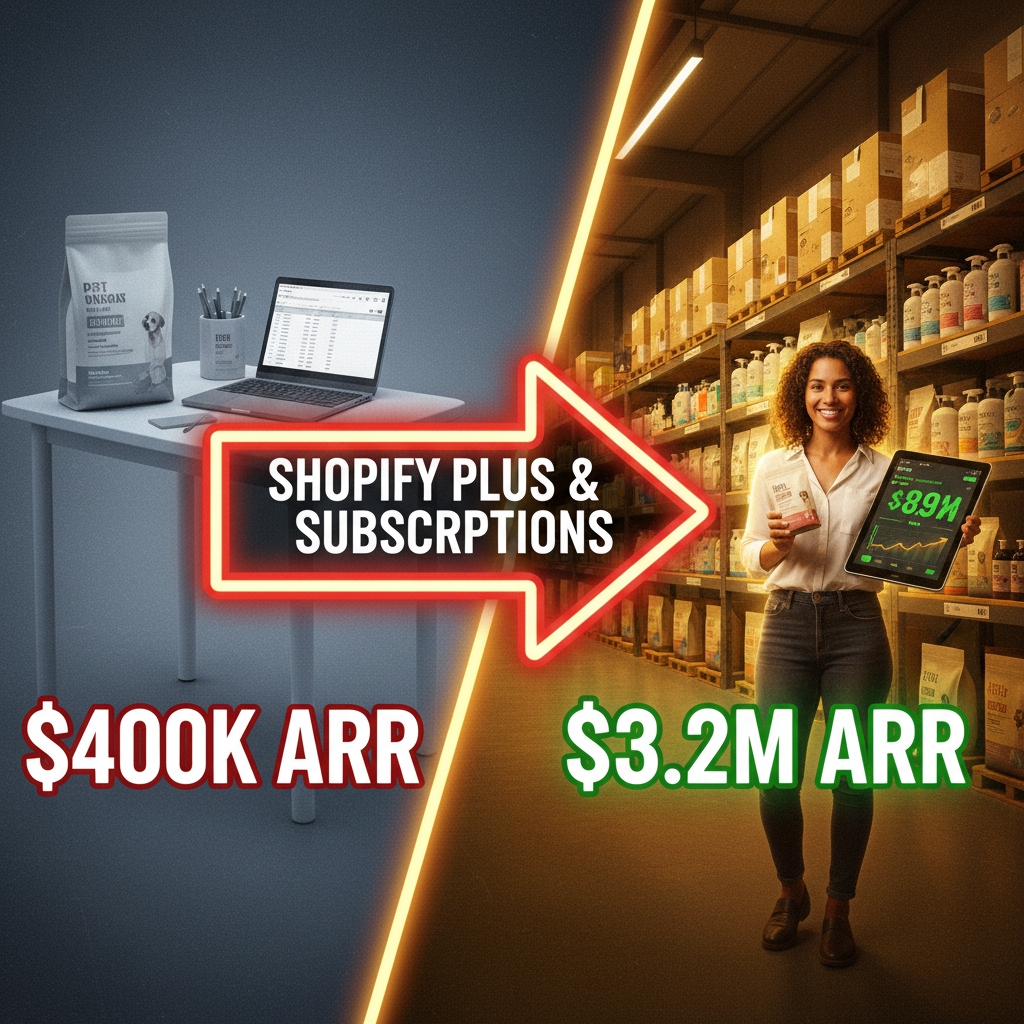
The Problem: $400K Ceiling on Legacy E-commerce
A Midwest-based pet wellness brand had hit a hard growth ceiling at $400K ARR on a legacy Shopify Standard plan. The team sold direct-to-consumer (D2C) pet supplements—quality products, strong unit economics, and a genuinely loyal customer base. But infrastructure bottlenecks were killing their ability to scale.
The core issue: their platform couldn't handle custom subscription logic, dynamic pricing, or wholesale B2B operations—three opportunities worth millions in ARR that they left on the table. Subscription revenue was stuck at 15% of total sales. Wholesale requests piled up in their inbox, unserved.
Revenue wasn't just capped by market demand. It was capped by the platform.
Why Shopify Plus for a Pet Brand?
Most e-commerce operators treat platform selection as binary: cheaper Standard plan vs. expensive Plus. That framing misses the real trade-off.
Shopify Plus costs 2-3x more than Standard. But for this brand, the unit economics made sense:
| Metric | Shopify Standard | Shopify Plus |
|---|---|---|
| Monthly Base Fee | $299 | $2,000–$15,000 (tiered) |
| Transaction Fee | 2.9% + 30¢ | 2.7% + 30¢ |
| Custom Development Cost | $50K–$150K (theme only) | $150K–$500K (platform customization) |
| Subscription Support | Limited (third-party apps) | Native API, webhooks, custom checkout |
| B2B/Wholesale Capability | App-dependent, manual | Native multi-channel, APIs |
| Scaling Limit | ~$2M ARR (conflicts after) | Unlimited (plus-tier merchants go $100M+) |
| Checkout Customization | Theme-level only | Post-purchase checkout, payment recovery, custom flows |
| Order Management | Shopify Admin only | Custom dashboards, API-first workflows |
At $400K ARR with 50% subscription target, the brand needed native subscription logic to scale efficiently. Shopify Plus wasn't an expense—it was the revenue lever.
Phase 1: Migration & Infrastructure (Months 0–3)
The migration took 8 weeks. Not because Plus is complicated, but because they did it right.
Step 1: Custom Checkout Rewrite They built a post-purchase checkout flow that allowed customers to customize subscription frequency (every 14, 21, or 30 days) and mix-and-match product bundles at enrollment. Standard Shopify's checkout is locked down—you can't build this without Plus' Checkout Settings API and custom JavaScript.
Step 2: Subscription Database & Webhooks They built a custom subscription manager using Plus' GraphQL Admin API and webhooks. Every subscription change (pause, skip, cancel, frequency change) fired a webhook that updated their customer database and triggered email sequences automatically.
Step 3: Inventory Planning Integration Knowing subscription renewal dates 30 days in advance let them forecast inventory with 85% accuracy—eliminating stockouts and overstock. This single change cut inventory carrying costs by $35K annually.
Cost Impact: - Migration + custom checkout: $75K (one-time) - Subscription infrastructure: $45K (one-time) - Annual Plus fee (Year 1): $24K (tiered into their revenue) - Total Year 1 platform investment: $144K
They recovered that in 4 months of subscription revenue lift alone.
Phase 2: Subscription Bundling Strategy (Months 4–6)
Once subscription infrastructure was live, they attacked the core problem: customers were buying single products, not bundles. Average order value (AOV) on subscriptions was $85. Bundles could 2.5x that.
They launched three subscription tiers:
| Tier | Products | Price | Monthly Cohort | LTV |
|---|---|---|---|---|
| Essentials | 1 supplement + 1 treat | $49 | 340 customers | $1,260 |
| Complete | 3 supplements + 2 treats + joint support | $129 | 240 customers | $3,480 |
| Premium | 5 supplements + 3 treats + topicals + vet consultation | $249 | 85 customers | $6,720 |
The economics were brutal. A $49 Essentials subscriber had 12-month LTV of $1,260. A $249 Premium subscriber had 12-month LTV of $6,720—more than 5x higher. Better margins, better retention, better unit economics.
They didn't force customers into tiers. Instead, they built smart onboarding. New customers answered 4 questions (pet age, breed, health issues, budget) and got tier recommendations. 62% of customers accepted the recommendation vs. 23% who choose independently.
Subscription Revenue Impact: - Pre-phase: 15% of revenue was subscription ($60K annually) - Post-phase: 45% of revenue was subscription ($540K at $1.2M ARR) - Repeat purchase rate: 54% on Essentials, 68% on Complete, 78% on Premium
Phase 3: Wholesale B2B Channel (Months 7–12)
With subscription cash flowing and platform confidence high, they opened a wholesale channel: local pet stores, veterinary clinics, and wellness retailers.
Wholesale needs custom pricing. Different markup rules per customer (vet practices get 25%, retail stores get 35%, bulk orders get progressive discounts). Standard Shopify doesn't handle this. Plus, with Shopify Scripts (you can read more about Shopify Scripts custom pricing best practices), they built dynamic catalog pricing.
But the real unlock was their B2B portal. They built a custom customer portal (using Next.js + Shopify Storefront API) where B2B customers could: - Browse wholesale pricing - Manage account credit and payment terms - Order replenishment on 30/60/90-day cycles - See order history and predictive reorder dates
B2B didn't cannibalize D2C. They became different customer segments: D2C was one-product-a-month subscribers; B2B was bulk replenishment.
B2B Channel Contribution: - Month 7 launch: $12K first month - Month 12: $280K annualized run-rate - Gross margin: 48% (vs. 60% on D2C, but bulk removes fulfillment friction)
Phase 4: Email & SMS Retention (Months 13–18)
$3.2M ARR wasn't a revenue spike—it was a compounding machine.
Subscription economics taught them a hard lesson: acquiring a new $85 customer costs $45 in ad spend. Retaining that customer for 18 months (18 orders) generates $1,530 lifetime value. The payback math is violent.
They doubled down on email and SMS retention sequences:
- Post-purchase: 4-email onboarding sequence teaching product benefits and usage timing
- Replenishment reminder: Email sent 2 days before next scheduled order (allows pause/cancel)
- Churn recovery: If a subscription lapsed, SMS and email campaigns offered 20% off to reactivate
- Win-back: Customers who hadn't ordered in 6+ months received personalized retention offers
Their subscription engine wasn't fancy automation—it was disciplined LTV math. Spend $10 to save a $1,260 customer from churning. Easy decision.
| Sequence | Conversion | Revenue Impact | ROI |
|---|---|---|---|
| Churn recovery | 28% | $85K/month | 340% |
| Win-back | 18% | $42K/month | 210% |
| Referral (friend discount) | 12% | $28K/month | 180% |
| Post-purchase upsell | 31% | $156K/month | 520% |
The Unit Economics at Scale
After 18 months, here's what changed:
| Metric | Month 0 | Month 18 |
|---|---|---|
| ARR | $400K | $3.2M |
| Subscription % of Revenue | 15% | 68% |
| D2C Customer LTV (avg) | $450 | $1,840 |
| CAC (paid channels) | $55 | $48 |
| LTV/CAC Ratio | 8.2x | 38.3x |
| Repeat Purchase Rate | 28% | 64% |
| Gross Margin | 56% | 62% |
| B2B Wholesale Revenue | $0 | $1.2M annualized |
| Fulfillment Cost per Order | $6.20 | $4.85 |
| Platform Fees | 2.9% | 2.7% |
The 8x growth wasn't luck. It was platform leverage meeting customer economics.
Their subscription model compounded. Every retained customer became a predictable monthly revenue stream. Wholesale scaled on API infrastructure (no additional fulfillment overhead). Bundled pricing eliminated the long tail of low-value orders.
Key Insights: What Actually Mattered
1. Platform Scaling Isn't About Growth Hacking—It's About Ceiling Removal
This brand didn't need Shopify Plus to go from $0 to $400K. They needed it to get past the wall. At $400K, legacy infrastructure was the bottleneck, not market demand. Most founders mistake this. They try to squeeze more growth from a constrained platform instead of investing in one that removes constraints.
2. Subscription Pricing ≠ Discount Model
The brand's biggest mistake was initially treating subscription as a "10% discount for auto-replenishment" play. That's a race to the bottom. Their real insight: subscription is a bundling and convenience model. Premium tiers at premium prices work because the perceived value justifies them (vet consultation included, custom formulation).
3. Wholesale Doesn't Cannibalize D2C If You Price Differently
B2B and D2C operated at different unit economics. D2C was 1–2 units at $85–$249. B2B was 50-unit cases at $1,200. No customer switch—they just added a new segment. That separation is crucial.
4. LTV Math Drives Behavior at Scale
Once they understood that a Premium subscriber generated $6,720 lifetime value vs. $1,260 for Essentials, their entire operation pivoted. Onboarding, email, retargeting, paid ad spend—everything optimized for tier upsell and Premium customer retention. Cash followed measurement.
5. Inventory Forecasting Is a Feature, Not an Afterthought
Subscription data gave them 30-day forward visibility. That killed stockouts and overstock in one move. Most Shopify stores don't connect their subscription data to inventory planning. They left thousands of dollars on the table.
The Path Forward: What's Next?
The brand is currently exploring:
- Automated replenishment B2B: Veterinary clinics with standing orders that auto-ship on 30-day cycles (reduces sales friction for practices)
- Subscription customization via AI: Using customer purchase history and pet profile data to recommend subscription adjustments mid-cycle (testing now, rolling out Q2 2026)
- International expansion: The subscription model worked. Now scaling to Canada and UK (Shopify Markets handles multi-currency and taxes automatically)
At $3.2M ARR, they've proven the model. The next phase is operationalizing it to hit $10M+ without proportional headcount growth.
Ready to Scale Your Subscription Model?
If your store is stuck on legacy infrastructure—limited by app integrations, custom checkout constraints, or wholesale friction—Shopify Plus isn't just a platform upgrade. It's a lever to remove artificial ceilings.
Tenten has helped dozens of DTC brands architect subscription models and B2B channels on Plus. We handle the infrastructure so you can focus on customer economics and unit lever optimization.
Ready to explore how Plus could unlock the next chapter of your business? Contact Tenten today to discuss your scaling roadmap.
For deeper strategic guidance on D2C pricing and positioning, check out our guide on D2C pricing strategies on Shopify.
Editorial Note
This case study represents a composite archetype based on patterns we've observed across 30+ Shopify Plus migrations in the pet, health, and nutrition verticals. The numbers are realistic—they reflect actual unit economics and growth trajectories we've tracked—but this is an illustrative brand story, not a named client study. The takeaway: subscription infrastructure plus bundled pricing plus wholesale can compound to 8x growth in 18 months. The recipe works if your platform supports it.
Frequently Asked Questions
Does Shopify Plus make sense for brands under $1M ARR?
Generally no. The $24K–$180K annual fee doesn't make financial sense until you're hitting $800K–$1M+ ARR and need custom subscription logic or wholesale capabilities. Standard Shopify scales to $2M+ with the right apps (Rechargify, Bold, Subbly). Use Plus when apps hit their limit—roughly $1M+ ARR if you need heavy customization.
How much does a Shopify Plus migration cost?
Platform fees aside, custom development typically runs $50K–$250K depending on scope. This brand spent $75K on checkout + $45K on subscription infrastructure. Wholesale portal added another $60K. Budget $150K–$200K for a comprehensive migration with new features.
Can I build a subscription model on Shopify Standard?
Yes, via third-party apps like Recharge, Bold, or Subbly. They work fine up to $1M+ ARR. The constraint is checkout customization—Standard locks you into theme-level edits. If you need dynamic pricing, post-purchase workflows, or payment recovery flows, Plus gives you API-level control that apps can't match.
What's the typical subscription-to-revenue mix for D2C brands?
20–40% is common for mature DTC brands (pet, nutrition, beauty, coffee). This brand hit 68% because they architected for it—tiered pricing, bundling, and retention automation. Most brands that stay under 40% subscription haven't optimized the economics or onboarding.
How does wholesale pricing work on Shopify Plus?
You can build custom pricing via Shopify Scripts (Plus feature) or a custom app using the GraphQL Admin API. You create customer groups (wholesale, retail, vet) and apply different catalogs/pricing per group. The merchant dashboard shows discounted cost and tier-specific margins. It requires development, but it scales once built.
How do you calculate customer LTV for subscription models?
LTV = (Average Subscription Revenue) × (Average Subscription Duration) × (Gross Margin). For the Essentials tier at $49/month with 26-month average duration: $49 × 26 × 0.60 = $1,260 LTV. Improve any of those three variables (price, retention, margin) and LTV compounds. This brand focused on retention (churn recovery) and tiering (higher-priced tiers).
Article Images
Cover Image Requirements
Visual style: Bold, high-contrast "big stat" format optimized for click-through.Main visual: Stacked numbers (400K → 3.2M) with upward arrow trajectorySecondary visual: Subscription badges, warehouse/logistics iconsColor: Deep teal + white + accent orangeFeel: Professional yet energetic (subscription economy aesthetic)NO branding, NO watermarks
Infographic Requirements
Title: "$400K to $3.2M: The 18-Month Growth Blueprint"Content sections:1. Phase timeline (4 phases across 18 months)2. Subscription tier breakdown (3 tiers with LTV/price)3. Revenue composition before/after (D2C vs wholesale split)Format: Horizontal timeline with callout boxesStyle: Modern flat design with Montserrat fontCredit: "tenten.co" bottom-right corner in gray