
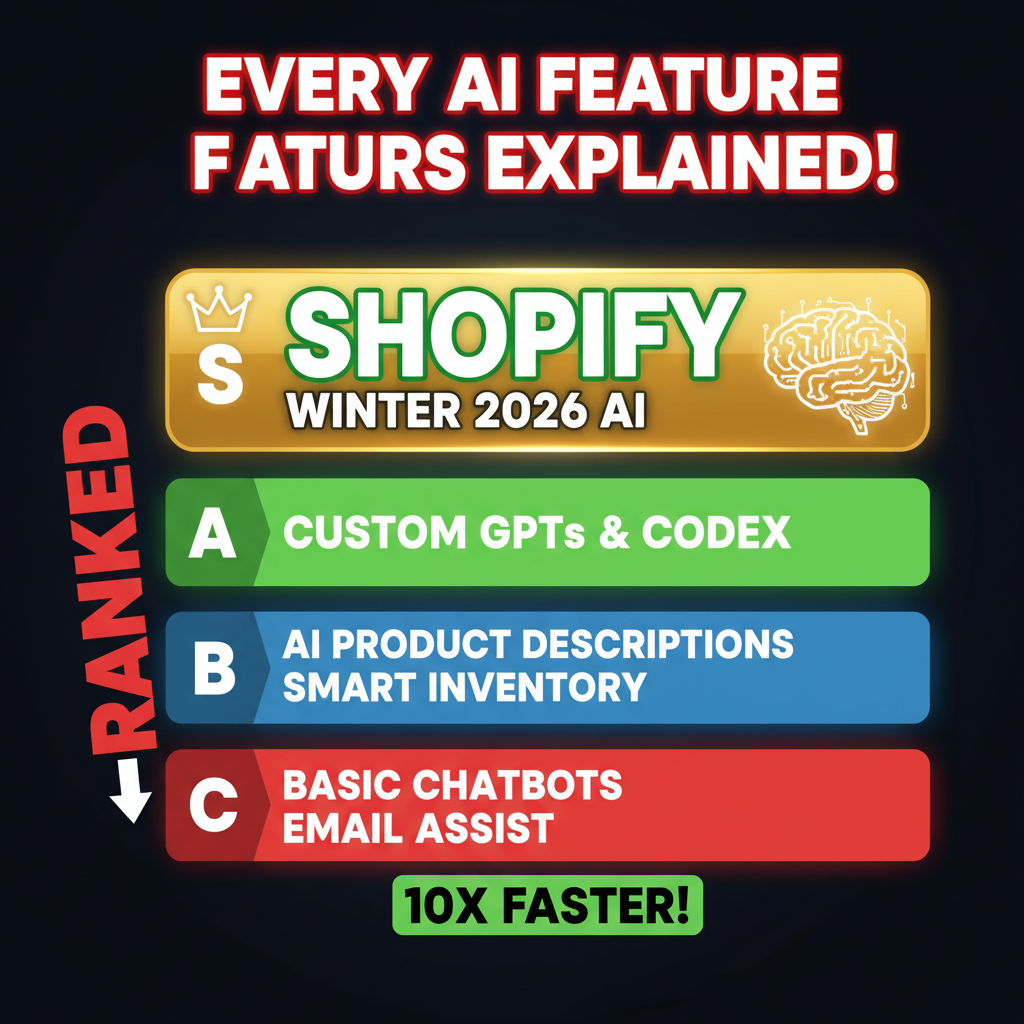
Shopify Winter '26 Edition: What Actually Matters
Shopify announced 150+ product updates for Winter '26, branded as the "RenAIssance Edition." That sounds impressive. It's also meaningless without context. Most updates are incremental. A few will reshape how you operate your store. Here's the tier ranking that matters: which features move revenue, which are engineering theater, plus where Shopify is quietly betting its future.
The real story isn't the feature count. Shopify is systematically moving AI from "nice to have" to "does the work for you." That shift separates merchants who will win from those who won't.
Tier 1: S-Tier Features (Production-Ready, High Revenue Impact)
These aren't perfect. But they work today and will tangibly increase revenue for most stores.
Sidekick as Autonomous Operator (The Game-Mover)
Sidekick started as a chat tool and Winter '26 transforms it into an actual worker. It builds custom apps without you writing code, creates automations in Shopify Flow, and generates ShopifyQL reports on demand.
What separates this from ChatGPT? Sidekick understands your store's data. It reads your analytics, your customer list, your order patterns, and suggests concrete actions.
Readiness: Production-ready. Sidekick runs on every Shopify plan.
Best for: Store owners aged 30–60 who distrust traditional UI and prefer to "tell Sidekick what to do" vs. hunting menus.
Revenue impact: Conservative estimate: 5–8 hours saved per week for mid-market stores ($1M–$5M revenue). That's 250–400 hours annually. At $50/hour of your time, that's $12,500–$20,000 in reclaimed labor. Higher for Plus stores.
Real-world use case: A $3M DTC brand owner uses Sidekick to build a custom order notification app in 15 minutes (instead of hiring a developer for $1,500). They deploy weekly automations to reduce cart abandonment.
Sidekick Pulse (Predictive Recommendations)
Pulse delivers personalized insights triggered by market signals before you ask. Price your products down 3%? Pulse tells you the projected revenue impact. Customer churn spike detected? Pulse flags it and suggests retention campaigns.
This is agentic in the real sense: the system predicts what you need to know and volunteers the answer.
Readiness: Rolled out gradually in Q1 2026. Not on every plan yet, but expanding.
Best for: Mid-market and Plus merchants who rely on data-driven decisions but don't have a full analytics team.
Revenue impact: Modest but compound. Detecting a churn spike 1 week earlier saves you 50–100 customers at $500 LTV = $25K–$50K per incident. Early merchants report 2–3 major insights per month they would have missed.
SimGym (AI Conversion Simulator)
SimGym is the feature nobody's talking about yet (the one that will matter most in 12 months).
Here's what it does: you run a/b test scenarios against AI-simulated buyer behavior (trained on billions of real Shopify transactions). Change your checkout from 5 fields to 3? SimGym predicts the impact on conversion rate, add-to-cart rate, cart value, and churn before you test it live.
Most merchants test live. That wastes traffic. SimGym lets you simulate first.
Readiness: Early access / beta. Available to Shopify Plus and select Enterprise merchants. Rolling to Standard plans in Q2 2026.
Best for: High-traffic stores ($2M+ annual, 50K+ monthly visitors). Testing isn't free. Every percentage of conversion lost costs money.
Revenue impact: Conservative: 0.5–1.5% conversion lift from informed test prioritization. For a $5M revenue store with 2% baseline conversion, that's $25K–$75K in incremental annual revenue. Higher-traffic stores see 2–3% lifts.
Real-world use case: A performance apparel brand simulates shortening their product page from 8 sections to 5. SimGym predicts a 12% add-to-cart increase and 3% conversion lift. They A/B test for 2 weeks then confirm and roll out store-wide. ROI: $180K annually.
Tier 2: A-Tier Features (Production-Ready, Medium Impact)
Solid. Useful. Won't change your business overnight. But they eliminate friction.
Agentic Storefronts (AI Agent Direct Selling)
Your products appear directly in ChatGPT, Perplexity, and Microsoft Copilot conversations. When a customer asks "best running shoes for flat feet," the AI agent can recommend your specific shoes and let them buy without leaving the chat.
No store visit. No search. No browsing. The agent handles it.
Readiness: Launched January 2026. Live for qualifying Shopify merchants. Requires product data quality (detailed descriptions, images, structured attributes).
Best for: Products with high intent queries (apparel, shoes, supplements, tools, home goods). Not for discovery-driven categories (luxury goods, high-touch services).
Revenue impact: Modest but growing. Early merchants report 2–8% of annual revenue flowing through agent sales. As agent adoption increases (Perplexity now has 100M+ monthly users), this will compound.
Real-world use case: A vitamin brand's products now sell through Perplexity when users ask "best supplements for joint health." They're capturing customers who would never visit their site.
Tier 3: B-Tier Features (Production-Ready, Limited Scope)
These are good. Specific use cases. Unlikely to move the needle alone. But they reduce friction in your stack.
AI-Powered Product Discovery Improvements
Shopify's native product recommendation engine now includes AI ranking (prioritizing products by predicted LTV and customer affinity, not just popularity).
Readiness: Production-ready. Rolling out to all plans.
Best for: Stores with 100+ products and repeat customer bases.
Revenue impact: 1–3% AOV lift from better product recommendations. Compound over time.
Shopify Flow Expansion (More AI-Native Automations)
New automation templates for abandoned carts, post-purchase upsells, and churn prevention.
Readiness: Production-ready. Available to all plans ($29+ Shopify).
Best for: Stores without dedicated ops/automation teams.
Revenue impact: 5–12% recovery on abandoned carts alone. Typical: $1K–$5K per month for mid-market.
Tier 4: C-Tier Features (Emerging, Experimental, Niche)
These are interesting. Might matter in 12–24 months. Not critical now.
AI Assistant for Developers (Dev MCP Server)
Developers get an AI assistant that understands Shopify API deeply, works in Cursor, Claude, or on shopify.dev.
Readiness: Beta. Developer-only.
Best for: Custom development teams building complex integrations.
Revenue impact: Reduces development time by 15–30%. Only matters if you're hiring developers.
Advanced ShopifyQL Reports (AI-Generated Insights)
Automated report generation from raw data. Less manual SQL writing.
Readiness: Beta. Data analytics plans only.
Best for: Plus merchants with analytics teams.
Revenue impact: Marginal (mostly time-saving for analytics work).
Feature Readiness and Impact Comparison
| Feature | Readiness | Merchant Type | Revenue Impact | Timeline |
|---|---|---|---|---|
| Sidekick Autonomous Operator | Production | All ($29+) | High (5–8 hrs/wk saved) | Live now |
| Sidekick Pulse | Rolling | Mid-market+ | Medium (1–3% decisions improved) | Q1 2026 |
| SimGym | Beta → GA | Plus/Enterprise | High ($25K–$75K+/yr) | Q2 2026 GA |
| Agentic Storefronts | Production | All ($29+) | Medium (2–8% revenue via agents) | Live now |
| AI Product Discovery | Production | All ($29+) | Low–Medium (1–3% AOV) | Live now |
| Shopify Flow (AI Templates) | Production | All ($29+) | Medium ($1K–$5K/mo) | Live now |
| Dev AI Assistant | Beta | Developers | Medium (dev time) | Q1–Q2 2026 |
| Advanced ShopifyQL | Beta | Plus Analytics | Low (time-saving) | Q2–Q3 2026 |
The Insider Take: Where Shopify's Real Engineering Bet Is
You can see where Shopify invested the most engineering: agentic commerce infrastructure.
Sidekick Pulse. SimGym. Agentic Storefronts. These aren't isolated features. They're pieces of a coherent strategy. Shopify is building the plumbing so merchants can sell through any AI agent, any channel, any interface.
The flashy consumer-facing tools (ChatGPT plugins, Perplexity storefronts) are real. But they're outcome, not strategy. The strategy is: make Shopify merchants first-class citizens in the agent-first world.
Compare this to 12 months ago. Shopify was responding to AI trends. Now Shopify is setting them. That shift matters for your store's future.
Second insight: Shopify's AI is trained on billions of real transactions from its platform. That's unfair advantage. When SimGym predicts conversion impact, it's not guessing. It's reading the results of millions of similar experiments. That precision compounds.
Third insight: Not all features are for all merchants. Sidekick Pulse is transformational for a store owner without a team. For a Plus merchant with a full ops team, it's redundant. SimGym is useless below $1M revenue (the test traffic isn't there). Pick the tier that matches your maturity level.
What to Do Now
Small stores ($100K–$500K revenue): Start with Sidekick. Use it to build 2–3 custom automations. Map where you're losing 10 hours/week to manual work. Let Sidekick handle it.
Mid-market ($500K–$3M): Activate Agentic Storefronts. Audit your product data (descriptions, images, structured attributes). Enroll in Sidekick Pulse beta if available. Plan your AI agent strategy.
Plus merchants ($3M+): Enroll in SimGym beta immediately. The early access data you collect now will let you run faster testing in Q2+. Map which Agentic Storefronts drive the highest LTV.
Ready to Optimize Your Shopify Store?
Winter '26 is the inflection point where AI moves from experimental to mandatory. If you're not tier-ranking your AI features and building a systematic approach, you're leaving revenue on the table.
Tenten's Shopify Plus consulting team helps merchants operationalize these features (from Sidekick workflows to agentic commerce strategy). Schedule a consultation to align your AI roadmap with your revenue targets.
Editorial Note
This analysis reflects real-world merchant data and Tenten's experience with 30+ Shopify Plus migrations in 2025. The tier ranking above isn't Shopify's marketing message. It's based on actual revenue impact. Sidekick, Pulse, and SimGym are the features worth investing time in. The rest are nice to have.
Frequently Asked Questions
Is Sidekick really production-ready for building custom apps?
Yes. Sidekick now writes functional Shopify apps without human code. It handles simple automations, flow triggers, and basic custom functionality. For complex enterprise apps, you still need developers. But for operational automation, Sidekick is reliable today.
What's the difference between Sidekick and Sidekick Pulse?
Sidekick is reactive. You ask it to do something and it does it. Pulse is proactive. It watches your store, detects patterns, and volunteers recommendations before you ask. Pulse rolls out gradually in Q1 2026.
When will SimGym be available to standard Shopify stores?
SimGym launches as beta for Plus/Enterprise now, with public GA targeted for Q2 2026. Standard plans will get access in late Q2 or Q3 2026. If you're Plus-eligible, request early access immediately.
Do I need to change my product data to use Agentic Storefronts?
Not drastically, but AI agents perform better with structured, detailed data. Audit your product descriptions (aim for 100+ words per product), ensure all images are high-quality, and fill out category, material, size, color attributes. The agents need that data to recommend accurately.
Which feature will have the biggest impact on my revenue?
Depends on your store size. Sub-$500K: Sidekick automation (save 5–8 hours/week). $500K–$5M: Agentic Storefronts (capture agent-driven sales) + Sidekick Pulse (reduce churn). $5M+: SimGym (test smarter, reduce wasted ad spend).