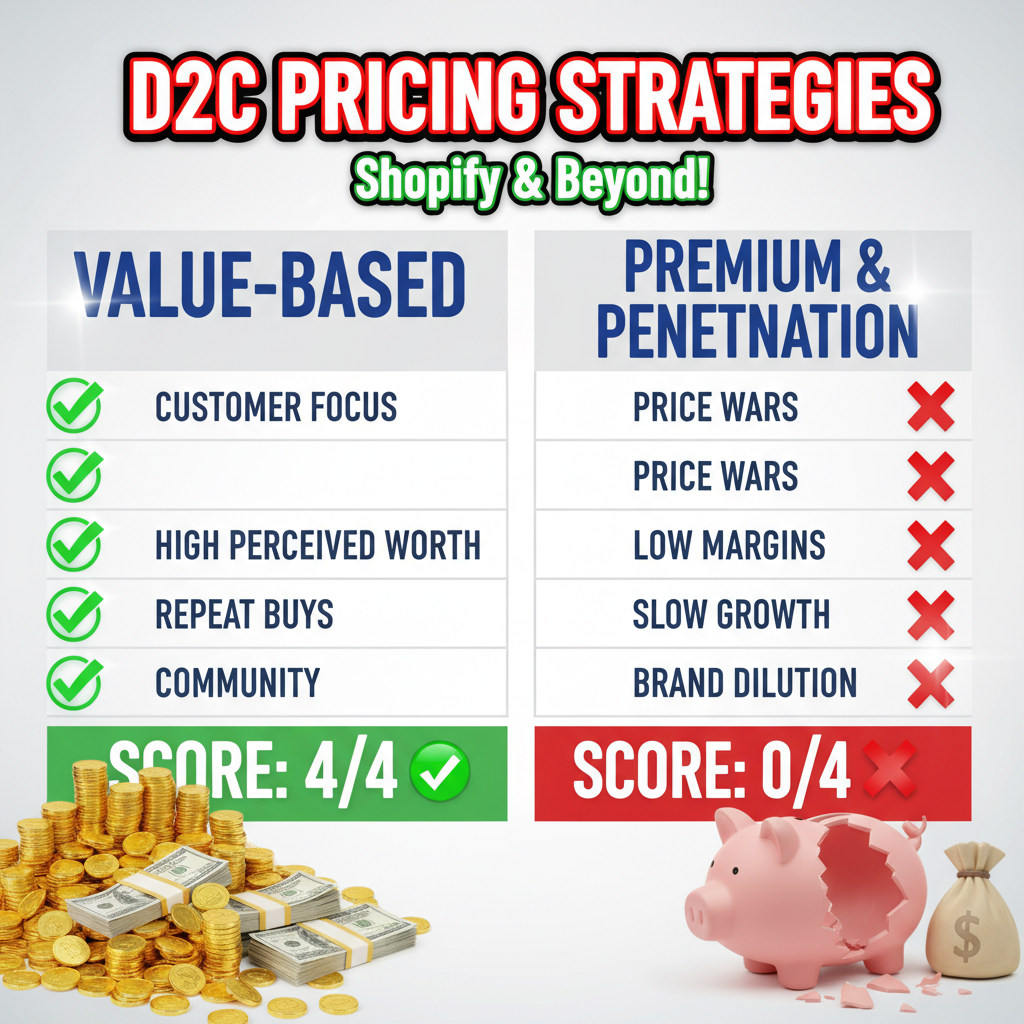
D2C Pricing Is Your Biggest Margin Lever
Most founders obsess over customer acquisition cost (CAC). But pricing is often a bigger margin driver than traffic.
Here's the math: Cut CAC by 10%, you improve margins by ~1-2%. Raise prices by 10%, you improve margins by 8-12% (assuming cost of goods stays constant). Price is a 5-10x leverage point.
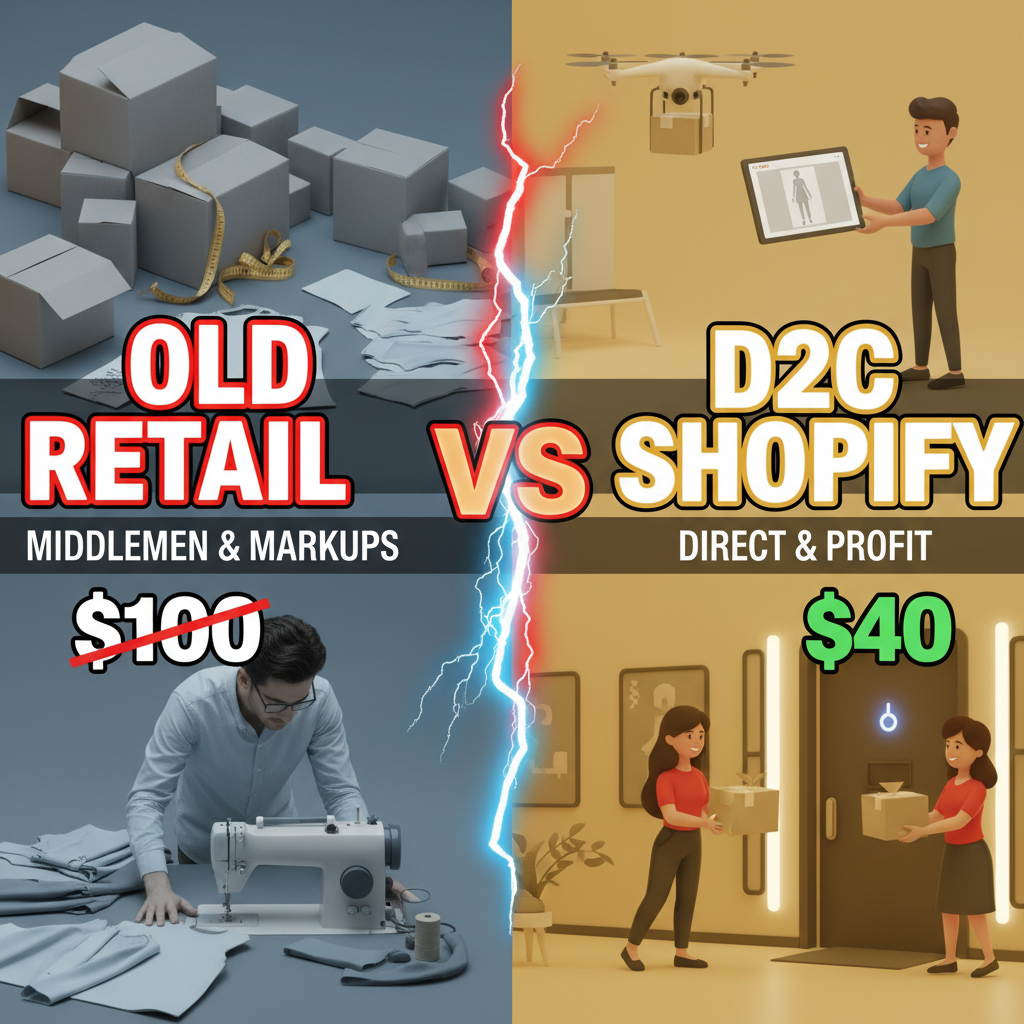
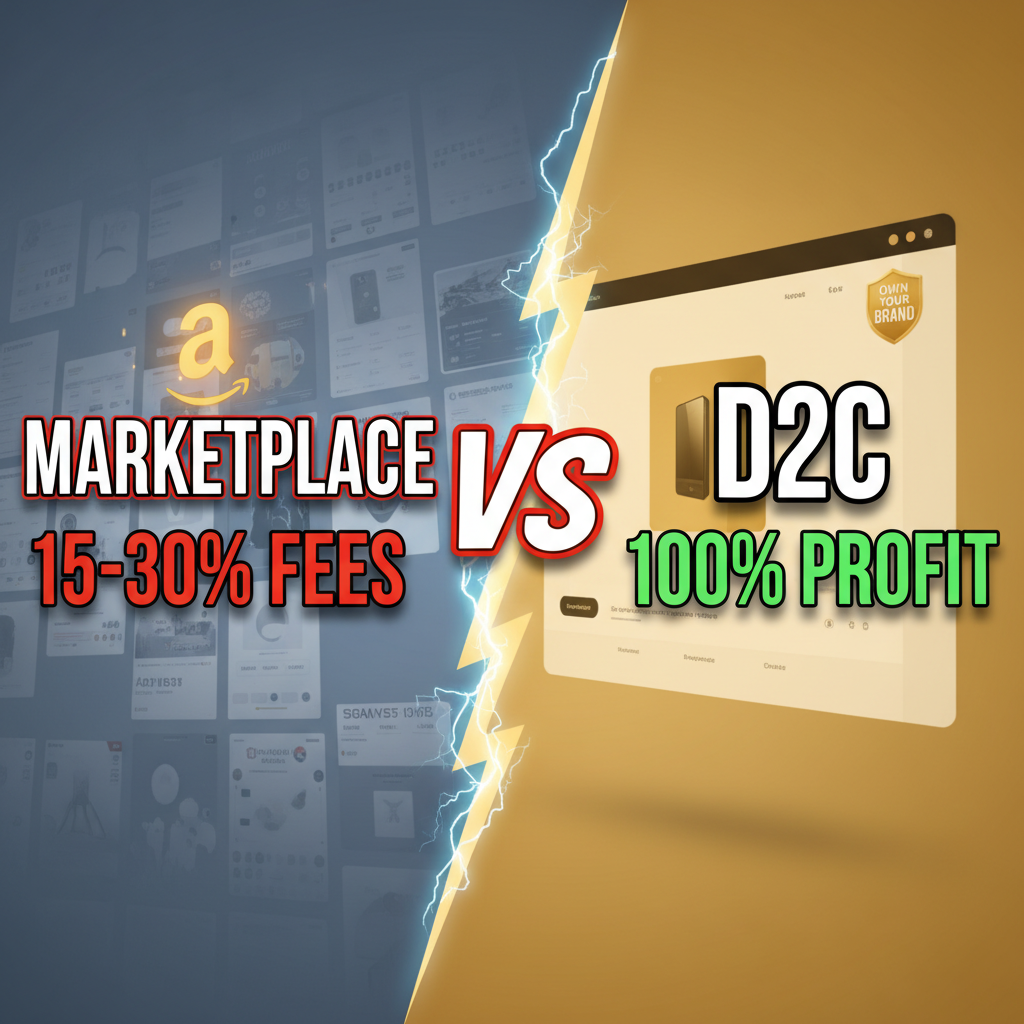
The D2C advantage: You own the customer relationship. No wholesaler, no retailer, no distributor markup. You can charge 50-200% more than wholesale because: 1. You control the narrative (positioning, brand story) 2. You have direct customer data (feedback, preferences, lifetime value) 3. You eliminate middlemen (no retailer margin) 4. You can justify premium pricing through brand, quality, scarcity
Yet most D2C brands price reactively—matching competitors or using cost-plus markup. This guide covers the pricing frameworks that actually work for Shopify DTC.
Three Pricing Models for D2C (And When to Use Each)
1. Value-Based Pricing — The Strongest Model
Definition: Price based on the value (financial or emotional) the customer perceives, not your cost.
How it works: 1. Identify the customer's "job to be done" (the underlying need/desire) 2. Quantify the value (financial gain, time saved, emotional benefit) 3. Price at 20-30% of that value
Example 1: Productivity software Customer's job: "Save 10 hours/week on email management" Value: 10 hours × $50/hour = $500/week value Price: $50-100/month (captures 10-20% of weekly value)
Example 2: Sustainable apparel Customer's job: "Buy high-quality clothes that align with my values" Value: Premium quality (2x lifespan) + moral satisfaction (priceless) Price: 80% more than fast-fashion equivalent Customers accept premium because they perceive greater value
Data point: McKinsey research found that 62% of consumers will pay more for sustainable products. Value-based pricing captures that willingness.
When to use: Niche brands, premium positioning, products with clear emotional/functional benefits.
Downside: Requires strong brand positioning and customer education. Can't value-price on a me-too product.
2. Penetration Pricing — Price Low to Gain Market Share
Definition: Price below market rate to acquire customers quickly, then raise prices later.
How it works: 1. Price 20-30% below competitors 2. Acquire volume/scale quickly 3. Lock in loyalty 4. Raise prices gradually as brand strengthens
Example: A new DTC coffee brand launches at $12/lb (competitors are $18-25/lb). They undercut to gain 10,000 customers in year 1. Year 2, raise to $16/lb. Loyal customers accept price increase because they're invested.
Data: Statista found that switching costs and loyalty lock-in prices 5-15% premiums once customers are acquired.
When to use: Commoditized markets, high customer acquisition is a bottleneck, you have funding to absorb margin initially.
Downside: You signal "cheap" positioning. Hard to raise prices later. Competitors undercut you. Margin suffers until scale.
3. Dynamic Pricing — Price Based on Demand, Inventory, Customer Segment
Definition: Adjust prices in real-time based on demand, scarcity, customer behavior, or segment.
Tactics:
3a. Scarcity-based pricing: Limited inventory = higher price - If only 5 units left, increase price 15-20% - Signal urgency: "Only 3 in stock"
Data: A/B tests show scarcity messaging increases conversion by 12-18% and allows 5-10% higher prices.
3b. Demand-based pricing: High-demand seasons = higher prices - Summer: +15% for seasonal products - Holiday: +20% for gift items - Post-viral spike: +25% temporarily
3c. Customer segment pricing: VIP customers see lower prices; new customers see higher prices - Returning customers: 10% loyalty discount - First-time buyers: standard price or slight premium (newer brand perception) - Wholesale/bulk: tiered discounts
3d. Time-based pricing: Earlier purchase = lower price - Pre-order: 15% discount - Last-minute: 20% premium (urgency)
When to use: Brands with significant demand variation, high inventory risk (perishable, seasonal), or strong customer data.
Downside: Requires real-time systems (Scripts, apps, or custom code). Can feel unfair if customers notice price changes.
Price Anchoring — Psychological Tactics That Work
Price anchoring is a cognitive bias: customers make decisions relative to the first price they see (the "anchor").
Tactic 1: Higher Original Price → "Sale" Price
Bad: Price = $50. No anchor. Good: ~~$75~~ $50 (33% off anchor)
Impact: Statista reports that showing an original, higher price increases perceived value by 25-35% and increases conversion by 8-12%.
How it works: 1. Set "original" price higher (based on value-based pricing, not arbitrary) 2. Offer at discount (20-40% typical) 3. Customer perceives deal: "I'm saving $25!"
Reality check: Don't lie about original price. Set MSRP/RRP high, then offer at net price. Legitimate and effective.
Tactic 2: Three-Tier Pricing (Good / Better / Best)
Example: - Good: $29 (basic version) - Better: $59 (most popular, 30% more) - Best: $99 (premium, deluxe features)
Impact: Most customers buy the middle tier (Best-tier anchors perceived value). McKinsey found middle-tier dominance increases average order value by 15-25%.
Why: Anchor of $99 makes $59 feel like a bargain. $29 feels cheap. $59 feels "just right."
How to implement on Shopify: 1. Create three product variants (or three separate products) 2. Display side-by-side 3. Highlight "Best" tier as recommended 4. Show value difference ($59 tier offers "2x features" vs. $29)
Tactic 3: Bundle Pricing (Increases AOV)
Example: - Shirt: $45 - Pants: $55 - Bundle: $85 (instead of $100)
Perceived savings: 15% discount on bundle Actual benefit: You move 2 items, increase AOV by 89%, while "discounting" only 15%
Data: Baymard Institute found bundling increases conversion by 20-30% and AOV by 18-25%.
Implementation: Use Shopify's bundle app or create a manual "bundle product" with pre-selected variants.
Tactic 4: Price Contrast (Emphasize Low Price of Entry)
Example: Coffee subscription
Bad: "Pay $180/year" Good: "Just $15/month"
Impact: Monthly framing feels 60% cheaper psychologically, even though annual cost is identical. Reduces payment friction.
Implementation: Show price in smallest logical unit. Annual → break into monthly. Larger quantity → break into unit price.
Margin Math: Price Optimization for DTC
Scenario: Apparel brand, currently $50 MSRP, 40% profit margin
Current state: - Price: $50 - COGS: $20 - Margin: $30 (60%) - Gross margin %: 60% - Monthly revenue: $100K - Monthly margin profit: $60K
Scenario 1: Increase price by 15% (to $57.50) - Assume 8% conversion drop (customers are price-sensitive) - New revenue: $100K × 0.92 = $92K - New margin profit: $92K × 0.60 = $55.2K - Result: -$4.8K monthly (-8%)
Verdict: 15% price increase wasn't worth it (lost customers outweighed higher price).
Scenario 2: Increase price by 8% (to $54), improve positioning - Assume 3% conversion drop - New revenue: $100K × 0.97 = $97K - New margin profit: $97K × 0.60 = $58.2K - Result: -$1.8K monthly (-3%)
Close call. Benefit depends on whether the 3% customer loss is permanent or one-time.
Scenario 3: Improve brand positioning, justify $60 price - Assume 5% conversion drop (but higher perceived value justifies premium) - New revenue: $100K × 0.95 = $95K - New margin profit: $95K × 0.60 = $57K - Result: -$3K monthly (-5%)
Better approach: Price increase + value communication + improved product/packaging = net positive.
Pricing Frameworks for Different DTC Categories
| Category | Margin Target | Strategy | Typical Price Point |
|---|---|---|---|
| Apparel/Fashion | 40-60% | Value-based (brand, quality) | $50-150 |
| Cosmetics/Beauty | 70-85% | Premium positioning (brand is 80% of cost) | $30-80 |
| Supplements/Nutrition | 50-70% | Value-based (health benefits) | $30-60 |
| Home/Furniture | 35-50% | Cost-plus (material cost drives price) | $100-500+ |
| Digital Products | 85-95% | Value-based (unlimited supply, high value) | $20-500 |
| Food/Beverage | 55-70% | Dynamic (perishable, seasonal variation) | $20-40 |
| B2B SaaS/Services | 60-80% | Value-based (ROI per customer) | $100-5K/month |
Dynamic Pricing Implementation on Shopify
Option 1: Shopify Scripts (Shopify Plus)
Set prices dynamically based on inventory, customer segment, or time.
# Discount high-demand items (limited inventory)
Input.cart.line_items.each do |line_item|
  inventory_count = line_item.variant.inventory_quantity

  if inventory_count < 5 && inventory_count > 0
    # Low stock: increase price 10%
    price_increase = line_item.line_price * 0.10
    line_item.change_line_price(line_item.line_price + price_increase)
  elsif inventory_count == 0
    # Out of stock: prevent sale
    line_item.change_line_price(0)
  end
end

Output.cart = Input.cart
Option 2: Apps
Use pricing apps like: - Surge Pricing - Codify (custom pricing rules) - Dynamic Pricing Pro
Option 3: Manual Seasonal Adjustments
Update prices quarterly (no automation needed).
Pricing Mistakes DTC Brands Make
Mistake 1: Pricing purely on cost + markup
Bad: COGS $20 + 100% markup = $40 (ignores value, ignores competition) Better: Understand customer's willingness to pay, value-based pricing, then optimize margin
Mistake 2: Following competitor pricing too closely
Bad: Competitor is $50, so you're $49 (race to bottom) Better: Differentiate via quality, positioning, or service. Command premium if justified.
Mistake 3: Not testing prices
Bad: Pick $50, live with it forever Better: A/B test price points ($45 vs. $50 vs. $55). Measure conversion and revenue.
Mistake 4: Changing prices too frequently
Bad: New price weekly (confuses customers, erodes trust) Better: Seasonal pricing (quarterly adjustments)
Mistake 5: Assuming customers are price-sensitive
Reality: Premium brands attract value-focused, not price-focused customers. Raising prices often increases prestige and conversion.
Price Testing Framework (4-week test)
Week 1: Establish baseline - Control group: standard price ($50) - Measure: conversion rate, AOV, revenue
Week 2-3: A/B test new price - Test group: new price ($54) - Run 2 weeks to reach statistical significance (300+ conversions) - Measure: conversion rate, AOV, revenue
Week 4: Analyze & decide - If conversion rate drop < 5%, increase price permanently - If drop > 8%, revert to original price - If drop = 5-8%, test intermediate price ($52)
Statistical power: You need 300+ conversions per variation to detect 3-5% revenue change with 95% confidence.
Ready to Grow Your Shopify Store?
Pricing is not negotiable. A 10% price increase with proper positioning and communication often lifts margin by 8-12%. Start with value-based pricing (understand your customer's job to be done), test anchor pricing, and implement bundling.
For brands scaling across multiple price points, geographies, or customer segments, Tenten's pricing strategy and analytics services help optimize margin while maintaining conversion and customer lifetime value.
Editorial Note Most DTC founders leave 15-25% annual margin on the table by pricing conservatively. Test higher prices. Most premium-positioned brands can command 20-30% price premiums over commodity competitors.
Frequently Asked Questions
How much can I raise prices before losing customers?
Depends on positioning and category. Premium brands can raise 10-15% without conversion drop. Commoditized brands can raise 3-5%. Test to find your elasticity.
Is value-based pricing ethical?
Yes, if you're truly delivering value. If customer gets $500 value and you charge $50, that's fair exchange. The problem is when you promise value you don't deliver.
Should I show the original price if I'm always on sale?
No. "Always 33% off" signals cheap, not premium. Better to price naturally (single, honest price) or use legitimate seasonal sales.
Can I use dynamic pricing without apps?
Yes, with Shopify Scripts (Plus only) or manual quarterly updates. Apps are easier but add checkout latency.
How often should I change prices?
Quarterly or seasonally. More frequent changes erode trust. Less frequent means you miss margin opportunities.