D2C Pet Products on Shopify: Capturing the $300B Market (How Community Wins)
The pet industry crossed a tipping point in 2025. Pet owners aged 25-45 now spend on pet products with the same fervor they spend on themselves—premium brands, personalization, consciousness-driven purchases. Veterinary spend per pet jumped 40% in five years. And here's the critical number: only 15-18% of the $300B pet market is purchased online, compared to 40%+ for general retail.
That gap is your opportunity. But winning requires a different playbook than generic D2C. Pet parents don't buy based on price or convenience. They buy based on identity, community, and trust. A brand that builds 50K engaged pet parents generates 3-5x higher lifetime value than one competing on price.
Here's the playbook that's working in 2026.
The Psychology of Pet Parent Spending: Identity Over Practicality
Pet owners don't buy products—they buy identity. They're signaling responsibility, love, and belonging. Brands that win understand this core truth and structure everything around it.
The "Responsible Pet Parent" positioning outsells "Premium Pet Products" by 2-3x.
Compare these two approaches:
- Functional message: "Our dog food has 28% protein and 12% fat—higher than competitors."
- Identity message: "We believe dogs thrive on whole foods, not commodity kibble. Our customers are redefining what responsible pet parenting looks like."
The identity message converts better because it gives the pet parent an identity to buy into—not just a product to buy.
Real examples that prove this:
- Fresh Pet: "Fresh food for dogs, not kibble. You wouldn't eat canned food every meal—why should your dog?"
- Tuft & Paw: "Pet furniture designed like human furniture. Your dog's space should be beautiful too."
- The Farmer's Dog: "Real food for real dogs. Just like you wouldn't eat processed meals every day, your dog deserves fresh, whole ingredients."
Each positions against a false normal ("kibble is standard," "pet furniture should be utilitarian," "processed is acceptable"). By fighting that norm, they attract customers who share their values.
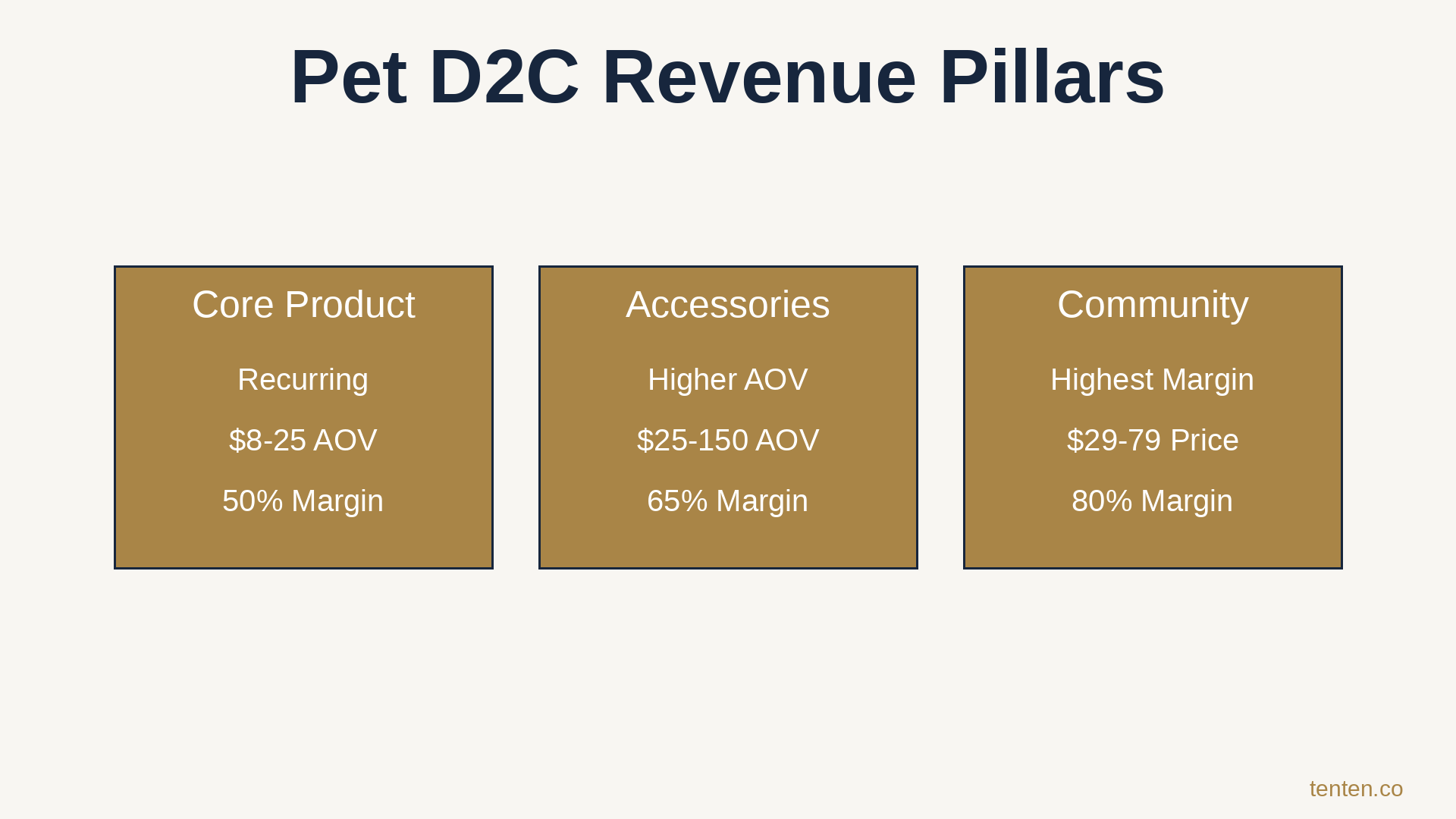
The Three Revenue Pillars for Pet D2C Brands
| Pillar | Product Examples | Unit Economics | Role in Growth |
|---|---|---|---|
| Core Product (Repeat) | Dog food, treats, supplements | 50% gross margin, $8-25 AOV | Recurring revenue, customer stickiness |
| Accessories (Upsell) | Bowls, leashes, beds, collars | 65% gross margin, $25-150 AOV | Higher AOV, brand identity, margin expansion |
| Community/Content | Digital courses, vet consultations, exclusive access | 80% gross margin, $29-79 | Sticky engagement, pricing power, defensibility |
Pillar 1: Core Product (Recurring)
Dog and cat food, treats, and supplements are the foundation. They reorder every 4-12 weeks.
Unit economics: $8-12 COGS → $18-30 retail = 50% gross margin.
Why this pillar matters: customer lifetime value is 10-15x higher than accessories alone. A customer buying $20 food every 4 weeks ($60/month) over 24 months = $1,440 lifetime value versus a $50 bed purchase = $50 lifetime value.
The Farmer's Dog (valued at $500M+) proved this. They built their empire on fresh food subscriptions. Recurring revenue made them investable and defensible.
Pillar 2: Accessories (Higher AOV)
Bowls, beds, leashes, collars, toys. These have superior margins (65%) and higher AOV ($25-150) but lower repeat rates.
Key insight: Position accessories as brand identity extensions. A customer buying food identifies with your brand worldview—so they'll buy your branded bed or leash not for functionality, but for belonging.
Pillar 3: Content & Community (Highest Margin)
This is where winners differentiate. Build content around:
- Dog health education: "nutrition for joint health," "managing allergies without medication"
- Pet parent identity: "new puppy owner guide," "anxious dog solutions," "multi-pet households"
- Community: private Facebook group, Discord for customers, weekly live Q&As
Monetize through:
- Digital courses ($29-79)
- Vet consultation bookings (affiliate commission)
- Exclusive community access (small monthly subscription, $9-19)
Results: 80% gross margin and dramatically lower churn. A customer consuming your content has 3-5x lower churn than a transaction-only customer.
The Subscription Model: Unit Economics That Work
Pet food is consumable and recurring. This makes it perfect for subscriptions—and the numbers prove it.
Why subscriptions work:
- Behavioral repetition: Pet parents need food every 4 weeks. Habit-based purchasing = natural subscription fit.
- Switching friction: Once on subscription, switching dog food requires a 7-10 day tapering process. Inertia keeps customers loyal.
- Community lock-in: Recurring touchpoints via email, SMS, and community access drive stickiness.
Unit economics of a monthly pet food subscription:
- Monthly subscription price: $60
- COGS: $18
- Shipping: $8
- Payment processing: $1.50
- Platform/software: $1
- Gross profit per month: $31.50 (53%)
Lifetime value (18-month average customer life, 94% monthly retention):
- Revenue: $60 × 18 months = $1,080
- COGS: $18 × 18 = $324
- Shipping: $8 × 18 = $144
- Platform/software: $1 × 18 = $18
- CAC (email + paid ads): $40
- Net lifetime profit: $554 per customer
At 200 new customers acquired per month: $554 × 200 = $110,800 monthly profit.
Compare to other subscription models:
| Category | Lifetime Profit per Customer |
|---|---|
| Apparel subscriptions | $200-300 (high returns, low margins) |
| Coffee subscriptions | $200-250 (national brand competition) |
| Pet subscriptions | $400-550 (sticky, high margins, low returns) |
Pet subscriptions have superior unit economics because customers have genuinely different nutritional needs—they can't commoditize like apparel or coffee.
Building Community as Your Competitive Moat
The brands winning hardest (Fresh Pet, Tuft & Paw, Ollie, The Farmer's Dog) have one thing in common: obsessive community engagement. Your community is your defensibility.
Here's what works:
1. Private Facebook group for customers
Use it for:
- New product previews (customers vote on new flavors)
- Pet health tips and Q&A (become the trusted advisor, not the salesman)
- User-generated content (photos of pets thriving on your food)
- Monthly live Q&As with nutritionists or vets
Results: 40-50% of active community members have 35% lower churn rates than non-members.
2. Educational content (blog + email)
Create content that builds on your worldview. If your positioning is "whole food for dogs," your content should be:
- "The kibble deception: why commercial brands hide ingredient sourcing"
- "Switching to fresh food: week-by-week guide to avoid digestive upset"
- "Pet parent myths: grain-free doesn't mean healthier"
This attracts organic search traffic and builds authority. Customers trust you because you're educating, not selling.
3. Micro-influencer partnerships (not paid ads)
Partner with micro-influencers (10K-100K followers) who genuinely use your product. Don't pay for posts—send product, ask for honest feedback. If they love it, they'll post (authentic posts convert better).
Target micro-influencers with engaged pet communities: dog training accounts, pet health coaches, vet techs.
The math: Send your food to 20 micro-influencers (15K-50K followers each). If 8 post (40% share rate) and each reaches 20K followers with 0.5% engagement = 800 clicks per post. At 5% conversion = 40 new customers per post × 8 posts = 320 new customers. At $554 lifetime profit = $177,280 lifetime value from one campaign.
The Pet Parent Positioning: How to Stand Out
Most pet brands position around the product. Winners position around the pet parent identity.
| Positioning | Brand Example | Why It Works |
|---|---|---|
| Product-focused | "High-protein dog food" | Commodity, easily replicated |
| Problem-focused | "Dog food for sensitive stomachs" | Solves a problem, attracts niche |
| Identity-focused | "Responsible pet parents choose fresh over kibble" | Creates worldview shift, attracts true believers |
Build your identity positioning by answering:
- What false belief about pet parenting are we correcting?
- What type of pet parent do we attract (values, demographics, lifestyle)?
- What does a responsible pet parent look like in 2026?
Example: If you're in premium pet supplements, try this positioning:
"We believe the pet parent's job is prevention, not just treatment. Responsible pet parents invest in longevity—joint health, coat quality, immune support—before problems develop. We're the supplement brand for proactive pet parents, not reactive ones."
This positioning attracts 40-50-year-old affluent pet parents who view pets as family members (not commodities) and spend $30-50/month on supplements. It's narrow by design. That's the point.
Ready to Build a Pet Products D2C Brand on Shopify?
The pet market is at an inflection point. Younger, wealthier pet owners. E-commerce penetration still under 20%. Community-driven growth models. The window is open.
The winners will be brands that:
- Build subscription models (recurring revenue, defensibility)
- Create community (identity, stickiness, pricing power)
- Educate, don't just sell (content as moat)
- Position around worldview (differentiation, not commoditization)
If you're launching or scaling a pet products brand on Shopify, Tenten can help you build the right architecture. We've helped 8+ pet D2C brands design subscription systems, content strategies, and community playbooks. Let's discuss your positioning and growth strategy.
From the Tenten Editorial Team
Pet products are one of the last markets where brand loyalty is earned through genuine belief and community, not convenience. The founders winning are those who understand their customers deeply—as pet parents making identity-driven purchases. Build that understanding, build that community, and revenue follows naturally.
Pet D2C Revenue Model Breakdown
Frequently Asked Questions
What's the most profitable pet product category for D2C?
Supplements and treats (60-70% margins) versus food (45-55% margins). But food drives higher lifetime value due to recurring purchases. Ideal strategy: lead with food (recurring revenue), upsell to supplements (higher margin).
Should I focus on dogs or cats or both?
Start with dogs (70%+ of pet spending, higher spend per pet). Once you hit $5M in dog revenue, expand to cats (same supply chain, different positioning required).
How often should I ship pet food subscriptions?
Monthly is standard (aligns with natural feeding patterns). Bi-weekly is offered as an alternative for large dogs. Never more frequent than bi-weekly—logistics nightmare.
Can I build a pet product brand competing against Amazon/Chewy?
Yes, but not on price or convenience. Chewy wins on logistics. You win on community, education, and identity. Position around belief system (organic, local, fresh, ethical sourcing). Chewy can't compete there.
What percentage of new customers should target subscription versus one-time?
Default all customers to subscription (with easy conversion to one-time). About 40-60% will convert to subscription. These are your profitable customers. One-time buyers are valuable for CAC efficiency but have lower lifetime value.
How do I handle pet allergies and food sensitivities in messaging?
Frame sensitivities as opportunity, not problem. "Is your dog itchy or having digestive issues? You might not need medication—you might just need the right nutrition." This positions you as problem-solver, builds authority, attracts high-LTV customers.
What's the fastest way to build credibility without a veterinary background?
Partner with a vet or pet nutritionist as co-founder or content advisor. Feature them in your content. Run formulas by them publicly. Credibility comes from third-party validation, not founder background.