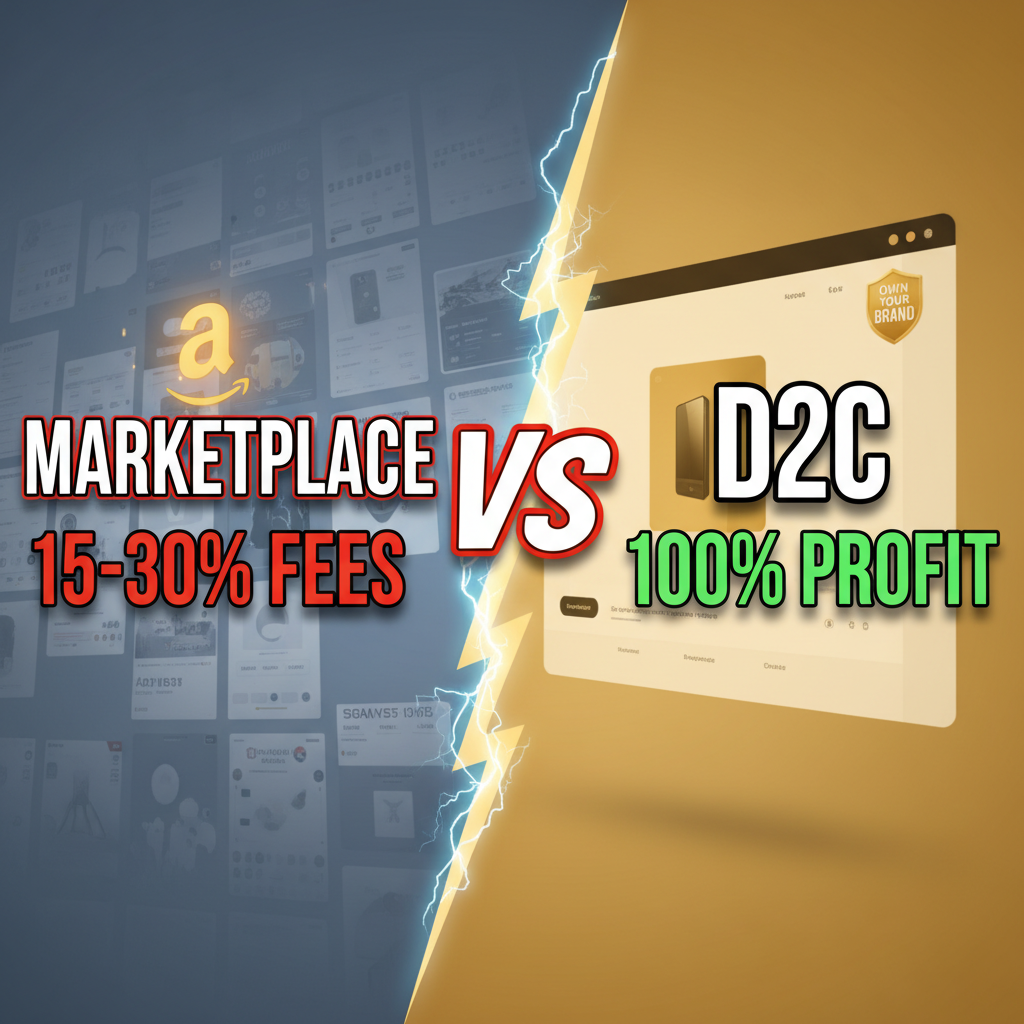
D2C vs Marketplace: The Real Financial Trade-Off
Most founders see this as binary: You either build a D2C brand on Shopify or you sell on Amazon.
That's wrong. The right answer is usually "both, but at different times for different reasons."
The confusion exists because D2C and marketplaces optimize for different variables: D2C optimizes for margin and customer lifetime value. Marketplaces optimize for velocity and reach. Neither is universally superior. They're different bets.
The Economics: Margin vs. Reach
Let's be concrete. You make a product that costs $15 COGS. You want to sell it for $45.
D2C Shopify Model:
| Expense | Cost |
|---|---|
| Cost of goods | $15 |
| Payment processing (2.9% + $0.30) | $1.40 |
| Shopify plan | $29/month (allocate per product) |
| Fulfillment (SFN or 3PL) | $3.00–$5.00 |
| Paid ads (Facebook/Google, assume 30% CAC ratio) | $9.00–$13.50 |
| Total cost per unit | $28.40–$34.90 |
| Revenue | $45 |
| Net margin | $10.10–$16.60 (22–37%) |
Amazon Marketplace Model:
| Expense | Cost |
|---|---|
| Cost of goods | $15 |
| Amazon FBA fees (15–45% for most categories) | $9.00–$20.00 |
| Payment processing (3.5% + gateway fee) | $1.88 |
| Total cost per unit | $25.88–$36.88 |
| Revenue | $45 |
| Net margin | $8.12–$19.12 (18–42%) |
Here's what jumps out: The margin bands overlap.
D2C doesn't automatically win on unit economics. Amazon's FBA fees are brutal, but they include logistics (picking, packing, shipping, returns). D2C requires you to replicate all of that. If you're using SFN, the cost profiles are similar.
The real difference isn't margin—it's customer acquisition cost (CAC) and repeat purchase rate.
The Acquisition Cost Divergence
On Amazon, you don't buy customers. Customers find you through search, categories, and recommendations. You can run sponsored ads on Amazon, but you're bidding in an auction where demand already exists.
D2C, you must build demand. You run Facebook ads, Google Shopping, TikTok, YouTube. Your CAC looks like:
- Early-stage D2C brand: $20–$40 CAC
- Mature D2C brand: $8–$15 CAC
For a $45 product with 22–37% margins, a $30 CAC is brutal. You need repeat purchases to make the math work. Your customer needs to buy 2–3 times to break even on acquisition.
Amazon flips this. You do pay for visibility (sponsored ads), but the base CAC is near-zero if customers search for your product category. If you sell "organic hair clips" and customers search "best hair clips," you appear in results. No ad budget required to earn that impression.
This is why Amazon works for commodity-adjacent products (vitamins, supplements, basic skincare, basic apparel). High search volume = low customer acquisition friction.
D2C works for premium, differentiated, high-loyalty products (luxury skincare, niche fitness, specialty food). You have a story, a community, a reason to ask customers to buy again.
The Three Decision Points
Decision 1: Are you selling something customers actively search for?
Yes: Start Amazon. Capture existing demand. Your job is to win a search result on page 1.
No: Start D2C. You need to educate and convert. Marketplaces can't do that—search volume doesn't exist yet.
Example: "Probiotic supplements" = high Amazon demand, Amazon wins. "Bioavailable supplement stacks optimized for cognitive function" = niche, needs education, D2C wins.
Decision 2: What's your gross margin?
Under 50%: Amazon might be your only option. Unit economics are too tight for D2C paid acquisition.
Over 50%: D2C becomes viable. You can afford paid customer acquisition and still hit profitability.
Example: Fast fashion reseller (25% margin) → Amazon only. Premium cold-brew coffee company (70% margin) → D2C only.
Decision 3: Can you sustain repeat purchases?
Yes (subscription, consumable, viral): D2C pays off. Your LTV/CAC ratio compounds over time.
No (one-time purchase, seasonal): Marketplace works better. You don't need repeat revenue; you need high velocity.
Example: Vitamins (consumable, 4–8 repeat purchases/year) → D2C ROI hits in 6–8 months. Novelty gift (one-time) → Amazon, capture searches, move inventory fast.
The Time-Sequencing Advantage
Most successful DTC brands do NOT start on Amazon. Here's why:
Year 1–2 (D2C only): You have no reviews, no social proof, no Amazon history. You get 30 impressions/month. Competing against established sellers is impossible. But on Shopify + paid ads, you can build a community, generate reviews, and prove product-market fit. You're also collecting first-party customer data.
Year 3+ (Add Amazon): You have 1,000+ reviews on Trustpilot. Your email list is 50K+. You've proven the product works at scale. Now you add Amazon. Amazon sees your external review velocity and social proof. They rank you higher. You win because you didn't start from zero.
The sequence matters: D2C first (build proof), then Amazon (leverage proof).
The opposite—starting on Amazon, then trying to launch D2C—is harder. You have no email list, no repeat customers, no brand loyalty. You're asking customers to trust you on a channel where you have no defensibility.
The Hybrid Game: FBA and Multichannel
Here's where it gets interesting. You can list your product on Shopify AND send inventory to Amazon FBA simultaneously. One inventory pool, two sales channels.
Pros: - Customers on both channels see you ship fast (FBA handles both) - You capture "searches" on Amazon, "ads" on D2C - Single fulfillment logistics (SFN or 3PL can send to Amazon FBA)
Cons: - No customer data from Amazon sales (Amazon owns the relationship) - Inventory tied up across both channels—forecasting complexity - You're paying SFN/3PL + Amazon FBA fees (2x logistics costs) - Returns management is fragmented (Shopify returns vs. Amazon returns)
This works if: - Your product has high velocity (you need inventory everywhere) - Your margins are fat enough to absorb 2x fulfillment costs - You have a team to manage dual inventory feeds
For most early-stage brands, it's overhead without upside.
The Data Ownership Asymmetry
This is the argument D2C evangelists always make—and it's real, but overstated.
On Amazon, you don't own customer emails. You can't email Amazon customers directly. Amazon owns that data.
On D2C (Shopify), you own customer emails. You can email them forever (compliance depending). You can sell them other products. You build an asset.
But here's the catch: D2C customer data only has value if you have repeatable products. If you sell one product once to each customer, your email list becomes a liability (high unsubscribe rates, low lifetime value).
If you sell consumables or subscription products, email data has 10X leverage. You can drive $5–$10 LTV per email on the list over time.
If you sell one-time novelty items, email data is worthless. Unsubscribe rates are 40%+.
Example: Athletic supplement brand (consumable) owns customer data = $1M+ in annual email revenue. Trendy fashion reseller (one-time) owns customer data = cost center.
The Maturity Model
Most successful brands follow this arc:
Stage 1 (Launch): D2C only. Prove the product. Build audience. Gather feedback.
Stage 2 (Traction, $500K+): Add marketplaces (Amazon, Etsy, maybe Faire). Leverage existing reviews and social proof. Capture adjacent demand.
Stage 3 (Scale, $5M+): Optimize channel mix. Some brands go 70% Amazon, 30% D2C. Others go 30% Amazon, 70% D2C. Depends on your category.
Stage 4 (Platform): Launch own ecosystem. Sell on own site + own marketplace + white-label to retailers. Full distribution.
When Marketplaces Become a Trap
Selling on Amazon at scale creates dependencies you can't escape:
- Amazon algorithm changes → your sales drop 50% overnight
- Amazon suspends your account for a policy violation → $500K inventory is locked up
- Amazon lowers your margins by 5% (they do this) → you can't compete elsewhere
Savvy founders use Amazon to validate and scale, but they're always building D2C as their hedge. The most resilient brands have 50%+ D2C revenue, not 100% marketplace dependency.
Ready to Optimize Your Channel Strategy?
D2C and marketplaces aren't mutually exclusive. The real skill is timing the transition from one to both. Tenten's e-commerce strategists can audit your product, margins, and customer base to design a multi-channel roadmap.
Editorial Note
The D2C vs. marketplace debate is really about risk and control. D2C is harder early but gets easier at scale. Marketplaces are easy early but harder at scale. The winning founders do both, at the right time.
Frequently Asked Questions
Can I sell the same product on both Shopify and Amazon simultaneously?
Yes, using multichannel fulfillment. One inventory pool ships to both channels. But manage inventory forecasting closely—overselling one channel starves the other.
What's a realistic CAC for D2C brands?
Early-stage (first 6 months): $20–$50. Mature (18+ months): $8–$15. As your brand builds social proof and repeats, CAC drops.
Should I start on Amazon or Shopify?
If your product is commodity-adjacent (vitamins, basics): Amazon. If your product needs brand storytelling: Shopify first. Most successful brands do Shopify first, then add Amazon.
What percentage of DTC brands should be on marketplaces?
3–6 months in, consider marketplaces if your gross margin exceeds 50%. Don't rush—focus on one channel until you have 100+ repeat customers and 4.5+ star reviews.
How do I choose between FBA vs. FBM on Amazon?
FBA (Fulfillment by Amazon): Pay higher fees, get Prime badge, less operational overhead. FBM (Fulfilled by Merchant): Keep more margin, manage your own fulfillment. If you use SFN, FBM is viable. FBA is easier but costlier.