Shopify Trust Signals: Reviews, Badges & Social Proof That Convert
Slug
shopify-trust-signals-reviews-badges-social-proof
Excerpt
Build customer trust with effective trust signals. Learn which reviews, badges, and social proof tactics actually drive Shopify conversions.
SEO Meta Data
- Title: Shopify Trust Signals: Reviews, Badges & Social Proof for Conversions
- Description: Strategic guide to trust signals on Shopify. Learn which reviews, security badges, and social proof tactics improve conversion rates and reduce friction.
- Canonical URL: https://tenten.co/shopify/shopify-trust-signals-reviews-badges-social-proof
Rich Text Content
The Trust Gap: Why Customers Don't Buy
A customer lands on your Shopify store. Your product is good. Your pricing is competitive. But they don't buy.
Why? They don't trust you yet.
Conversion obstacles:
- "Is this company real or a scam?"
- "Will I actually get my product?"
- "What if it's broken?"
- "Can I return it?"
- "What do other customers think?"
These aren't product objections—they're trust objections. Removing them increases conversion by 25-40%.
Trust signals are the invisible infrastructure that answers those questions without you having to write copy. They're the difference between a store that looks sketchy and one that feels established.
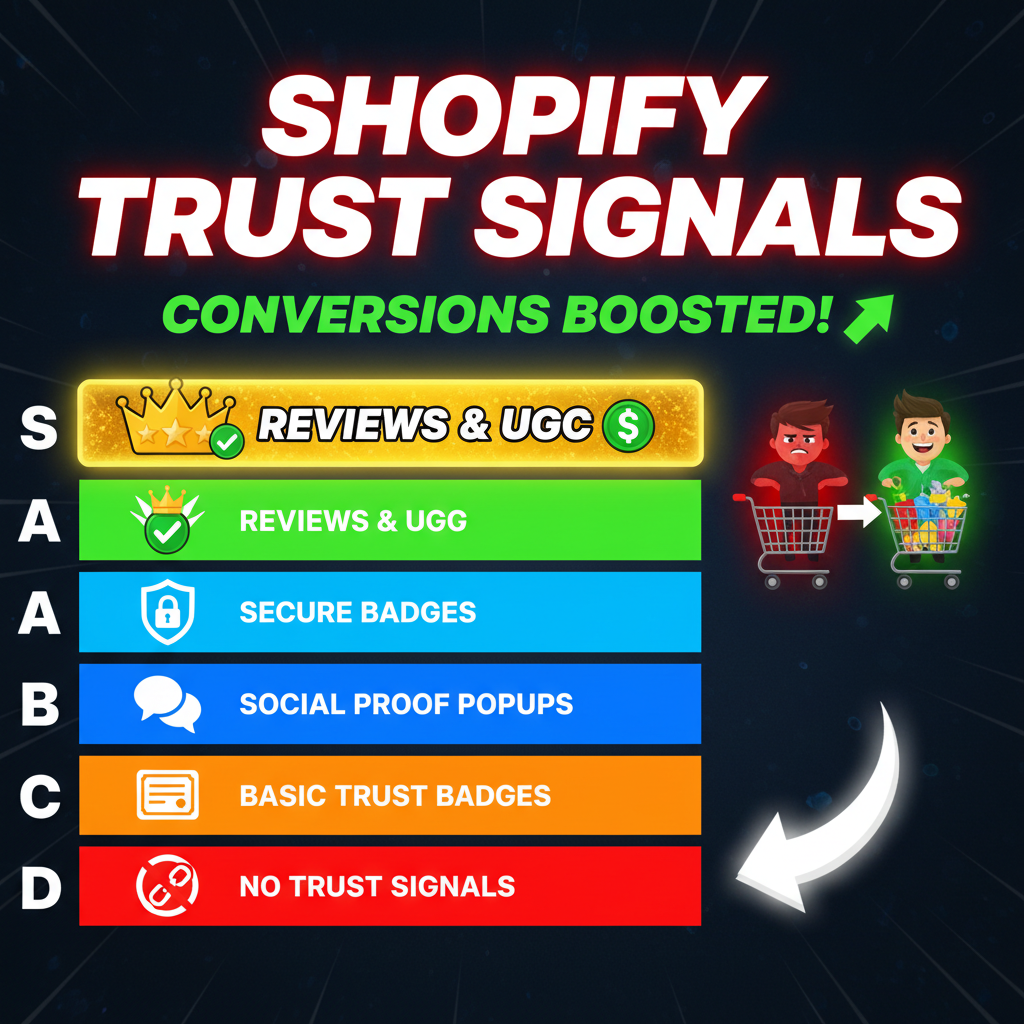
The Hierarchy of Trust: What Actually Works
Not all trust signals are equal.
Tier 1 (Essential—do these first):
- Product reviews (ideally >50, average rating >4.5 stars)
- Clear shipping + return policy
- Email contact + live chat
- SSL certificate (every modern browser shows lock icon)
Tier 2 (High-impact, medium effort):
- Trust badges (security seals, money-back guarantee, payment icons)
- Customer testimonials (video, not text)
- Social proof (follower count, press mentions, customer count)
- Detailed product descriptions (shows you care about quality)
Tier 3 (Nice-to-have, lower impact but builds authority):
- Case studies from known brands
- Industry certifications
- Awards or recognitions
- Founder story / "About Us" page
Focus on Tier 1 + Tier 2 first. Tier 3 is icing.
Product Reviews: The Single Most Important Trust Signal
Research shows: Products with 50+ reviews at 4.5+ stars convert 2.5X better than products with <10 reviews.
Why? Numbers signal legitimacy. Someone will always find a reason to doubt a single 5-star review. Fifty reviews is harder to dismiss.
The challenge: New stores have zero reviews.
Solution: Generate your first 50 reviews quickly (not through trickery—through strategy).
Month 1 strategy:
- Ship product
- Email post-purchase: "We'd love your honest review. Even if you had issues, feedback helps us improve." Include direct review link.
- Offer small incentive (optional): "Leave a review and get 10% off your next order." (Disclose the incentive—FTC requires it.)
- Follow up via SMS 1 week later with review link
Result: 10-15% of customers will review. If you sell 100 units, expect 10-15 reviews by week 2.
The speed win: Timing matters. Ask within 48 hours of delivery (before they forget the experience). Baymard Institute found 2X higher review rates when asked within 2 days.
Months 2-3: Accelerate with reviews app
Install Shopify reviews app (native) or third-party app like Loox, Yotpo, or Trustpilot.
These apps automate the ask:
- Email sequence (automatic 24, 48, 72 hours post-purchase)
- SMS reminders (higher click rate than email)
- Photo/video reviews (social proof on steroids—photos 3X higher conversion than text-only)
Typical performance with reviews app:
- 30-40% will see the request
- 5-10% will complete reviews
- 2-3% will include photos
Result: 200 orders in 90 days = 10-15 reviews (text) + 4-6 photo reviews = 14-21 rich pieces of social proof.
The psychology of display:
Where you show reviews matters.
Best placement:
- Product page (immediately under images, before "Add to Cart")
- Reviews section with photos (larger social proof)
- Average rating badge on collection pages (shows legitimacy)
- Customer testimonials on homepage (video reviews of top products)
Never bury reviews at the bottom. Put them where hesitation happens—right before the purchase decision.
Trust Badges: Which Ones Actually Work
Not all badges are equal. Some are snake oil.
High-impact badges:
- Security badges ("SSL Secure," "Norton Secured")
- Payment methods ("Visa," "Mastercard," "PayPal," "Apple Pay")
- Money-back guarantee ("30-day returns," "Satisfaction guaranteed")
- Industry certifications (if you have them—e.g., "Organic certified," "Fair Trade")
Low-impact or useless badges:
- "Eco-friendly" (unverifiable, generic)
- Random award badges (no one recognizes them)
- "Award winning" (requires context—which award? From whom?)
The test: If a customer doesn't immediately recognize what it means, it won't help.
Placement:
Put trust badges in 3 locations:
- Above the fold (top of homepage): Security + payment methods. Signals immediate trustworthiness.
- Product pages (near CTA): Security + money-back guarantee + payment methods. Removes friction right before checkout.
- Footer: All trust signals (security, payments, return policy link). Reassurance for skeptics.
The data:
Baymard Institute tested trust badge placement on e-commerce sites:
- No badges: 1.8% conversion
- Generic badges only: 2.0% conversion
- Relevant badges (security + money-back): 2.4% conversion
- +33% lift from strategic badge placement
Simple math: 1000 visitors, 1.8% baseline = 18 conversions. Add trust badges correctly = 24 conversions. For a store selling $50 products, that's $300 more per 1000 visitors.
Customer Testimonials: The Video Advantage
Text reviews work. Video testimonials work 4X better.
Why? Video is harder to fake. Seeing a real person saying "This product changed my life" carries weight that text can't match.
The challenge: Getting customers to record videos.
Solution: Make it easy. Pay them.
Video testimonial campaign:
- Email top customers (by LTV or satisfaction): "We'd love a 30-second video of you sharing your honest feedback. We'll send you a $50 gift card."
- Provide simple guide: "Record on your phone, say what you like, 30 seconds max."
- Upload to website and YouTube
- Use best ones on homepage and product pages
Cost: $50/video × 10 videos = $500 investment.
ROI: If each video increases conversion by 1% on your homepage, and homepage gets 500 visitors/day, that's 5 additional conversions per day. $50 products = $250/day incremental revenue. ROI breaks even in 2 days.
Where to use video testimonials:
- Homepage hero section (1-2 most compelling testimonials auto-playing)
- About page (founder + customer testimonials, builds credibility)
- Product pages (testimonials specific to that product)
- Testimonials page (all 10 videos in one place)
- YouTube channel (embed on homepage)
Social Proof: Numbers and Logos That Work
Social proof comes in three flavors:
1. Customer count:
"Trusted by 50,000+ customers" → signals scale and legitimacy.
Display prominently on homepage. Make it honest. Update it monthly.
2. Follower count:
On Instagram/TikTok, visible follower count signals authority. Higher follower count → higher willingness to try.
3. Press logos:
"Featured in Forbes," "As seen in TechCrunch" → signal mainstream recognition.
Only use if true. Baymard found fake press logos reduce trust (when discovered).
The risk: Overstating hurts. "Featured in Inc Magazine" when you submitted a guest post is misleading. Only include articles you actually appeared in.
Detailed Product Descriptions: Trust Through Transparency
A 50-word product description says "I don't care about quality."
A 500-word description that covers material, sizing, care instructions, and use cases says "I'm confident in what I'm selling."
Trust signals in product copy:
- Material specifications: "100% organic cotton, GOTS certified." (Not: "premium quality")
- Sizing guide: Include actual measurements + fit recommendations + return policy for sizing issues.
- Care instructions: How to wash, store, and maintain. Shows durability.
- Use cases: "Works for hot yoga, pilates, and casual wear." Helps customers envision themselves using it.
- What's included: Exactly what they receive: product, packaging, manuals, etc.
- Warranty: "Lifetime warranty on stitching, 90-day satisfaction guarantee."
- Environmental impact: "This product uses 30% less water to produce than industry standard." (Verifiable claims only.)
Example bad description:
"Amazing shirt. Premium fabric. Comfortable. Buy now."
Example good description:
"100% organic cotton pique polo. Machine washable. Fits true-to-size (see sizing chart). Pre-shrunk to eliminate fitting issues. Available in 12 colors. Made in Portugal. 30-day returns if it doesn't fit perfectly."
The second version removes 5 trust objections and answers questions before customers ask.
The Trust Roadmap: 90-Day Implementation Plan
Weeks 1-2:
- Install reviews app (Loox, Yotpo, or native Shopify)
- Email existing customers asking for reviews + photos
- Add trust badges to homepage and product pages
Weeks 3-4:
- Create video testimonial campaign
- Record 3-5 customer videos
- Reach out to 10 customers for additional testimonials
Weeks 5-6:
- Upload testimonial videos to website and YouTube
- Feature best testimonials on homepage and product pages
- Add customer count to homepage ("Trusted by X customers")
Weeks 7-8:
- Audit product descriptions
- Add detailed specs, sizing, care instructions to top 10 products
- Add warranty/guarantee info to product pages
Weeks 9-10:
- Monitor review volume
- Optimize testimonial placement based on which drives highest conversion
- Test badge variations (A/B test: badges vs. no badges)
Weeks 11-12:
- Document results (conversion lift %)
- Scale what works (more video testimonials if they drive conversions)
- Plan next phase (case studies, certifications if relevant)
The Metrics: What to Measure
Track these to know if trust signals are working:
| Metric | Target | Tool |
|---|---|---|
| Average product rating | 4.5+ stars | Reviews app |
| Review count per product | 50+ | Reviews app |
| Homepage conversion rate | +25% from baseline | Google Analytics |
| Product page conversion rate | +15% from baseline | Google Analytics |
| Cart abandonment rate | <70% | Shopify Analytics |
| Customer trust (qualitative) | Fewer "Is this real?" inquiries | Customer support inbox |
Set these targets at the start of your 90-day plan. Measure weekly. Adjust based on data.
Ready to Build Customer Trust at Scale?
Trust is the moat that protects your store from price competition and algorithm changes. Competitors can copy your prices. They can't copy the trust you've built.
If you want to systematize trust signals and optimize them for your Shopify store, schedule a consultation. We help brands build trust architecture that converts.
Editorial Note
This guide covers the trust signal hierarchy, placement strategy, and 90-day implementation plan. Includes Baymard Institute data on badge effectiveness and video testimonial ROI calculations.
Article FAQ
Q: Should I pay for customer reviews?
A: You can offer incentives (like a discount on next purchase) but must disclose it. You cannot pay for positive reviews only or hide the incentive. FTC requires transparency.
Q: How many reviews do I actually need?
A: 50 reviews at 4.5+ stars is the threshold where conversion lifts measurably. 100+ reviews signal serious scale. After 200+ reviews, diminishing returns (trust is already established).
Q: Are video testimonials worth the cost?
A: Yes. They drive 4X higher impact than text reviews. Cost is $50-100/video. If even one video generates 5 additional conversions per month ($250 revenue), it pays for itself monthly.
Q: Should I feature negative reviews?
A: No. Never cherry-pick negative reviews or emphasize them. But don't hide negative reviews entirely—people are suspicious of all-5-star products. Show honest reviews (including 3-4 stars) to look credible.
Q: What badges should a new store use if they don't have certifications?
A: Security badge (SSL), payment method icons, and money-back guarantee. Those three cover 80% of trust objections for new stores. Skip fancy badges until you've earned them.