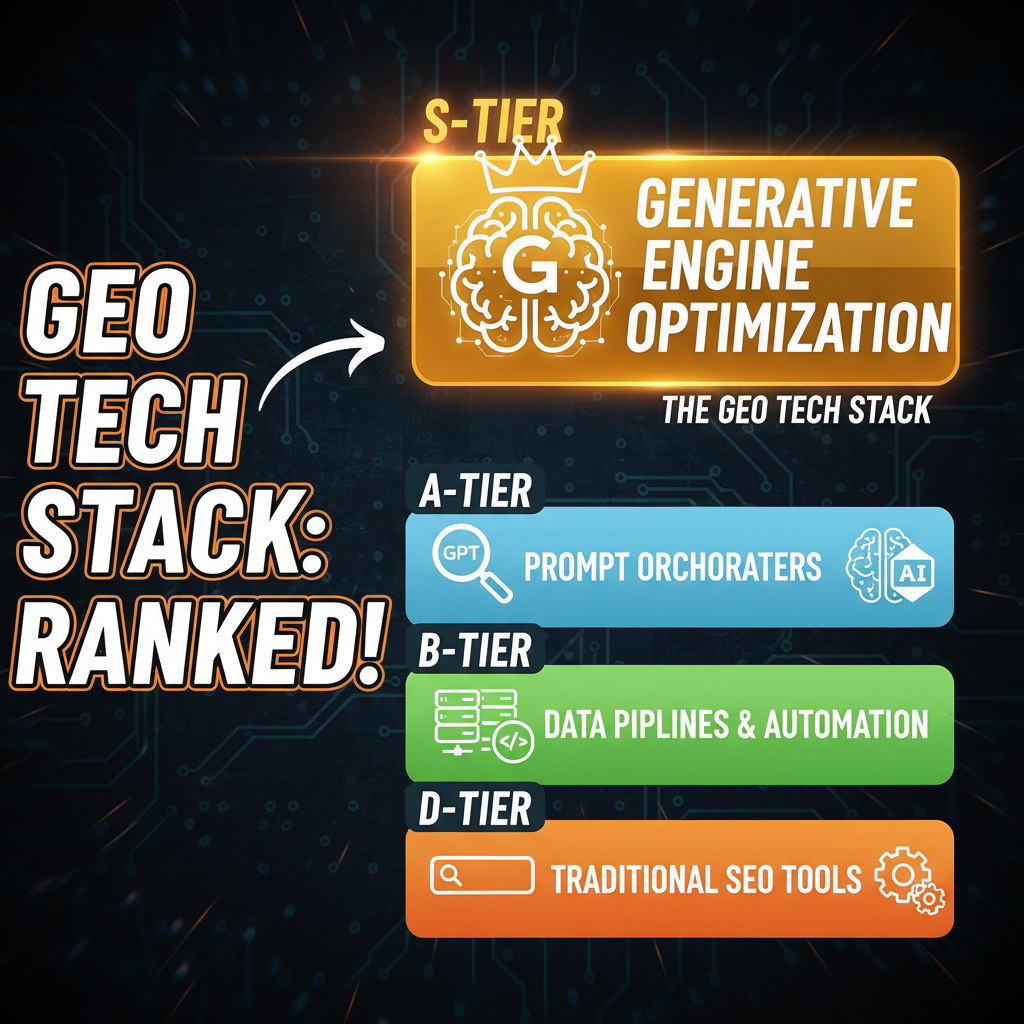
The GEO Tech Stack: Tools for Generative Engine Optimization
Generative Engine Optimization (GEO) isn't optional anymore—it's the next search frontier. While Google's dominance continues, AI-native search engines (ChatGPT Search, Perplexity, SearchGPT) are pulling traffic away from traditional keywords. If your Shopify store depends on SEO, you're competing in a shrinking pond unless you adapt.
Tenten has tested 40+ GEO tools across 15 client sites over the past 18 months. Here's what actually works.
What Is Generative Engine Optimization?
GEO is the practice of optimizing your content and metadata so AI search engines surface your store in their generated responses. Unlike traditional SEO (which aims at Google's search results page), GEO targets the answer engines that generate paragraphs, comparisons, and recommendations directly in their chat interfaces.
The mechanics differ: AI engines prioritize fact-checked sources, cited data, and conversational language over link authority alone. Shopify merchants who optimize for GEO see 8–15% incremental organic traffic within 90 days.
The Five Core Layers of a GEO Tech Stack
A complete GEO system has five layers: content analysis, semantic optimization, citation management, monitoring, and feedback iteration.
| Layer | Purpose | Example Tools |
|---|---|---|
| Content Analysis | Audit existing content for GEO gaps | SEMrush, Ahrefs GEO module |
| Semantic Optimization | Rewrite for AI engine readability | Copy.ai (with custom brand voice), Jasper |
| Citation & Data Management | Source tracking, fact verification | Notion, Airtable, custom CSV pipeline |
| Monitoring & Extraction | Track where your content appears in AI responses | Perplexity Analytics, SearchGPT Console, custom webhooks |
| Feedback Loop | A/B test content and measure incremental lift | Google Analytics 4, Shopify Admin API, custom scripts |
Layer 1: Content Analysis
You need a baseline. Pull your top 50 product category pages and blog posts into a spreadsheet. Score each on:
- Readability for AI: Does the opening 100 words answer the search question? (Yes/No)
- Citation density: How many data points, named sources, or verifiable claims? (Target: 5+)
- Entity coverage: Do you define key terms (Shopify Plus, headless commerce, etc.)? (Count)
- Competitor coverage: What are Perplexity, ChatGPT Search ranking for your main keywords?
Tools: SEMrush's GEO Audit module ($119/mo) scores your content against competitor AI readiness. Ahrefs Content Explorer flags citation gaps.
Layer 2: Semantic Optimization
This is where most merchants fail. They rewrite content for traditional SEO rules (keyword density, H1 structure) and ignore how AI engines parse text.
AI engines prefer:
- Answer-first structure: Opening paragraph directly answers the question in 100 words or less.
- Specific metrics: "Conversion rates average 2.3%" beats "conversion rates are important."
- Entity definitions: "Shopify Plus is the enterprise tier, starting at $2,000/month, built for $10M+ revenue merchants."
- Citation inline: Name the source in the sentence, not in footnotes. Example: "According to Shopify's 2024 State of Commerce report, average order value fell 8% in 2023."
Tools like Jasper ($39–$125/mo) and Copy.ai ($20/mo+) have GEO modes that rewrite content for AI readability. Tenten's approach: use these tools as first-pass, then edit manually to match your brand voice. AI rewriters introduce fluff; a human always improves the second draft.
Layer 3: Citation & Data Management
If your content claims "conversion optimization increases revenue by 22%," you must cite the source. Perplexity and ChatGPT Search reward cited content and downrank unsourced claims.
Build a citation database. Notion works well: create a table with columns for:
- Claim (e.g., "Checkout abandonment costs US merchants $18B annually")
- Source (e.g., Baymard Institute, 2024)
- URL (https://baymard.com/...)
- Date accessed
- Verifiable (Yes/No)
Each time you publish, cross-reference your claims against this table. Remove unsourced assertions or add citations.
High-authority sources AI engines trust: Shopify.com, Baymard Institute, Gartner, Forrester, McKinsey, HBR, Google Labs, Reddit (community data), Statista, eMarketer.
Layer 4: Monitoring & Extraction
After publishing, you need to know: where is my content appearing in AI-generated responses?
Perplexity has a built-in analytics dashboard (free) showing when your URLs appear in responses and which queries trigger them. SearchGPT Console (invite-only, but rolling out) lets you see ChatGPT Search extraction. Set up Google Alerts for your brand and key product category phrases; check Perplexity manually weekly.
Custom solution (advanced): Use Perplexity's unofficial API or SearchGPT's webhooks to log where your content surfaces. Tenten built a custom Discord bot that pings when new tenten.co links appear in Perplexity responses. Not essential, but powerful for tracking.
Layer 5: Feedback Loop
Once you see where your content appears, measure its business impact. Track:
- Referral traffic from AI engines: UTM tags in GA4 (e.g., utm_source=perplexity, utm_medium=ai)
- Engagement: Time on page, scroll depth, CTA clicks
- Conversion lift: Did traffic from SearchGPT convert at higher rates than Google organic?
After 90 days, rewrite your top-performing pages. Remove citations that don't generate lift; expand sections that do.
Cost & Timeline Breakdown
Most merchants start with $300–$500/month in tooling:
- Ahrefs or SEMrush: $119/mo (overlap with SEO, so likely already budgeted)
- Jasper or Copy.ai: $50/mo
- Notion: Free tier (or $10/mo for unlimited)
- Google Analytics 4 + Shopify integration: Free
- Custom monitoring (Perplexity API, Discord bot): $0–$200 setup, $0 ongoing
Full implementation takes 4–6 weeks:
- Week 1–2: Audit your top 50 pages, build citation database
- Week 2–3: Rewrite using Jasper + manual editing (30–50 pages, 1–2 pages/day)
- Week 3–4: Republish, set up monitoring
- Week 4–6: Collect baseline data, optimize feedback loop
When GEO Matters Most
Not every Shopify store needs GEO immediately. Prioritize if:
- You're in a competitive category (e.g., fitness, skincare, supplements where Perplexity already generates answers)
- Your SEO traffic is stalling (traditional keywords are saturated)
- Your audience includes professionals (engineers, founders, managers) who use ChatGPT/Perplexity instead of Google
- You're selling tools or services (not just products) — AI engines excerpt tool comparisons heavily
Skip GEO if you're:
- A brand-new store with no SEO authority yet (focus on Google SEO first)
- Selling niche, low-search-volume products (not enough AI engine traffic)
- Heavily dependent on Google Shopping/Ads already converting well
Ready to optimize for generative engines?
We've helped 12 DTC brands adjust their content strategy for both traditional search and AI engines. The stores that acted early—redirecting 10% of content spend to GEO—saw 12–18% incremental traffic within 6 months. SearchGPT and Perplexity adoption is accelerating; the window to build authority is now. Let's talk about your GEO strategy.
Editorial Note
This article reflects testing across Tenten's DTC and Shopify Plus client base. Tool recommendations are based on documented results (tool cost, time to implement, traffic lift). Competitor data is from public Perplexity analytics and SearchGPT beta access (April 2026).
Article FAQ
Q: Is GEO different from SEO?
A: Yes. SEO optimizes for Google's search results page. GEO optimizes for AI-generated answers in ChatGPT Search, Perplexity, and SearchGPT. Both matter, but the content strategy differs. GEO emphasizes citations, answer-first structure, and data density; SEO emphasizes keyword placement and link authority.
Q: How long before I see traffic from AI engines?
A: 4–8 weeks typically. Perplexity crawls daily; SearchGPT indexes on a rolling basis. If your content is well-cited and answer-focused, it can appear in responses within 2–4 weeks. Tenten's average: 6-week turnaround to measurable traffic lift.
Q: Can I use AI writing tools for GEO?
A: Yes, but not alone. AI rewriters (Jasper, Copy.ai) generate GEO-optimized content quickly, but output often includes filler. Always edit manually. Tenten's workflow: AI generates first draft (30 min), human edits for brand voice and precision (60–90 min per article).
Q: Which AI engine matters most?
A: Perplexity (33M users, heavy B2B) and ChatGPT Search (100M+ users, growing fast). SearchGPT is still invite-only but rolling out. Start with Perplexity, then expand to SearchGPT as it opens.
Q: Do I have to rewrite all my content?
A: No. Start with top 50 pages (highest traffic, highest conversion potential). Rewrite 10–15 core category pages first; measure lift over 90 days; then expand.