
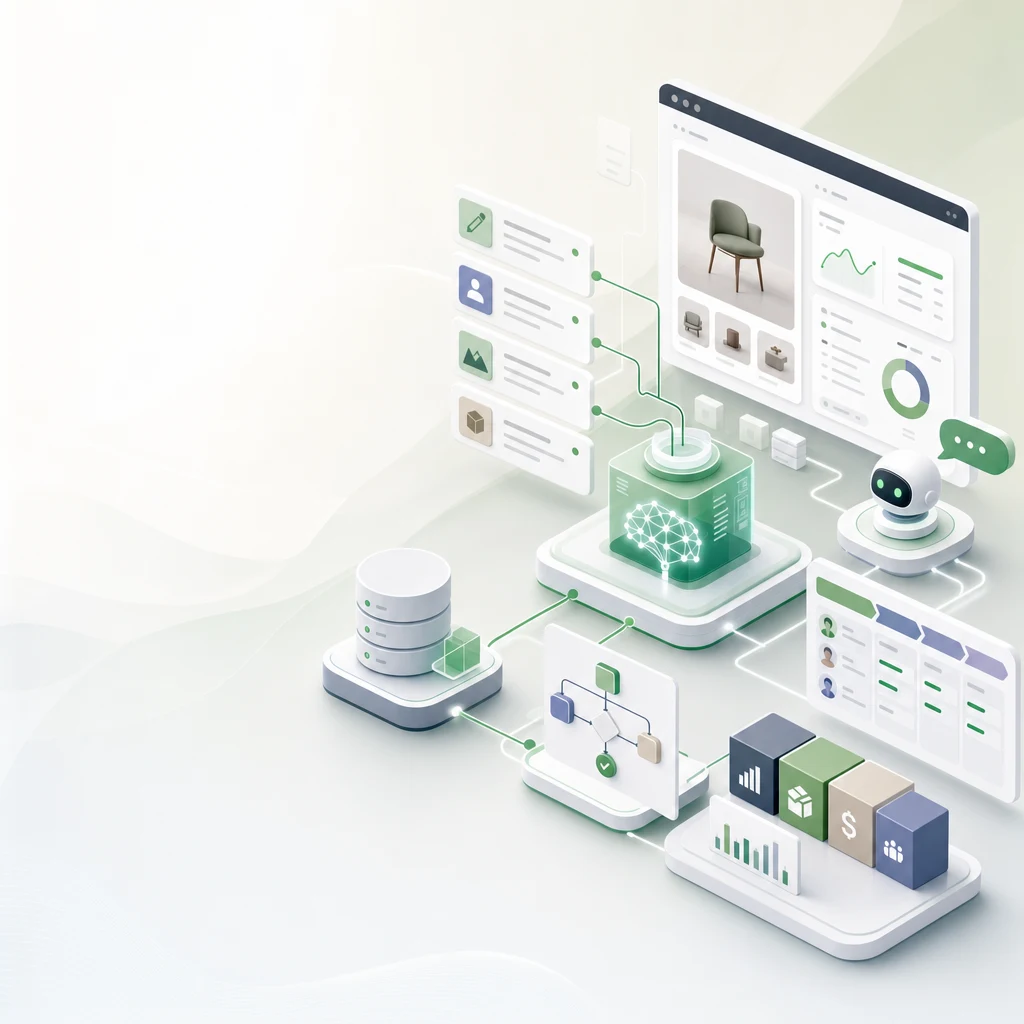
Shopify merchants and D2C operators are staring down a genuine inflection point: the AI-native CMS, CRM, PIM, and ERP platforms described below are no longer prototypes — they are in production at real companies, with funding rounds, GA releases, and community adoption to prove it. Here is a practical map of each category, what actually differentiates the leading platforms, and which stack makes sense at your stage.

What Makes a Platform Truly "AI-Native" (and Why It Matters for Merchants)
The phrase gets thrown around loosely, but three concrete capabilities separate AI-native systems from legacy tools with an AI chatbot bolted on.
Structured, Relationship-Aware Data
Traditional CMSes and ERPs store content and records as loosely connected blobs. AI can read the surface text, but it cannot reason about relationships, validate against business rules, or make schema-aware edits. Sanity CEO Magnus Hillestad framed the distinction at the company's March 2026 launch: "When content is modeled intentionally, with relationships, validation rules, governance, and real-time APIs, AI systems stop guessing and start reasoning." The same principle applies to CRM records in Attio and product data in Akeneo — structure is what makes AI output trustworthy rather than plausible-sounding.
Native MCP (Model Context Protocol) Support
Anthropic's open standard, released in late 2024, lets AI agents running inside Claude Code, Cursor, and v0 read and write directly against a system's internal data through a standardized interface. Sanity, Attio, and HubSpot's 2026 versions all ship MCP servers as a standard feature. CMS Critic reported hockey-stick adoption of Sanity's MCP server across its 1M+ users and 6,000 teams. For Shopify merchants building internal automation with Claude or Cursor, native MCP support eliminates a layer of custom integration work that would otherwise take weeks.
Agent Execution, Not Just Generation
The third capability is the one that changes daily operations. AI-native systems do not just draft copy — they take action. Attio's Ask Attio creates records, updates fields, and triggers workflows in plain English. Clay's Claygent navigates company websites, public databases, and gated forms autonomously. Odoo's January 2026 update lets AI agents ingest uploaded files and build analytical views directly. The practical test: can an external agent make a meaningful, schema-aware change to your data without a human clicking through a UI?
AI-Native CMS: From Content Management to Content Operating System
The CMS market in 2026 has split into two camps: open-source extensible application frameworks (Payload, Strapi, Directus) and enterprise SaaS orchestrators (Contentful, Kontent.ai, Sanity). Their AI strategies differ accordingly.
Here are the five platforms most frequently recommended in Reddit developer communities (r/nextjs, r/webdev, r/headlessCMS) throughout 2026:
| CMS | Core AI Capabilities | Pricing | Best Fit |
|---|---|---|---|
| Sanity | Content Agent (GA January 2026), MCP Server, Agent Context | Free tier; Growth $15/seat | Multi-brand, multi-country, bulk content operations |
| Payload CMS | SSO, AI Auto-Embedding, Visual Editor | Free open source; Payload Cloud separate | Next.js-native teams wanting full data ownership |
| Strapi | AI schema generation from Figma, screenshots, or text | Free open source; Cloud priced separately | Teams needing SQL-only architecture |
| Contentful | AI Actions for bulk localization, SEO, brand compliance | Enterprise pricing, high floor | Large global brands with complex localization |
| Hygraph | AI Assist, Translation Agent, Summarization Agent | API-usage based | GraphQL-native teams doing multi-channel distribution |
Sanity Content Agent in Practice
Sanity built Content Agent on Mastra runtime with Temporal and Redis. The team started with 35 tools in a single agent before experimenting with multi-agent designs, then pulled most capabilities back to the main agent after finding that sub-agents lost too much context — keeping sub-agents only for specific mutation work. During early access, over 40 organizations including Morning Brew, Complex, CoinDesk, and Braze used it for work that previously took days. One team tracked 111 articles needing topic updates in a spreadsheet; Content Agent returned 227 staged edits. Another ran 170+ threads transforming press releases into articles. A third coordinated link updates across 11 countries in a single 57-message conversation.
For Shopify merchants running content-heavy storefronts or multi-regional catalogs, the practical implication is that bulk editorial operations — seasonal copy refreshes, localization passes, SEO updates across hundreds of PDPs — become agent-executable rather than manually intensive.
Payload CMS for Shopify-Adjacent Builds
Payload is the community favorite on r/nextjs because it is Next.js-native, config-based, and database-agnostic (Postgres, MongoDB, SQLite). Microsoft, ASICS, and Blue Origin are public customers. If your Shopify store relies on a custom headless frontend or a companion editorial site, Payload's zero-license-fee model and tight Next.js integration make it the default starting point for developer-led teams.
Contentful took a different road, stopping its self-description as a headless CMS and repositioning as a Composable DXP or Content Operating System. Its AI Actions target enterprise-scale localization and translation — a different buyer than the developer-first Payload or Strapi user.
AI-Native CRM: From System of Record to System of Action
CRM is the category where AI has penetrated deepest. Legacy CRM is fundamentally a database plus UI that users maintain by hand. AI-native CRM automates the maintenance and actively moves deals forward.
| CRM | Core AI Capabilities | Pricing | Status |
|---|---|---|---|
| Attio | Ask Attio, AI Attributes, AI Workflows, MCP Server | Free (3 seats); Plus $29/seat; Pro $69/seat | $124M raised total |
| Clay | Claygent AI research agent, 150+ data source waterfall | Launch $185/mo; Growth $495/mo | Restructured pricing March 2026 |
| HubSpot | Agentic Engagement Object, Smart Deal Progression | Starter low; rises with seats | ~$35B market cap Q1 2026 |
| Salesforce | Einstein + Agentforce 3.0, 24/7 intent tracking | Bundled in higher tiers | Agentforce 3.0 announced March 2026 |
| Folk | AI enrichment, clean UI | SMB-priced below Attio | Niche for 20–50 person teams |
Attio vs. HubSpot: The Practical Trade-Off
Ask Attio is the feature most cited on Reddit and G2 in 2026. One G2 reviewer described the experience: the AI agent pulls data across multiple users' email in a workspace, researches a new company on entry, links the domain, and writes a description automatically. The same reviewer called out the Claude integration as smoother than the native UI. The main community complaint is workflow setup complexity — multiple G2 reviewers flagged that "setting up workflows is tricky the first time. Lots of documentation, but it still doesn't feel simple."
HubSpot's Spring 2026 release introduced the Agentic Engagement Object (AEO) as a new core data object, plus Smart Deal Progression. Futurum Group framed this as HubSpot's direct challenge to Salesforce, Microsoft, and Oracle. G2 reviews split on AI quality: automated email and meeting scheduling save real time, but Breeze's pipeline-depth analysis still feels thin compared to Salesforce Einstein.
For Shopify merchants running D2C with a wholesale or B2B channel, Attio's custom data model flexibility (investment pipelines, partnership trackers, and hiring funnels all fit the same schema) at $29–$69 per seat is often the better fit than HubSpot's more opinionated structure.
Clay is positioned differently — it is not a full CRM but a data enrichment and GTM workflow platform. Claygent visits company websites, scrapes gated forms, and queries 150+ data sources autonomously. In Clay's own case studies, OpenAI used Clay to double enrichment coverage from 40% to over 80%. The March 2026 pricing restructure collapsed the old Starter ($149), Explorer ($349), and Pro ($800) tiers into Launch ($185) and Growth ($495), with CRM sync, HTTP APIs, and Web Intent data moving from the $800 tier down to $495 — a material price cut for teams running integrated outbound.
AI-Native PIM: Preparing Product Data for AI Shopping Agents
PIM took on new strategic weight in 2026 for a specific reason: OpenAI's Agentic Commerce Protocol, launched with Stripe in September 2025, lets users browse and buy products inside ChatGPT. Walmart, Shopify merchants, and Etsy sellers have adopted it. Product data has evolved from an internal operations resource into the direct variable that determines whether AI agents can understand and recommend your products. Catsy's February 2026 report called this shift "machine-readable product content as a revenue channel."
| PIM | Core AI Capabilities | Pricing Range | Best Fit |
|---|---|---|---|
| Akeneo | GenAI content generation, automated data mapping, PX Insights | Community free; Growth/Enterprise ~$25,000+/year | 900+ global brands; fashion, luxury, manufacturing |
| Pimcore | Unified PIM+DAM+MDM+CMS+Commerce, open source | Community free; Enterprise custom | Dev-resourced enterprises (Pepsi, Sony, Audi) |
| Salsify | Enterprise PXM, strong in regulated industries | $2,500–$10,000/month | Fortune 500 with complex supply chains |
| Plytix | AI editing (1,000 free credits/month), Brand Portals | From $300/month | SMBs, Shopify merchants graduating from spreadsheets |
| Sales Layer | AI agents chaining up to 10 actions per workflow | 6-week implementation | Mid-to-large B2B manufacturers and distributors |
| Apimio | 30-minute setup, two-way Shopify sync, completeness scoring | From $49/month | Shopify merchants and SMBs |
The EU Digital Product Passport Factor
One structural driver no Shopify merchant buying PIM in 2026 can ignore: the EU's Digital Product Passport initiative. According to European Commission planning, traceability and sustainability data requirements will phase in across product categories between 2026 and 2030. For organizations running on fragmented or inaccurate product information, choosing the wrong PIM stops being an operations cost and becomes a compliance risk. Akeneo and Pimcore are the most commonly cited platforms for DPP readiness in enterprise procurement discussions.
Sales Layer is the most aggressive on the agent side. Its AI agents can chain up to 10 actions into a single workflow — content generation, translation, UNSPSC classification, and image enhancement in one pass. Most clients are operational within six weeks.
For Shopify-native merchants, Apimio's two-way Shopify sync and $49/month floor make it the lowest-friction entry point. Plytix is the next step up when Brand Portals and multi-channel distribution become priorities.
AI-Native ERP: From Transaction Ledger to Proactive Agent
ERP is the category where transformation has moved slowest, but 2026 brought the most new entrants. Incumbents (NetSuite, SAP, Microsoft Dynamics 365, Workday, Oracle) are bolting AI layers onto existing products. A crop of AI-native startups that emerged through 2025 is targeting the gap where NetSuite is too expensive, too slow to deploy, and too hard to implement.
| ERP | Core AI Capabilities | Pricing / Funding | Positioning |
|---|---|---|---|
| NetSuite (Oracle) | SuiteAI: transaction matching, anomaly detection, predictive forecasting | Base ~$999/month + $99–$199/user + $75K–$250K implementation | Mid-market to enterprise default |
| SAP S/4HANA | SAP Business AI: forecasting, invoice capture, process simulation | Enterprise; multi-million-dollar contracts | Global large enterprise, regulated industries |
| Microsoft Dynamics 365 | Copilot integration, Power BI, document summarization | Per-seat | Companies already on Microsoft stack |
| Odoo | Document OCR, predictive lead scoring, AI agents with file upload, Ask AI | $7–$31/user/month (Community free) | SMBs, startups, customization-heavy use cases |
| Rillet | AI agents automating journals, accruals, reconciliations; Smart GL; zero-day close | $70M Series B (August 2025, a16z, Sequoia, ICONIQ) | VC-backed startups, pre-IPO, SaaS subscription models |
| Campfire | Ember AI agent, unified GL as single system of record | $100M raised across Series A and B in 2025 | Early growth-stage tech companies |
| Doss | AI-native inventory management layering on top of existing ERP | $55M Series A, March 2026 | Physical-goods companies, NetSuite alternatives |
| DualEntry | AI-assisted intercompany allocations, automated consolidation | Weeks-level implementation | Mid-market NetSuite alternative |
Odoo for Shopify Merchants
Odoo's AI strategy matters most for US SMBs because the pricing ($7–$31/user/month) runs less than a tenth of NetSuite. The January 2026 update lets AI agents build analytical views grouped by day, month, quarter, or year. Braincuber's US deployment data showed this feature alone saves roughly 3–5 hours per week in dashboard maintenance for finance teams running multi-entity reporting. Odoo 20 is scheduled for September 2026, positioned as a major leap in agentic AI workflows.
Rillet, Campfire, and Doss: The New Wave
Rillet and Campfire both raised $100M in 2025, both have 90–120 employees, and both target companies that have outgrown QuickBooks but are not ready for NetSuite. The difference is focus: Rillet emphasizes accounting control and reporting rigor (the founding team includes former EY controllers and ex-auditors), while Campfire takes a broader operational-data angle with Ember AI unifying the general ledger.
Doss took a third path. Instead of rebuilding the whole ERP, it layers AI-native inventory management on top of whatever ERP already exists. Doss co-founder Wiley Jones was candid in a TechCrunch interview in March 2026: his read on the mid-market fight is that the winner will be whoever rebuilds architecture to be most legible to agents. For Shopify merchants managing physical inventory across multiple warehouses or 3PLs, Doss represents a lower-disruption path than a full ERP migration.
Four Recommended Stacks by Company Stage
Software choices do not make sense without stage context. Here are four stack recommendations drawn from Reddit, G2 community feedback, and enterprise software decision surveys.
Seed / Early-Stage (Under 10 People, Revenue Under $1M)
- CMS: Payload CMS (self-hosted, Next.js-native) or Sanity free tier
- CRM: Attio free tier (up to 3 seats) or Folk
- PIM: Plytix or Apimio (if ecommerce)
- ERP: Odoo Community free edition
Total monthly cost under $100 is achievable. Payload and Odoo are both open source with zero license fees, Attio's free tier covers the core, and Apimio's $49/month floor is realistic at this stage.
Series A to B Growth Stage (10–50 People, Revenue $1–10M)
- CMS: Sanity Growth ($15/seat) with Content Agent enabled
- CRM: Attio Pro ($69/seat) or Clay Launch ($185/month) as a CRM accelerator
- PIM: Akeneo Growth or Sales Layer (for complex product mix)
- ERP: Rillet or Campfire (SaaS / subscription businesses); Odoo Enterprise (physical goods)
The priority here is scalability over cost minimization. Rillet's early 2026 customer cases showed zero-day close, which works as a material value driver for IPO-track startups.
Mid-Market (50–500 People, Revenue $10–100M)
- CMS: Sanity Enterprise with MCP Server, or Contentful Enterprise
- CRM: HubSpot Enterprise (Spring 2026 AEO) or Salesforce + Agentforce
- PIM: Akeneo Enterprise or Pimcore (if you need unified PIM+DAM+CMS)
- ERP: NetSuite (the default) or DualEntry (AI-native alternative)
Mid-market typically runs a hybrid stack: SaaS CMS for operational simplicity, CRM integrated deeply with marketing automation, ERP that can handle global multi-entity consolidation.
Enterprise (500+ People)
- CMS: Sanity (strongest for bulk content operations) or Contentful Enterprise orchestrator
- CRM: Salesforce + Agentforce (deep customization) or HubSpot Enterprise
- PIM: Salsify, Pimberly, Inriver, or Stibo Systems
- ERP: SAP S/4HANA, Oracle Fusion Cloud, or NetSuite (multi-entity)
Options narrow at this scale because compliance, localization, and cross-border complexity outgrow smaller vendors. The decision criterion stops being price and starts being "how deeply can AI agents integrate with existing workflows."
Key Takeaways
The single most important shift in stack evaluation for 2026 is this: the question has moved from "what can this system do" to "what can this system let my AI agents do." A CMS without structured schema will only ever produce shallow summaries regardless of how sophisticated the AI layer appears. A CRM that cannot expose MCP endpoints forces every automation through brittle custom integrations.
For Shopify merchants specifically, the practical priorities are: choose a PIM that produces machine-readable product content now that AI shopping agents are a live commerce channel; evaluate ERP options against Odoo before defaulting to NetSuite at ten times the cost; and treat native MCP support as a non-negotiable criterion for any CMS or CRM you plan to use with Claude, Cursor, or ChatGPT over the next 12 months. The "buy insurance" pattern that dominated software procurement for the last several years has become a financial drag — the AI-native era rewards operable depth over feature breadth.