The Discount Trap
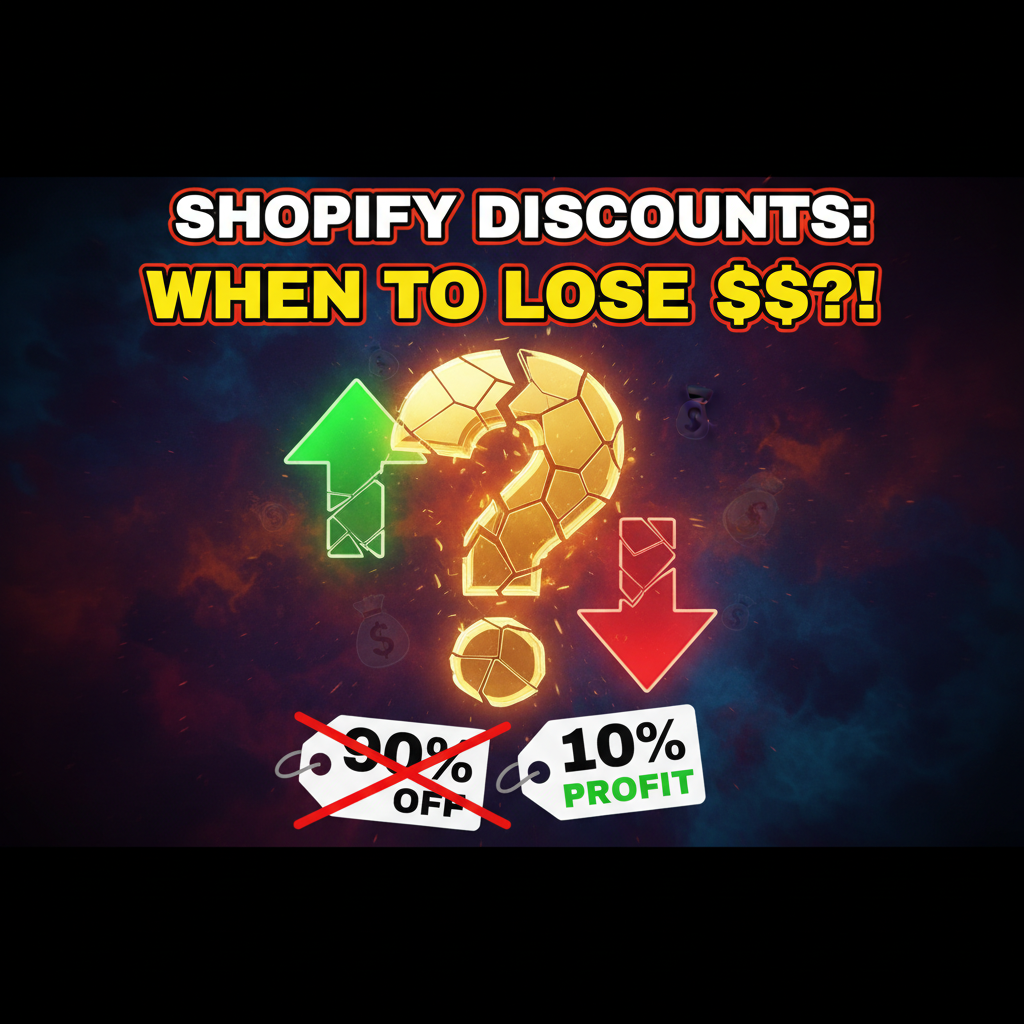
Here's the uncomfortable truth: most Shopify merchants are addicted to discounting, and it's destroying their businesses.
The pattern goes like this:
- Launch without discounting. Conversion rate is 1.5%
- Run a "20% off" sale. Conversion jumps to 3.2%
- Remove the discount. Conversion drops back to 1.8%
- Panic. Run another sale.
- Repeat until margins are razor-thin and customers expect perpetual discounts.
This is margin suicide.
A $5M DTC brand we worked with was running discounts 40% of the year. They blamed low conversion rates. The real problem: customers weren't buying at full price because they'd been trained to wait for sales.
We eliminated all discounts except two strategic promotions (Black Friday, customer-appreciation in Q3). Conversion at full price increased 40%. Revenue per customer went up 65%. Operating margin improved from 8% to 22%.
That's not luck. That's discipline.
The Economics of Discounting
Let's say you sell a $100 item with a 50% cost:
Full Price (No Discount):
- Price: $100
- Cost of goods: $50
- Gross margin: $50 (50%)
- At 2% conversion, 100 visitors = 2 sales = $100 revenue, $100 gross profit
20% Discount:
- Price: $80
- Cost of goods: $50
- Gross margin: $30 (37.5%)
- To match $100 revenue, you need 1.25 sales
- To hit 1.25 sales from 100 visitors, conversion must be 2.5%
- Most merchants see conversion increase to ~2.7-3.0%, so they gain ~$80 extra revenue but lose $20 in margin per sale
- Net impact: +0 to +$20 revenue at significantly lower margin
The math is cruel. A 20% discount requires a 33% increase in conversion just to break even on dollars. Margins crater even if units sold go up.
When Discounting Actually Works
Discounting isn't always bad. But it only makes sense in specific contexts:
Scenario 1: You Have Excess Inventory
If you over-ordered and have dead stock, discounting clears it. The alternative—sitting on inventory for another season—costs warehouse fees, ties up capital, and risks obsoletion.
Discount the excess, take the margin hit, and move on. But this is damage control, not a growth lever.
Scenario 2: You're Trying to Acquire a New Customer Cohort
First-time buyers have high friction. They don't trust your brand. A small discount (10-15%) can reduce psychological barriers.
Key constraint: Only discount for new customers, not repeat buyers. Use Shopify's customer segmentation to apply the discount only to first-time purchasers. Existing customers who've already overcome the trust barrier will pay full price.
Scenario 3: You're Competing in an Absolute Commodity Category
If you're selling identical products to competitors (i.e., everyone has the same supplier, same specs), price is your only differentiator. Discounting is rational.
But be honest about this: if your product is truly commoditized, your unit economics are thin, and you'll never build a defensible business. Consider repositioning or exiting.
Scenario 4: Specific Seasons or Events Justify a Discount
Black Friday, Cyber Monday, Boxing Day, customer-anniversary sales—these are moments when customers expect discounts. Running them is table stakes.
The rule: cap discount promotions to 4-6 times per year. More frequent discounting trains customers to wait.
The Real Lever: Price Optimization, Not Discounting
Instead of discounting, optimize your prices.
Strategy 1: Segment Your Catalog by Price Elasticity
Not all products have the same demand sensitivity to price. Some customers are inelastic (they don't care about price). Others are hyper-elastic (they bolt at a $5 increase).
| Product Type | Price Elasticity | Pricing Approach |
|---|---|---|
| Luxury/premium (brand, limited edition) | Low (inelastic) | Premium pricing, no discount |
| Fast-fashion (trending, seasonal) | Medium | Modest price increases, rare discount |
| Commodity (commodity bulk items) | High (elastic) | Thin margins, compete on efficiency |
| Services/bundles (add-on value) | Very low | Aggressive bundling, upselling |
A premium apparel brand should never discount signature pieces. Fast fashion can afford quarterly clearances. Commodity items need razor-thin operations.
Strategy 2: Implement Dynamic Pricing (Carefully)
Some Shopify apps allow dynamic pricing based on:
- Inventory levels (increase price as stock runs low)
- Demand (increase price as demand rises)
- Competitor pricing (undercut by 5%)
- Time (weekend vs. weekday pricing)
Dynamic pricing can increase revenue 8-15% without changing volume. The catch: it requires technology and customer trust. If customers discover they paid different prices, resentment grows.
Use dynamic pricing for:
- Perishable or seasonal goods (flowers, holiday items)
- Digital goods or services
- B2B sales with negotiation
Avoid it for:
- Luxury/premium brands (damages trust)
- Small catalogs (customers will notice variation)
Strategy 3: Use Bundling Instead of Discounting
Customers perceive bundles as discounts but you preserve margins.
Example:
- Single item: $50
- Bundled with complementary product (cost $12): Bundle price $65
Perceived discount: "Buy two get one at 30% off" = feels like a deal.
Actual margin: You're up $27 compared to selling one item at full price.
Bundles work because they:
- Increase average order value
- Reduce return rates (customers feel they got a deal)
- Clear slow-moving inventory alongside bestsellers
- Introduce customers to new products
The Pricing Decision Framework
Here's the decision tree Tenten uses with clients:
Start: Are conversion rates sub-1.2%?
→ Yes: Test price reduction, but do it systematically. Drop price 5%, measure conversion impact over 2 weeks. If conversion increases 10%+ in volume, keep the new price. If not, revert. Don't discount; just optimize the price point.
→ No (1.2%+ conversion): Do NOT discount. Instead, invest in:
- Copywriting and product photography (higher perceived value)
- Paid ads targeting high-intent audiences
- Upselling and bundles
- Customer reviews and testimonials
Secondary: Do you have excess inventory?
→ Yes: Run a time-limited clearance. Mark it "End of Season" to signal it's not a regular promotion. Clear inventory within 2 weeks.
→ No: Skip the discount.
Tertiary: Is this a critical customer acquisition moment?
→ Yes (new product launch, new market): Offer a first-purchase discount (10-15%) only to new customers. Exclude repeat buyers.
→ No: Don't discount.
Tenten's Pricing Optimization Playbook
We don't ask clients to discount. We help them capture more revenue at full price:
-
Map willingness to pay. Use tools like Van Westendorp Price Sensitivity Meter to understand what customers will actually pay. Often, brands discover they're priced 10-20% below market.
-
Test price increases. Increase price 5-10% on low-velocity items first. Measure impact. Most merchants lose <5% volume for 5% price increase = net positive revenue.
-
Build social proof. Reviews, testimonials, and user-generated content reduce price sensitivity by 15-25%. Invest here instead of discounting.
-
Create scarcity. "Only 3 left" or limited-edition releases create urgency without discounting. Behavioral economics shows scarcity increases conversion 20-30%.
-
Implement loyalty programs. Offer points, member-exclusive access, or early-release perks instead of discounts. This increases repeat purchase rate without margin erosion.
-
Optimize product positioning. Position products against the "aspiration value" they provide, not the cost. Instead of "Sale: 20% off", it's "Elevate your morning routine for under $100."
Red Flags: When You're Discounting Too Much
- Customers never buy at full price
- You're running sales more than 2 weeks per month
- Your margin profile has declined >3% in the past year
- Repeat customer purchase frequency hasn't increased
- Customer lifetime value (LTV) is decreasing
- Cashflow is tight despite high revenue
If any of these apply, you're in the discount trap.
Learning from Competitors
Look at how premium brands handle discounting:
- Apple: Zero discounting except EOL clearance. Maintains 38% gross margin.
- Nike: Limited seasonal sales (Black Friday, year-end). Average discount: 15-20%. Gross margin: 47%.
- DTC standouts (e.g., Allbirds): Strategic seasonal sales only. Heavy focus on premium positioning and community building. Margins maintained at 60%+.
Meanwhile, fast-fashion brands like Shein discount perpetually and operate on margins under 15%. Shein's business only works at massive scale with logistics efficiency.
Which playbook fits your store?
Key Takeaways
Discounting feels like growth but it's often margin erosion disguised as volume. The merchant that doesn't discount usually wins.
Instead, focus on:
- Optimizing price points to actual demand
- Investing in brand and positioning
- Using bundles and scarcity instead of discounts
- Limiting discounts to 4-6 strategic moments per year
If you must discount, make it systematic, time-limited, and segment-specific. Otherwise, embrace full price and let product quality and brand trust do the heavy lifting.
Frequently Asked Questions
What's the minimum discount that moves the needle?
A 10-15% discount typically shows measurable conversion lift. Below 10%, most customers don't register the discount. Above 25%, you're eroding margins significantly.
Should I discount for email subscribers?
Use a first-purchase discount (10-15%) to convert newsletter signups into customers. But don't offer discounts to existing subscribers—they've already proven intent.
How do I test if a price increase is sustainable?
A/B test a 5% price increase on a subset of products. Monitor conversion rate and revenue for 2 weeks. If revenue increases (even if volume dips 3-5%), the increase is sustainable.
What's the right discount frequency?
4-6 major promotions per year (Black Friday, Cyber Monday, customer appreciation, seasonal clearance, two ad-hoc). More frequent discounting trains customers to wait.
Should I match competitor pricing?
If competitors are discounting heavily, don't follow. Instead, differentiate on quality, brand, or service. Price-matching commoditizes your business.
How do I stop the discount habit if customers expect it?
Gradually reduce frequency. If you're discounting monthly, move to bi-monthly, then quarterly. Simultaneously invest in brand, reviews, and positioning so customers perceive value at full price.
Is a bundle the same as a discount?
Economically no—bundles preserve or increase margin. Psychologically yes—customers perceive bundles as deals. Use bundles instead of discounts whenever possible.
What's the best discount strategy for new customer acquisition?
Offer first-purchase-only discounts (10-15%) via email or paid ads. Exclude existing customers. This reduces acquisition cost without devaluing your product to repeat buyers.