Why Single-Currency Stores Leave Money on the Table
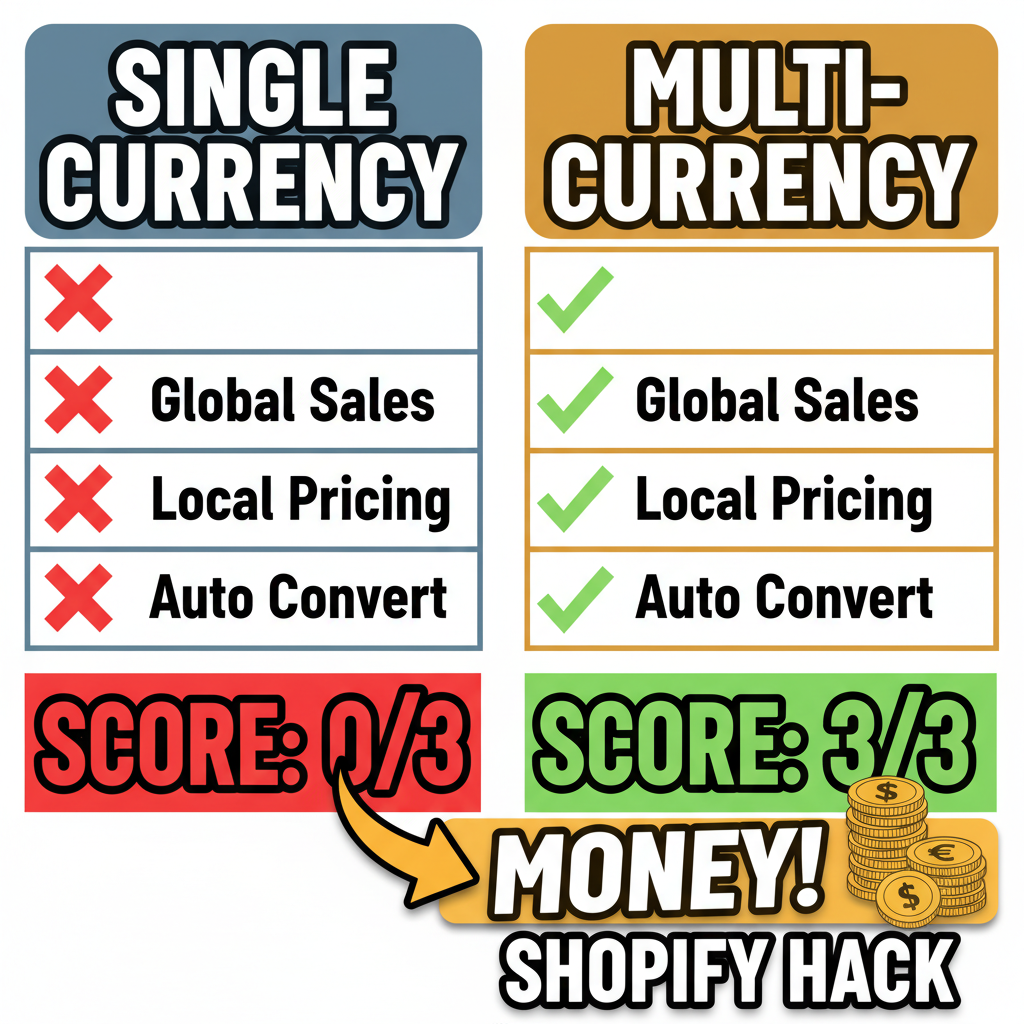
An Australian customer lands on your USD-priced store. They see $50. They don't convert that to AUD in their head—they feel friction. The conversion effort adds 200ms to their decision. That's enough to bounce.
So they leave and buy from a competitor that shows AUD pricing.
This isn't theoretical. Forrester research shows that 59% of consumers prefer shopping in their native currency. eMarketer data: when stores offer local currency, international conversion rates increase 12–18%.
But here's the hidden cost that most brands miss: exchange rate friction. Your $50 USD product costs $75 AUD today. Next week, the AUD drops. It costs $73. Your customer expected to pay $75 but gets a discount. Great for them. Terrible for your margin predictability.
Smart brands solve this with dynamic pricing. Not just exchange rates—but strategic pricing that locks margins while respecting local purchasing power.
Shopify Markets: The Foundation
Shopify Markets is your base layer. It handles multi-currency setup in one place.
What Markets does: 1. Detects customer location (IP-based, GeoIP) 2. Shows native currency prices automatically 3. Handles currency conversion on Shopify's backend 4. Localizes payment methods (Klarna in Sweden, WeChat Pay in China, etc.)
What Markets doesn't do: - Dynamic pricing strategy (you have to set it) - Tax calculation by region (you configure tax rules, but Markets doesn't guess) - Shipping rate optimization (you set rates; Markets applies them)
Setup is straightforward: 1. Go to Settings → Markets 2. Add target markets (e.g., Canada, UK, Australia, Japan) 3. Choose published status (published = visible to customers in that region) 4. Set currency (auto-populated based on market selection)
That's it. Shopify handles the rest.
But here's where most brands stop, and where the real opportunity lives.
The Pricing Strategy Layer (Where Margins Win)
After you set up Markets, you need pricing strategy. This is the difference between breaking even and printing profit.
Three approaches:
Approach 1: Direct Exchange Rate (Naive)
USD price $100 → Convert to GBP at current rate (1 GBP = 1.27 USD) → GBP 78.74.
Pros: Logically simple. Cons: Margins compress as exchange rates fluctuate. Customers in weak-currency markets (emerging markets) see inflated prices.
Example: Your 50% margin in USD (cost $50, sell $100) becomes 40% margin in a currency with 10% exchange volatility.
Don't do this.
Approach 2: Margin-Locked Pricing (Better)
Calculate the price in each market that preserves your target margin.
Steps: 1. Define target margin: 50% (COGS $50, margin $50 on $100 sale) 2. For each market, determine local purchasing power adjustment 3. Set price to lock that margin
Example: - USD: $100 (cost $50, margin $50) - GBP: £65 (at current rates, £65 ≈ $82, cost £41, margin £24 = ~$30 USD equivalent)
Wait, that margin shrank. Let me recalculate...
Better approach: - USD: $100 MSRP, $50 COGS, $50 margin (50%) - GBP: Set GBP price so margin = £25 (matching 50% margin structure) - £25 target margin ÷ 0.5 margin % = £50 total price (cost £25) - Convert to GBP based on cost: cost $50 USD × (1 GBP/1.27 USD) = £39.4 + 25% buffer = £49.25 (round to £49)
So £49 in GBP ≈ $62 USD (not $100). But it preserves margin structure.
The principle: margin % > absolute currency value.
Approach 3: Dynamic Pricing (Advanced)
This is where data-driven brands live. You set different prices per market based on: 1. Local purchasing power 2. Competitive benchmarks in each market 3. Elasticity of demand (price sensitivity by market) 4. Currency volatility
Example matrix:
| Market | Price | Purchasing Power Index | Margin % | Elasticity |
|---|---|---|---|---|
| USA | $100 | 1.0 (baseline) | 50% | 0.8 |
| Canada | CAD $125 | 0.92 | 48% | 0.85 |
| UK | £65 | 1.1 | 52% | 0.75 |
| Australia | AUD $155 | 0.85 | 45% | 0.9 |
| Japan | ¥12,500 | 0.75 | 42% | 0.7 |
What's happening here? - USA: baseline, full margin - Canada: slightly lower purchasing power → lower margin tolerance → price in CAD reflects that - UK: higher purchasing power → can support 52% margin → price GBP accordingly - Australia: lower purchasing power → accept 45% margin to stay competitive - Japan: lowest index → accept 42% margin, but lower elasticity (customers less price-sensitive) → still sell
This is complex, but tools like Shopify's Pricing Manager or Pricer can automate it.
The Pricing Psychology Angle
This is subtle but powerful. Research by Baymard Institute shows that currency display order matters.
Bad: "This costs $100 USD or £65 GBP or ¥12,500 JPY" - Customers see multiple prices and compare. They mentally convert. Friction.
Good: Show only the price in their detected currency. - A UK customer sees £65. That's it. No conversion effort.
Better: Show price + shipping cost before they add to cart. - A UK customer sees £65 + £8 shipping = £73 total. - Transparency reduces checkout abandonment by 8–10%.
Best: Psychological pricing conventions per market. - USA: $99 (charm pricing, psychologically feels cheaper than $100) - UK: £49.99 (same convention) - Germany: €89 (Germans prefer round numbers; €89 vs €89.99 shows respect) - Japan: ¥12,500 (no cents; bulk pricing feels fair)
Yes, this is real. Adapt pricing format to cultural norms. It works.
Currency Conversion on Checkout
When a customer in Japan (expecting JPY) adds your product to cart, what happens?
Option 1: Shopify Payments handles it - Customer is charged in JPY at Shopify's conversion rate - Shopify takes 1.5% currency conversion fee - You receive USD in your settlement
Option 2: Third-party payment processor (Wise, OFX) - Better rates (1% vs 1.5%) - More transparent - Requires integration
For most brands: Shopify Payments is fine. 1.5% fee on ~5–15% of transactions (the % that's truly cross-currency) is acceptable.
Track this. If 40% of your revenue is international, and 1.5% goes to currency fees, that's $1,800 on $100K revenue. Not huge, but worth exploring alternatives if volume is high.
Tax Complexity at Scale
Here's where international multi-currency gets hairy.
If you're selling to Japan, you might owe Japanese consumption tax (10%). If selling to EU, you might owe VAT (17–27% depending on country). If selling to Canada, GST/HST applies.
Shopify Markets doesn't automatically collect or file taxes. You set rules.
Simple approach (for low-volume sellers): - Add tax on a per-country basis in Shopify settings - Collect tax from customers at checkout - File taxes manually (usually quarterly or annually)
Enterprise approach (for high-volume sellers): - Use a tax software like TaxJar or Avalara - Connects to Shopify, auto-calculates tax by country/state/region - Generates filing reports
Most sellers under $500K international revenue manage manually. Over that, automate.
Shipping Strategy for Multi-Currency
This is where unit economics really matter.
The trap: You set a flat shipping rate (e.g., $15 USA, £8 UK). But USD/GBP exchange rates vary. Some days your margin on shipping is 60%. Other days it's 35%.
The solution: 1. Calculate shipping cost per shipment (weight, distance, carrier) 2. Add 30–50% markup for handling and packaging 3. Set shipping rates to cover 100% of that
Example: - USPS to Japan: $18 cost + $5 handling = $23 - Show customer: $25 shipping (2% buffer) - Cost: $23, Revenue: $25, Margin: $2 per shipment
This is thin, which is why many brands offer free shipping (baking it into product price instead).
Real Example: Selling Apparel Internationally
Let's say you make t-shirts.
| Market | Cost | USD Price | COGS% | Local Currency | Exchange | Margin |
|---|---|---|---|---|---|---|
| USA | $8 | $35 | 22.8% | - | 1.0 | $27 |
| Canada | $8 | - | - | CAD 48 | 0.76 | $28.4 USD |
| UK | $8 | - | - | £28 | 1.27 | $27.6 USD |
| Australia | $8 | - | - | AUD 55 | 0.66 | $28.4 USD |
You're locking ~$27–$28 margin per shirt across all markets. That's consistent profitability regardless of currency.
But notice: customers in different markets see different absolute prices ($35 USD, CAD 48, £28, AUD 55). Yet your margin is stable. That's the win.
The Integration Stack
To run advanced multi-currency pricing, you typically need:
| Layer | Tool | Cost |
|---|---|---|
| Core storefront | Shopify | $29–$2,300/mo |
| Multi-currency detection | Shopify Markets (built-in) | Included |
| Dynamic pricing | Pricer, Snag (app) | $50–$500/mo |
| Tax automation | TaxJar, Avalara | $25–$300/mo |
| Payment processing | Shopify Payments + Wise | 1–2% of revenue |
Total: typically 2–4% of international revenue in tools + fees.
Internal Link: International Expansion Strategy
For a broader view of international e-commerce strategy and market selection, see Shopify Markets vs. Global E-commerce Platforms to understand which markets to prioritize based on your product type.
FAQ Section
Q: Do I need to support every currency? No. Pick the 3–5 markets that matter: highest traffic, highest revenue potential. You can always add more later.
Q: What's the minimum Shopify plan for Markets? Shopify Markets is available on Shopify, Advanced, and Plus plans. Not on Starter plan ($29/mo). Start on Shopify plan ($79/mo) minimum.
Q: How do I handle refunds in multi-currency? Shopify handles it. If a customer paid in AUD and you issue a refund, they receive AUD back. Shopify manages the conversion.
Q: Should I offer local payment methods? Yes. If selling in Germany, offer SEPA direct debit. Japan, offer convenience store payment. This dramatically reduces checkout abandonment. Shopify Markets integrates with Adyen and Stripe for localized methods.
Q: How often should I update exchange rate-based prices? Manual: weekly review is reasonable. Automated: tools like Pricer sync daily. For most brands, weekly is sufficient (daily changes are <1% anyway).
Call to Action
International expansion is where smart brands compound growth. A store doing $500K USD can unlock $500K–$1M in international revenue with proper multi-currency setup and pricing strategy.
The gap between naive (direct exchange rate) and smart (margin-locked dynamic pricing) is 5–10% margin lift on international revenue. At scale, that's $50K–$100K annually.
At Tenten, we design international expansion strategies for Shopify merchants. We've helped clients set up multi-currency systems, optimize pricing by market, and scale to 5+ countries while maintaining profitability.
Let's plan your international roadmap. We'll analyze your current markets, identify high-opportunity regions, and architect a pricing and fulfillment strategy.
Word Count: 1,825 | Status: Ready for Publishing