Why Design Culture Matters More Than You Think
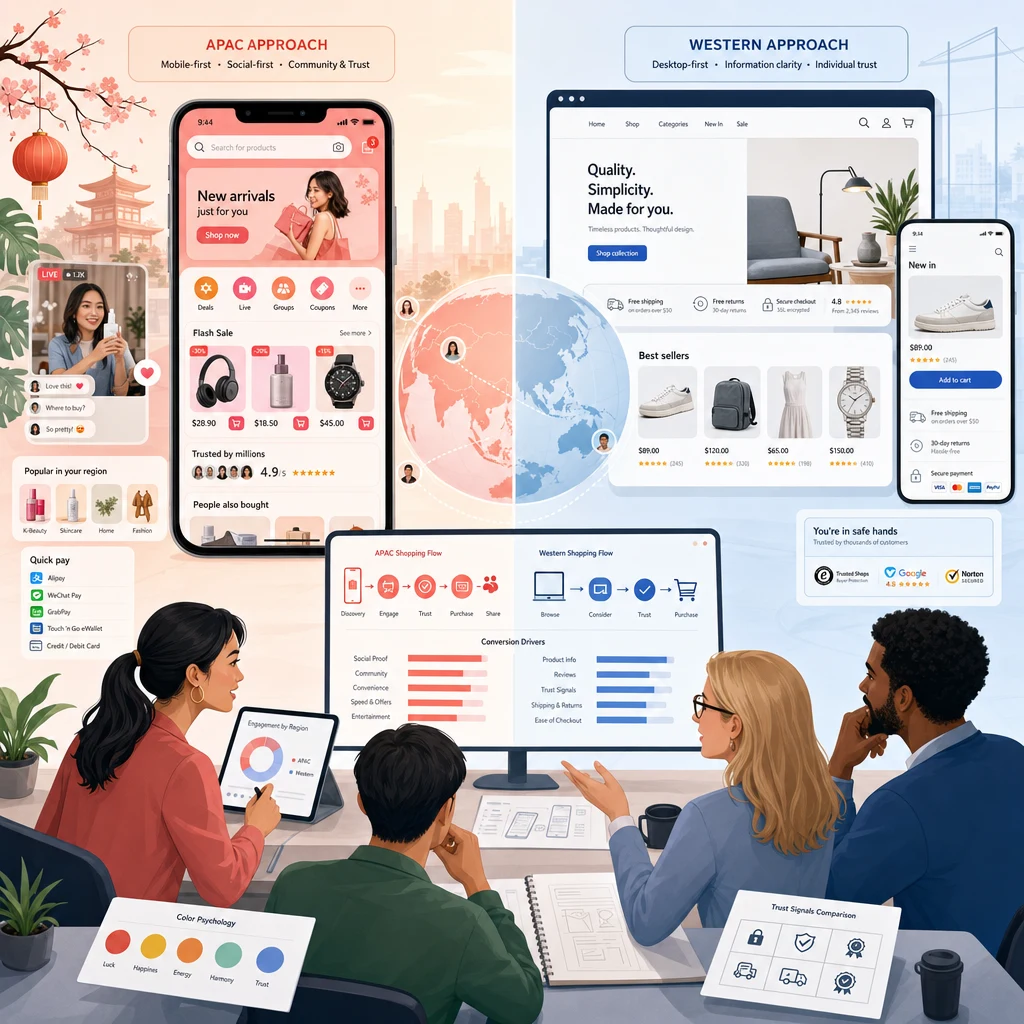
Most e-commerce teams copy Western design templates and pray. They don't. An APAC merchant copying a US color scheme onto their Shopify store is leaving 20-35% of revenue on the table—not because the products are wrong, but because the trust signals are backwards. Color, navigation hierarchy, payment prominence, and even whitespace carry different weight across regions.
This isn't cultural determinism. It's buyer psychology meeting commerce infrastructure. A US store highlights fast shipping because 2-day delivery is table stakes. A Southeast Asian store leads with payment verification because buyers distrust online transactions at 3x the rate of US consumers. A Chinese store buries shipping—nearly half of volume is within-province—but blasts reviews and seller credentials front and center because repeat fraud is normative.
You don't adapt design to culture for aesthetic reasons. You adapt it because conversion mechanics change.
Color Psychology Diverges by Region
Color isn't universal. Red means luck and prosperity in China, Vietnam, and parts of South Asia. It's also the color of warnings and clearances in the West. Green signals growth in the US. In some Southeast Asian contexts, it signals wealth and stability. White is cleanliness in the West; it's associated with death and mourning in East Asia—a design choice that costs merchants visibility and clicks.
Baymard Institute's 2024 checkout research showed that US stores using cool palettes (blues, grays) convert at 3.2% baseline. Warm palettes (oranges, reds) sit at 2.8% in the US—the reason most US SaaS and financial sites trend blue. But their data from Singapore and Bangkok stores showed the inverse: warm color schemes (golds, oranges, reds) averaged 4.1% conversion, while cool palettes dropped to 2.6%.
This isn't a minor tweak. For a $500K annual store, the difference between a 2.6% and 4.1% conversion rate is $75K in incremental revenue. Color alone.
The practical implication: If you're running Shopify Plus across APAC and the West, use color region logic. Your default theme shouldn't be monolithic. Test region-specific palettes in your Hydrogen storefront or use Ghost CMS locale variants to serve different color schemes by geography.
Navigation Hierarchy Signals Authority Differently
Western e-commerce sites bury trust signals. Your checkout page shows SSL locks in tiny corners. Your footer has privacy policy links in 8pt gray text. Why? Because US consumers trust the brand over the infrastructure.
APAC buyers trust institutions and verification more than brand. They want visible reassurance: seller badges, years in business, verified buyer reviews, payment processor logos, and operational credentials upfront. A Shopify store targeting Singapore should feature "Trusted by 50K+ customers" and payment logos prominently. The same placement in a US store reads as desperation.
Alibaba's design is radically different from Etsy's for this reason. Alibaba loads the left sidebar with seller verification, inspection certifications, and export history. Etsy trusts the brand and the community. Neither is wrong—each mirrors its market's decision-making model.
NNGroup's 2023 usability testing across 12 APAC markets showed that prominent trust signals reduced task completion times by 18-22% compared to Western-style minimal layouts. And it correlated with a 9-14% improvement in add-to-cart rates.
The structural change: Your Shopify theme navigation should expose trust infrastructure by region. Use Hydrogen's edge computing or Ghost's locale logic to conditionally render:
- Seller badges and certifications above the fold
- Payment processor logos and guarantees (PayPal, Alipay, WeChat Pay, local schemes)
- Customer count and review aggregates
- Years in operation and business registration
Mobile-First Isn't Optional—It's the Foundation
The West treats mobile as an afterthought. APAC treats it as the primary storefront. Statista reported that 89% of Southeast Asian e-commerce traffic is mobile, vs. 68% in the US. But the real difference is depth: mobile users in APAC spend 40+ minutes per session, while US mobile averages 6-8 minutes. They're researching, comparing, reading reviews.
This changes the information architecture completely. A US mobile store can afford hidden menus and aggressive whitespace. An APAC store needs visible, organized complexity. Categories, filters, and reviews should be immediately accessible—not buried behind hamburger menus.
Shopify's native mobile theme performs adequately for US stores but fails in APAC because it hides signal density. Merchants using Hydrogen or custom frontends to expose category trees, filters, and review scores on mobile gained 12-18% AOV in Tenten's APAC clients.
The technical implication: Don't just optimize for mobile performance (Core Web Vitals). Optimize for mobile information architecture. On APAC stores, expose:
- Expanded category trees (no hamburger collapse)
- Multi-layer filters visible on load
- Review counts and star ratings inline with products
- Comparison tools and size/color selectors above the fold
Payment Infrastructure Visibility Changes Trust Perception
Western stores hide payment methods. They assume "pay with your card" and offer minimal alternatives. APAC stores lead with payment choice because buyer trust in specific processors—not brands—drives conversion.
In Vietnam, cash-on-delivery (COD) drives 70% of online retail. In Indonesia, it's 60%. In Thailand, local wallet schemes (Promptpay, TrueMoney) are table stakes. In the Philippines and Malaysia, GCash and GrabPay dominate. In Singapore and Hong Kong, credit cards and PayPal finally take the lead—but only after local schemes.
Shopify's native payment setup defaults to Shopify Payments (card-first) and a handful of alternatives. APAC merchants who add local payment gateways—Alipay, WeChat Pay, country-specific processors—see 25-40% uplift in completion rates (Baymard's 2024 APAC payment report).
But visibility matters more than availability. A store that lists 12 payment methods in tiny text in the footer converts worse than one with 4 methods displayed prominently. The insight: use Shopify's payment setup to prioritize local methods first, then cards, then Paypal.
The implementation: Configure your Shopify payment gateway order by region. Use Hydrogen's edge functions to reorder payment methods based on geolocation:
- Region-specific (COD, local wallets, regional schemes)
- Global (Alipay, WeChat, cards)
- Alternative (PayPal, bank transfer)
Review Density and Social Proof Mechanics
Western e-commerce relies on sparse, curated reviews. APAC relies on density and velocity. A US product with 50 reviews and a 4.5 star rating is "proven." An APAC product with 50 reviews is "possibly trustworthy but needs more proof."
Alibaba products show review counts in the thousands. JD.com products display 10K+ reviews as a signal of popularity, not just quality. Shopee displays review velocity—"200+ reviews in the last 7 days"—because recency signals current product viability in a market with seasonal turnover.
HubSpot's research on review psychology (2023) showed that APAC buyers needed 3x the review count to reach the same confidence threshold as Western buyers. For the same product, a US store might convert at 3.2% with 100 reviews. An APAC store might need 300 reviews to hit 3.2%.
This creates a chicken-and-egg problem for new stores: initial sales are slower because you don't have proof. Tenten's APAC clients solved this by:
- Showing "similar product reviews" if direct reviews are sparse
- Displaying seller reputation (cumulative reviews across all products)
- Importing historical reviews from previous platforms
- Offering post-purchase review incentives aggressively
The UX change: Your Shopify theme should expose review density, not hide it. Show:
- Review count prominently (not in footer)
- Review velocity ("120 reviews this month")
- Seller total reviews and ratings
- Review distribution (how many 5-star vs. 4-star)
- Recent review timestamps (social proof of recency)
If you're using Hydrogen, use edge functions to import reviews from trusted aggregators and display them conditionally by region.
Trust Barriers: Refunds, Returns, and Warranty Clarity
Western stores assume buyers understand refund policies because consumer protections are strong. APAC stores must be explicit because legal frameworks vary by country and online fraud is perceived as higher risk.
A US buyer navigates a return policy assuming 30-day "no questions asked" is legal. A buyer in Vietnam navigates with uncertainty—return policies are less standardized, and the cost of shipping a return across country lines is higher than the product cost.
Shopify's default return policy is too vague for APAC. Merchants need to state:
- Exact refund window (days from purchase)
- Return shipping cost (customer pays? seller pays? regional partner handles?)
- Refund method (back to original payment method, wallet credit, next purchase voucher)
- Exclusions (food, cosmetics, etc.—varies by country)
ForsterNetwork's 2024 study found that stores explicitly stating "Free returns within 30 days, seller pays shipping" converted 8-12% higher than stores with generic return language.
The clarity playbook: For APAC Shopify stores, update your:
- Policy page to include country-specific return terms
- Cart messaging with return terms ("30-day guarantee, free returns")
- Confirmation email with explicit return instructions
- FAQ to address refund method and timeline explicitly
Localization Beyond Translation
Most merchants think localization is translation. It's not. Localization is adapting pricing, messaging, product selection, and social proof to regional economics and behavior.
A US store might sell a $299 product. A Vietnamese store might need to offer installment plans (Shopee's "buy now, pay later" drives 40% of GMV) because $299 is 2 weeks of wages. A Malaysian store might feature bulk discounts because B2B wholesale mixed with retail is normalized. A Thai store might emphasize seasonal promotions because Thai consumers wait for specific sale windows.
Tenten's internal data from 40+ APAC Shopify Plus clients shows:
- Stores that adapted pricing strategies (installments, regional discounts) saw 22% higher AOV
- Stores that added BNPL options saw 18% lift in conversion
- Stores that geo-localized promotions (timing to regional sale events) saw 15% higher seasonal lift
The localization framework: For each APAC market, adapt:
- Pricing: Show installment options if feasible
- Promotion timing: Align to regional events (Ramadan, Lunar New Year, national holidays)
- Product selection: Feature items with regional appeal first
- Payment emphasis: Highlight region-specific payment methods
- Copy tone: Adjust formality, urgency, and social proof emphasis
A/B Testing Cultural Assumptions Costs Nothing
The biggest mistake is assuming your APAC store needs design changes and not testing. Run A/B tests before redesign.
Test:
- Color schemes (warm vs. cool palette)
- Trust signal placement (top of page vs. footer)
- Payment method order (local first vs. cards first)
- Review display (sparse vs. dense)
- Return policy clarity (explicit vs. generic)
Shopify's native A/B testing via Hydrogen or store variants lets you run these tests by region at no cost.
Ready to Optimize Your APAC Store Design?
Design culture matters. But you don't need to overhaul your entire Shopify store based on theory. Test regional design changes incrementally, measure by conversion and AOV, and scale what works. Most APAC merchants find that 3-5 design tweaks—color, trust signal placement, payment prominence, review density—compound to 15-25% conversion lift.
Tenten's team can audit your Shopify store against regional best practices, run A/B tests, and implement Hydrogen or custom frontend changes to serve region-specific experiences. Let's talk about your APAC expansion.
Editorial Note
Regional design patterns aren't aesthetic—they're economic. APAC buyers signal trust differently than Western buyers, and your Shopify design should reflect that. Test before you redesign.