
What Is Shopify Sidekick (in Plain Terms)

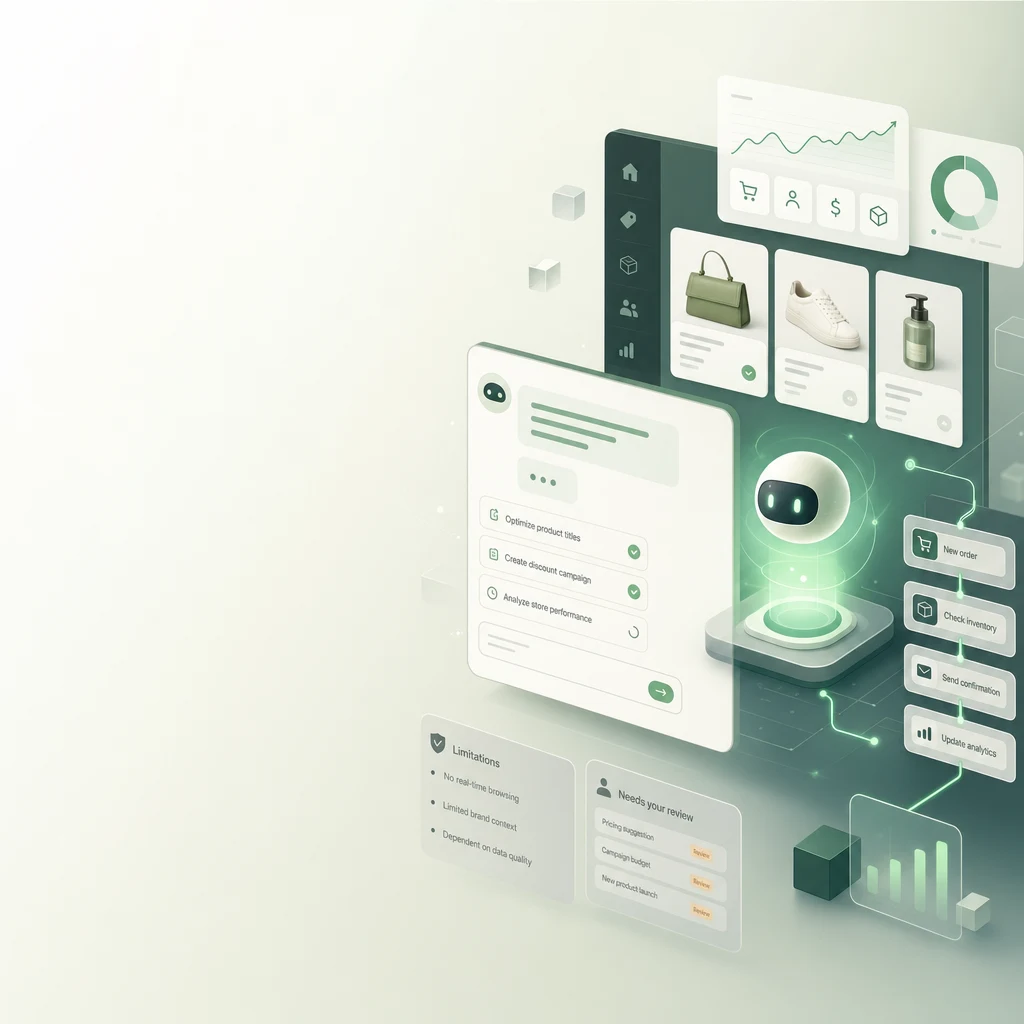
Shopify Sidekick is an AI agent that lives inside Shopify's admin and helps merchants manage operations through natural language commands.
Instead of clicking through menus to create a post, generate images, write copy, or analyze trends, you tell Sidekick what you want. "Write three product descriptions for winter jackets." "Generate social media captions for my latest collection." "Show me which products underperformed last quarter." Sidekick interprets the request, executes it, and returns results.
Shopify released Sidekick in beta in 2024. By 2026, it's the default AI assistant for Shopify Plus merchants and growing adoption among standard Shopify stores. According to Shopify's Q4 2025 merchant survey, 58% of merchants using the admin are now aware of Sidekick. Of those, 34% have used it at least once, and 18% use it regularly (weekly or more).
Sidekick is free for all merchants. Shopify positions it as an operational efficiency tool—a way to reduce repetitive work, accelerate content creation, and surface business insights.
What Sidekick Can Actually Do
Sidekick's capabilities span four core areas: content generation, analytics, operational tasks, and customer insights.
Content Generation is Sidekick's strongest domain. It can write product descriptions, generate marketing copy, create email campaigns, write social media captions, brainstorm product names, and draft blog posts. All of this happens inside the Shopify admin. You request content, Sidekick generates it, and you refine or publish directly.
The quality is solid for commodity content—product descriptions, email subject lines, social media filler. It's weaker for brand-voice-specific or highly creative work. If your brand has a distinct voice (like Glossier or Dollar Shave Club), Sidekick's defaults will feel generic. You'll need to refine substantially.
Analytics and Reporting lets you ask questions about your store's performance. "What were my top-selling products last quarter?" "Which customer segments have the highest lifetime value?" "Which traffic source converts best?" Sidekick queries your store data and synthesizes an answer.
This is useful for quick questions. For complex analysis, Sidekick's insights are basic. It doesn't handle multivariate analysis, predictive modeling, or cohort analysis well. If you need sophisticated analytics, you'll reach for Shopify's native reports or a third-party tool like Littledata or Klaviyo.
Operational Tasks cover repetitive admin work. Sidekick can help tag and organize products, create bulk edits (price changes, description updates), draft email templates, and surface customer service trends. For smaller merchants, this saves hours each month.
The limitation: Sidekick can suggest bulk edits, but it can't execute them autonomously in most cases. You review and approve before Sidekick applies changes. This keeps you in control but reduces time savings.
Customer Insights lets Sidekick surface patterns in customer behavior, common support questions, and churn signals. Early data suggests Sidekick catches things humans miss—for example, identifying that a specific product variant has a 30% higher return rate than others.
Again, the limitation is depth. Sidekick surfaces correlations and flags anomalies but doesn't dig into causation. It will say "This product has high returns," not "Returns are high because the size chart is inaccurate" (you'd need to investigate further).
Where Sidekick Excels
Sidekick delivers clear value for three use cases.
First: Acceleration of content workflows. If you're writing 20 product descriptions, Sidekick can draft all 20 in 5 minutes. You spend 30 minutes refining. Total time: 35 minutes instead of 120 minutes. That's a 70% time saving. For merchants managing catalogs of 500+ products, this compounds. Shopify's usage data shows that merchants using Sidekick for content generation cut content creation time by an average of 55% in their first three months.
Second: Operational triage. Sidekick surfaces issues before they become crises. High return rates on specific variants, declining email engagement, customer support bottlenecks, inventory imbalances—these show up in your reports, but Sidekick highlights them proactively. This is valuable for merchants without dedicated analytics or operations teams.
Third: Ideation and brainstorming. Sidekick is good at generating options. Need 20 email subject line variations? Sidekick delivers them in seconds. Need product name ideas for a new line? Sidekick generates 30 options. You filter down, but the initial exploration is instant. This accelerates creative processes that usually require brainstorming meetings.
Where Sidekick Struggles
Sidekick has four real limitations that matter.
First: Brand voice and tone consistency. Sidekick generates content that's professional and grammatically correct but generic. It doesn't understand your brand's unique voice unless you explicitly teach it. If your brand is irreverent (like Old Spice) or intimate (like Allbirds), Sidekick's output will feel like a template.
A workaround exists: provide Sidekick with examples of on-brand content and ask it to match the tone. But this requires explicit instruction each time. There's no persistent "brand voice" that Sidekick learns.
Second: Complex decision-making and strategy. Sidekick can surface data and identify trends. It can't solve strategic problems. Example: "My conversion rate dropped 15% last month. What should I change?" Sidekick can identify that email engagement is down, that traffic quality declined, or that checkout abandonment increased. But it won't tell you whether to invest in email optimization, paid acquisition improvement, or checkout redesign—that's a strategic call requiring business context Sidekick lacks.
Third: Integration depth and automation. Sidekick lives in the Shopify admin. It can query your store data and suggest changes, but it can't deeply integrate with external tools. Want Sidekick to automatically pull data from your email platform (Klaviyo, Omnisend) and synthesize insights? Not possible natively. Want Sidekick to automatically sync your product catalog to Google Shopping and update ads? Not natively supported.
If you need AI that orchestrates across your entire marketing and operations stack, Sidekick is insufficient.
Fourth: Customization and fine-tuning. Sidekick uses Shopify's base models. You can't fine-tune it on your own data. You can provide examples and context, but you can't train Sidekick to understand your specific product category, customer base, or vertical deeply.
This matters for niche merchants. If you sell specialized equipment (climbing gear, lab instruments, industrial components), Sidekick's general-purpose knowledge is less useful. A fine-tuned model would outperform.
How Sidekick Compares to Alternatives
There are three categories of alternatives worth considering.
General-purpose AI assistants (ChatGPT, Claude, Gemini): These tools are more flexible and powerful than Sidekick. They can handle complex requests, do research, write in custom voices, and integrate with external tools via plugins. The tradeoff: they're not integrated with Shopify. You copy data in and out manually. For one-off tasks, general assistants are fine. For continuous, operational use, the friction is high.
Shopify app alternatives (Bezel, Zapify, etc.): Third-party apps in the Shopify App Store offer AI capabilities. Some focus on copywriting. Others focus on SEO optimization or customer service. These apps specialize more deeply than Sidekick. If you need an AI tool built specifically for email copywriting (vs. Sidekick's general copywriting), Klaviyo's AI tools outperform Sidekick's email generation.
The tradeoff: specialist tools cost money ($29–$299/month). Sidekick is free. If you only need one specialist tool, the cost is justified. If you need five, the cost compounds.
Custom AI integrations (built by agencies): Merchants with technical teams or working with agencies can build custom AI workflows. Example: A product feeds into an LLM that generates descriptions, which are validated by a human review step, then auto-published to Shopify. This is optimized for your specific workflow and data.
Tradeoff: this requires 4–12 weeks of development and costs $15,000–$50,000.
Who Should Use Sidekick (and Who Shouldn't)
Use Sidekick if:
- You manage a product catalog of 100+ SKUs and spend hours monthly on descriptions, copy, and basic reporting.
- You're a standard Shopify merchant without dedicated marketing operations or analytics staff.
- You want to accelerate content workflows without investing in specialist tools.
- Your brand voice is professional or neutral (Sidekick works better for this than for highly distinctive voices).
Don't rely on Sidekick if:
- Your brand has a distinct, proprietary voice that requires careful tonal control.
- You need deep integration with external tools (email platforms, ad networks, analytics suites).
- You're selling niche, highly specialized products where generic AI knowledge is insufficient.
- You need strategic business intelligence beyond basic trend spotting.
- Your use case is custom AI agents for product discovery or purchasing (Sidekick isn't designed for this).
The 2026 Roadmap
Shopify is actively developing Sidekick. Based on public statements and beta features, expect these capabilities in 2026:
Deeper integration with Flow and Functions. Sidekick will trigger custom workflows and Shopify Functions automatically. Example: "If a product's return rate exceeds 25%, flag it for review and notify the ops team." This will blur the line between Sidekick and workflow automation.
Multi-channel expansion. Sidekick is currently admin-focused. Expect Sidekick to expand into Point of Sale, mobile, and customer-facing channels. Merchants will be able to offer Sidekick to staff and customers in more contexts.
Agentic purchasing integration. Sidekick will power agentic commerce on Shopify. Instead of just generating content, Sidekick will handle conversational product discovery and purchasing for customers.
Fine-tuning on store data. Shopify is likely to introduce options for merchants to fine-tune Sidekick on their own product catalogs and customer data. This will improve relevance for specialized merchants.
These shifts position Sidekick as a broader platform, not just a content generation tool.
The Verdict
Sidekick in 2026 is valuable for what it is: a free, integrated AI assistant for operational tasks and content generation. It's not a replacement for specialist tools, custom development, or human expertise. It's a productivity multiplier for merchants who have repetitive work and limited resources.
For most Shopify merchants, using Sidekick is a no-brainer. It's free, reduces busywork, and surfaces useful insights. The ceiling is real—you'll need other tools for deeper analytics, brand-voice control, and complex automation. But within its scope, Sidekick delivers clear ROI.
If you're not using Sidekick yet, start with a simple task: ask it to draft product descriptions for five products. Review the output. Refine. Publish. Measure time saved. That will tell you whether Sidekick fits your workflow.