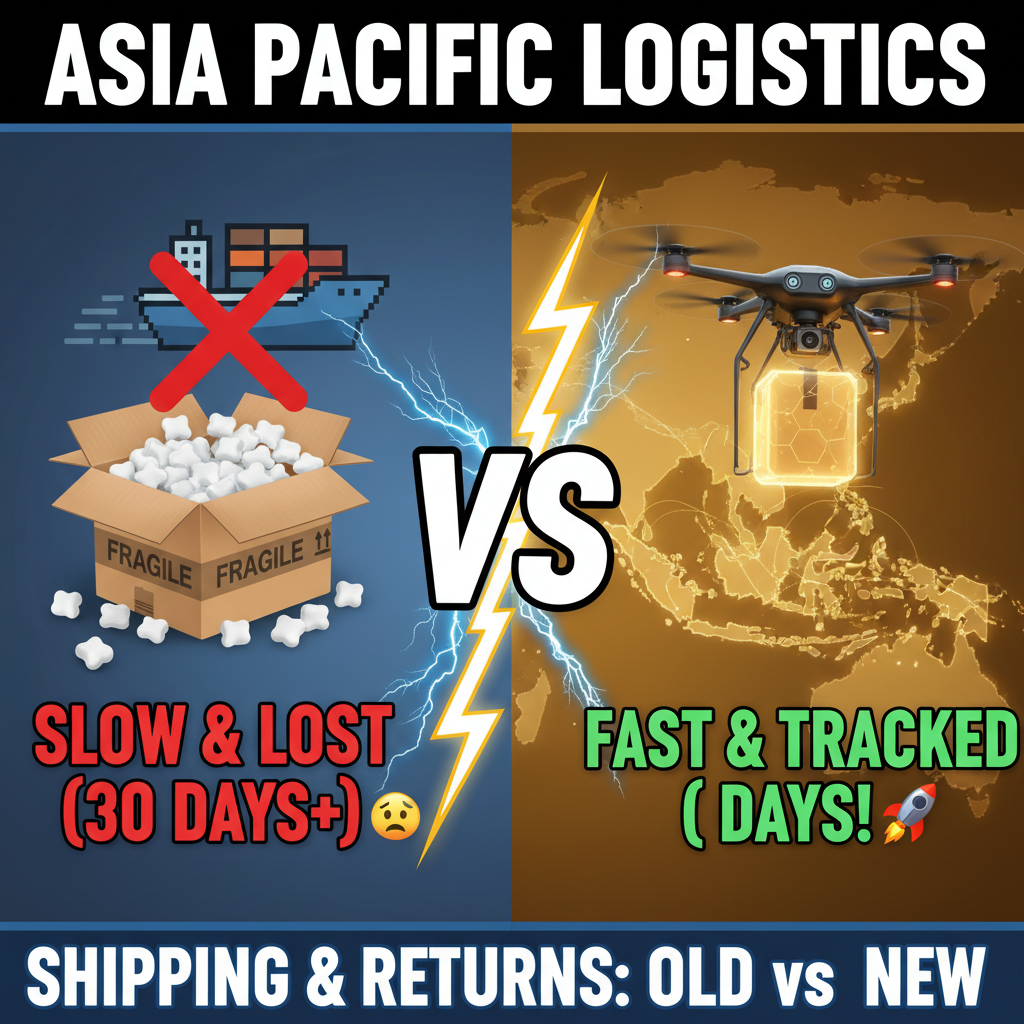
The APAC Logistics Challenge: 3x More Complex Than Domestic
APAC (Asia-Pacific) e-commerce is growing 25% annually. But the region's logistics are fragmented. Japan has different customs rules than Singapore. Australia has different carrier networks than India. Thailand has different return policies than Taiwan.
Most US-based Shopify store owners who expand to APAC don't realize this until they ship to Hong Kong and the package sits in customs for 3 weeks. Or they process a return from Melbourne and realize that shipping cost $30 but the refund was $50.
APAC logistics isn't harder—it's systematically different. This guide breaks down the mechanics that actually work.
Understanding APAC Customs and Duties
The US has one customs system (USCBP). APAC has 15+ separate customs authorities. Each has different rules for:
- Declared value thresholds (duty-free limits vary: Japan is $200, Singapore is $400, Australia is $1,000)
- Restricted goods (some countries ban certain cosmetics, vitamins, or electronics)
- Processing times (Singapore: 1-2 days, India: 5-10 days, China: varies wildly)
- Tax collection (Some countries charge GST/VAT at delivery)
Here's the APAC customs matrix:
| Country | Duty-Free Limit | GST/VAT at Import | Avg Clearance | Restrictions |
|---|---|---|---|---|
| Japan | $200 | 8% + processing | 2-3 days | Limited cosmetics/food |
| Singapore | $400 | No GST on imports | 1-2 days | Electronics require cert |
| Australia | $1,000 | 10% GST | 3-5 days | Strict food/supplement rules |
| Hong Kong | $664 | No import duty | 1-2 days | Limited food restrictions |
| South Korea | $150 | 10% VAT | 2-4 days | Electronics require cert |
| Thailand | $150 | 7% VAT | 3-7 days | Strict pharma/supplement rules |
| India | $30 | 5-28% duty + 18% GST | 5-15 days | Highly variable by product |
| New Zealand | $400 | 15% GST | 3-5 days | Strict biosecurity (food, plant matter) |
The rule: Always declare the true value of goods. Undervaluation triggers customs seizures and delays. Shopify's commercial invoices auto-calculate declared value—use those, don't manipulate them.
Shipping Strategy: Two-Tiered Model
Most Shopify stores use one shipping method for all APAC. This is a mistake. You need two:
Tier 1: Standard shipping (10-15 days, $8-$15). - Use DHL, FedEx, or local APAC carriers (SF Express, S.F. Express, Best Express) - Target: orders under $80 or non-time-sensitive categories (apparel, general merchandise) - Carrier selection by region: SF Express dominates China/HK/Taiwan, DHL dominates Australia/Singapore, Yamato dominates Japan - Economics: At $100 AOV with 12% gross margin ($12), $10 shipping is breakeven. Acceptable for customer acquisition.
Tier 2: Express shipping (2-4 days, $25-$40). - Use FedEx International Priority or DHL Express - Target: orders over $100 or high-value items (jewelry, electronics) - Customers willing to pay $25+ shipping are often time-sensitive - Economics: Works when AOV > $200 or when positioning as "premium/luxury"
The carrier comparison for APAC:
| Carrier | China | Japan | Singapore | Australia | Pricing | Tracking |
|---|---|---|---|---|---|---|
| DHL Express | Excellent | Good | Excellent | Excellent | $20-$35 | Real-time |
| FedEx | Good | Good | Good | Good | $18-$35 | Real-time |
| SF Express | Excellent | Fair | Good | Limited | $8-$15 | Excellent |
| Yamato | Limited | Excellent | Limited | Fair | $15-$25 | Excellent |
Implementation: Set conditional shipping rules in Shopify. Orders to Australia/NZ > $150 = offer express only. Orders to China < $80 = offer standard SF Express only. This reduces customer confusion and shipping cost bleed.
Returns and Reverse Logistics: The Money Sink
Returns in APAC are operationally complex because reverse logistics are fragmented. A return from Melbourne back to your warehouse in Singapore costs $30-$50. A customer who bought a $40 item isn't going to pay that.
The winning strategy: Segment returns by geography and AOV.
Strategy A: No returns (AOV < $50, APAC regions with high return friction like India, Thailand) - Accept returns only for defective items - Require customer to initiate return request with photos - Offer store credit instead of refund (avoids reverse shipping cost) - Economics: Reduces return rate from 8-10% to 2-3%
Strategy B: Free returns (AOV $50-$150, established markets: Japan, Singapore, Australia, Hong Kong) - Accept returns within 30 days - Use local reverse logistics partners (Australia: AusPost, Japan: Yamato return service, Singapore: DHL return) - Refund to original payment method - Economics: Return rate 5-8%, acceptable because AOV covers reverse logistics
Strategy C: Prepaid returns (AOV > $150, all regions) - Issue prepaid return label to customer - Customer pays for return shipping upfront (often $15-$25 deducted from refund) - Refund net of shipping cost - Economics: Return rate drops to 2-4%, remaining returns are genuine defects
Example math: - $50 AOV product, customer wants to return from Sydney - Return shipping from Sydney to your warehouse: $35-$45 - If you accept free returns: You refund $50, pay $40 reverse shipping, lose $90 - If you use Strategy B: Customer pays $0 up front, you cover the logistics cost but keep better customer satisfaction data - If you use Strategy C: Customer pays $20 return shipping, you refund $30 net, total cost is $20 + $30 = $50 (breakeven)
Most APAC e-commerce brands use a hybrid: free returns on full-price items (>$100), prepaid returns on clearance items (<$50).
3PL Selection for APAC: Where to Warehouse
If you're selling $20K+/month in APAC, you need regional warehouses. Shipping from a US warehouse to APAC takes 10-15 days and costs $15-$30 per unit. A Singapore or Sydney warehouse takes 2-4 days and costs $5-$10 per unit.
APAC 3PL providers by region:
Singapore (Central Hub) - DHL Supply Chain | Flexport + local partner | ShipBob Singapore - Typical cost: $300-$600/month + $2.50-$4 per unit - Speed: 2-3 day domestic APAC delivery - Best for: Brands selling to Singapore, Malaysia, Thailand, Indonesia
Australia (Domestic Focus) - Kennards Packaging | Big W Logistics | Fulfill (Local 3PL) - Typical cost: $400-$800/month + $3-$5 per unit - Speed: 1-2 day domestic, 3-5 days to NZ - Best for: Brands targeting Australia/NZ primarily
Japan (Asia's Largest Market) - Yamato Business Logistics | SG Global | Nippon Express - Typical cost: $500-$1,000/month + $3-$6 per unit - Speed: 1-2 day domestic, 3-5 days to APAC - Best for: Brands selling primarily in Japan or serving Japanese resellers
Hong Kong (Transshipment Hub) - Geodis | DHL eCommerce | SCHENKER - Typical cost: $250-$500/month + $2-$4 per unit - Speed: 2-3 days to most APAC, 5-7 days to Australia - Best for: Brands starting APAC (lowest commitment), or multi-regional sellers
India (Emerging Market) - Ecomiz | XCel Logistics | Unicommerce - Typical cost: $200-$400/month + $1.50-$3 per unit - Speed: 2-3 days domestic, 5-7 days to Asia - Best for: Brands targeting Indian market specifically
The APAC Logistics Playbook: Step-by-Step
Month 1: Research and testing - Map your customer geography (which APAC countries are buying?) - Test 2-3 carrier options for each region (DHL, SF Express, FedEx) - Set conditional shipping rules in Shopify (different carriers by geography) - Budget: $500 test shipments
Month 2: Customs and returns strategy - Document declared values and restrictions for top 5 countries - Define return policy by geography (Strategy A/B/C from above) - Set up return shipping partnerships (AusPost for Australia, Yamato for Japan) - Budget: $200-$500 in partnerships
Month 3: Scale to 3PL (if >$10K/month in APAC volume) - Select regional 3PL partner (suggest: Singapore for Asia, Australia for AU/NZ) - Ship inventory (start with 200-500 units) - Test fulfillment integration with Shopify - Monitor: fulfillment speed, damage rate, customer satisfaction - Budget: $2,000-$5,000 initial inventory transfer + setup
Months 4+: Optimize and expand - Scale inventory in 3PL based on demand - Add second warehouse if volume > $20K/month (split inventory geographically) - Refine return policies based on actual return rate data - Consider local payment methods (Alipay, WeChat Pay, GCash) to boost conversion - Budget: $500-$1,500/month ongoing
Founder Insights: The Hidden APAC Logistics Wins
Three non-obvious truths about APAC logistics:
First: Customs clearance time is not fixed. A package can clear Singapore in 2 days or 10 days depending on factors outside your control (port congestion, holiday timing, customs staffing). Build 15-20% time buffer into all APAC delivery estimates.
Second: Return customer LTV in APAC is lower than North America. US repeat purchase rate is 15-25%. APAC is 8-12% because shipping costs make repeat purchases less economical. Expect APAC LTV to be 30% lower than domestic US. Price accordingly.
Third: Payment method matters more in APAC than North America. Only 40% of APAC shoppers prefer credit cards. China demands Alipay. Thailand uses KBANK. Philippines uses GCash. India uses UPI. If you don't support local payment methods, you lose 30-50% of conversions. Use Shopify Payment methods to auto-detect by region.
Ready to Scale APAC E-Commerce?
APAC logistics are complex but predictable once you understand the system. The brands that win are obsessive about mapping customs rules, testing carriers early, and building returns strategy before they scale.
We help Shopify brands scale APAC operations from first shipment to $500K+ annual APAC revenue. From carrier selection to customs compliance to 3PL integration, we've done it 50+ times. Let's talk about your APAC expansion.
Explore our international logistics services →
Editorial Note
I spent weeks debugging a shipment stuck in Indian customs because the declared value didn't match the commercial invoice format that Indian customs expected. A simple documentation fix would have saved $2,000 in delays and rework. APAC logistics rewards specificity and planning. Skip that and you'll pay in time and money.
Frequently Asked Questions
What's the difference between standard and express shipping in APAC?
Standard (10-15 days, $8-$15) uses regional carriers like SF Express and arrives in batches. Express (2-4 days, $25-$40) uses FedEx or DHL priority and is routed individually. Use standard for budget-conscious customers and high-volume categories. Use express for time-sensitive or high-value orders.
Do I need to charge customs duties to my APAC customers?
No. Under most APAC import rules, customs duty is collected at the border by the carrier or local customs authority—not by you. However, some countries (India, Thailand) may charge GST or VAT at import, and the customer pays it on delivery. This is separate from your order.
Should I use different 3PLs for different APAC countries?
Not initially. Start with one central hub (Singapore or Hong Kong) for your first $10K-$20K/month in APAC volume. Once you exceed $20K/month, add a second warehouse closer to your highest-volume market (Australia, Japan, India, etc.) to reduce delivery times and costs.
What's the best strategy for returns from APAC customers?
Hybrid approach: free returns on orders >$100 (established markets: Japan, Singapore, Australia), prepaid returns on orders <$50 (cost split with customer), and no returns on very low AOV items or emerging markets. This balances customer satisfaction with operational cost.
How do I handle currency and payment for APAC customers?
Display prices in USD (assumed APAC norm for e-commerce) or local currency if you're specifically targeting one market. For payment, Shopify Payments handles multi-currency automatically. Enable local payment methods (Alipay for China, Yamada Card for Japan, etc.) through Shopify apps to boost conversion 20-30%.