
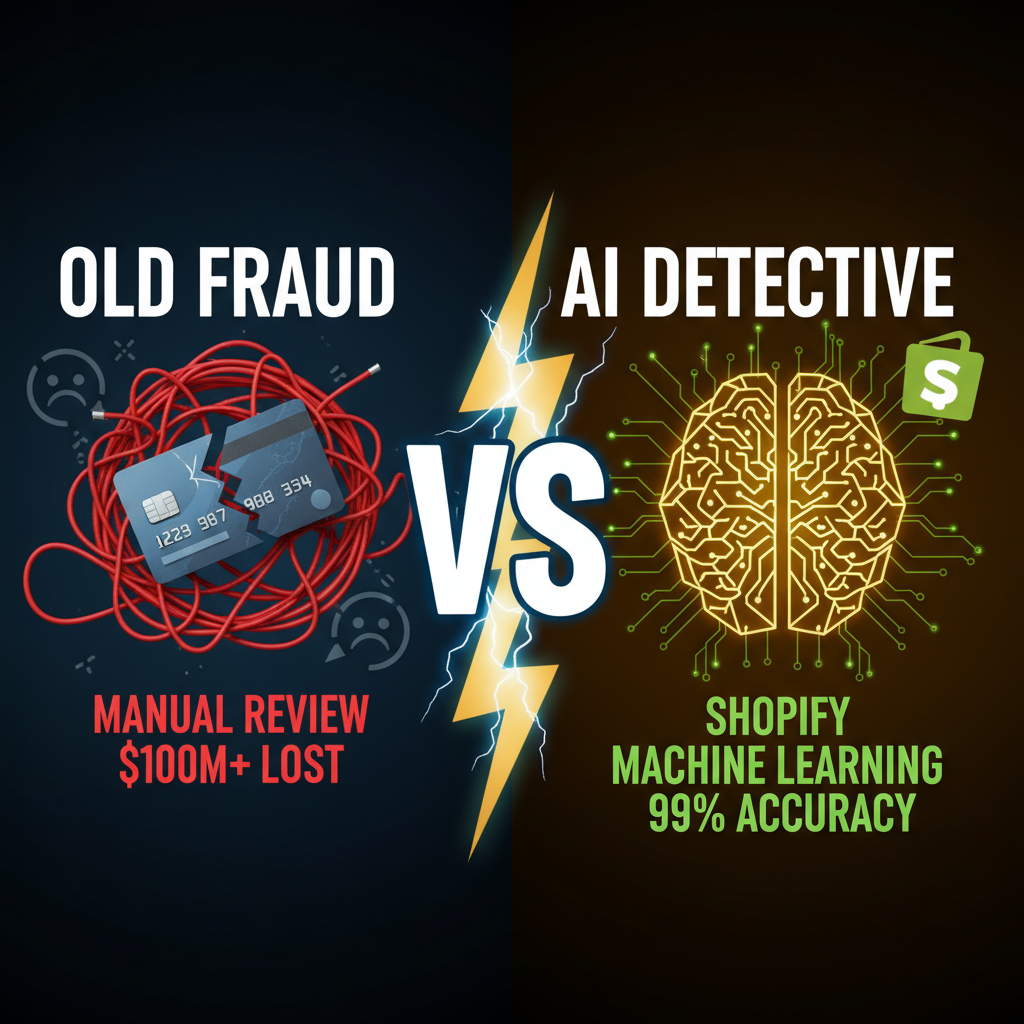
Payment fraud costs e-commerce merchants $41 billion annually according to Statista's 2024 E-Commerce Fraud Report. But here's what most merchants don't realize: fraud isn't random. Fraudsters operate with predictable patterns, and modern machine learning systems have gotten unnervingly good at spotting them.
Shopify's approach to fraud detection isn't a list of static rules that decline every transaction from Nigeria or flag orders over $500. That's 2010s thinking. Instead, Shopify uses ensemble machine learning models that score thousands of signals in milliseconds—device fingerprinting, behavioral anomalies, graph analysis of payment networks, even the cadence of how fast someone types their shipping address.
Here's what actually happens under the hood, why fraud rings are getting smarter, and what you should do about it.
Why Static Rules Die Against Modern Fraud
Traditional fraud prevention worked like this: flag orders from certain countries, decline anything with mismatched billing/shipping addresses, decline high-value orders. Crude, but it worked for a while.
Modern fraud rings have evolved. They use residential proxies that mask IP location. They employ thousands of stolen credit cards testing low-value charges ($5–$50) to validate card data. They coordinate across multiple "mule" accounts to distribute high-value orders. They even hire payment processors to give them insider access to your stored payment data.
Static rules get bypassed the moment fraudsters understand them. A rule that says "decline all orders from Country X" teaches fraudsters to route through Country Y. A rule about order value triggers fraud migration—smaller orders placed faster, across more accounts.
Shopify's machine learning approach sidesteps this arms race. Instead of encoding business rules, models learn patterns from millions of historical transactions. They capture second-order signals that human analysts would miss: whether device fingerprints correlate across multiple accounts, whether the shape of transaction velocity matches known fraud patterns, whether a customer's behavioral profile has suddenly shifted.
The ML Fraud Detection Pipeline
Here's the architecture of how Shopify's fraud detection works:
| Stage | What Happens | Timeline |
|---|---|---|
| Ingestion | Transaction metadata captured: device fingerprint, IP, geolocation, past behavior, payment method, order contents | Real-time |
| Feature Engineering | Raw signals transformed into predictive features: velocity scores, recency patterns, merchant history, device clustering | <50ms |
| Model Scoring | 5-10 ensemble models (gradient boosting, neural networks, graph embedding) score the transaction independently | <20ms |
| Aggregation | Scores combined into single risk percentile (0-100); threshold determines auto-approve, review, or auto-decline | <10ms |
| Decision | Decisioning engine applies merchant policies: approve low-risk, flag mid-range for manual review, decline high-risk | <5ms |
| Feedback Loop | Merchant and customer feedback labeling re-trains models monthly, improving accuracy | Batch process |
Total latency: ~100ms. The customer waiting at checkout doesn't notice.
The Signals That Matter
Shopify's models track hundreds of features, but the high-confidence signals fall into four buckets:
Device & Network Signals
Device fingerprinting captures browser attributes, OS, screen resolution, and installed plugins. The uniqueness of a device fingerprint predicts fraud risk better than IP geolocation alone. Why? Because fraudsters test stolen cards across many devices, while legitimate customers repeat-order from the same phone. Shopify's models detect when a single card is used across dozens of mismatched device profiles—a classic fraud indicator.
IP geolocation still matters, but as one signal among hundreds. A customer ordering from a VPN in Germany while their billing address is in Denver gets scored differently if they've ordered from Germany before (legitimate) versus this being their first international transaction after a 6-month dormancy (riskier).
Behavioral Patterns
How long does a legitimate customer spend filling out their checkout? Do they correct typos in their address? Do they read the privacy policy before converting? Fraudsters often cut corners—they paste data, they don't correct errors, they power through checkout in 20 seconds.
Shopify models this as "behavioral velocity"—how fast someone completes transactions relative to their historical baseline. A customer who normally takes 3 minutes suddenly checking out in 15 seconds on a high-value order is a red flag. Conversely, a brand-new customer rushing through checkout gets moderated by other signals: are they using a saved payment method? Do they have purchase history?
Transaction Velocity & Graph Patterns
This is where ensemble ML shines. Shopify builds a graph of payment networks—not just individual transactions, but how cards, devices, billing addresses, and merchant accounts cluster together.
Fraud rings coordinate. They use 500 stolen cards, but those cards ping from 12 shared proxy servers. They deposit fraud revenue into 3 linked bank accounts. They run through 8 different Shopify stores operated by the same cartel.
Graph neural networks detect these clusters. A single stolen card might seem fine. But when that card connects to 47 other cards through shared device fingerprints and IP addresses, the model immediately assigns it to a fraud ring cluster—because that's what the training data showed.
Temporal & Sequential Patterns
Fraud has a rhythm. Fraudsters test low amounts, then increase. They buy fast-moving merchandise (electronics, luxury goods) not slow movers (kitchenware). They avoid declining transactions—they batch-test cards and move on.
Legitimate merchants have rhythm too—they reorder the same products, they have seasonal patterns, they build relationships. ML models learn your store's baseline transaction distribution. Deviations get scored.
A sudden spike in orders for iPhones at 3am, all from new customers, all declining existing saved payment methods, all with device fingerprints from Russia—that's a pattern. Shopify's models would catch it in the first 10 transactions.
Why Ensemble Models Beat Single Models
Shopify doesn't rely on one fraud detection model. They deploy 5-10 models in parallel—gradient boosting (XGBoost/LightGBM), deep neural networks, support vector machines, rule-based decision trees, and graph neural networks.
Each model has blind spots. XGBoost excels at feature interactions but can overfit on noise. Neural networks are flexible but need massive data. Graph models catch cluster fraud but miss individual anomalies. By scoring every transaction across all models and weighting them, Shopify captures the strengths of each while canceling out false positives from any single model.
The ensemble approach also explains why Shopify rarely blocks legitimate transactions. If one model flags you as high-risk (because you used a VPN), but four others see you as normal (because you have purchase history, billing matches shipping, and you've ordered before), the ensemble score pulls you through.
Here's the catch: ensemble models are computationally expensive. They require infrastructure to score millions of transactions daily, retrain monthly, and monitor model drift. Most e-commerce platforms can't afford this. Shopify can, because fraud loss prevention directly protects their platform revenue.
The Hidden Cost: False Positives
Machine learning fraud detection isn't perfect. False positives—legitimate transactions incorrectly flagged as fraud—are a silent killer for conversion rates.
A customer with a new credit card making their first purchase from an unfamiliar country gets flagged. They're forced through a second verification step. 30% abandon at that point. Shopify's challenge is tuning the model threshold to minimize false positives without letting fraud through.
Shopify publishes limited data on false positive rates, but industry benchmarks suggest 1-3% of legitimate transactions get flagged for manual review. That sounds low until you realize it's millions of customers yearly. Each manual review step reduces conversion by 5-15%.
Shopify counters this by allowing merchants to adjust risk thresholds. Risk-averse merchants can lower thresholds (more reviews, higher false positive rate). High-risk merchants (luxury goods, international shipping) can accept lower thresholds (more fraud gets through, but higher conversion).
Graph Neural Networks: The Emerging Advantage
The newest frontier in fraud detection is graph neural networks (GNNs)—models that treat payment networks as interconnected graphs rather than isolated transactions.
A GNN learns patterns like: "When cards A, B, C, and D share the same IP address, they form a cluster. Cluster correlates with 85% fraud probability." Or: "When device D1 connects to billing address B1 and shipping address S1, but we've never seen S1 before, risk score increases by 20%."
GNNs are particularly effective at catching the most sophisticated fraud: merchant account takeovers, where a legitimate account's credentials are stolen and used to process fraudulent orders. Traditional models might see legitimate transaction patterns (same device, same merchant) and approve. GNN models spot that the customer's typical purchase categories have shifted from clothing to electronics, the AOV jumped 5x, and device location is now a new geography—combined, those anomalies flag the account for review.
Shopify likely uses GNNs for high-value merchants and Shopify Plus accounts, where the cost of false positives is higher and the fraud risk is more sophisticated.
Real-World Example: Detecting a Fraud Ring
Let's walk through how Shopify's ML system catches an actual fraud ring attacking a DTC fashion store:
The Setup: Fraudsters obtain 2,000 stolen credit cards. They target your store because you have fast shipping and high AOV ($150 average). They want to do $250K in fraud.
Batch 1 (Cards 1-50): They test low-value orders ($5–$25) to validate card data. Traditional ML flags 8% as fraud (good). But the ensemble model notices something: these 50 cards, from different countries and devices, all target the exact same product SKU. All decline payment methods they've seen before. All checkout in <30 seconds with no browsing. Graph model connects them—they're a cluster.
Batch 2 (Cards 51-150): Fraudsters increase order value to $50–$100. They vary the products (learning that your model flags same-SKU purchases). Ensemble model now sees: 100 transactions, all new customers, all from devices seen in Batch 1, all shipping to 5 drop addresses in Miami and Los Angeles. Graph model strengthens the cluster membership. Behavioral model flags the identical checkout speed. Combined, ensemble score: 92/100 risk.
Batch 3 (Attempted): System auto-declines all remaining cards. You receive an alert: "Detected fraud ring, 150+ coordinated transactions, $15K processed, $235K blocked."
This detection happens across all three batches, automatically, without manual intervention. You lose $15K but prevent $235K in fraud. More importantly, chargebacks are minimized because Shopify's system caught most fraud before settlement.
What Merchants Should Do
As a Shopify merchant, you can't see the exact ML models or thresholds Shopify uses. But you can optimize your store to reduce fraud risk:
Reduce Friction for Legitimate Customers: Shopify's models learn your baseline behavior. High-converting stores with low fraud (validated by historical data) get better model thresholds. Conversely, stores with high friction or complex checkout get worse scores—models assume you're attracting fraud-prone customers.
Monitor Chargeback Rates: Chargebacks are the lag indicator of fraud you missed. If your chargeback rate spikes above 1% (industry average), your store's profile shifts in Shopify's model. The system adapts, and you might see more false positives. Audit your product/market fit—are you attracting fraud-prone customer cohorts?
Use Shopify Fraud Tools: Shopify offers manual fraud analysis, bulk order review, and customer verification tools. These integrate with the ML backend and provide merchant feedback that retrains models. Using these tools doesn't just catch fraud—it improves Shopify's model accuracy for your store.
Adjust Risk Tolerance: Shopify Payments settings let you tune fraud thresholds. Set "Review high-risk orders" if you want to see suspicious orders before they're declined. Set "Decline orders automatically" if you want maximum friction reduction. Know your risk appetite and configure accordingly.
Understand International Orders: If you ship globally, Shopify's models may flag international orders more aggressively in early batches. Historical data (merchants with proven low fraud on international orders) improves confidence. Your store's fraud history matters—stores that have processed 1,000+ international orders with 0 chargebacks get better thresholds.
The Arms Race Continues
Fraud and ML are locked in an arms race. Fraudsters adapt the moment they understand how detection works. Shopify's advantage is scale—they see billions of transactions monthly, which means they see new fraud patterns weeks or months before smaller platforms.
But clever fraudsters are already adapting. Synthetic fraud (creating entirely new identities) is rising. Fraudsters are using real-time account opening APIs to create "aged" accounts that bypass first-purchase friction. They're hiring insiders at payment processors for data leaks.
Shopify's response: next-generation models incorporating behavioral biometrics (how you hold your phone, how you type), real-time knowledge graph updates (flagging known fraud rings as they emerge), and external intelligence feeds (sharing fraud patterns with other platforms).
The merchants who win are those who treat fraud as an ongoing operational concern, not a one-time setup. Monitor your fraud metrics monthly. Update your Shopify fraud settings as your business model evolves. Partner with Shopify to review high-risk orders manually until the ML system learns your baseline.
Frequently Asked Questions
1. How does Shopify detect fraud if I'm a legitimate customer ordering from a new device or country?
Shopify uses ensemble ML models that weigh hundreds of signals. A new device + new country might trigger one model, but your account history, billing-shipping match, and payment method status could override the flag in other models. The ensemble combines them. That said, some legitimate transactions do get flagged for manual review (1-3% false positive rate). If you're flagged, Shopify Payments will request additional verification.
2. Can I see why my order was declined?
Shopify Payments doesn't expose the exact ML model output to merchants or customers. You'll see "Payment Declined" but not the specific risk score or triggering signal. However, Shopify's customer service can investigate if you contact them. If you're the merchant, Shopify's merchant dashboard shows a "Risk" label and simple risk category (Low/Medium/High) for orders.
3. Does Shopify's fraud detection block orders from specific countries?
No, not automatically. Shopify's ML models are country-agnostic at the rule level. That said, if fraud rings predominantly operate from certain countries, the models learn that correlation during training. So yes, orders from countries with historically higher fraud rates will have slightly higher baseline risk scores—but they're not auto-declined. Legitimate customers from any country can still convert if other signals are positive.
4. How often does Shopify retrain its fraud models?
Shopify retrains ML models monthly, sometimes weekly for high-risk cohorts. Merchant feedback (approving flagged orders, reporting false declines) directly feeds the retraining pipeline. This is why it's important to use Shopify's manual review tools—your feedback improves model accuracy system-wide.
5. If Shopify's ML is so good, why does fraud still happen?
Three reasons. First, false negatives: fraud that slips through models. Second, chargeback lag: fraud can be processed and shipped before the cardholder disputes it. Third, merchant acceptance: some merchants deliberately lower fraud thresholds to accept more risky orders for higher conversion. Shopify's job is detecting fraud; the merchant's job is deciding how much fraud risk to accept.
Article JSON-LD (FAQPage Schema)
{"@context": "https://schema.org","@type": "FAQPage","mainEntity": [{"@type": "Question","name": "How does Shopify detect fraud if I'm a legitimate customer ordering from a new device or country?","acceptedAnswer": {"@type": "Answer","text": "Shopify uses ensemble ML models that weigh hundreds of signals. A new device + new country might trigger one model, but your account history, billing-shipping match, and payment method status could override the flag in other models. The ensemble combines them. That said, some legitimate transactions do get flagged for manual review (1-3% false positive rate). If you're flagged, Shopify Payments will request additional verification."}},{"@type": "Question","name": "Can I see why my order was declined?","acceptedAnswer": {"@type": "Answer","text": "Shopify Payments doesn't expose the exact ML model output to merchants or customers. You'll see 'Payment Declined' but not the specific risk score or triggering signal. However, Shopify's customer service can investigate if you contact them. If you're the merchant, Shopify's merchant dashboard shows a 'Risk' label and simple risk category (Low/Medium/High) for orders."}},{"@type": "Question","name": "Does Shopify's fraud detection block orders from specific countries?","acceptedAnswer": {"@type": "Answer","text": "No, not automatically. Shopify's ML models are country-agnostic at the rule level. That said, if fraud rings predominantly operate from certain countries, the models learn that correlation during training. So yes, orders from countries with historically higher fraud rates will have slightly higher baseline risk scores—but they're not auto-declined. Legitimate customers from any country can still convert if other signals are positive."}},{"@type": "Question","name": "How often does Shopify retrain its fraud models?","acceptedAnswer": {"@type": "Answer","text": "Shopify retrains ML models monthly, sometimes weekly for high-risk cohorts. Merchant feedback (approving flagged orders, reporting false declines) directly feeds the retraining pipeline. This is why it's important to use Shopify's manual review tools—your feedback improves model accuracy system-wide."}},{"@type": "Question","name": "If Shopify's ML is so good, why does fraud still happen?","acceptedAnswer": {"@type": "Answer","text": "Three reasons. First, false negatives: fraud that slips through models. Second, chargeback lag: fraud can be processed and shipped before the cardholder disputes it. Third, merchant acceptance: some merchants deliberately lower fraud thresholds to accept more risky orders for higher conversion. Shopify's job is detecting fraud; the merchant's job is deciding how much fraud risk to accept."}}]}CTA Blocks
Primary CTA: Ready to audit your store's fraud strategy? Talk to our Shopify experts about optimizing your payment settings and fraud thresholds.Contact us at tenten.co/contactSecondary CTA: Explore Shopify Plus fraud tools and advanced merchant features.Learn more at tenten.co/shopify