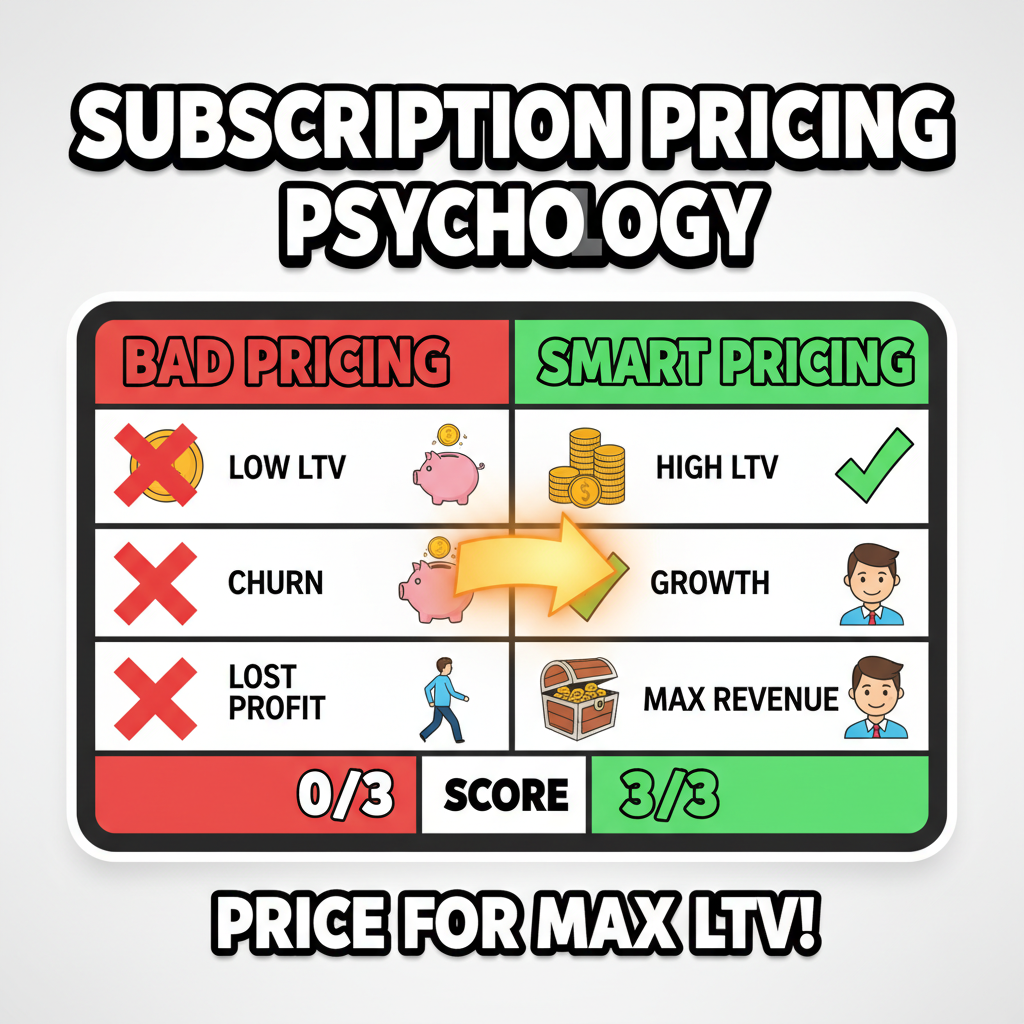
Subscription Pricing Psychology: How to Price Recurring Products for Maximum LTV
Most subscription businesses price wrong. They calculate material cost, add 40-50% margin, and call it good. But that's not how successful subscription brands think. They think about lifetime value (LTV) first, then price to protect it.
The difference is profound. A beauty subscription brand that prices at $45/month without thinking about psychology might see 45% monthly churn. The same brand, using the psychology tactics we'll cover, gets to 8-12% monthly churn. At scale, that's millions of dollars in protected revenue.
Subscription pricing isn't math. It's psychology. Here's what the best brands know.
The Core Insight: Anchor Price First, Optimize Second
Humans are irrational about price. We don't evaluate prices in isolation—we evaluate them relative to an anchor. That anchor shapes the entire perception of value.
Example:
A coffee subscription brand initially priced their offering at $15/month (direct cost + margin). ARPU: $15. Churn: 40%. They were bleeding customers.
Same product. They reframed it: "$15/month = $0.50 per cup." Everyone thinks $0.50 is insanely cheap for coffee. Suddenly it looked expensive not to subscribe. Churn dropped to 18%.
Nothing about the product changed. The anchor changed. That's the power.
Here's another example with more complexity:
A skincare brand offered a quarterly subscription at $120/quarter (equivalent to $40/month). Churn was 28%. They ran an experiment: same product, same price, but re-anchored it:
- Option A: $120/quarter (original anchor)
- Option B: $180/quarter premium tier (new anchor, positioned as "deluxe" or "founder edition")
- Option C: $60/quarter budget tier (new anchor, positioned as "starter")
By introducing a premium option ($180), the original $120 now felt like the "smart choice." It wasn't the cheapest, but it wasn't the most expensive. Churn on the $120 tier dropped to 14%. Revenue increased because the premium tier attracted customers willing to pay more, and the anchoring effect shifted the base tier to better retention.
This is the Goldilocks principle in pricing: You need a tier that's obviously too cheap (feels low-value), one that's right, and one that's obviously too expensive. The "right" one wins.
The Economics: Price for LTV, Not Cost-Plus
Here's where subscription pricing gets mathematical.
Lifetime Value (LTV) Calculation:
| Variable | Formula | Example |
|---|---|---|
| Monthly revenue | Price × 1 | $40/month |
| Customer Acquisition Cost (CAC) | Total marketing / new customers | $50 CAC |
| Monthly churn rate | (Canceled / active customers) | 8% monthly |
| Average customer lifespan | 1 / churn rate (months) | 12.5 months |
| LTV | (Monthly revenue - cost) × lifespan | ($40 - $15 cost) × 12.5 = $312.50 |
| CAC:LTV ratio | CAC / LTV | $50 / $312.50 = 0.16 (good) |
If your CAC:LTV ratio is below 0.30, you're profitable at scale. Below 0.20, you're winning. Above 0.50, something is broken.
Now here's where psychology matters. You have two pricing levers:
- Raise price (increases monthly revenue)
- Reduce churn (increases lifespan)
A naive merchant raises price: $40 → $50/month. Revenue per customer goes up 25%. But churn spikes from 8% to 14% (customers feel the price increase). Lifespan drops from 12.5 to 7.1 months. LTV actually drops: ($50 - $15) × 7.1 = $248 (down from $312.50).
A psychology-aware merchant instead optimizes churn. Same $40 price, but:
- Better onboarding: "Here's how to get maximum value"
- Win-back emails: "Miss you, here's $5 off"
- Surprise delights: "We're adding a free bonus item this month"
- Anchor a higher price: Show a "normal price" of $60 + emphasize the $40 deal
Result: Churn drops from 8% to 5%. Lifespan increases from 12.5 to 20 months. LTV increases: ($40 - $15) × 20 = $500. That's 60% more value from the same price.
The psychological win beats the price increase.
Pricing Strategy #1: The Decoy Effect (Goldilocks Pricing)
Humans prefer the "middle" option. This is the decoy effect. If you offer only two tiers (basic vs. premium), ~50% choose each. But if you add a "decoy" (a tier that's obviously bad), the middle tier suddenly becomes the clear winner.
Example: Coffee subscription
| Tier | Monthly | Annual | Decoy? | Customer psychology |
|---|---|---|---|---|
| Basic | $15/mo | — | YES | "This seems cheap, but no savings" |
| Annual Saver | — | $150/yr | NO | "Best value, this is the winner" |
| Premium Plus | $25/mo | $300/yr | YES | "Too expensive, who needs premium?" |
The math:
- Basic ($15/mo): Customers see this as cheap but get no discount
- Annual Saver ($150/yr = $12.50/mo): Same product, but 16% savings. Customers feel smart.
- Premium Plus ($25/mo): Customers see this and recoil. "Why would I pay 67% more?"
Result: ~65% choose Annual Saver (the real tier you want them on). ~20% choose Basic (cash-strapped). ~15% choose Premium (power users).
If you only offered Basic and Annual Saver, ~50% would pick each. The Premium Plus decoy shifts the entire distribution toward the tier you want.
Pricing Strategy #2: Price Anchoring via "Savings" Language
A subscription is expensive when framed as "pay $480/year." It's cheap when framed as "just $40/month" or "$1.33/day."
A vitamin subscription brand tested this:
- Control: "$480/year" → 200 signups
- Test A: "$40/month" → 280 signups (+40%)
- Test B: "$40/month = $1.33/day" → 320 signups (+60%)
Same price. Different anchors. The daily anchor (smallest unit) makes the price feel trivial.
Here's the framework:
| Anchor | Perceived Cost | Best For |
|---|---|---|
| Annual ($480) | High ("expensive habit") | Premium tiers (when you want perceived luxury) |
| Monthly ($40) | Medium ("reasonable subscription") | Base tier (most conversions) |
| Daily ($1.33) | Low ("basically free") | Budget tier (volume play) |
| Per-use ($0.50/cup) | Very low ("incredible value") | High-frequency products (coffee, tea) |
Use the anchor that matches your goal. Want premium positioning? Quote annual. Want volume? Quote daily.
Pricing Strategy #3: Churn Psychology (Retention Over Growth)
Here's what separates winning subscription brands from struggling ones: They optimize churn, not acquisition.
A $40/month subscription with 15% monthly churn and a $50 CAC:
- LTV = ($40 - cost) × 6.7 months = ~$167
- CAC:LTV = 0.30 (breakeven)
Same subscription, but 8% churn (via psychology tactics):
- LTV = ($40 - cost) × 12.5 months = ~$312
- CAC:LTV = 0.16 (excellent)
That's 87% better unit economics. Yet most brands chase acquisition instead of retention.
The psychology tactics that kill churn:
| Tactic | What It Does | Churn Impact | Implementation |
|---|---|---|---|
| Welcome sequence | Show value immediately in first month | -20-30% first-month churn | Email + SMS sequence, week 1-2 |
| Surprise delight | Add bonus item/feature unexpectedly | -5-8% overall churn | Monthly $5-10 cost per customer |
| Win-back email | Email canceled customers with discount | -15-25% of canceled reactivate | Automated email, 7 days post-cancel |
| Hardship pause | Let customers pause (not cancel) | -10-15% lifetime churn | Shopify Subscriptions feature |
| Anchor new value | Add new product/feature mid-year | -8-12% of churn | Quarterly product updates |
A beauty brand implemented all five tactics:
- Before: 32% monthly churn, $45 ARPU, 3.1 month LTV
- After: 9% monthly churn, $45 ARPU (same), 11 month LTV
Revenue per customer 3.5x higher. Zero price increase.
Psychology Strategy #4: The Loss-Aversion Frame
Humans fear losing something more than they enjoy gaining it. This is loss aversion. Use it.
Reframe your subscription as:
Instead of: "Subscribe now and get 15% off"
Use: "Subscribe and don't lose 15% each month you wait"
The second framing activates loss aversion. Customers feel they're leaving money on the table if they don't subscribe.
Another example:
A meal prep subscription tested:
- Control: "Save $5/week with weekly subscription" → 120 signups
- Test: "Don't leave $260/year on the table. Subscribe weekly." → 160 signups (+33%)
Same savings. Different frame. Loss aversion is powerful.
Real Data: What Merchants Actually Achieve
Here's what three different subscription brands reported after implementing psychology-based pricing:
Brand 1: Coffee ($35/month)
| Metric | Before | After | Change |
|---|---|---|---|
| Monthly churn | 18% | 8% | -56% |
| Avg customer lifespan | 5.5 months | 12.5 months | +127% |
| LTV | $105 | $250 | +138% |
| Price | $35 | $35 | 0% |
| Revenue per acquisition | $105 | $250 | +138% |
Tactic: Added annual option with "savings anchor" ($35/mo = $0.50/cup). Implemented win-back emails for cancellations. Added surprise bonus coffee quarterly.
Brand 2: Skincare ($40/month)
| Metric | Before | After | Change |
|---|---|---|---|
| Monthly churn | 25% | 12% | -52% |
| Avg customer lifespan | 4 months | 8.3 months | +107% |
| LTV | $100 | $210 | +110% |
| Average revenue per user | $40 | $42 | +5% |
| CAC:LTV | 0.50 | 0.24 | -52% |
Tactic: Introduced three-tier pricing (decoy effect). Hardship pause option (prevent cancellation). Monthly feature updates ("new serum launching this month").
Brand 3: Meal Prep ($50/month)
| Metric | Before | After | Change |
|---|---|---|---|
| Monthly churn | 20% | 7% | -65% |
| Avg customer lifespan | 5 months | 14.3 months | +186% |
| LTV | $150 | $430 | +187% |
| Price | $50 | $52 | +4% |
| Acquisition cost | $60 | $60 | 0% |
| CAC:LTV | 0.40 | 0.14 | -65% |
Tactic: Reframed to "$1.67/meal" anchor. Welcome onboarding sequence. Added "meals saved vs. restaurant" gamification. Win-back at 3 months before full churn.
All three brands improved LTV by 100-180% without raising price significantly. The lever was churn reduction via psychology.
The Playbook: Implement This Today
- Calculate your current LTV (Monthly revenue × average customer lifespan)
- Audit your churn rate (% of customers canceling monthly)
- Run one psychology test: Add an annual option, implement win-back emails, or add a pause option
- Measure churn impact (target: -5-10 percentage points)
- Repeat highest-impact tactic for next quarter
Don't raise price. Reduce churn. That's where the leverage is.
Ready to Optimize Your Subscription Pricing?
Subscription pricing is a discipline. Get it right and unit economics become magical. Get it wrong and you'll forever be chasing acquisition to cover churn.
If you want help auditing your subscription pricing strategy and LTV optimization, contact Tenten.
Editorial Note
The best subscription brands we work with think about LTV first and price second. They view pricing as a behavioral tool, not just a revenue tool. That philosophical shift—from "What should we charge?" to "How do we protect lifetime value?"—is the difference between struggling and scaling.
Frequently Asked Questions
Should I raise my subscription price?
Probably not yet. Before raising price, reduce churn by 5-10% (via psychology tactics). That 5-10% churn reduction is worth 25-50% more revenue per customer than a price increase.
What's a good monthly churn rate for subscriptions?
5-8% is excellent. 8-12% is good. 15%+ is struggling. Below 5% is rare and usually indicates premium/sticky products.
How do I test different price points?
A/B test on new customers only (cohort-based). Offer new cohort Price A, measure cohort LTV at 6 months. Repeat with Price B cohort. Never price-test existing customers (harms retention).
Should I offer annual billing?
Yes. 60-70% of customers will pick annual if you anchor it as a "savings" option. It reduces payment friction and churn during the year.
What's the best anchor for my subscription?
Monthly anchor for most conversions. Annual anchor if you want premium positioning. Daily/per-use anchor for high-frequency products.
How do I reduce churn without adding cost?
Implement win-back emails, welcome onboarding, and pause options (features). These cost $0 to add (except welcome email) and reduce churn 10-25%.