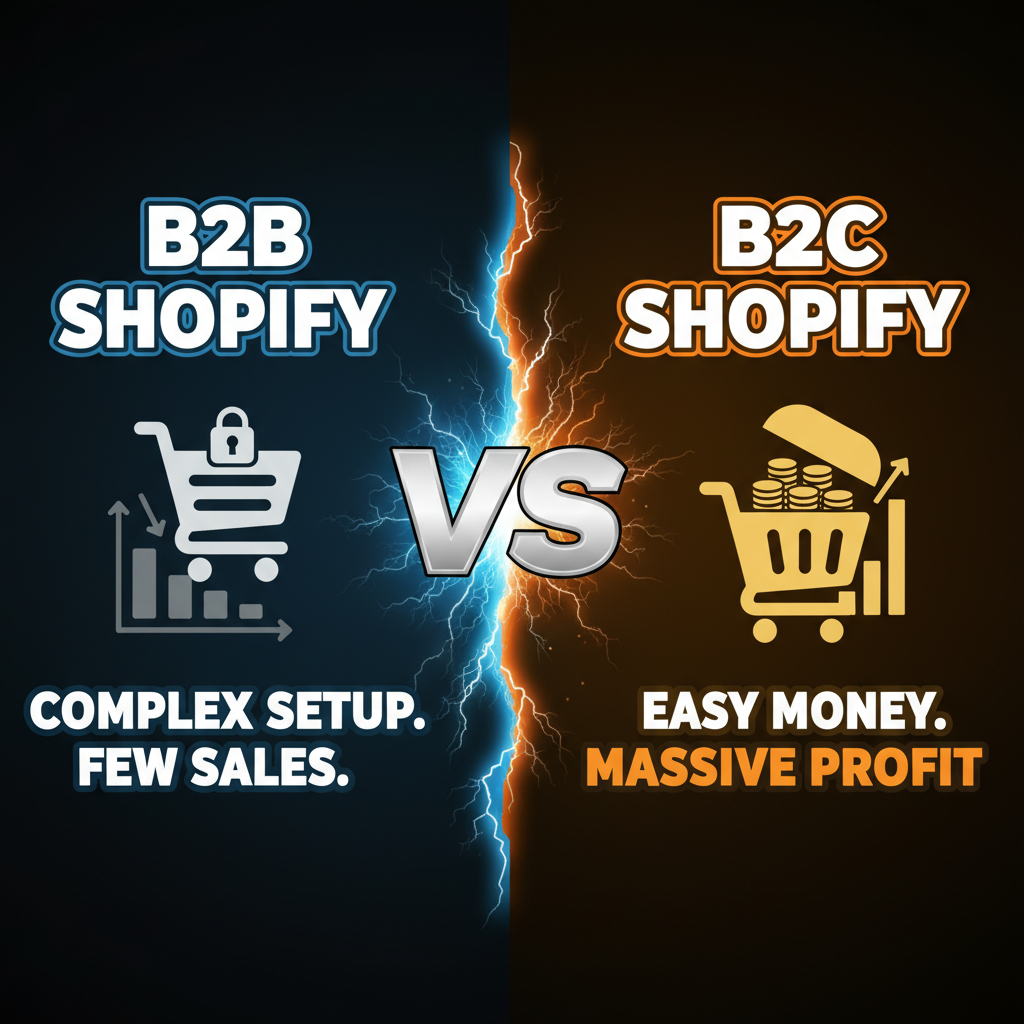
The Fundamental Difference: Decision-Maker vs. End-User
A B2C store optimizes for impulse. The buyer sees product, likes it, buys in 3 clicks. Duration: 5 minutes.
A B2B store optimizes for verification. The buyer researches, compares, checks pricing tiers, negotiates terms, gets approval from 2–4 decision-makers. Duration: days to weeks.
This difference cascades through every layer: product pages, checkout, pricing, customer support, and contract terms.
Most merchants try to run B2B and B2C on the same Shopify store. It almost never works. They end up optimizing for neither.
B2C Store: Speed and Impulse
Core Mechanics
| Feature | Why It Matters | Example |
|---|---|---|
| One-click checkout | Minimize friction for individual buyers | Shopify's Shop Pay (reduces checkout to 1 click for repeat buyers) |
| Simple pricing | Price doesn't vary; everyone pays same | Apparel: $49 shirt is $49 for everyone |
| Product images (3–5 per item) | Show lifestyle, fit, scale | Clothing brand: model wearing product, flat lay, close-up of fabric |
| Customer reviews | Build social proof for strangers | Review section under every product; average stars visible |
| Instant fulfillment | Order ships next day | 2–3 day delivery standard |
| Email/SMS marketing | Drive repeat purchases | Abandoned cart, new launch, seasonal sale |
Checkout Flow (B2C)
Guest Checkout → Payment → Confirmation → Fulfilled
Most buyers don't create accounts. You lose their data unless you capture emails at checkout.
Pricing Model (B2C)
Flat rate. $49 = $49 for all. Occasionally, tiered discounts (buy 2 get 10% off) but no negotiation.
Example: $1M/year Fashion Brand (B2C)
- Product count: 200 SKUs (dresses, tops, bottoms, accessories)
- Average order value: $65
- Repeat rate: 35% (customers buy 1.5x/year average)
- Cart abandonment: 68% (normal for fashion)
- Fulfillment: Drop-shipped or distributed via 3PL, ships in 1–2 days
B2B Store: Relationship and Verification
Core Mechanics
| Feature | Why It Matters | Example |
|---|---|---|
| Account creation (mandatory) | Track buyer, company, order history, credit terms | Wholesale app (e.g., Shopify B2B Edition) requires login |
| Tiered pricing | Different prices for different order quantities | 1–10 units: $20 ea. 11–50 units: $18 ea. 50+ units: $15 ea. |
| Bulk order tools | Buyers need to purchase 50–500 units at a time | CSV upload, "add all from previous order" button |
| Detailed product specs | Buyers need certifications, dimensions, materials, MOQ | PDF spec sheets, COO, compliance docs |
| Quote requests | Not all buyers want to buy today; quote now, order later | "Request a quote" button instead of "Add to cart" |
| Net-30 / Net-60 payment terms | B2B buyers don't pay upfront; they're invoiced | Shopify Plus + custom payment app (e.g., Affirm B2B) |
| Dedicated account manager | Large orders need relationship management | Slack/email notification when VIP account orders |
Checkout Flow (B2B)
Login → Browse Pricing Tier → Build Bulk Cart → Request Quote / Order → Invoice & Fulfillment
Buyers create accounts. You own all their data. Repeat orders are faster (previous cart available).
Pricing Model (B2B)
Tiered by volume. 100 units = one price. 500 units = another price. Negotiated terms for large accounts.
Example: $3M/year Packaging Supplier (B2B)
- Product count: 50 SKUs (corrugated boxes, labels, tissue)
- Average order value: $1,500–$5,000
- Repeat rate: 95% (same buyers re-order monthly or quarterly)
- Minimum order quantity (MOQ): 100 units (wholesale requirement)
- Fulfillment: Manufactured to order, 3–4 week lead time
Technical Setup Comparison
B2C Architecture (Standard Shopify)
| Layer | Solution | Cost |
|---|---|---|
| Platform | Shopify Standard ($39–$299/mo) | Included |
| Checkout | Shopify default (Shop Pay) | Included |
| Pricing | Simple product prices | Included |
| Inventory | Shopify inventory (auto-sync with sales channels) | Included |
| Fulfillment | Shopify Fulfillment Network OR manual 3PL | $0–$1.50/order (SFN) |
| Payments | Shopify Payments OR Stripe | 2.9% + $0.30 |
| Customer Data | Shopify native CRM + email tool | Included |
| Reports | Shopify admin analytics | Included |
Total Stack Cost: $39/month + payment fees = ~$500/month for small store
B2B Architecture (Shopify Plus + Integrations)
| Layer | Solution | Cost |
|---|---|---|
| Platform | Shopify Plus ($2,000–$10,000/mo) | $2,000+/mo |
| Checkout | Custom liquid templates OR B2B Edition ($200–$1,000/mo) | $200–$1,000/mo |
| Pricing | Tiered pricing app (e.g., Bold Product Options, Wholesale Pro) | $50–$300/mo |
| Inventory | Advanced inventory management (Fishbowl, Odoo, TraceLink) | $100–$500/mo |
| Fulfillment | Custom fulfillment rules + 3PL integration | $0–$1,000/mo |
| Payments | B2B payment terms (Affirm B2B, PayPal Commerce Platform) | 1–3% + fees |
| Customer Data | HubSpot OR Salesforce (CRM) | $50–$1,200/mo |
| Reports | Custom dashboards (Metabase, Tableau, or dev build) | $100–$500/mo |
Total Stack Cost: $2,500–$15,000/month
Feature Comparison Table
| Feature | B2C Priority | B2B Priority | Implementation |
|---|---|---|---|
| Fast checkout | High | Low | Shopify Shop Pay (native) |
| Social proof (reviews) | High | Low | Judge.me OR Yotpo ($50/mo) |
| Product discovery | High | Medium | Search + filters (native) |
| Tiered pricing | Low | High | Bold OR Wholesale Pro app ($100/mo) |
| Account management | Low | High | Shopify B2B Edition ($200–$1,000/mo) |
| Bulk upload | Low | High | CSV app OR custom build |
| Quote requests | Low | High | Custom form OR Shopify Inquiry app |
| Net-30 payments | Low | High | Affirm B2B OR custom integration |
| Order history | Low | High | Shopify account page (native) |
| Dedicated support | Low | High | Manual email + Slack |
Pricing Strategy: The Critical Difference
B2C Pricing (Single-Price Model)
Shirt = $49. Everyone pays $49. Occasionally, site-wide sale (20% off). That's it.
B2B Pricing (Tiered Model)
| Quantity | Price Per Unit |
|---|---|
| 1–10 | $20.00 |
| 11–50 | $18.00 (10% volume discount) |
| 51–100 | $16.00 (20% discount) |
| 101–500 | $14.00 (30% discount) |
| 500+ | $12.00 (40% discount) |
Buyers see their cost drops as they order more. This incentivizes bulk purchases and increases average order value.
Real Numbers (Packaging Supplier):
- Without tiered pricing: Average order = 150 units @ $20/unit = $3,000
- With tiered pricing: Average order = 250 units @ $16/unit = $4,000 (+33% revenue gain)
Tiered pricing works because B2B buyers optimize for cost. Show them savings, they order more.
Fulfillment & Lead Time
B2C Fulfillment
- Order-to-ship: 1–2 days
- In-stock model: Carry inventory, ship immediately
- Customer expectation: "I ordered Tuesday, I get it Friday"
B2B Fulfillment
- Order-to-ship: 5–14 days (often made-to-order)
- Made-to-order model: Order after purchase, manufacture, ship
- Customer expectation: "I ordered Tuesday, I'll get it in 2 weeks"
This changes cash flow entirely. B2C is cash-on-delivery (you keep revenue immediately). B2B often has Net-30/Net-60 terms (you get paid 30–60 days after shipment).
Buyer Psychology: What Matters Most
B2C Buyer Motivation
- Impulse + social proof — "I like it. Others rate it 4.8 stars. I'll buy."
- Speed — "I want it this week."
- Aesthetics — Product looks good in photos.
- Price point — Is it in my budget?
Decision time: 5–15 minutes
B2B Buyer Motivation
- Total cost of ownership — "If I buy 500 units, what's my total cost? My per-unit cost?"
- Reliability — "Will you deliver on time? What if I need extra stock in Q4?"
- Specs & compliance — "Does this meet our certification requirements? What's the lead time?"
- Relationship — "Will you support us if there's an issue?"
Decision time: 3–7 days (includes internal approvals)
Real-World Setup: Which Model Are You?
Choose B2C If:
- Products are low-cost ($10–$500)
- Customers are individuals (not companies)
- Repeat purchases happen <4x/year
- You want high transaction volume, lower average order value
- You can manage 50K+ annual transactions
Examples: Fashion, beauty, fitness equipment, e-books, software
Choose B2B If:
- Products are medium-to-high cost ($500–$10K+)
- Customers are companies, wholesalers, distributors, resellers
- Customers re-order quarterly or monthly
- You want lower transaction volume, higher average order value
- You can manage 100–500 annual transactions
Examples: Manufacturing, packaging, raw materials, enterprise software, industrial equipment
Hybrid (B2C + B2B) If:
- You sell to both individual consumers AND bulk wholesale buyers
- Example: Coffee roaster selling $15 bags to consumers AND 50-lb bulk to cafes
- Warning: Hybrid stores are complicated. Most fail because they optimize for neither.
The Implementation Path
Starting B2B? 3-Month Roadmap
Month 1: Foundation
- Install Shopify B2B Edition ($200–$1,000/mo)
- Create tiered pricing (quantity-based discounts)
- Set up account creation requirement at checkout
Month 2: Workflow
- Implement quote request system (Inquiry app OR custom form)
- Set up Net-30/Net-60 payment terms (Affirm B2B OR manual invoicing)
- Create bulk upload tool (CSV import app)
Month 3: Scale
- Integrate CRM (HubSpot, Salesforce) for account tracking
- Set up automated replenishment (subscription/auto-order)
- Build customer dashboard (order history, invoices, contact)
Cost: $300–$2,000/month beyond Shopify fees
FAQ: B2B vs B2C on Shopify
Q: Can I run B2B and B2C on the same Shopify store?
Technically yes, but operationally no. You end up with compromised UX for both. Better to run separate storefronts (Shopify multistore feature) with different URLs/brands.
Q: Do I need Shopify Plus for B2B?
Not mandatory, but highly recommended. B2B features (custom apps, integrations, high transaction volume) are easier on Plus. Standard Shopify works for small B2B (<$500K/year), but you'll hit limits.
Q: How do I handle returns for B2B orders?
B2B returns are rare because buyers inspect before reselling. When they happen, negotiate directly (usually partial credit, not refund). Implement a returns form OR direct buyers to your account manager.
Q: What payment terms should I offer?
Standard is Net-30 (invoice due 30 days after shipment). Net-60 if order >$10K. Cash upfront if buyer is new or high-risk. Clearly state on invoice.
Q: How long are B2B sales cycles?
3–7 days for existing customers (reorder). 14–30 days for new customers (requires approval from 2–4 decision-makers).
Q: How do I set MOQ (Minimum Order Quantity)?
On product page, show: "Minimum order: 50 units" in bold. Use validation rules so cart won't allow <50 units. Enforce in checkout logic.
The Tenten B2B Playbook
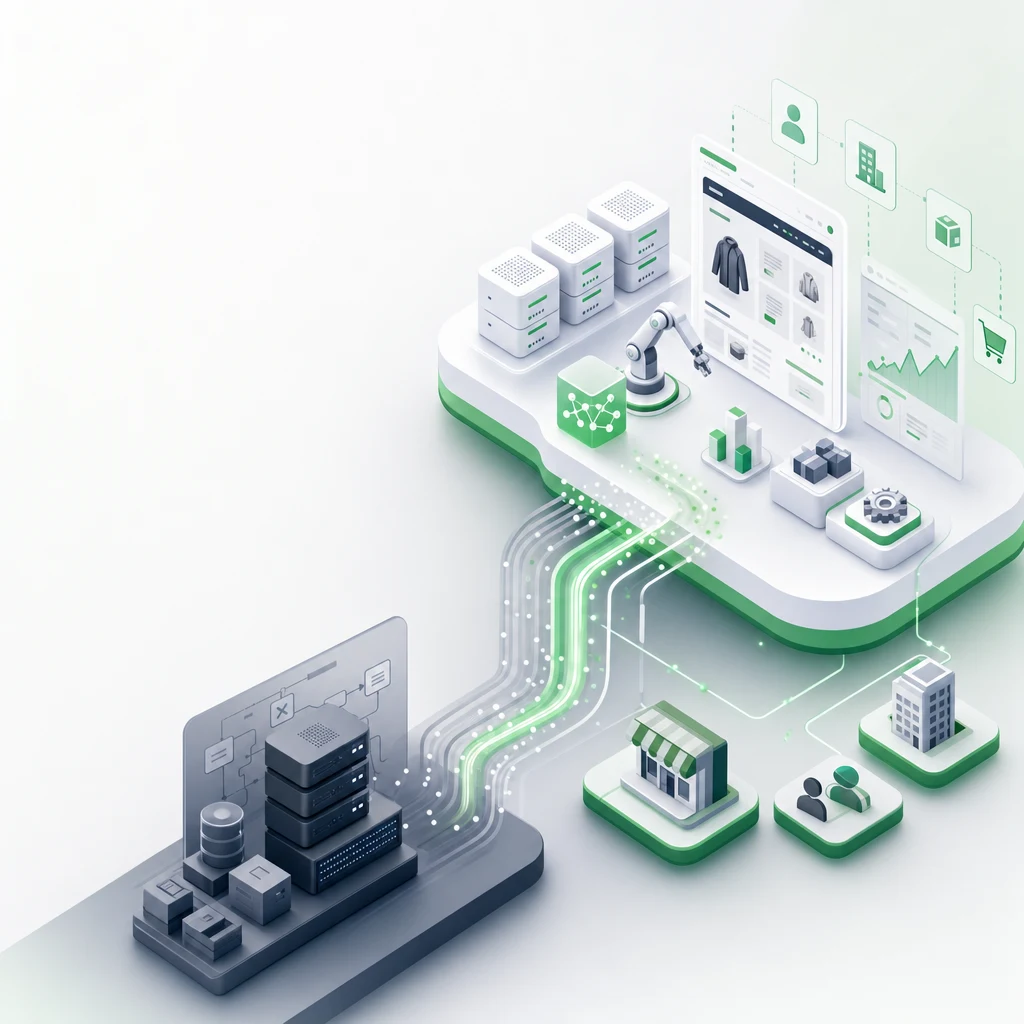
For B2B clients, we structure stores in 4 components:
-
Commerce (Storefront)
- Tiered pricing by volume
- Account-based checkout
- Quote request capability
-
Fulfillment (Operations)
- Made-to-order or just-in-time inventory
- Lead time transparently displayed
- Custom fulfillment workflows
-
Finance (Payments & Terms)
- Net-30/Net-60 invoicing
- Auto-renewal / subscription orders
- Chargeback protection
-
Relationships (CRM)
- Account dashboard (order history, invoices, contacts)
- Dedicated account manager (email, Slack, phone)
- Quarterly business reviews (QBR) for top 10%
Most B2B merchants see 2–3x improvement in retention and 20–30% increase in average order value within the first year.
Closing: B2B and B2C Aren't the Same Game
B2C optimizes for impulse and speed. B2B optimizes for verification and relationship. The platforms, pricing, fulfillment, and buyer psychology are fundamentally different.
Pick your model. If you're hybrid, consider running separate storefronts. Build the right infrastructure from the start. You'll avoid the costly mistakes of trying to optimize for both.
Ready to build your B2B or B2C Shopify store? Let's talk about your business model and infrastructure.