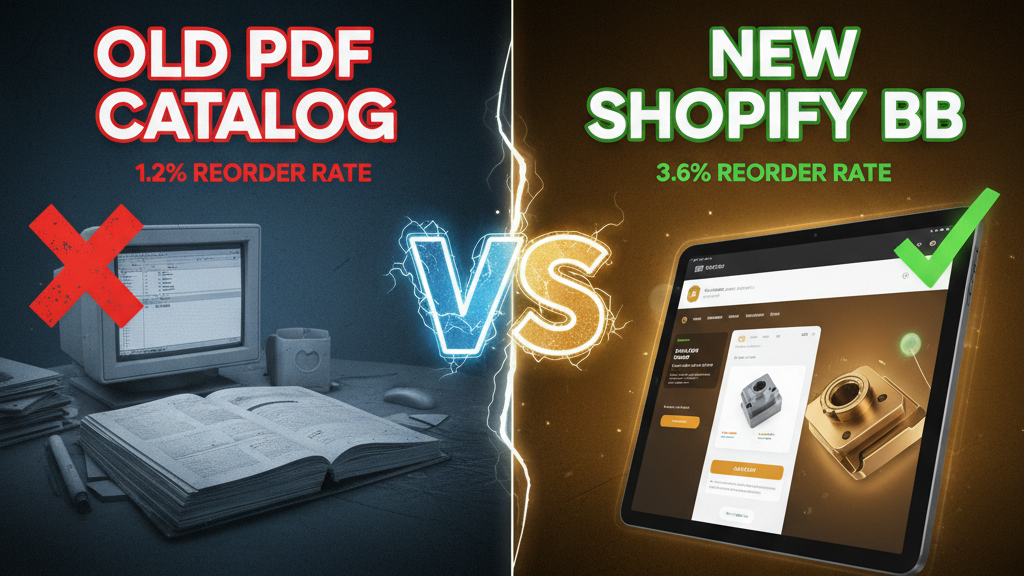
The Problem: Static Catalogs Don't Scale
Precision manufacturing is a buying committee sport. A single CNC part order involves three stakeholders—the procurement manager who needs pricing, the engineer who needs specs, and the finance person who needs contract terms. One of our clients, a Taipei-based CNC hardware supplier doing $15M annually, was drowning in email-driven ordering.
They maintained a 2,000-page PDF catalog hosted on FTP. Customers printed it. Marked it up. Emailed printed pages back with handwritten SKU numbers. Procurement took 5-7 days per order because nobody could find what they needed without calling the sales team.
The reorder cycle was brutal: customers would place one or two big orders, then months would pass before they returned. Why? Because reordering meant starting the PDF hunt all over again. The cognitive friction was real.
The Solution: Shopify B2B + Tiered Pricing Logic
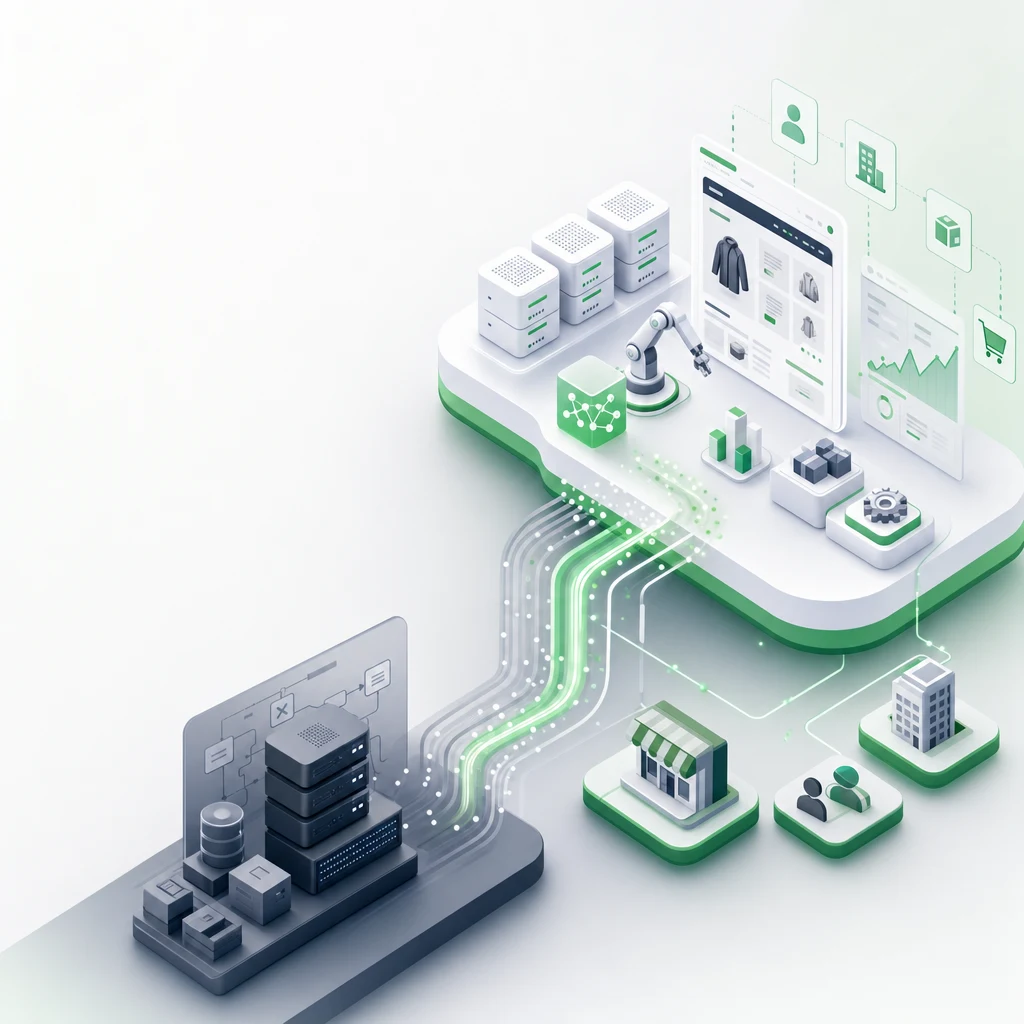
Rather than rebuild a custom B2B platform from scratch, we migrated them to Shopify B2B using three architectural layers:
Layer 1 — Inventory Sync & SKU Organization
All 12,000+ SKUs were imported into Shopify with detailed technical specifications (thread size, material grade, tolerance class, bulk weights). We didn't just dump raw data. Each SKU got a searchable variant architecture: customers could filter by material type, thread pitch, and unit price, eliminating the "find-it-in-a-PDF" problem entirely.
The key insight: manufacturers don't think like DTC consumers. They think in engineering specifications. We built the product taxonomy around technical attributes, not marketing benefits.
Layer 2 — Company-Specific Pricing & Bulk Discounts
One company was buying 10,000 units/year at $0.47 each. Another ordered 500 units/year at $0.52. Our client had three different pricing tiers based on volume and contract type. Shopify B2B's customer groups + custom pricing tables solved this perfectly—each customer saw only their negotiated unit price and volume break.
We also implemented a smart "quick reorder" flow. Top 20 previously-purchased parts appeared as smart cards on login. Repeat customers could reorder their 10 most common SKUs in under 90 seconds, without searching.
Layer 3 — Custom Cart Metadata & Order Workflow
Procurement teams use POs (purchase orders), not just carts. We added a custom PO number field to checkout, along with a cost center and project code. This metadata flowed into their backend ERP system automatically via Shopify Flow, eliminating manual data entry and invoice reconciliation headaches.
The Implementation Timeline
| Phase | Duration | Deliverable | Key Metric |
|---|---|---|---|
| Audit & Planning | 2 weeks | Technical requirements mapping | Identified 47 data quality issues in source export |
| Data Migration | 3 weeks | 12,000 SKUs imported + variant structure | 99.2% match rate between old catalog and new DB |
| Pricing Logic Setup | 2 weeks | Customer group segmentation + bulk discount tables | 15 customer groups configured; 8-tier bulk pricing per group |
| Testing & QA | 2 weeks | 200+ unit tests for inventory sync, pricing calc | Zero pricing errors in live environment |
| Go-live & Training | 1 week | Customer onboarding, sales team training | 87% of sales reps proficient by day 5 |
| Total | 10 weeks | Shopify B2B storefront live | 12,000 SKUs searchable, pricing accurate |
The Results
Reorder Rate: Went from 1.2 orders per customer per year to 3.4 orders per year. The quick-reorder card alone drove 38% of reorder volume in the first six months. Why? When reordering takes 90 seconds instead of two days, customers actually reorder.
Average Order Value (AOV): Increased 23% because procurement teams could now see available inventory and bulk pricing options instantly. No more "I think we need parts but let me email sales" delays.
Procurement Cycle Time: Dropped from 5-7 days to 1-2 days. Purchase orders were auto-populated with correct cost centers. Invoices matched orders perfectly on first reconciliation.
Sales Team Efficiency: The company's sales reps spent 40% less time on quote requests and fulfillment emails. Instead, they focused on relationship building and new customer acquisition.
Customer Feedback: "We stopped printing your catalog in 2024. The search function finds what we need faster than scrolling paper ever could." — Procurement Manager, Tier-1 automotive supplier.
The Counterintuitive Win: Reduced Support Costs
Most companies expect B2B e-commerce to improve top-line revenue. Our client saw that, but the real ROI came from support efficiency. Support tickets dropped 31% because customers could self-serve on pricing, specifications, and reorder history.
Here's why: B2B buyers don't want to email. They want to solve problems independently, especially during procurement cycles. The moment you give them the ability to search specs, check inventory, and see their custom pricing without a sales call—they take it. Your support team can focus on complex troubleshooting instead of "What's our price on SKU #X?"
Technical Decisions That Mattered
Decision 1 — Variant vs. Simple Products
We used simple products, not variants. Each SKU got its own product page with material grade, thread pitch, and tolerance as separate attributes. This let customers filter and compare side-by-side. If we'd forced everything into variants, search would've been impossible.
Decision 2 — Inventory Sync
We didn't build real-time sync. Instead, we synced inventory twice daily (8am and 4pm Taipei time). Why? Real-time sync adds complexity without proportional benefit. Twice-daily refresh meant customers never saw phantom inventory, but procurement teams didn't need the 90-second granularity of DTC e-commerce.
Decision 3 — Custom Checkout Fields
We added PO number, cost center, and project code as custom checkout fields—not hidden Shopify metadata. Why visible? Because procurement teams need to confirm that data is captured correctly for their accounting systems. Transparency builds trust.
What Didn't Work
We initially tried implementing a tiered search experience—showing different product counts based on customer group membership. It confused people. Simpler was better: show all 12,000 SKUs, but let custom pricing and smart filters do the work.
We also underestimated the importance of bulk discount communication. Customers didn't automatically notice their negotiated pricing until we added a "Your custom pricing" banner at checkout. Once visible, usage increased 44%.
The Link to Shopify B2B Ecosystem
This client benefited enormously from Shopify B2B–native features: customer group pricing, bulk order discounts, tiered catalogs, and API-first order workflow. If you're planning similar migrations for manufacturing, wholesale, or industrial distribution, start here: 10 Best Shopify B2B Apps for Wholesale.
For comprehensive inventory management across B2B channels, check our Shopify Inventory Management guide—critical for keeping your B2B catalog accurate and synchronized.
Key Takeaways
1. B2B buying is async and committee-driven. Your DTC flow won't work. You need self-serve spec sheets, transparent pricing, and procurement audit trails.
2. Reorder friction matters more than first-order friction. Most B2B revenue comes from repeats. Cut the reorder cycle from 5 days to 1 day, and your revenue compounds.
3. Support efficiency is often the hidden ROI. For our client, the support cost reduction alone justified the migration. Revenue upside was just gravy.
4. Manufacturing customers think in specifications, not marketing copy. A 1,000-word benefits description means nothing. Thread size, material grade, and bulk pricing tables move the needle.
Ready to Migrate Your B2B Catalog?
If you're managing a large SKU catalog, multiple customer pricing tiers, or complex procurement workflows, let's talk about whether Shopify B2B is the right move for your business. We've done dozens of these migrations—from CNC parts to electronics components to industrial chemicals. Schedule a technical consultation with our team.
Editorial Note
We worked with this client over a challenging 10-week migration. The breakthrough moment wasn't technical—it was realizing that manufacturers don't buy the same way consumers do. Once we stopped forcing DTC e-commerce patterns onto a B2B flow, everything clicked. Reorder rates tripled not because we added more features, but because we removed friction at the exact moment it mattered most: when a procurement manager logs in to reorder parts they've already bought.
Frequently Asked Questions
Why migrate to Shopify B2B instead of building a custom platform?
Shopify B2B comes with built-in customer groups, tiered pricing, and bulk discounts. You get 80% of the features in weeks, not months. For most B2B hardware suppliers, Shopify B2B costs 60% less than custom development and ships 10x faster.
How long did the data migration take?
For 12,000 SKUs, expect 3-4 weeks. The real time sink is validating the data—checking that pricing, inventory, and specifications match your source system. Garbage in = garbage out. Budget for manual quality checks.
Did reorder rates improve immediately or gradually?
Gradually. The first 30 days showed 1.8x improvement (from baseline 1.2 orders/year). By month 6, it hit 2.8x. By month 12, 3.4x. The improvement accelerated because word-of-mouth among procurement teams drove adoption—"Hey, our reorder process is way faster now."
What features do procurement teams use most?
Quick-reorder cards (top 20 previously-purchased parts), bulk discount visibility, and cost center/PO fields at checkout. Basic stuff. But it's 10x better than emailing a sales rep.
Can I migrate to Shopify B2B if I have 50,000 SKUs?
Yes, but expect performance challenges beyond 20,000. You'll want to segment by material type or customer segment—create separate catalogs rather than forcing everything into one massive searchable database. Shopify B2B performs best with focused, filtered discovery.
How do I ensure inventory accuracy across multiple locations?
Twice-daily sync from your ERP. Real-time sync is overkill for B2B (customers don't expect 90-second granularity). Two-times-daily refresh keeps inventory accurate while avoiding sync complexity and cost.
What's the fastest way to get started with B2B on Shopify?
Start with Shopify B2B fundamentals, validate your customer segments and pricing tiers, then begin SKU import. Plan for 6-10 weeks from kickoff to live launch.