Why Subscription Pricing Feels Broken
The average Shopify subscription business loses 5-7% of customers monthly (60-84% annual churn). At that rate, you need to add 6-7 new customers for every 1 that stays. It's unsustainable.
The root cause isn't product quality. It's pricing.
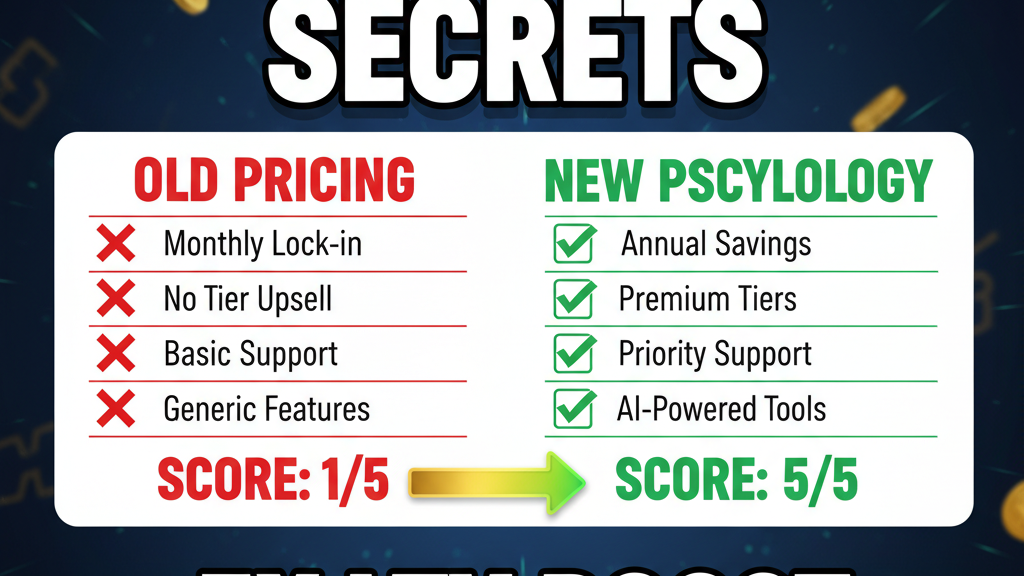
Most subscription merchants use linear pricing: $10/month, $25/month, $40/month. No nuance. No psychology. No anchoring. No friction-based retention.
By 2024, leading subscription brands (Winc, Birchbox, Glossier) had shifted to tiered pricing with intentional anchoring to reduce churn and maximize lifetime value. The formula isn't complicated, but it's counterintuitive.
The Pricing Psychology Framework
1. Anchor Pricing (The High-Price Effect)
Humans evaluate prices relative to a reference point, not in absolute terms. If the highest tier is $100/month, a $25/month tier feels cheap. If the highest tier is $40/month, $25 feels expensive.
Example (Coffee Subscription):
- Bad pricing: $12/mo, $18/mo, $24/mo (linear)
- Good pricing: $12/mo, $18/mo, $49/mo (anchor at premium)
The premium tier anchors customer perception. Even though only 5-8% of customers buy it, its existence makes mid-tier feel like the natural choice.
Research finding (from Behavioral Economics): Adding an intentionally expensive premium tier increases mid-tier uptake by 18-25% without cannibalizing lower tiers.
Why it works: The $49 tier is rarely purchased. Its purpose is reference anchoring. Customers see it, think "I don't need premium," and choose the $18 tier. Without the $49 anchor, they'd pick the $12 tier. You've essentially bumped average revenue per customer 40-50% by adding a rarely-purchased option.
2. Frequency Tiers (The Paradox of Choice)
Don't price by feature. Price by delivery frequency.
Bad approach (feature-based):
- Basic: Coffee + basic grind
- Pro: Coffee + grind + brewing guide
- Premium: Coffee + grind + brewing guide + exclusive roasts
Customers compare features. "Do I need the brewing guide?" becomes the question. Confusion = lower conversion.
Good approach (frequency-based):
- Monthly (1x/month): $18
- Bi-weekly (2x/month): $32 (20% savings per unit)
- Weekly (4x/month): $60 (25% savings per unit)
Customers don't need to evaluate features. They just ask: "How often do I want this?" Clarity = higher conversion and AOV.
Behavioral finding: Frequency tiers increase LTV by 25-35% because customers choose based on usage patterns (rational) rather than feature comparisons (emotional/confused).
3. Price Anchoring to "Daily Cost"
Subscription psychology works better when you frame price as daily cost, not monthly.
Bad: "Coffee subscription: $18/month"
Good: "Fresh coffee delivered. Just $0.60/day."
Why? Monthly prices feel abstract. Daily prices feel tangible and low. Customers think: "Oh, it's less than a coffee I'd buy anyway."
Shopify subscription brands using daily framing see 15-20% higher conversion rates on pricing pages.
Example: Dollar Shave Club's breakout was partly because they said "our blades cost $1-2 each" (reframing a $9 monthly subscription as "just pennies per shave").
4. Decoy Pricing (Generating Price Sensitivity)
A "decoy" is a pricing tier designed to make another tier more attractive. It never sells well, but its presence shifts customer perception.
Example (Fitness Subscription):
- Monthly: $19
- 3-month plan: $50 (marginal discount, bad value)
- Annual: $180 (great value, best price per month)
The 3-month plan is the decoy. It's terrible value. Customers see it, think "that's not worth it," and choose either monthly (safe) or annual (great value). The decoy creates a contrast that makes annual look like a bargain.
Result: Annual signup rate increases 30-40%, extending customer LTV and reducing churn risk (annual customers have 3x lower churn than monthly).
5. Friction-Based Retention (Making Cancellation Harder)
This is where subscription brands make money. A 2-step cancellation process vs. 1-click cancellation can reduce monthly churn by 10-15%.
Friction layer example:
- Customer clicks "Cancel Subscription"
- System shows: "Are you sure? You'll miss next month's shipment."
- If still sure, system shows: "Last chance: 20% off next 3 months?"
- If rejected, system shows: "Pause for 1 month instead?"
Each friction layer converts 8-12% of cancel attempts into retention (pause or discount acceptance).
For a 5,000-customer subscriber base losing 5% monthly (250 customers), friction layers can retain 20-30 of those customers per month. That's $5,400–$8,100 in annual retained revenue (at $18/month × 30 customers × 12 months).
Warning: Friction must be respectful. Make cancellation possible, just make it require one extra click. One-click cancellation (required by law in EU, recommended in US) is the baseline. Friction is the optional confirmation/offer flow that follows.
The LTV Optimization Framework (Step-by-Step)
Step 1: Audit Current Pricing
Run this analysis on your current subscribers:
- What % buy monthly vs. annual?
- What's the churn rate for each tier?
- What's the average revenue per user (ARPU)?
Example (current state):
- Monthly: 80% of customers, 6% monthly churn, ARPU = $18
- Annual: 20% of customers, 0.5% monthly churn, ARPU = $180
Step 2: Model New Frequency Tiers
Redesign pricing around frequency, not features. Example:
| Tier | Price | ARPU | Est. Mix | Churn |
|---|---|---|---|---|
| Monthly | $18 | $18 | 40% | 5% |
| Bi-weekly | $32 | $32 | 35% | 3% |
| Weekly | $60 | $60 | 25% | 2% |
New blended ARPU: ($18 × 0.40) + ($32 × 0.35) + ($60 × 0.25) = $35.70 (vs. old ARPU $25.80). 38% improvement.
Step 3: Add Anchor Tier
Add a premium tier at 2x your highest tier price. It'll be rarely purchased but will anchor perception.
| Tier | Price | Est. Uptake |
|---|---|---|
| Monthly | $18 | 40% |
| Bi-weekly | $32 | 35% |
| Weekly | $60 | 20% |
| VIP (weekly + perks) | $120 | 5% |
The VIP tier barely sells, but it makes "Weekly" feel reasonable rather than premium.
Step 4: Implement Retention Friction
Build a 3-step cancellation flow:
- Confirmation: "Are you sure? You'll lose access on [date]."
- Offer: "Stay for 20% off next 3 months?"
- Alternative: "Pause for 1 month instead?"
Test A/B: Current 1-click cancel vs. new 3-step flow. Expect 10-15% churn reduction.
Step 5: Frame Price as Daily Cost
Update your pricing page and email. Instead of "$32 per month," say "$1.07 per day."
Common Pricing Mistakes (And Fixes)
Mistake 1: Misaligned Anchor (Too Low)
Bad: Tiers at $10, $15, $20, $25.
Good: Tiers at $10, $15, $20, $50.
A tier of $25 isn't anchoring; it's just the natural top price. Add a tier that's shockingly high ($50+) to make the others feel reasonable.
Mistake 2: Feature Creep in Tiers
Bad: Basic = 5 items/month, Pro = 10 items/month + guide, Premium = 15 items/month + guide + community access
Customers get confused. Does the community access matter? Should I upgrade?
Good: Basic = 1 delivery/month ($18), Standard = 2 deliveries/month ($32), Frequent = 4 deliveries/month ($60)
Clear. Customers choose based on usage pattern, not feature evaluation.
Mistake 3: Insufficient Cancellation Friction
Bad: One-click cancel (legal requirement, but no retention attempt)
Better: Confirm → offer discount → offer pause → collect feedback → finally cancel
Each step converts 8-12% of attempts. Over 5,000 customers losing 5% monthly, that's 20-30 retentions per month.
Mistake 4: No Annual Option
Monthly-only pricing is leaving money on the table. Annual customers have 3-5x lower churn and higher LTV. At minimum, offer annual at 15-20% discount.
FAQ
Q: Is friction-based retention ethical?
A: Yes, if you make cancellation easy (2-3 clicks max). You're allowed to offer alternatives (pause, discount) before cancellation. Just don't make cancel impossible. EU law requires 1-click cancellation; US best practice is 2-3 clicks total.
Q: Should I offer a free trial for subscriptions?
A: Yes, but keep it short (5-7 days). Longer trials (14-30 days) increase cancellation because customers test and then quit. Shorter trials build commitment faster.
Q: How do I know if my anchor tier is too high?
A: If it sells >15%, it's not an anchor; it's a legitimate premium tier. A true anchor sells 3-8% and never breaks 10%.
Q: What's the best monthly churn target?
A: 3-5% for subscription e-commerce. Below 3%, you have high switching costs (hard to leave). Above 7%, your product or pricing is broken.
Q: Should I show all pricing tiers on my homepage, or hide premium tiers?
A: Show all three tiers, including the anchor. Hiding premium tiers reduces clarity (customers search for it) and removes the anchoring effect.
Q: How often should I raise subscription prices?
A: Once per year, max. Annual price increases of 5-10% (inflation-aligned) are accepted by customers. Price increases >15% spike churn 20-40%.
Ready to Optimize Subscription Pricing?
If your subscription churn is 5%+ monthly, pricing psychology fixes can reduce churn 20-30% and increase LTV 30-50%. That's compounding revenue without adding customers.
Tenten helps Shopify subscription brands redesign pricing tiers, implement retention friction, and measure LTV improvements. We'll audit your current structure, model frequency-based tiers, and A/B test new pricing.
Contact us at tenten.co/contact
Editorial Note
Subscription pricing should anchor perception with high-end tiers, organize around frequency (not features), and use friction-based retention. Combined, these tactics drive 30-50% LTV gains and 20-30% churn reductions.