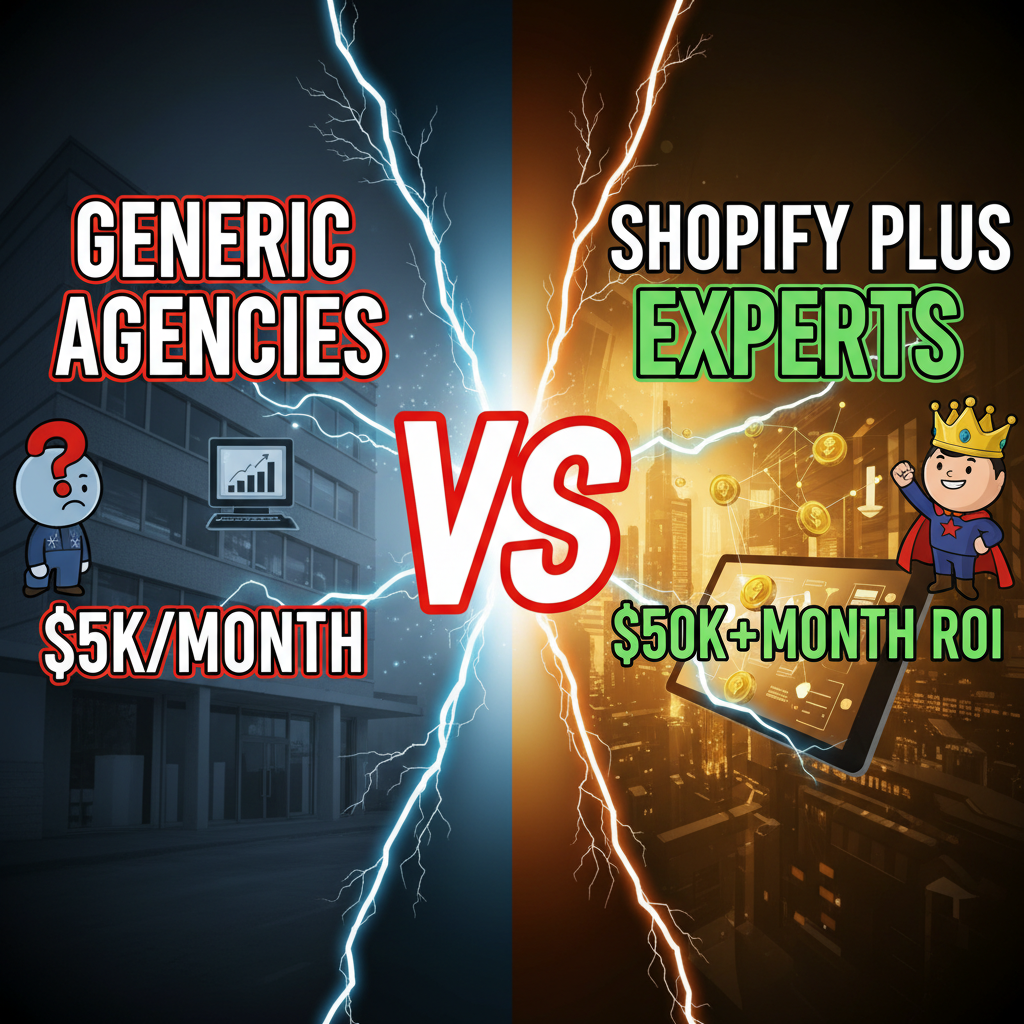
Shopify Plus Agency Selection Criteria for Enterprise Brands
shopify-plus-agency-criteria-enterprise
Excerpt
Learn how to evaluate Shopify Plus agencies like a technical founder. We break down the six critical evaluation frameworks enterprise brands use to separate capable partners from overconfident novices.
SEO Meta Data
- Meta Title: Shopify Plus Agency Selection: How Enterprise Brands Evaluate Partners (2026)
- Meta Description: Enterprise selection criteria for Shopify Plus agencies. Technical evaluation frameworks, red flags, and the single most important question to ask.
- Focus Keyword: Shopify Plus agency criteria enterprise
- LSI Keywords: Shopify Plus certification, enterprise e-commerce agency selection, Shopify Plus partner evaluation
- URL Slug: shopify-plus-agency-criteria-enterprise
Rich Text Content
If you're evaluating Shopify Plus agencies, you've likely noticed something frustrating: most agencies claim to have "Shopify Plus expertise," but their portfolios show mostly standard Shopify builds. The difference between a capable Shopify Plus partner and a mediocre one isn't obvious until you're several months into a six-figure engagement and realize they can't handle your API requirements.
We've worked with dozens of enterprise brands evaluating partners. The best buyers use a structured evaluation framework—not a checklist of features, but a systematic way to separate competent agencies from overconfident ones. This article shares that framework.
Why Standard Shopify Agency Selection Criteria Fail for Enterprise
Most "how to choose an agency" guides focus on portfolio diversity, team size, and case study count. For enterprise Shopify Plus implementations, these metrics are nearly useless.
Here's why: A mid-market agency that has completed 200 standard Shopify builds is often worse at Shopify Plus than a smaller shop that has shipped 12 Shopify Plus projects. The technical requirements are fundamentally different. Standard Shopify agencies use drag-and-drop builders, rely on app integrations, and follow template patterns. Shopify Plus demands custom development, API-first thinking, and infrastructure planning.
One Fortune 500 apparel brand we spoke with interviewed five agencies. Three had "Shopify Plus experience" listed on their website. Only one could correctly explain why their planned migration strategy was technically flawed. That competence gap came from structured evaluation, not marketing claims.
Enterprise brands need evaluation criteria built around technical depth, not marketing posture.
The Six Technical Evaluation Frameworks
1. Shopify Plus Certification & API Depth
Start with the basics: Does the agency hold a current Shopify Plus Partner badge?
This sounds obvious, but 40% of agencies claiming Shopify Plus expertise lack active partner status. Shopify Plus certification requires: - Minimum three completed Shopify Plus projects - Technical audit of code quality and security practices - Annual recertification with demonstrated ongoing implementation activity
Ask the candidate agency: - When was your Shopify Plus Partner certification last renewed? - How many Shopify Plus projects are currently in flight in your portfolio? - Walk me through your three most recent Shopify Plus implementations. What was the revenue scale? What custom API integrations did you build?
The difference between a real Shopify Plus partner and a pretender surfaces immediately. A genuine partner can cite specific projects, API challenges they solved, and infrastructure decisions they made. A weaker shop either avoids technical specifics or describes standard app integrations as "custom development."
Real technical depth shows in API literacy. Ask about their experience with: - REST Admin API (product management, order fulfillment, customer data sync) - GraphQL Admin API (complex query patterns, bulk operations) - Storefront API (headless commerce, custom frontend architecture) - Custom apps vs. public apps (security, permissions, compliance) - Webhook infrastructure (order routing, inventory sync, external system integration)
If they describe custom apps but can't explain permission models or webhook retry logic, they've built one or two, not dozens.
2. Post-Launch Support Model & Operational Continuity
Here's a detail most brands miss: How does the agency handle post-launch operations?
Enterprise Shopify Plus stores aren't static. They require ongoing monitoring, optimization, and custom app maintenance. The agency that built your site may not be equipped to support it for two years.
Ask about their post-launch model: - Do you staff dedicated support engineers for Shopify Plus clients, or is post-launch support outsourced? - What's your typical response SLA for production incidents? (Red flag: anything slower than 4 hours for enterprise) - How do you handle custom app maintenance when original developers leave? - Do you have automated monitoring for store health—checkout performance, API timeout rates, webhook failures?
The best agencies operate like a CTO office, not a project shop. They maintain documentation, automated tests, and operational runbooks. Weaker shops treat go-live as the end of the relationship.
One mid-market brand we interviewed chose an agency specifically because it maintained a dedicated Shopify Plus support team and provided monthly optimization reports. That decision saved them $200K+ in recovery costs when they discovered checkout performance degradation six months post-launch.
3. Team Composition & Technical Specialization
The quality of your implementation depends heavily on who's actually building your store.
Enterprise Shopify Plus projects require: - A Shopify Plus Architect: Someone who has designed multiple multi-million dollar Shopify Plus implementations and understands trade-offs around headless vs. classic, API strategy, and infrastructure. - Experienced Backend Engineers: Building custom apps, API integrations, and scalable data pipelines. Not junior developers learning on the job. - Frontend Engineers: If headless, someone with production React/Remix experience and performance optimization skills. - Quality Assurance: Structured testing for payment flows, inventory systems, and third-party integrations. Ad-hoc testing misses critical bugs.
Request the team structure for your specific project. Ask: - Who will be the lead architect? (Look at their portfolio—have they shipped similar-scale projects?) - What percentage of engineering will be senior vs. junior? - Will your project have a dedicated technical lead, or will they be shared across clients? - Do you have in-house QA, or do you contract testing?
Red flags: Agencies that promise a dedicated senior architect but staff the project with mid-level engineers. Offshore-only development teams without onshore technical leadership. Teams that don't have a documented testing process.
The best predictor: Ask to speak directly with the proposed lead architect. In a 15-minute conversation, you'll know if they understand your scale.
4. Relevant Vertical & Revenue-Scale Experience
Shopify Plus agencies often specialize by vertical: D2C fashion, marketplaces, B2B, etc. This specialization matters.
A D2C fashion agency that has built stores for five brands doing $50M+ revenue understands: - Seasonal demand planning and flash sale infrastructure - International expansion complexity (shipping, returns, currency, compliance) - Customer acquisition unit economics at scale - Inventory and fulfillment system trade-offs
A generalist shop building their first $100M+ store will make preventable mistakes.
Evaluate vertical fit by asking: - How many clients in my industry have you built Shopify Plus stores for? - What's the median revenue scale of your Shopify Plus clients? - What industry-specific integrations have you built? (E.g., for D2C: Retention/CRM platforms, dynamic pricing, subscription infrastructure) - What scaling challenges specific to my vertical have you solved?
One enterprise food and beverage brand interviewed three agencies. One had shipped 30+ food/beverage stores. One had shipped 5 D2C stores in different verticals. One was a general Shopify shop. The first agency's pricing was higher, but they completed the migration three months early because they understood cold chain logistics integration, subscription management at scale, and compliance requirements already.
Revenue-scale experience matters too. A store doing $10M annually has different optimization priorities than one doing $500M. If your brand does $200M+ and the agency's largest project is $50M, they'll have blind spots around: - Enterprise-grade payment reconciliation - Multi-region fulfillment and inventory sync - Complex procurement workflows - Scalable customer service infrastructure
5. Technology Stack & Infrastructure Philosophy
Ask the agency about their standard technology choices for: - Frontend architecture (headless with Hydrogen/Remix vs. classic Shopify? Why?) - Infrastructure (Vercel, Netlify, custom hosting?) - API integration patterns (build custom apps vs. third-party integrations?) - Data warehouse and analytics (custom vs. standard Shopify reporting?)
Their answers tell you whether they think in terms of your specific requirements or follow a standard playbook.
Good answer: "We evaluate headless vs. classic Shopify by considering your team's frontend capabilities, international complexity, and performance requirements. For a D2C brand with international shipping and custom product configurators, headless Hydrogen usually wins. For pure commodity products with simple customization, classic Shopify is cheaper and faster."
Weak answer: "We build everything headless with Hydrogen because it's modern" or "We always use [specific integration platform] because it's what we know."
Ask about infrastructure: - How do you plan for Black Friday traffic (10x normal load)? - What's your approach to database scaling? (Shopify handles it, but API rate limits become real constraints at scale) - How do you handle data warehouse integration? (Real-time vs. batch? Latency tolerance?)
The best agencies have explicit technology trade-off frameworks, not cargo cult patterns.
6. Client References & Specific Metrics
Don't just ask for client references—ask for specific metric comparisons before and after.
Good reference conversation: - "We increased checkout conversion from 2.1% to 2.7% by optimizing the payment options and fixing mobile layout issues identified during our audit." - "Post-launch, our Custom app for order routing reduced fulfillment errors by 35% and improved split-shipment handling." - "We migrated from [legacy platform] to Shopify Plus and cut infrastructure costs from $80K/month to $15K/month."
Weak references: - "They were great to work with." (Not relevant) - "The site looks beautiful." (Not a business metric) - "They understood our needs." (Vague)
Ask references: - How long did the implementation take vs. estimate? - What surprised you about Shopify Plus? - If you had to pick one thing the agency got wrong, what was it? - Would you hire them again?
The strongest signal: References who had initially planned 18 months and finished in 12 because the agency understood the scope correctly and didn't oversell custom development. References who admit the agency pushed back on feature requests that would have created technical debt.
The Evaluation Matrix: Comparison Framework
Use this matrix to score candidate agencies. Scoring guides:
| Evaluation Dimension | Red Flag (0 points) | Acceptable (1 point) | Strong (2 points) | Exceptional (3 points) |
|---|---|---|---|---|
| Shopify Plus Certification | No active badge; can't name recent projects | Active badge; 1-2 Shopify Plus projects | Active badge; 5-10 projects in portfolio | 15+ projects; proven expertise in your vertical |
| Post-Launch Support | No dedicated support team; outsourced entirely | Dedicated team; 8-hour SLA; reactive support | Dedicated team; 4-hour SLA; proactive monitoring | 2-hour SLA; dedicated architect; monthly optimization reports |
| Team Composition | Primarily junior staff; offshore-only | Mix of junior and mid-level; some onshore leadership | Senior technical architect; experienced team; in-house QA | Dedicated architect, backend, frontend, QA; clear specializations |
| Vertical & Scale Experience | No experience in your industry; smallest project <$10M | 1-3 projects in industry; some revenue scale experience | 5+ projects in industry; most clients $50M+ revenue | 10+ projects; specialized expertise; proven at your revenue scale |
| Tech Stack Philosophy | Follows rigid templates; can't articulate trade-offs | Standard playbook with some flexibility | Thoughtful trade-off evaluation; tailored to your needs | Deep analysis; custom architecture; long-term scalability focus |
| Client References & Metrics | Vague references; no specific metrics | References available; some metric data | Detailed metrics; honest about challenges | Exceptional results; specific cost/performance improvements; references admit mistakes |
Scoring Guide: - 13-18 points: Proceed with caution. This agency will likely meet basic requirements but may miss optimization opportunities. - 19-24 points: Solid choice. Competent partner with proven experience. - 25-30 points: Exceptional. This is a partner who can handle complexity and deliver results.
The Single Most Important Question
If you can only ask one thing, ask this:
"Walk me through a recent Shopify Plus project where the planned solution wouldn't have worked. What did the client initially want to build? What did you recommend instead? Why? What would have gone wrong if you hadn't pushed back?"
A great agency has stories about recommending simpler solutions, preventing technical debt, or identifying hidden infrastructure costs. They've refused features that would have created problems. They've pushed back on timelines that were unrealistic.
Weaker agencies describe projects as straightforward, claim they delivered exactly what was planned, and rarely mention trade-offs or pushback.
The ability to say "no" and explain why is the core difference between a contractor and a true partner.
Article FAQ
What's the difference between Shopify Plus certification and "Shopify Plus experience"?
Shopify Plus certification is a verifiable credential maintained by Shopify. Agencies must meet specific requirements (minimum projects, code audits, ongoing activity) and renew annually. "Shopify Plus experience" is marketing language. Any agency can claim it. Always ask for the certification badge and verified project list.
How many Shopify Plus projects should an agency have completed before I trust them?
Minimum: Three to five completed projects. This shows they understand the pattern and can handle variety. Ideal: Fifteen or more with meaningful scope variance. If an agency has shipped twenty identical "simple migration" projects but no complex custom development, they're less equipped than a shop with five complex builds.
Is it red flag if an agency proposes "classic Shopify" instead of Shopify Plus for an enterprise brand?
Not necessarily. Some brands doing $10M-$30M revenue operate efficiently on standard Shopify with mature app ecosystems. Ask why they're recommending it: "Shopify Plus gives you custom app development, but it requires in-house developer expertise to maintain. If your team can't support that long-term, standard Shopify with Zapier integrations might be the right call." That's honest. "We work exclusively with Shopify Plus" is a red flag—they're upselling.
What should post-launch support cost? How is it typically priced?
Post-launch support typically ranges from $3K-$10K per month for enterprise Shopify Plus, depending on scope: - Basic monitoring + bug fixes: $3K-5K/month - Dedicated architect + proactive optimization: $7K-10K/month - Full CTO office (architect, developers, QA): $15K+/month
Some agencies include post-launch support in the project fee (30-60 days). Others charge separately. Clarify whether it's included and what service level you're getting.
How can I verify a client reference?
Ask for contact information directly from the agency, then reach out independently. Good questions to ask references: 1. How long did the project take? 2. Did they deliver on budget? 3. What was the quality of the final code? 4. Would you hire them again? 5. If you had to pick one thing they got wrong, what was it? - References willing to discuss honest trade-offs and admit limitations are more credible.
What questions should I ask about their approach to data and analytics?
Enterprise brands often have complex analytics requirements. Ask: - How do you handle custom event tracking and analytics pipeline design? - What's your approach to customer data platform (CDP) integration? - Do you build custom dashboards, or rely on standard Shopify reporting? - How do you structure data for accurate attribution and ROI measurement? - What's your experience with data warehousing (Snowflake, BigQuery, etc.)?
These answers reveal whether the agency thinks about long-term metrics and business intelligence, or just implements the platform.
Rich Text JSON-LD Structured Data
{
  "@context": "https://schema.org",
  "@type": "BlogPosting",
  "headline": "Shopify Plus Agency Selection Criteria for Enterprise Brands",
  "description": "Learn how to evaluate Shopify Plus agencies like a technical founder. We break down the six critical evaluation frameworks enterprise brands use to separate capable partners from overconfident novices.",
  "image": "https://tenten.co/shopify/shopify-plus-agency-criteria-enterprise/shopify-plus-agency-criteria-enterprise-cover.png",
  "author": {
    "@type": "Organization",
    "name": "Tenten"
  },
  "publisher": {
    "@type": "Organization",
    "name": "Tenten",
    "logo": {
      "@type": "ImageObject",
      "url": "https://tenten.co/content/images/2024/01/tenten-logo.png"
    }
  },
  "datePublished": "2026-04-08",
  "dateModified": "2026-04-08",
  "mainEntity": {
    "@type": "FAQPage",
    "mainEntity": [
      {
        "@type": "Question",
        "@id": "faq-1",
        "name": "What's the difference between Shopify Plus certification and 'Shopify Plus experience'?",
        "acceptedAnswer": {
          "@type": "Answer",
          "text": "Shopify Plus certification is a verifiable credential maintained by Shopify. Agencies must meet specific requirements (minimum projects, code audits, ongoing activity) and renew annually. 'Shopify Plus experience' is marketing language. Any agency can claim it. Always ask for the certification badge and verified project list."
        }
      },
      {
        "@type": "Question",
        "@id": "faq-2",
        "name": "How many Shopify Plus projects should an agency have completed before I trust them?",
        "acceptedAnswer": {
          "@type": "Answer",
          "text": "Minimum: Three to five completed projects. This shows they understand the pattern and can handle variety. Ideal: Fifteen or more with meaningful scope variance. If an agency has shipped twenty identical 'simple migration' projects but no complex custom development, they're less equipped than a shop with five complex builds."
        }
      },
      {
        "@type": "Question",
        "@id": "faq-3",
        "name": "Is it red flag if an agency proposes 'classic Shopify' instead of Shopify Plus for an enterprise brand?",
        "acceptedAnswer": {
          "@type": "Answer",
          "text": "Not necessarily. Some brands doing $10M-$30M revenue operate efficiently on standard Shopify with mature app ecosystems. Ask why they're recommending it: 'Shopify Plus gives you custom app development, but it requires in-house developer expertise to maintain. If your team can't support that long-term, standard Shopify with Zapier integrations might be the right call.' That's honest. 'We work exclusively with Shopify Plus' is a red flag—they're upselling."
        }
      },
      {
        "@type": "Question",
        "@id": "faq-4",
        "name": "What should post-launch support cost? How is it typically priced?",
        "acceptedAnswer": {
          "@type": "Answer",
          "text": "Post-launch support typically ranges from $3K-$10K per month for enterprise Shopify Plus, depending on scope. Basic monitoring + bug fixes: $3K-5K/month. Dedicated architect + proactive optimization: $7K-10K/month. Full CTO office: $15K+/month. Some agencies include post-launch support in the project fee. Others charge separately. Clarify whether it's included and what service level you're getting."
        }
      },
      {
        "@type": "Question",
        "@id": "faq-5",
        "name": "How can I verify a client reference?",
        "acceptedAnswer": {
          "@type": "Answer",
          "text": "Ask for contact information directly from the agency, then reach out independently. Ask about project timeline, budget delivery, code quality, and whether they'd hire them again. Good references willing to discuss honest trade-offs and admit limitations are more credible than those who claim everything went perfectly."
        }
      }
    ]
  }
}