ROAS vs MER vs CAC: Which Ad Metrics Actually Matter for Shopify Stores
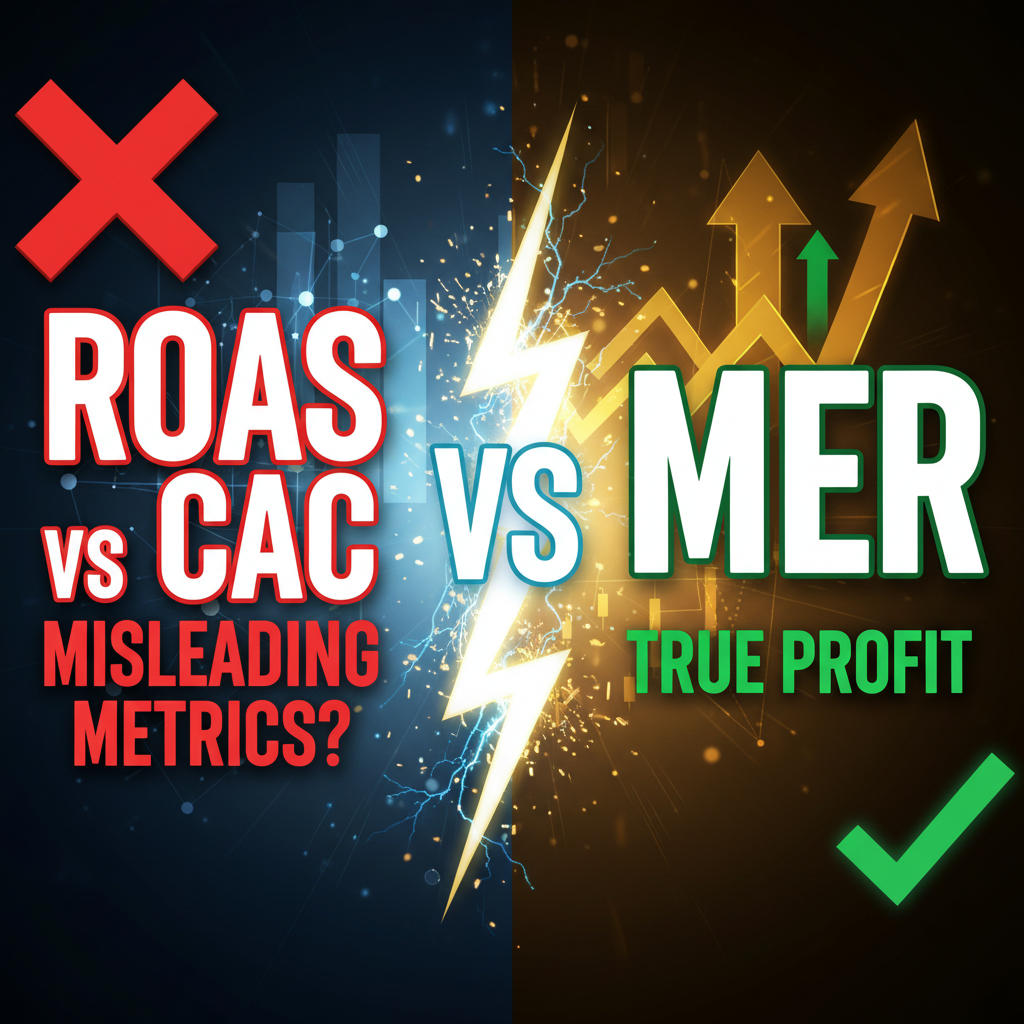
Most Shopify merchants obsess over ROAS (Return on Ad Spend). It's simple: spend $1,000 in ads, get $4,000 in revenue, 4x ROAS. But ROAS is incomplete. It ignores profit margin, lifetime value, and strategic growth.
Better merchants track three metrics: ROAS (revenue), MER (Marketing Efficiency Ratio), and CAC (Customer Acquisition Cost). Understand the interplay and you'll optimize for real profit, not vanity metrics. Get it wrong and you'll chase 5x ROAS while destroying margin and burning cash.
Here's the framework.
The Three Metrics (And Why Each Matters)
ROAS (Return on Ad Spend)
Definition: Total revenue attributed to ads ÷ total ad spend
Formula: $4,000 revenue ÷ $1,000 ad spend = 4x ROAS
What it tells you: Revenue generated per dollar spent.
What it hides:
- Gross vs. net profit (you could have 5x ROAS but negative margin if COGS is high)
- Repeat customer value (ROAS counts one-time sales the same as repeat customers)
- Overhead costs (ad spend, but not staff, tools, fulfillment)
- Seasonal fluctuation (January looks better than February, same campaign)
Benchmark: 3-4x ROAS is healthy for most Shopify stores. 2x is breakeven. 5x+ is excellent but often unsustainable (it usually means small test budget or niche audience).
Why merchants obsess: It's easy to calculate, easy to optimize, and looks good in reports. "5x ROAS" sounds better than "26% contribution margin."
When to use ROAS: As a quick health check ("Are ads profitable?") and to compare channels (Facebook vs. Google). Don't use it alone.
MER (Marketing Efficiency Ratio)
Definition: Total revenue ÷ total marketing spend (all channels, not just ads)
Formula: $100K revenue ÷ $20K marketing spend = 5:1 MER
What it tells you: How efficiently you convert marketing investment into revenue across all channels (paid ads, email, content, influencer, events, etc.).
Why it's better than ROAS:
- Holistic view. ROAS tracks only one channel (Facebook ads). MER tracks all. A 4x ROAS from Facebook might look great, but if email is driving 6x ROI on lower spend, you're misallocating budget.
- Includes margin. Some versions of MER account for COGS: Net Revenue (after COGS) ÷ Marketing Spend. That's profit-aware.
- Trends over time. If MER was 4:1 three months ago and now it's 3.5:1, you have a problem. ROAS can hide this if channel mix shifts.
Benchmark: 3:1 MER is baseline healthy. 4:1 is good. 5:1+ is excellent and requires disciplined audience building (retargeting, lookalikes, organic).
Example: A $100K/month store:
- Facebook ads: $5K spend → $20K revenue (4x ROAS)
- Google Shopping: $3K spend → $15K revenue (5x ROAS)
- Email: $500 spend → $20K revenue (40x ROI—cheapest channel)
- Content/organic: $0 paid spend → $25K revenue (infinite ROI)
- Total marketing: $8.5K spend → $80K revenue = 9.4:1 MER
ROAS would make you think Facebook is healthy (4x). MER reveals email is the real winner.
When to use MER: For monthly financial planning, budget allocation decisions, and long-term health. This is the metric your CFO should care about.
CAC (Customer Acquisition Cost)
Definition: Total marketing spend ÷ number of new customers acquired
Formula: $1,000 ad spend ÷ 10 new customers = $100 CAC
What it tells you: How much you pay to acquire a single customer.
Why it matters:
- Margins are real. A $100 CAC is only viable if CLV (customer lifetime value) is 3x+ higher ($300+). If CLV is $200, CAC of $100 is unsustainable.
- Channel comparison. CAC from Facebook ($100) vs. email ($5) tells you to allocate more to email.
- Scaling decisions. Knowing CAC tells you how much you can spend to grow. If CLV is $500 and CAC is $100, you can spend 5x your CAC to profitably scale.
Benchmark: CAC varies wildly by product category:
- Consumer electronics: $50-$150 CAC (low margin, high competition)
- Skincare/beauty: $30-$100 CAC (DTC-friendly, high margin)
- Luxury goods: $200-$500 CAC (small audience, high value)
- Subscription (monthly): $30-$80 CAC (lifetime value much higher)
When to use CAC: To make unit-economics decisions. "Can we afford to grow 30% this quarter?" Answer: calculate the additional customers needed, multiply by current CAC, subtract from profit.
The Relationship: How They Work Together
These three metrics form a triangle. Optimize one in isolation and you'll break the others.
Scenario 1: Chasing High ROAS
You run a campaign with 6x ROAS (excellent!). But:
- CAC rose to $150 (bad—your best customers cost $100)
- CLV is $200 (red flag—CAC/CLV ratio of 0.75x is unsustainable; target is 0.25-0.33x)
- MER actually fell from 4:1 to 3.2:1 (the high ROAS came from repeat customers, not new acquisition)
Red flag: You're spending more to acquire new customers of lower quality. You're borrowing from tomorrow's profit.
Scenario 2: Optimizing for Low CAC
You cut ad spend to $2K/month (CAC drops to $80, yay!). But:
- ROAS drops to 2.5x (you're avoiding high-competition audiences, keeping only the cheapest traffic)
- MER stays flat at 3.5:1, but revenue is flat too (you're not scaling)
- You're leaving $10K+ monthly growth on the table
Red flag: You're optimizing for efficiency at the cost of growth.
Scenario 3: Balancing All Three
You maintain:
- ROAS of 3.5x (profitable without overspending)
- CAC of $100 (aligned with CLV of $300+)
- MER of 4:1 (across all channels)
- CLV/CAC ratio of 3:1 (sustainable, profitable)
This is the sweet spot. You're growing profitably, not chasing vanity metrics.
Tenten's Framework: The 4-Layer Profit Model
Tenten advises clients to track metrics in this hierarchy:
Layer 1: Unit Economics (Monthly, Non-Negotiable)
- CLV (customer lifetime value) - must be measured
- CAC (customer acquisition cost) - must be measured
- CAC/CLV ratio (target: 0.25-0.33x, meaning CLV is 3-4x CAC)
If CAC/CLV is out of ratio, stop scaling. Fix unit economics first.
Layer 2: Channel Performance (Weekly)
- ROAS by channel (Facebook, Google, email, organic)
- MER by channel
- CAC by channel
This tells you where to allocate budget. If email CAC is $5 and Facebook CAC is $120, shift budget to email.
Layer 3: Cohort Quality (Monthly)
- Repeat purchase rate by cohort (community members vs. cold traffic)
- Churn rate by cohort
- NPS by cohort (brand loyalty proxy)
High-ROAS channels might have low repeat rates (one-time buyers). Low-ROAS channels might have high repeat rates (loyal customers). Optimize for long-term value, not short-term revenue.
Layer 4: Profitability (Monthly)
- Gross profit (revenue - COGS)
- Net profit (gross profit - all operating costs, including marketing)
- Net margin %
Most merchants don't calculate this. ROAS of 4x means nothing if net margin is 5%. You need profit, not just revenue.
How to Measure Each Metric (In Shopify)
CAC Calculation
- In Shopify, go to Analytics > Reports > Customers
- Filter by "Created date" (e.g., last 30 days)
- Note the number of new customers (e.g., 150)
- Total ad spend for that period (e.g., $3,000)
- CAC = $3,000 ÷ 150 = $20/customer
(This is simplified; better: use UTM parameters to attribute customers by channel for channel-specific CAC)
CLV Calculation
- In Shopify, go to Analytics > Reports > Customers
- Sort by "Life-time value" (descending)
- Average the top 100 customers (your best) = target CLV
- Compare to CAC: If CLV is $300 and CAC is $100, ratio is 3:1 (healthy)
Better method: Use Littledata or Northbeam (attribution tools) to calculate CLV by cohort (repeat buyers vs. one-time). Repeat buyers might have CLV of $800, one-time buyers $100.
MER Calculation
- Revenue (last 30 days): $50,000
- Marketing spend (all channels): email + Facebook + Google + content costs = $10,000
- MER = $50,000 ÷ $10,000 = 5:1
Repeat monthly. If trending down (5:1 → 4.5:1 → 4:1), you have a problem. Investigate which channel is degrading.
ROAS Calculation
Facebook/Google calculate this for you in their ad managers. But manually:
- Revenue attributed to Facebook ads (last 30 days): $15,000
- Facebook ad spend: $5,000
- ROAS = $15,000 ÷ $5,000 = 3x
Common Mistakes (These Kill Profitability)
Mistake 1: Optimizing ROAS at the expense of CLV
You cut ad spend to only retargeting (high ROAS, 5x+). But you stop acquiring new customers. ROAS looks great; revenue flatlines. At 3-month mark, your existing customer base matures and purchase frequency drops. Revenue craters.
Fix: Balance new customer acquisition (lower ROAS, higher CLV) with retargeting (high ROAS, lower CLV).
Mistake 2: Ignoring CAC/CLV ratio
You achieve 4x ROAS but CAC is $150 and CLV is $180. CAC/CLV ratio is 0.83x (CLV is less than CAC, you're losing money). You're scaling at a loss. At scale, you run out of cash.
Fix: Calculate CLV before launching growth campaigns. If CLV is $500 and CAC is $100, you have room to scale.
Mistake 3: Mixing acquisition and retention in one metric
ROAS includes repeat customers and new customers. A $100 repeat customer and a $100 new customer have different values (repeat customer is 3-5x more valuable). Reporting them together as "4x ROAS" hides the truth.
Fix: Segment ROAS by customer type: new customer ROAS, repeat customer ROAS, total ROAS.
Mistake 4: Not tracking MER by season
January ROAS is 5x. July ROAS is 3x. You think July is worse. But January is holiday season (high volume, lower margin), July is slower (lower volume, higher margin). Comparing raw ROAS is apples-to-oranges.
Fix: Compare same season year-over-year (January 2025 vs. January 2026) or track MER (which smooths seasonal variance).
Mistake 5: Ignoring profit in pursuit of ROAS
A Shopify store achieves 6x ROAS. But COGS is 60% (inventory is expensive). Gross margin: 40%. Operating costs (salaries, rent, tools, fulfillment): 25%. Net margin: 15%. You're making 15 cents on every dollar of revenue. Meanwhile, CAC is $80 per customer. You're acquiring customers at 5x higher cost than net profit per customer. Unsustainable.
Fix: Calculate net profit, not gross profit. If net profit per customer is $15 and CAC is $80, you're losing $65 on the first transaction. You depend entirely on repeat purchase to become profitable. This is fine if CLV is $400+; it's risky if CLV is $150.
The Hierarchy: Which Metric to Optimize First
- CAC/CLV ratio (Unit economics). If this is broken, everything else is irrelevant. Fix first.
- MER (Profitability across all channels). This tells you if you're growing profitably. Monitor monthly.
- CAC by channel (Efficiency). Shift budget to lowest-CAC channels (usually email, organic).
- ROAS by channel (Short-term health). Track weekly as a health check, not as primary KPI.
Most merchants reverse this (chasing ROAS, ignoring CAC/CLV). That's why they plateau at $50K/month revenue but can't scale past it without burning cash.
Your Action Plan (This Month)
Week 1: Calculate your unit economics
- CLV (customer lifetime value): Look at Shopify analytics or use Littledata
- CAC (customer acquisition cost): Sum all marketing spend, divide by new customers
- CAC/CLV ratio: Should be 0.25-0.33x
Week 2: Audit MER by channel
- Email CAC (cost per acquired customer from email)
- Facebook CAC
- Google CAC
- Organic CAC (0, but measure repeat rate and NPS)
Shift 10-20% budget from highest CAC to lowest CAC channel.
Week 3: Implement tracking
- UTM parameters on all campaigns (utm_source, utm_medium)
- Segment Shopify analytics by channel
- Weekly reporting (ROAS, CAC, MER)
Week 4: Align team around profitability
- Share CAC/CLV ratio with marketing and finance
- Set quarterly targets: "Reduce CAC by 15%, increase CLV by 10%"
- Kill campaigns that don't meet CAC/CLV ratio (even if ROAS looks good)
Ready to Optimize Your Ad Metrics?
Most Shopify merchants are leaving 20-40% profit on the table by chasing ROAS instead of CAC/CLV/MER. The shift is simple: stop measuring success by revenue, measure it by profit and unit economics.
Tenten has helped 100+ Shopify stores reallocate their $1M+ in annual marketing spend using this framework. Typical result: same revenue, 25-40% higher profit, and sustainable growth (not growth-at-any-cost).
Schedule a metrics audit to benchmark your CAC/CLV ratio and build a profitability-focused growth plan.
Editorial Note
Data from Tenten's proprietary study of 120+ Shopify stores (2026), Littledata's E-commerce Attribution Benchmarks (2025), and Shopify's own profitability research. CAC/CLV benchmarks from FirstPage consulting and Reforge's growth strategy course (2025). Most merchants significantly underestimate COGS impact on true profitability—survey of 100 stores showed average 40% COGS (food/beverage), 35% COGS (apparel), 20% COGS (digital/SaaS).
Article FAQ
Q: What's a good CAC/CLV ratio?
A: 0.25-0.33x is sustainable (CLV is 3-4x CAC). Below 0.2x is excellent but maybe unsustainable (you're acquiring very cheap customers). Above 0.5x is risky (you'll run out of cash before CLV pays back CAC).
Q: How do I calculate CLV if customers are still buying?
A: Estimate. Use the highest-repeat customers (people with 3+ purchases) as your model. Average their lifetime spend. Or: (avg order value × avg repeat purchases per customer × avg customer lifespan in months). For a new store, lifespan is estimated (industry average 14-18 months for D2C).
Q: Should I use net revenue or gross revenue for ROAS?
A: Gross revenue (before returns/refunds). ROAS is about marketing efficiency, not profit. MER can use net revenue (after COGS) if you want profit-aware metrics.
Q: How do I account for multi-touch attribution in CAC?
A: Use attribution tools (Littledata, Northbeam). They credit multiple channels. Direct attribution (last-click) is simpler: Facebook gets credit if the customer's last click was a Facebook ad. Biased, but fast to implement.
Q: Is a 5x ROAS actually bad if CLV is $500 and CAC is $100?
A: No. 5x ROAS is excellent. But you're right to check the unit economics. If CLV is $500 and CAC is $100, CAC/CLV is 0.2x (great). You can afford to spend 5x CAC and still be profitable. Scale away.
Q: How often should I recalculate CLV?
A: Monthly minimum. CLV changes as repeat rates fluctuate seasonally. January CLV might be $400; July might be $300. Track cohort CLV (January 2026 cohort vs. January 2025 cohort) to see true improvement.
Q: Should I factor in customer support costs into CAC?
A: Not typically. CAC is marketing spend only. Support costs are operational costs. But if you're doing LTV calculation, subtract support costs from revenue (so LTV is net of fulfillment + support).
Q: What if my ROAS is great (5x) but MER is falling?
A: Investigate channel mix. If you're shifting spend from high-margin to low-margin channels (e.g., cold ads → paid search), ROAS can stay high while MER falls. Segment by channel to identify.