Brand vs Performance Marketing: Why the Split Matters
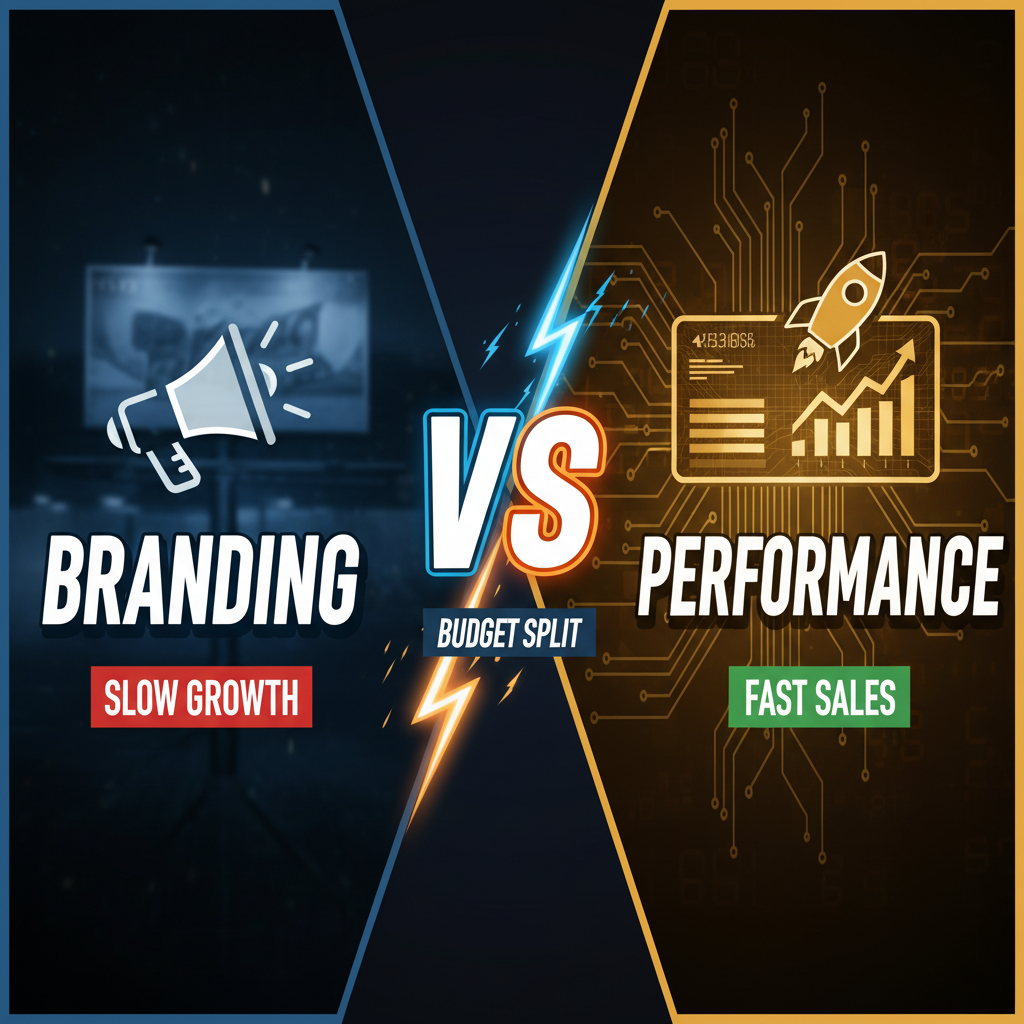
The biggest strategic mistake DTC brands make is simple: they chase performance metrics at the expense of brand strength. A $2M revenue Shopify store might spend 80% of marketing budget on paid search and social ads (performance) and only 20% on brand-building (content, design, story). Within 18 months, customer acquisition costs (CAC) climb 35%, repeat purchase rates drop, and brand defensibility cradles.
This isn't accidental. Performance marketing delivers immediate data: dollar spent, customer acquired, revenue generated. Brand marketing delivers long-term equity without a quarterly attribution label. The psychology is obvious. But the math tells a different story.
Defining the Two Systems
Performance marketing drives immediate conversions. Paid search, social ads, retargeting, email sequences—anything with clear input/output accounting. Average DTC CAC: $35–$75. Revenue per acquisition: $120–$250.
Brand marketing builds preference and defensibility. Content, design systems, community, PR, founder voice—the stuff that makes customers choose you when they have choice. Brand lift (from awareness campaigns) takes 60–90 days to show in conversion data. But once active, it cuts CAC 25–40% and increases repeat purchase lifetime value 40–60%.
The tension: performance marketing is measurable week-to-week. Brand marketing shows ROI in quarters, not days.
The Math Behind Budget Allocation
| Revenue Stage | Brand Budget | Performance Budget | CAC Trajectory | Repeat Purchase LTV |
|---|---|---|---|---|
| $500K | 20% | 80% | Rising 3–5%/Q | $200–$300 |
| $2M | 30% | 70% | Stable to rising 2–3%/Q | $300–$400 |
| $10M | 40% | 60% | Declining 1–2%/Q | $400–$600 |
| $50M+ | 50% | 50% | Stable to declining | $600–$1000 |
This isn't arbitrary. At $500K revenue, you need customer volume. Spend for conversions. But at $2M, you can sustain 25–30% of budget on brand. At $10M, brand becomes your CAC defense—companies that don't invest drop CAC efficiency sharply.
Warby Parker spent 40% on brand (founder storytelling, design, DTC narrative) early. They paid more per customer initially. But CAC stabilized while competitors' CAC climbed. At scale, this was a $100M+ advantage.
Why Performance Alone Breaks Down
Every paid channel has saturation. By 2024, CPM on Facebook Reels climbed 18–24% YoY across DTC categories. Google Search cost-per-click rose 12–15% annually. A store running performance-only will see CAC compound 8–12% annually from channel saturation alone.
The math: a $2M store with $150 CAC spending 100% on performance (say, $400K annual budget) acquires ~2,666 new customers. Next year, with 10% CAC inflation, the same budget acquires ~2,400 customers. In three years, same budget, -15% customer acquisition volume. That's why mature DTC brands panic.
Strong brand work doesn't saturate. Earned media (PR, word-of-mouth, content seeding) scales differently. A viral TikTok costs $0 incremental CAC. A podcast episode you're a guest on reaches 50K relevant listeners for zero media spend. Community building (Discord, Reddit, forums) creates defensible customer stickiness.
The Retailer Example: Brand vs Performance in Action
A mid-market athletic apparel brand started with $2M revenue, 85% performance, 15% brand.
Year 1: $2M revenue, $150 CAC, 200 new customers/month. CAC rising 8%/Q due to channel saturation.
Year 2: They shifted to 65% performance, 35% brand. Hired a content team, started a podcast, built a product design narrative. CAC flattened at $155 (beat inflation). New customers: 210/month. Revenue growth: 18% vs. 12% expected.
Year 3: Maintained 65/35 split. CAC dropped to $135 (brand lift + repeat purchase improved). New customers: 240/month. Repeat purchase rate rose from 25% to 32% due to brand loyalty. Revenue: $3.2M (vs. $2.36M with performance-only trajectory).
The gap: $840K additional revenue from a simple allocation shift.
Building a Brand System Inside Performance
You don't need to choose. The winning move is building brand work inside your performance channels.
Instead of generic product ads (performance-only), create founder storytelling around your paid ads. Build YouTube educational content targeting your search keywords. Host a monthly livestream Q&A (brand) that drives email signups (performance). The boundaries dissolve.
Brands like Allbirds, Brandless, and Rothy's succeeded by embedding brand narrative into paid media. Product origin story in the ad copy. Customer testimonials with real faces (not stock). This isn't brand marketing—it's performance marketing with a face. And it works.
| Tactic | Pure Performance | Hybrid (Brand + Performance) | Pure Brand |
|---|---|---|---|
| Email nurture | Product-focused, discount-driven | Story + product + social proof | Educational, founder voice |
| Paid social | Generic product shot + discount | Founder story, product origin, lifestyle | Awareness only, no CTA |
| Content | Minimal (conversion-focused blog posts) | Pillar + seeded podcast, guides, tutorials | Thought leadership, no CTA |
| CAC | Rising 8–12%/year | Rising 2–3%/year | Flat to declining |
The Allocation Framework
At $500K–$2M: 25% brand, 75% performance. You need cash flow. But invest in founder voice, product narrative, and community to create defensibility.
At $2M–$10M: 35% brand, 65% performance. You can sustain brand investment. Your customer LTV improves, CAC stabilizes, and your paid channels last longer.
At $10M–$50M: 45% brand, 55% performance. Brand is now your moat. Performance is still your growth engine, but brand is what keeps CAC from climbing.
At $50M+: 50%+ brand. You're building defensibility against competitors and private equity acquirers. Performance is efficient. Brand is strategic.
These aren't religious allocations. Test your own CAC curves. If your CAC is rising >10% annually at the same budget, you need more brand. If CAC is flat or declining, your brand is working.
Ready to Scale With a Winning Budget Mix?
Finding the right brand-performance split is how mature DTC brands sustain growth without burning capital on rising CACs. At Tenten, we help Shopify merchants model their marketing mix and forecast customer lifetime value across brand and performance investments. Whether you're optimizing collection pages for performance or building founder authority for brand defensibility, we've got the playbook.
Let's talk about your marketing strategy and what's holding you back. Contact Tenten today.
Editorial Note
The biggest insight we see: DTC founders treat brand and performance as competing systems. In reality, they're symbiotic. Brand work is performance insurance. Performance pays for brand. Start measuring CAC trajectory, not just CAC. Once it rises >8%/year, you've found your signal to shift budget.
Frequently Asked Questions
What's the difference between brand and performance marketing?
Performance marketing drives immediate conversions with measurable ROI (paid ads, email, SEM). Brand marketing builds long-term preference and defensibility (content, founder story, design). Performance is weekly attribution; brand is quarterly equity.
Why do DTC brands spend too much on performance?
Performance marketing shows immediate results: dollar spent, customer acquired. Brand results take 60–90 days to show in conversion data. The psychology favors quick metrics, even if long-term CAC efficiency suffers.
How do I know if my CAC is rising due to saturation?
Track year-over-year CAC at the same budget level. If your budget is flat but CAC rises 8%+/year, channel saturation is real. This signals you need brand work to create defensibility and word-of-mouth growth.
Can small stores (under $1M) afford brand marketing?
Yes, but differently. Start with founder storytelling in product ads, free content (blog, YouTube), and community (Reddit, Discord). These are 0-cost brand tactics that compound. Allocate budget to performance first, but seed brand early.
What's a realistic payback timeline for brand investment?
60–90 days for brand awareness lift to show in conversion metrics. 6–12 months for CAC trends to stabilize. 18–24 months for repeat purchase improvements to compound. Think quarterly, not weekly.