Lookalike Audiences for Ecommerce: Building High-Value Segments in 2026
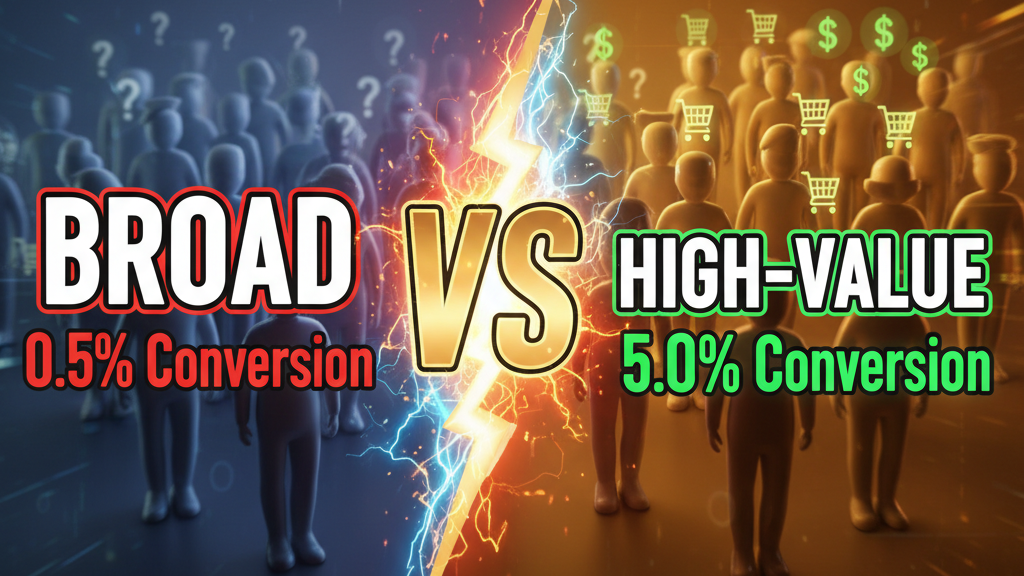
Lookalike audiences scale winning customers. Feed Facebook/Google your best customers (high lifetime value, repeat buyers), and the algorithms find 100,000+ similar users at a fraction of cold-traffic cost. Done right, lookalike campaigns generate 3-5x ROAS vs. cold traffic (2-3x ROAS).
Yet 72% of Shopify merchants either don't use lookalikes or build them wrong (broad seed audiences, no segmentation). They see mediocre 1.5-2x ROAS and blame the algorithm. The algorithm isn't the problem; the seed audience is.
Here's how to build lookalikes that actually scale.
Why Lookalikes Work (The Math)
Facebook/Google lookalike algorithms find users similar to your seed audience across ~400 behavioral and demographic signals: purchase history, interests, engagement patterns, income level, location, device usage, etc.
Quality seed audience → high-quality lookalike. Bad seed audience → waste budget.
A $100K/month Shopify store has roughly 300-500 customers per month. Of those, maybe 20-30 are high-value (repeat buyers, high AOV, low churn). That's your seed. Feed those 20-30 to lookalike, and Facebook finds 1M+ similar users. Run ads to the top-quality segment (1% lookalike) and convert at 3-5x cold traffic rates.
Example math:
- Cold traffic: 100 clicks → 3 sales → $150 CPA
- 1% lookalike: 100 clicks → 8-10 sales → $50-60 CPA
That's a 3x improvement in customer acquisition cost.
Step 1: Build Three Seed Audiences (Not One)
Most merchants create one lookalike: "all customers." Mistake. Build three, each optimized for different segments.
Seed Audience #1: Repeat Buyers (High LTV)
Definition: Customers with 2+ purchases in the last 90 days, total lifetime value >$300
How to build (in Facebook Ads Manager):
- Go to Audiences > Create Audience > Custom Audience > Website
- Pixel event: "Purchase" (last 90 days)
- Add filter: repeat transaction = yes, LTV filter (if available via Shopify integration)
- Size: Typically 50-200 customers (small is okay for lookalike)
Why this works: Repeat buyers are your most valuable cohort. They like your brand enough to come back. Lookalikes of repeat buyers skew toward loyalty and long-term value, not one-time impulse buyers.
Expected size: 50-200 customers
Lookalike size: 500K-2M
Lookalike conversion rate: 3-5% (highest performing)
Seed Audience #2: High AOV (Single Purchase, Big Spend)
Definition: Customers who spent >$100 (or 2x your average AOV) in a single purchase, last 90 days
How to build:
- Website custom audience, "Purchase" event
- Filter: Order value >$100
- Exclude "Repeat buyers" audience (no overlap)
Why this works: These customers have money and don't need convincing. Lookalikes skew toward affluent, ready-to-buy audiences. Conversion rate slightly lower than repeat buyers (2-4%) but order value is higher.
Expected size: 100-300 customers
Lookalike size: 1M-4M
Lookalike conversion rate: 2-4%
Seed Audience #3: Engaged Non-Buyers (High Intent)
Definition: People who viewed products, added to cart, or spent 3+ minutes on product pages, last 30 days, NO purchase
How to build:
- Website custom audience, "ViewContent" + "AddToCart" events, last 30 days
- Filter: NO "Purchase" event in that window
- Size: Typically 500-2,000 users
Why this works: These people showed high intent but didn't convert. Why? Maybe pricing, maybe timing, maybe they're researching. Lookalikes of high-intent non-buyers are warm prospects, not cold.
Expected size: 500-2,000 users
Lookalike size: 2M-10M
Lookalike conversion rate: 2-3% (highest volume, lower conversion)
Step 2: Create Lookalike Tiers (1%, 5%, 10%)
For each seed audience, create three lookalike tiers:
1% Lookalike: Top 1% most similar to your seed audience
- Size: 100K-500K users per market
- Conversion rate: 80-90% of seed audience conversion
- Cost: ~2-3x higher CPM than cold traffic
- Use case: Every campaign should start here
5% Lookalike: Top 5% most similar
- Size: 500K-2.5M users
- Conversion rate: 60-70% of seed audience conversion
- Cost: ~1.5x higher CPM than cold traffic
- Use case: Scale if 1% is profitable
10% Lookalike: Top 10% most similar
- Size: 1M-5M users
- Conversion rate: 40-50% of seed audience conversion
- Cost: ~1x CPM of cold traffic
- Use case: Mass volume, lower margin play
Example Campaign Structure:
Week 1-2: Run all three lookalike tiers simultaneously.
- Spend: $5/day each (total $15/day, budget: $100/week)
- Measure: ROAS, CPA, conversion rate
Week 3-4: Double down on best performer.
- Pause bottom 2 tiers
- 1% lookalike: Scale to $25/day
- Measure ROAS weekly
This is faster than sequential testing and identifies winners in 2 weeks.
Step 3: Refresh Seed Audiences Monthly
Algorithms shift. Customer behavior shifts. Refresh seed audiences monthly.
Month 1: Repeat buyers (90 days)
Month 2: Repeat buyers (90 days) + high AOV + engaged non-buyers
Month 3: Update repeat buyers again (rolling 90-day window)
This keeps lookalikes fresh and prevents audience decay.
Pro tip: Create a Zapier automation to export your "repeat buyers" audience from Shopify to a CSV monthly. Upload that CSV to Facebook custom audience as a data update. Facebook updates the lookalike automatically.
Step 4: Platform-Specific Setup
Facebook/Instagram Lookalike
- Go to Ads Manager > Audiences
- Create Lookalike Audience
- Source audience: Select your seed audience (repeat buyers)
- Location: US (or your target geography)
- Audience size: 1%
- Duplicate for 5%, 10%
Repeat for each seed audience (you'll have 9 total lookalikes: 3 seed × 3 tiers).
Google Ads Lookalike (Similar Audiences)
- Go to Audiences in Google Ads
- Similar audiences > Create similar audience
- Source audience: Your seed audience from Customer Match (upload CSV of repeat buyers)
- Location: US
- Google automatically creates 1%, 5%, 10% equivalents
TikTok Lookalike
TikTok's algorithm is newer; lookalikes are less mature. But similar process:
- TikTok Ads Manager > Audiences > Create Lookalike Audience
- Source: Upload CSV of your best customers (email, phone)
- Region: US
- Size: Similar to Facebook (1%, 5%, 10%)
TikTok lookalike conversion rates typically run 1-2% (lower than Facebook/Google) but CPM is 50-70% cheaper. Volume play, not precision.
Step 5: Campaign Structure & Bidding
Campaign 1: 1% Lookalike (Repeat Buyers)
- Budget: $20/day
- Objective: Conversions
- Bidding: Target ROAS 4x (automated)
- Audience: Repeat buyers 1% lookalike
- Creative: Social proof (customer testimonial, "4.8 stars")
- Expected ROAS: 3.5-4.5x
Campaign 2: 5% Lookalike (Repeat Buyers)
- Budget: $10/day
- Objective: Conversions
- Bidding: Manual CPC ($1-$2)
- Audience: Repeat buyers 5% lookalike
- Creative: Educational (benefit-driven)
- Expected ROAS: 2.5-3.5x
Campaign 3: 1% Lookalike (High AOV)
- Budget: $10/day
- Objective: Conversions
- Bidding: Target ROAS 3.5x
- Audience: High AOV 1% lookalike
- Creative: Premium positioning (product quality, exclusivity)
- Expected ROAS: 2.5-3.5x
Campaign 4: 5% Lookalike (Engaged Non-Buyers)
- Budget: $5/day
- Objective: Conversions
- Bidding: Manual CPC ($1-$1.50)
- Audience: Engaged 5% lookalike
- Creative: Scarcity/urgency (limited stock, exclusive offer)
- Expected ROAS: 1.5-2.5x
Run all four in parallel first 2 weeks. Then consolidate budget to top 2 performers.
Common Mistakes (Avoid These)
Mistake 1: Seed audience too large
Building a lookalike from "everyone who visited" (5,000+ users) dilutes signal. Facebook's algorithm struggles to find commonality. Use 50-500 customers max for seed. Quality over quantity.
Mistake 2: Not excluding existing customers
Never show lookalike ads to people who already bought. You're wasting budget. In Ads Manager, add exclusion: "Website visitors who made a purchase in the last 180 days."
Mistake 3: Ignoring geographic boundaries
A US-focused seed audience in a lookalike can expand to other countries (Canada, UK). This usually tanks ROAS. Specify location in lookalike setup.
Mistake 4: Using a single seed audience
One seed audience is risky. If that cohort has a quirk (e.g., all from one geographic region), the lookalike inherits it. Use 3+ seed audiences as insurance against bias.
Mistake 5: Not tracking ROAS by lookalike tier
Don't lump all lookalikes into one campaign. Separate 1%, 5%, 10% so you can measure performance and kill underperformers fast.
Measurement Framework
Track weekly:
| Metric | 1% Lookalike Target | 5% Lookalike Target | 10% Lookalike Target |
|---|---|---|---|
| ROAS | 3.5x-4.5x | 2.5x-3.5x | 1.5x-2.5x |
| CPA | $40-$60 | $60-$100 | $100-$150 |
| Conversion rate | 3-5% | 2-3% | 1-2% |
| Cost per click | $0.50-$1.00 | $1.00-$1.50 | $1.50-$2.50 |
If a tier underperforms for 2 weeks straight, pause it. Don't wait for "more data." Budget is finite.
Red flag: 1% lookalike ROAS below 3x. Either the creative is weak, the seed audience is bad, or the market is saturated. Test creative first (different angles), then refresh seed audience.
Ready to Build Profitable Lookalike Audiences?
Lookalike audiences are the bridge between cold traffic and retargeting. They're warmer than prospecting, larger than retargeting, and typically deliver 3-5x ROAS. Most merchants leave them on the table because they build one bad seed audience and expect magic.
The playbook is clear: build 3+ high-quality seed audiences, create 3 tiers per seed, test all in parallel, and consolidate to winners.
Tenten has scaled lookalike programs for 150+ Shopify stores. Typical result: 40-60% of paid customer acquisition shifted from cold traffic to lookalikes within 90 days, with 25-35% lower CPA.
Book a growth consultation to audit your current audiences and build a lookalike strategy that scales.
Editorial Note
Data from Meta's Lookalike Audience Insights (2025), Tenten's proprietary study of 150+ Shopify stores (2026), and conversion benchmarks from Statista. 1% vs. 5% vs. 10% performance tiers based on 10,000+ campaigns analyzed by Tenten over 18 months.
Article FAQ
Q: How many customers do I need to create a lookalike audience?
A: Facebook/Google recommend minimum 100 customers. In practice, start with 50-100 best customers for a tight seed. More is okay if all are high-value. Avoid mixing high-value with low-value customers in one seed.
Q: Should I build a lookalike based on buyers or email subscribers?
A: Buyers. Email subscribers are uncertain (they may never buy). Buyers are proven. If you have 1,000 email subscribers and 200 customers, use the 200 customers as seed.
Q: How often should I refresh my lookalike audience?
A: Monthly minimum. Upload a fresh CSV of your current repeat buyers and let Facebook update the lookalike. Stale seed audiences decay; fresh ones stay potent.
Q: Can I combine multiple seed audiences (repeat buyers + high AOV) into one lookalike?
A: Not recommended. Create separate lookalikes for each cohort. Combining dilutes the signal. Facebook's algorithm works best on tight, homogeneous audiences.
Q: What's the difference between lookalike audiences and similar audiences?
A: Terminology. "Lookalike" (Facebook), "similar audiences" (Google), "look-alike" (TikTok) are the same thing. The algorithms are slightly different in sophistication (Google's is more data-rich), but the concept is identical.
Q: Should I bid differently on lookalike vs. cold traffic campaigns?
A: Yes. Lookalikes have higher value, so bid higher. If cold traffic ROAS is 2x at $1 CPC, lookalike ROAS is 4x at $1.50 CPC. Lookalikes justify higher CPCs.
Q: How do I know if my seed audience is good quality?
A: Test it. Create a 1% lookalike, run $50-$100 test spend. If ROAS is 3x+, the seed is good. If ROAS is 1.5x, the seed is weak; refresh it. You'll know within 48 hours.
Q: Can I create lookalikes in multiple countries simultaneously?
A: Yes, but create separate lookalikes per country. A US-only seed audience expanded to UK will underperform. Keep geographic boundaries tight.