Personalization on Shopify: From Generic to 1-to-1 Commerce
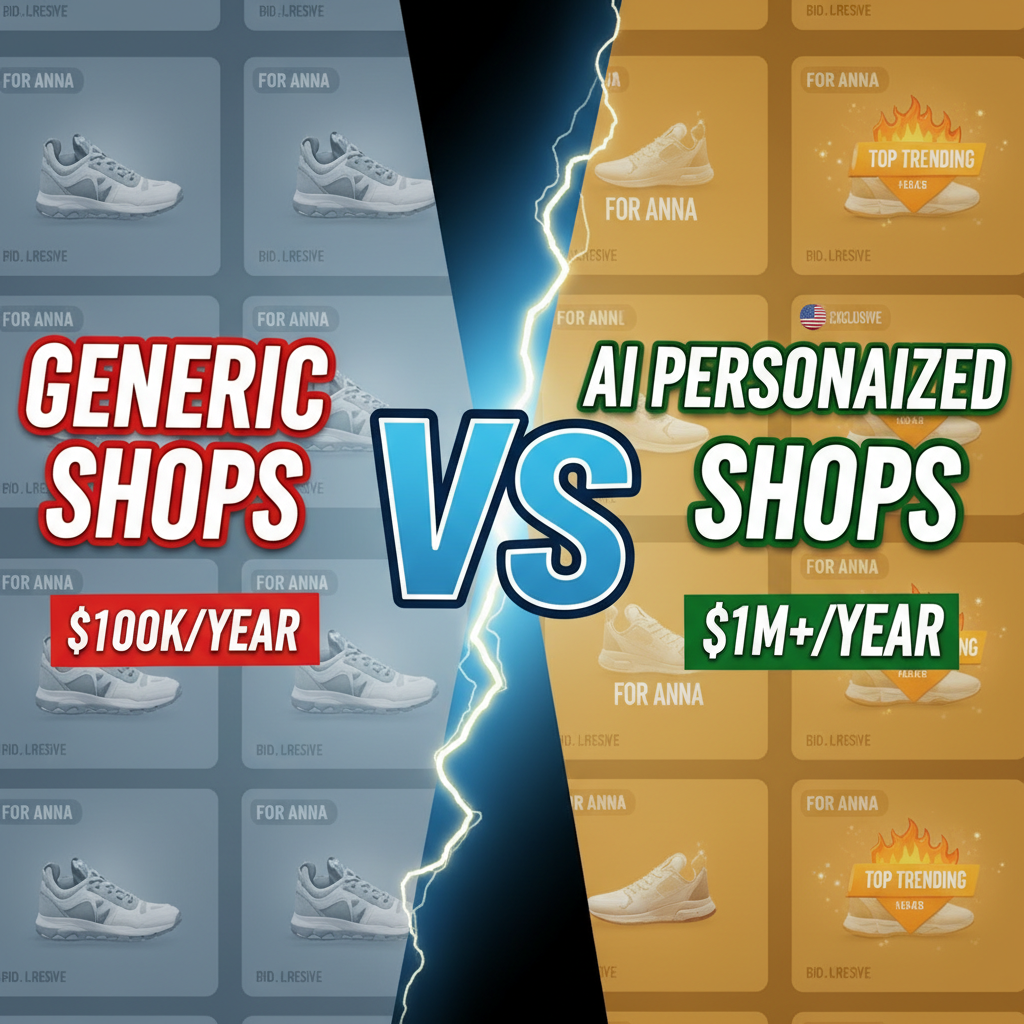
The conversion gap is real. A generic storefront converts at 1–2%. A personalized one converts at 4–8%. That's a 300–400% lift.
Why? Because personalization is not a feature—it's customer recognition. When someone sees products relevant to them, not the store's general inventory, they perceive higher value and buy faster.
Shopify's native personalization tools (Product Recommendations app, Dynamic Checkout, Store sections) are good. But they're basic. If you want 4–8% conversion rates, you need to architect deeper.
The Personalization Stack: What You Actually Need
Personalization requires three layers:
| Layer | Technology | Purpose |
|---|---|---|
| Data Collection | Analytics, pixel tracking, CDP | Know who your customer is, what they viewed, what they bought |
| Recommendation Engine | ML-powered recommendation API | Match customer profile to relevant products |
| Delivery Layer | Dynamic content, Hydrogen, theme apps | Show recommendations on homepage, collections, email |
Most Shopify merchants implement layer 3 (showing recommendations) without layers 1–2 (collecting data, computing predictions). That's why their personalization feels weak.
Layer 1: Data Collection (First-Party CDP)
You need to know: browsing history, purchase history, customer segment (RFM, persona, cohort), product category affinity, price sensitivity, seasonal patterns.
Shopify native: Shopify's built-in analytics tracks page views, cart additions, and purchases. It's basic but functional. The Shopify API lets you query customer behavior.
Third-party CDP (recommended for Shopify Plus): Segment, mParticle, or Treasure Data. These platforms unify data from Shopify, email (Klaviyo), ads (Facebook, Google), and web analytics. They create a unified customer profile.
Lightweight alternative: Klaviyo. It's an ESP but functions as a lightweight CDP for mid-market stores. It tracks email engagement, purchases, and browse behavior (via their pixel). You can segment by behavior immediately.
The critical detail: first-party data only. Third-party cookies are dying. You need pixel-tracking and email-based identity matching. Shopify Shop Pay covers this (Shop Pay users get logged-in tracking without cookie reliance).
Cost: Native Shopify = $0. Klaviyo = $20–500/month. Segment/mParticle = $120–1000+/month. ROI: +2–4% conversion = $20K–200K+ incremental revenue for most stores. Pays for itself in days.
Layer 2: The Recommendation Engine
You have three architectures:
Option 1: Shopify's native Product Recommendations app - Shows related products on product pages - Uses Shopify's proprietary collaborative filtering algorithm - Requires no setup beyond app install - Limitation: only feeds on-page recommendations, not email/homepage
Option 2: Klaviyo or Gorgias (email-based) - Driven by email behavior + purchase history - Personalizes email campaigns (product recommendations in abandoned cart emails, post-purchase, etc.) - Best for email revenue (often 25–35% of total revenue) - Limitation: only powers email recommendations, not site
Option 3: Custom API recommendation engine (Shopify Plus) - Build on top of Shopify's GraphQL API - Pull customer purchase history + browsing behavior from CDP - Feed to recommendation model (collaborative filtering, content-based, or hybrid) - Use Hydrogen (Shopify's React-based storefront framework) to render dynamic recommendations - Most flexible, highest complexity
Best practice for mid-market: Combine options 1 + 2. Use Shopify native for product pages. Use Klaviyo for email. Upgrade to option 3 only if you're Shopify Plus and have $10M+ revenue (ROI justifies engineering cost).
Layer 3: Dynamic Content Delivery
Once you have data + recommendations, you need to deliver them.
On-site recommendations: - Homepage hero section: "Recommended for you" (instead of "New In" or "Sale") - Product pages: "You might also like..." + "Recently viewed products" - Collections: reorder by customer affinity (put products they're more likely to buy higher on the page) - Post-purchase: "Complete the look" recommendations
Use Shopify's Product Recommendations app or a Hydrogen theme for this.
Email recommendations: - Abandoned cart: 3 related products they browsed but didn't cart - Post-purchase: complementary product upsell - Win-back: products similar to their best-performing category - Birthday/anniversary: personalized product bundle
Use Klaviyo's drag-and-drop email builder + CDP segmentation.
SMS personalization (optional): - Post-purchase tracking: personalized shipping updates + product care tips - VIP exclusive: early access to restocks of products they've viewed - Abandoned checkout: recovery SMS with recommended alternatives
Gorgias or Twilio + Shopify API integration.
Tactic 1: Behavioral Segmentation for Email
This is the highest-ROI personalization lever for most merchants. Segment your email list by behavior (not just demographics).
RFM Segments (gold standard): - High-value repeat (high R, high F, high M): exclusive member perks, early access - At-risk repeat (low R, high F, high M): win-back campaign with incentive - High-intent first-time (high R, low F, high M): convert to repeat with loyalty incentive - High-value dormant (high R, low F, low M): re-engagement campaign
Assign dynamic recommendation rules to each segment. High-value repeats get premium product recommendations. At-risk repeats get their most-viewed product category (to re-engage) + discount incentive.
A/B test by Klaviyo shows RFM-segmented email campaigns have 34% higher repeat purchase rates and 41% higher AOV than non-segmented broadcasts.
Tactic 2: Dynamic Homepage Content Based on Device/Location
Personalization isn't just customer behavior—it's context.
By device: Mobile users scroll fast. Show fewer products per section, taller hero images. Desktop users want more choice. Show grid layouts with 12–16 products per section. (Hydrogen + CSS media queries handle this natively.)
By geography (for multi-region stores): If a customer is in California, show California-local products or case studies first. If they're in Canada, show CAD pricing prominently.
By first-time vs. repeat: First-time visitors see your brand story + testimonials. Repeat customers see "New In" or personalized product section immediately.
Use Shopify's customer data + Hydrogen dynamic sections. Liquid theme code can also implement this with simple conditional logic.
Tactic 3: Product Recommendation Sequencing
Personalization isn't one algorithm—it's a sequence of escalating specificity.
| Stage | Algorithm | Example |
|---|---|---|
| Cold start (new customer, no data) | Popular products + trending | "Shop bestsellers" |
| Warm start (1 page view) | Similar products to viewed item | "If you liked this, try these" |
| Engaged (3+ page views) | Collaborative filtering (people like you bought this) | "Customers who liked X also bought Y" |
| High data (5+ purchases) | Predictive model (what will maximize their LTV) | "We think you'll love this new arrival" |
Each stage shows different products, in different order, with different confidence levels.
Shopify's native Product Recommendations app does this. Klaviyo's predictive content does this for email. For custom implementations, use algorithms like Matrix Factorization (collaborative filtering) or Factorization Machines (hybrid model).
Tactic 4: Avoid Personalization Pitfalls
Pitfall 1: Over-personalization. If your recommendations feel creepy ("we've been tracking you"), you lose trust. Solution: make recommendations look curated, not algorithmic. Use natural language ("our editors picked this for you") alongside algorithm recommendations.
Pitfall 2: Stale recommendations. If your engine only uses historical data, it'll recommend the same products repeatedly. Solution: inject seasonal products, new arrivals, and trending items into the recommendation feed. Mix 70% personalized + 30% fresh.
Pitfall 3: Narrow serendipity. If recommendations only show similar products, customers never discover new categories. Solution: include 10–15% "bridge" products—items at the intersection of their main category + adjacent categories. If they buy skincare, show skincare + wellness + beauty devices.
Pitfall 4: Data privacy risk. Collecting customer behavior at scale invites privacy risk. Solution: use first-party data only (Shopify native, email opt-in). Don't rely on third-party cookies. Comply with GDPR/CCPA by making opt-out easy and transparent.
Ready to Grow Your Shopify Store?
Personalization is the most direct path to increasing conversion and repeat purchase rates. A 2–4% lift in conversion translates to 20–50% incremental revenue for most stores.
Tenten architects personalization strategies for Shopify and Shopify Plus merchants. We design recommendation engines, build dynamic content systems, and integrate CDP + email platforms to create 1-to-1 customer experiences.
Next steps: Audit your current personalization stack. Are you showing generic "New In" content or behavior-driven recommendations? Let's design a personalization strategy for your store.
Editorial Note Personalization at scale requires infrastructure—data collection, recommendation algorithms, and delivery systems. But the ROI is so clear that any serious e-commerce operator should prioritize it. The merchants winning in 2026 aren't doing "personalization theater" (random product carousels). They're investing in real recommendation architectures that drive 300–400% higher conversion.
Frequently Asked Questions
What's the easiest way to add personalization to Shopify?
Install Shopify's free Product Recommendations app (shows related products on product pages) + set up Klaviyo email with behavior-based segmentation. This combo covers 80% of personalization ROI. No coding required.
Do I need Shopify Plus to build a recommendation engine?
No, but Shopify Plus gives you more flexibility. For standard Shopify, use Klaviyo (email recommendations) + Product Recommendations app (on-site). For Shopify Plus, you can build custom APIs and Hydrogen frontends. The difference is scale + customization, not viability.
How much does a custom recommendation engine cost?
Using third-party APIs (Shopify + Klaviyo): $0–500/month. Using a CDp (Segment, mParticle) + custom ML model: $2,000–10,000/month + engineering costs ($10K–50K to build). ROI typically justifies this only for stores doing $5M+ annual revenue.
What data do I need to personalize effectively?
Purchase history, browsing history, RFM metrics, category affinity, and customer segment (repeat, at-risk, high-value, etc.). Shopify's native data covers this. A CDP (Segment, Klaviyo) enriches it.
Can personalization hurt my conversion rate?
Only if poorly executed (creepy messaging, off-target recommendations, too much data collection). Best practice: make recommendations feel curated, not algorithmic. Transparent data collection. Easy opt-out. When done right, 0% downside, 300–400% upside.