The A/B Test That Cost A Brand $80K
One DTC brand we worked with wanted to test a new product image on their hero section. They thought they were running a 4-week test.
Turns out, their testing tool wasn't splitting traffic properly. Both variants were shown to the same users randomly. Statistical power was 0.18 (they needed 0.80). After 4 weeks and $30K in ad spend driving traffic, they had no statistical validity. They made a decision based on noise, implemented it, and realized 3 weeks later their "winner" was actually losing conversions.
Cost to revert + re-optimize: $80K in revenue loss + 2 weeks of operations.
This happens because most Shopify brands don't understand statistical rigor. They run tests too short, don't calculate sample size, and make decisions based on a few hundred sessions.
Here's how to avoid it: Understand the math, choose the right tool, and run tests long enough.
Why Shopify's Native A/B Testing Falls Short
Shopify has native A/B testing for theme variants (Product Pages → Online Store → Themes → Edit → A/B Tests).
What it does well: - Simple, no external tools - Built into Shopify, no pixel/code injection needed - Basic statistical reporting (confidence level shown)
What it doesn't do: - Multivariate testing (testing multiple elements simultaneously) - Targeting by audience/device/traffic source - Checkout optimization (you can't A/B test the checkout flow) - Mobile-specific variants (you can't serve different tests on mobile vs. desktop) - Revenue weighting (shows conversion %, not AOV or profit impact)
For basic product page changes (hero image, product title text), native testing is fine.
For conversion optimization at scale, you need a third-party tool.
The Testing Tool Shootout
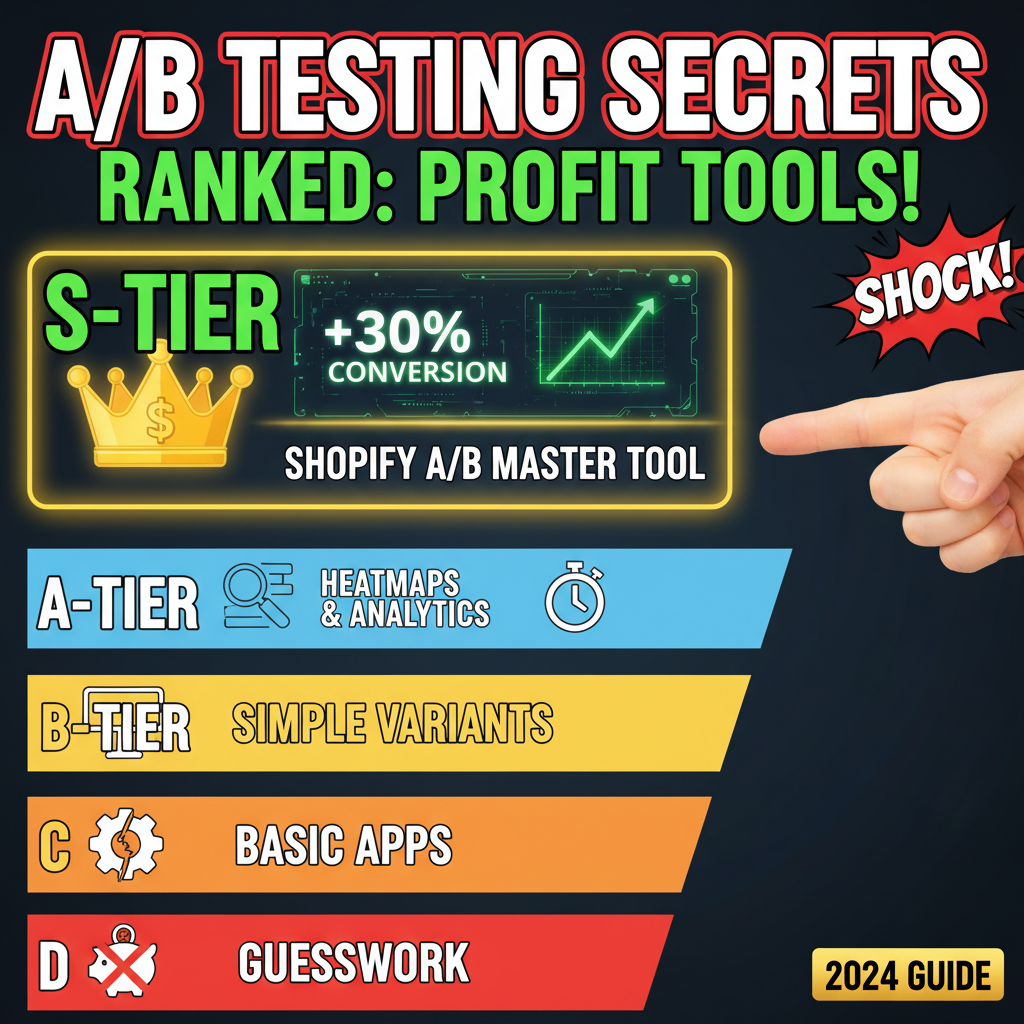
| Tool | Price | Strength | Weakness | Best For |
|---|---|---|---|---|
| Shopify Native | Free | Built-in, simple | Limitations (no checkout, no mobile split) | Product page image/copy tests |
| Unbounce | $99–$600/mo | Drag-drop builder, mobile-first | Not Shopify-native, requires redirect | Landing pages, checkout pages |
| Convert | $299–$1K+/mo | Statistical rigor, holdout groups | Expensive, steeper learning curve | Enterprise, revenue-critical tests |
| Optimizely | $600+/mo | Advanced segmentation, server-side testing | Overkill for most brands | Enterprise, high-traffic |
| Variant | $150–$500/mo | Shopify-native, visual editor, mobile support | Newer tool, smaller community | Mid-market Shopify |
| Unbounce + Shopify integration | $99–$600/mo | Standalone page builder | Doesn't modify existing Shopify pages natively | New landing pages |
Real talk: Most DTC brands should start with Shopify's native testing for simple product page variants. Move to Variant or Unbounce when you're testing checkout, multivariate, or need audience targeting.
Statistical Rigor: The Math You Need (But Can Skip If You Understand This)
Most A/B tests fail because sample size is too small.
Here's the formula:
Required sample size per variant = (2 × (Z α/2 + Z β)² × p(1-p)) / (p - p')²
Where: - Z α/2 = 1.96 (assuming 95% confidence level) - Z β = 0.84 (assuming 80% statistical power) - p = baseline conversion rate - p' = expected improvement (e.g., 2% base, hoping for 2.5%)
Practical example: - Baseline conversion: 2% - Hopeful improvement: +0.5% (to 2.5%) - Calculation: You need ~3,200 conversions per variant (6,400 total) - At 2% conversion rate on 10,000 visitors = 200 conversions - Time needed: 6,400 / 200 = 32 weeks of traffic
Translation: To detect a 25% improvement (2% → 2.5%) with 80% power, you need 32 weeks of traffic.
Most brands run 2-week tests. That's statistical malpractice.
Non-obvious insight: If you need a 2-week test to see a winner, your expected effect size is too large (unrealistic). Realistic improvements are 5–15%, which require 4–12 weeks of testing.
Instead of hoping for 50% improvements (which need 1–2 weeks), run tests optimized for 10% improvements (which need 6–8 weeks).
The Testing Hierarchy (What to Test First)
Not all tests are equal. Some move the needle; most don't.
Tier 1: High-Impact Tests (Expected Lift 5–50%) 1. Checkout optimization — Removing form fields, changing payment methods, simplifying flow. Expected: 5–20% uplift 2. Trust signals — Moving trust badges above fold, adding money-back guarantee, showing reviews earlier. Expected: 3–15% uplift 3. Hero CTA clarity — Changing button text ("Shop Now" vs. "View Collection"), button color, CTA placement. Expected: 5–25% uplift 4. Product image sequence — Lifestyle photo first vs. product-only first. Expected: 3–10% uplift
These tests move conversions because they address clarity, trust, or intent.
Tier 2: Medium-Impact Tests (Expected Lift 2–8%) 1. Copy changes — Headline rewording, benefit language changes. Expected: 2–8% uplift 2. Layout changes — Swapping element order (description above reviews vs. below). Expected: 1–6% uplift 3. Color changes — Button color, text color, accent color. Expected: 2–5% uplift
Tier 3: Low-Impact Tests (Expected Lift <2%) 1. Font changes 2. Spacing/padding adjustments 3. Icon variations
Execution rule: Run Tier 1 tests first (highest ROI on testing time). Only move to Tier 2 after exhausting Tier 1 opportunities.
One brand I worked with spent 6 months running Tier 3 tests (font experiments, color tweaks). 0.8% average lift per test. Then we ran 4 Tier 1 tests: +18%, +12%, +7%, +10%. One Tier 1 test was worth 15x more than the entire previous testing program.
Real Winning Tests (With Data)
Test 1: "Money-Back Guarantee" vs. No Guarantee
Brand: Supplement company Pages: Product page + checkout confirmation Baseline conversion: 2.1% Test duration: 8 weeks Sample size: 4,200 conversions per variant Result: 2.1% → 2.35% (+11.9%) Statistical significance: 95% Insight: Single line above checkout ("30-day money-back guarantee") addressed hidden objection
Test 2: Checkout Step Reduction
Brand: Apparel e-commerce Baseline checkout completion: 68% (32% cart abandonment) Test duration: 6 weeks Removed "Shipping Info Step" (auto-filled from billing address) Result: 68% → 73.5% (+8.1% completion) Insight: One step removal in 7-step flow removed 5% of friction
Test 3: Product Hero Image (Lifestyle vs. Product)
Brand: DTC beauty Baseline conversion: 3.2% Test duration: 10 weeks Sample size: 3,000 conversions per variant Result: Lifestyle photo 3.4% vs. Product-only 3.15% (+7.6% for lifestyle) Insight: Lifestyle image showed product in-use; added emotional resonance
Test 4: CTA Button Color (Blue vs. Orange)
Brand: Supplements Baseline: 2.8% Test duration: 4 weeks Sample size: 800 conversions per variant (underpowered!) Result: Blue 2.82% vs. Orange 2.76% (−2.1%) Verdict: Inconclusive. No stat sig at n=800. Lesson: CTA color doesn't move needle. Don't test it.
Second non-obvious insight: The tests that feel obvious to try are often low-impact. Button color, font, spacing—these don't matter. Trust signals, CTA clarity, form friction—these do. Run counterintuitive tests. They're usually higher impact.
The Testing Calendar (How to Batch Tests)
Running one test per month is slow. Here's how to run 3–4 simultaneous tests:
Structure: Test on separate pages/elements
| Week | Test 1 | Test 2 | Test 3 | Test 4 |
|---|---|---|---|---|
| 1–8 | Product Page Hero | Checkout Button | Email Popup | PDP Trust Badges |
| 9–16 | Implement winner | PDP Copy Test | Checkout Confirmation | Nav Menu Reorg |
Key: Each test runs on a different element, so they don't interfere.
Avoid: Running Test 1 and Test 2 on the same page simultaneously (you can't isolate which element caused the lift).
Common Testing Mistakes (And How to Fix Them)
Mistake 1: Peeking at results early You're seeing 55% vs. 45% after 2 weeks and declare a winner. Statistically invalid. You just got lucky. Fix: Commit to 6–8 week test window before checking results. Use a calendar.
Mistake 2: Testing too many things simultaneously Running 10 variations of the same element. Can't isolate the winner; creates noise. Fix: Test one element at a time. If testing copy headlines, test A (current) vs. B (one alternative), not A vs. B vs. C vs. D.
Mistake 3: Not accounting for external factors Your test ran during Black Friday (anomalous traffic). Conversion was 8%, but that's not real baseline. Fix: Run tests during "normal" traffic periods. Avoid holidays, campaigns, viral moments.
Mistake 4: Testing something you can't afford to implement You test a complete redesign. Conversion lifts 12%. But redesign costs $50K and implementation is 8 weeks. Fix: Test changes you can implement in <1 week and cost <$2K. Quick wins compound.
Mistake 5: Ignoring multi-device variance Desktop conversion is 3%, mobile is 1.5%. You run one test. Average is 2.1%. You make a decision. But the improvement on mobile is opposite the improvement on desktop. Fix: Analyze by device. Run separate tests for mobile/desktop if patterns differ.
The Internal Link Setup
Want to improve your testing beyond A/B testing? Learn about multivariate testing on Shopify for testing combinations of elements. Or check out conversion rate optimization strategies for a broader framework.
Building a Testing Roadmap (12-Month Plan)
Q1: Foundation (Checkout & Trust) 1. Checkout optimization (form reduction, trust badges) 2. Money-back guarantee test 3. Product page hero CTA clarity
Expected cumulative lift: 15–25%
Q2: Product Page (Images & Copy) 1. Hero image (lifestyle vs. product) 2. Product title/headline rewrite 3. Description copy restructure
Expected cumulative lift: 8–15%
Q3: Collections & Discovery (SEO + UX) 1. Collection page sorting options 2. Filter placement/visibility 3. Product image grid layout
Expected cumulative lift: 5–12%
Q4: Email & Retention 1. Welcome email sequence 2. Post-purchase upsell email 3. Cart abandonment email
Expected cumulative lift: 10–20% (repeat purchase lift)
Year-end cumulative: 40–70% conversion rate improvement
Third non-obvious insight: Testing is compounding. Each win stacks. A 10% improvement Q1 × 12% improvement Q2 × 8% improvement Q3 = 38% cumulative, not 30%. Test quarterly, not randomly.
The Bottom Line
A/B testing works, but only if you:
- Run long enough (6–8 weeks minimum for realistic improvements)
- Test high-impact elements (checkout, trust, clarity, not button colors)
- Understand statistical rigor (know your sample size requirement)
- Batch smartly (run 3–4 tests simultaneously on different elements)
- Build a testing roadmap (strategic quarterly tests, not random experiments)
One brand I worked with committed to this framework. After 12 months of systematic testing, their conversion rate improved from 1.8% to 3.1% (72% lift). That's +0.8M in annual profit (at $50M revenue scale).
The testing itself was free. The implementation cost was ~$30K in developer time. ROI: 26:1.
FAQ
Q: How many variants should I test? A: One. Test A (current) vs. B (one alternative). Testing 5 variants splits traffic, reduces sample size, and makes analysis noise.
Q: Can I run multiple tests on the same page? A: Only if they're on completely separate elements (hero image + footer link). If they're related (headline + subheading), they interact; results aren't clean.
Q: What's the minimum conversion rate to start A/B testing? A: 1%. Anything below 1% conversion requires too many visitors to achieve statistical power. Focus on traffic growth first.
Q: Should I weight tests by revenue, not conversions? A: Yes, if your goal is profit. A test that increases AOV by 8% but conversion by 2% is usually better than 10% conversion increase with flat AOV.
Q: How do I keep test results from influencing future design decisions? A: Document all tests + results in a shared spreadsheet. Reference it before designing new pages. Avoid repeating failed experiments.
Ready to run a systematic testing program on your Shopify store? Contact Tenten for a testing audit and quarterly roadmap.
Frequently Asked Questions
How many variants should I test?
One. Test A (current) vs. B (one alternative). Testing 5 variants splits traffic, reduces sample size, and makes analysis noise.
Can I run multiple tests on the same page?
Only if they're on completely separate elements (hero image + footer link). If they're related (headline + subheading), they interact; results aren't clean.
What's the minimum conversion rate to start A/B testing?
1%. Anything below 1% conversion requires too many visitors to achieve statistical power. Focus on traffic growth first.
Should I weight tests by revenue, not conversions?
Yes, if your goal is profit. A test that increases AOV by 8% but conversion by 2% is usually better than 10% conversion increase with flat AOV.
How do I keep test results from influencing future design decisions?
Document all tests + results in a shared spreadsheet. Reference it before designing new pages. Avoid repeating failed experiments.