AI Fraud Detection: The Economics of Chargeback Prevention
Here's a number that keeps CFOs awake: A single chargeback costs you $25–$100.
That's not the original charge amount. That's the chargeback fee on top of losing the sale.
A $150 product order triggers a $150 chargeback fee. Total cost to you: $300.
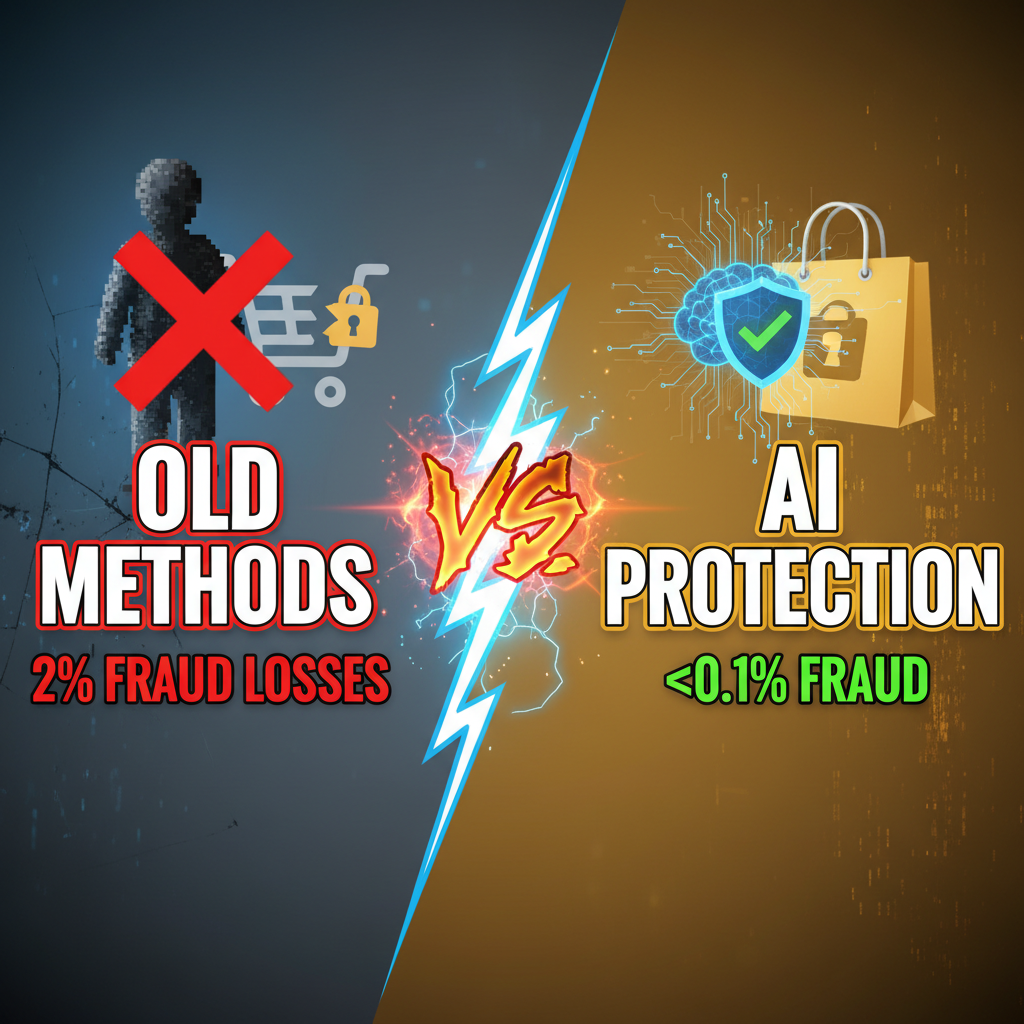
Scale this: A $1M/year Shopify store with 1.5% chargeback rate (industry average for D2C) loses $15K annually. A mature store with 0.5% chargeback rate loses $5K. The difference? One has fraud detection. One doesn't.
AI fraud detection systems catch 95%+ of fraud before chargebacks happen. The ROI is simple: $5K–$15K annual savings in chargeback fees justifies a $50–$200/month tool cost.
How AI Fraud Detection Actually Works
Phase 1: Signal Collection
When a customer submits an order, the fraud detection system collects signals:
| Signal Type | Data |
|---|---|
| Transaction | Amount, currency, card type (credit vs. debit) |
| Device | IP address, device fingerprint, browser, OS |
| Geolocation | Customer IP country, shipping address, billing address |
| Customer history | First-time buyer? Returning? Purchase frequency? |
| Email domain (free vs. business), email age, email reputation | |
| Behavior | How fast did they fill the form? Did they hesitate? Did they change info? |
A single order generates 50–100 data points.
Phase 2: Pattern Matching
AI models (neural networks, gradient boosting, etc.) compare signals to known fraud patterns:
- High-risk pattern: Card issued in UK, shipping to Nigeria, first-time buyer, $500 order, IP from VPN. Fraud confidence: 87%.
- Low-risk pattern: Customer email from verified domain, returning customer, 3rd order, card and shipping from same address, order amount consistent with history. Fraud confidence: 2%.
Machine learning models are trained on millions of historical fraud cases. They identify micro-patterns humans miss.
Phase 3: Decision
Based on confidence score, the system makes a decision:
| Confidence | Action |
|---|---|
| <5% | Accept order. Process normally. |
| 5–50% | Accept but flag. Process order. Monitor for chargeback. |
| 50–95% | Require additional verification. Ask customer for 3D Secure or additional info. |
| >95% | Decline. Block transaction. |
The threshold is configurable. Most Shopify stores set threshold at 50–70% (balance between blocking fraud and avoiding false positives).
The Real Impact: Avoiding Chargebacks
Why is this important? Because chargebacks destroy your profit margin.
Let's calculate:
| Scenario | Order Value | Chargeback Fee | Lost Product Cost | Total Loss |
|---|---|---|---|---|
| $150 order, fraud prevented | $150 | $0 | $0 | $0 |
| $150 order, fraud not caught | $0 | $25–$100 | $15 (COGS) | $40–$115 |
If you catch 1,000 fraudulent orders/year (typical for a $5M store), you save $40K–$115K annually.
Tool cost: $200/month = $2,400/year.
ROI: 17–48x.
Fraud Detection Tools for Shopify (2026)
Tier 1: AI-Native Platforms
| Tool | Cost | Accuracy | Integration |
|---|---|---|---|
| Sift | $250–$1,500/month | 95–97% | Native Shopify app |
| Kount | $200–$800/month | 93–95% | API, Shopify + 3PL |
| Feedzai | $300–$2,000/month | 96–98% | Enterprise API |
| Ravelin | $150–$600/month | 92–94% | API, native Shopify |
These tools use real-time neural networks trained on billions of transactions globally. They're industry-standard.
Tier 2: Chargeback Prevention (Risk Management)
| Tool | Cost | What It Does |
|---|---|---|
| Ethoca | $0–$500/month | Alerts before chargeback. Allows dispute recovery. |
| Verifi | $0–$500/month | Chargeback alerts + friendly fraud recovery tools. |
These don't prevent fraud upfront. They catch chargebacks after the fact and help you fight them (recovering 40–60% of illegitimate chargebacks).
Tier 3: 3D Secure / Authentication
| Tool | Cost | What It Does |
|---|---|---|
| Stripe 3D Secure | Included in Stripe | Requires customer password confirmation (high friction). Reduces chargeback liability. |
| Shopify Payments + 3DS | Included | Native integration. Reduces friction vs. Stripe. |
3D Secure is not fraud detection—it's liability shift. If a customer later disputes and you used 3DS, the bank covers the loss, not you.
Best Practice Stack (2026):
Most sophisticated stores use a three-layer stack:
- AI fraud detection upfront (Sift, Kount): Blocks/flags fraud before order.
- 3D Secure (Shopify Payments): Secondary verification on flagged orders.
- Chargeback alerts (Ethoca, Verifi): Post-fact recovery for disputes that slip through.
Cost: ~$400–$800/month. Coverage: Prevents 95%+ of fraud, recovers 40% of chargebacks that happen.
Implementation: Step-by-Step
Step 1: Choose a Tool
For most Shopify stores under $5M, Sift or Ravelin is best. Easy setup, great API, native Shopify support.
For enterprise (>$10M), Feedzai offers more customization.
Step 2: Install the App
Sift and Ravelin have Shopify apps. Install in 2 minutes.
The app auto-collects signals (IP, device fingerprint, email, geolocation) and scores every order in real-time.
Step 3: Set Your Threshold
Most stores set threshold at 60–70%. This means: - <60% fraud confidence: Accept normally - 60–90% fraud confidence: Require 3D Secure verification - >90% fraud confidence: Decline
Adjust based on your chargeback rate and your tolerance for blocking legitimate orders.
Step 4: Enable 3D Secure
If the fraud detection flags an order, prompt the customer for 3D Secure verification (password entry, biometric, etc.).
Friction: Yes. False positives require customer action. But it recovers 50–70% of fraud that slips through detection.
Step 5: Monitor Performance
Track these metrics monthly:
| Metric | Target |
|---|---|
| False positive rate (legitimate orders blocked) | <0.5% |
| True positive rate (fraud actually prevented) | >90% |
| Chargeback rate | <0.5% (down from 1–1.5% pre-detection) |
If false positives are >1%, loosen your threshold. Too much friction = cart abandonment.
The False Positive Problem
This is the hardest part of fraud detection: Avoiding legitimate customer declines.
Example: A traveling executive buys products from Japan (IP Japan) while their card is registered in the US. The fraud system flags it. The customer gets declined. They call your support team angry.
False positive rate matters. The best tools boast <0.5% false positive rate, meaning <1 in 200 legitimate customers get blocked.
How to minimize false positives:
- Whitelist returning customers: Returning customers with clean history = auto-accept, no flags.
- Use soft declines: Instead of blocking, use 3D Secure verification (non-intrusive). Customer solves a puzzle, order processes. Less friction.
- Monitor velocity: A customer ordering 10 products in 5 seconds = red flag. But a customer ordering over 1 hour = fine.
- Geographic intelligence: Japan IP ordering to Japan address = fine. Japan IP ordering to Nigeria address = flag.
Advanced Use Case: Rules Customization
Sophisticated stores build custom rules:
IF customer_email_domain = "gmail.com"
  AND order_amount > $200
  AND first_time_buyer = TRUE
  AND shipping_country != billing_country
THEN fraud_confidence += 25%
This lets you encode domain knowledge ("our customers usually don't buy expensive items on first order from different countries").
Tools like Sift let you build custom rules in addition to machine learning models. Rules + ML = 95%+ accuracy.
Cost-Benefit Analysis by Store Size
| Store Size | Chargeback Rate | Annual Chargeback Cost | Tool Cost | ROI |
|---|---|---|---|---|
| $500K/year | 1.5% | $3,750 | $2,400 | 56% |
| $2M/year | 1.2% | $12,000 | $4,800 | 150% |
| $5M/year | 0.8% | $20,000 | $6,000 | 233% |
| $10M/year | 0.5% | $25,000 | $9,600 | 160% |
Even at $500K/year, fraud detection pays for itself.
Red Flags to Look For (Manual Review)
Even with AI, train your team to spot obvious fraud:
| Red Flag | Action |
|---|---|
| Multiple orders to same shipping address, different names | Contact buyer. Verify. |
| Order with $0 shipping (unusual) | May indicate stolen account. Flag. |
| Bulk order of high-resale items (electronics, shoes) | Common fraud. Flag. |
| Same credit card for 10+ orders in 1 day | Carding attack. Block card. |
| Shipping to freight forwarder or mail drop | Higher fraud risk. Flag. |
Manual review catches 20–30% of sophisticated fraud that AI misses (because it's novel). Pair AI with human judgment.
The Future: AI Fraud Detection Gets Smarter
By 2027, fraud detection will:
- Use LLMs for context: "Customer bought shoes 3x, now wants electronics. Low fraud risk even if uncommon."
- Integrate biometric verification: Face/fingerprint at checkout (lower friction than 3DS password).
- Learn from supply chain: "We know this order is for resale. High risk" or "This order is for restaurant, legitimate business, low risk."
- Cross-channel learning: Fraud patterns from returns, customer service, shipping → fed back to detection model.
Ready to Implement Fraud Detection?
Fraud is not inevitable. Chargebacks are not the cost of doing business. Tenten's fraud prevention specialists can audit your current chargeback rate, recommend tools, and build custom rules for your store.
Editorial Note
Most Shopify store owners treat chargebacks as a tax on business. They're not. They're a sign you need detection. The best stores catch fraud early, lose zero on chargebacks, and operate with 0.1–0.3% chargeback rate (vs. industry 1–1.5%). That's the competitive advantage.
Frequently Asked Questions
Will fraud detection slow down my checkout?
No. Fraud detection happens in the background (milliseconds). Customers don't notice. Only flagged orders may require 3D Secure (1–2 extra steps).
What if a fraudster uses a VPN to hide their IP?
Fraud detection uses 50+ signals, not just IP. Device fingerprint, email reputation, purchase pattern all factor in. VPN masking alone doesn't prevent detection.
Can I recover money from chargebacks?
40–60% of chargebacks are "friendly fraud" (legitimate customer disputes incorrectly). Tools like Ethoca and Verifi help fight these. You provide evidence (tracking, delivery confirmation), and the bank may overturn the chargeback.
Do I need fraud detection if I use Shopify Payments?
Shopify Payments includes basic fraud filtering, but it's not AI-powered. For stores >$500K/year, add a dedicated AI tool (Sift, Kount) on top. You'll catch 30% more fraud.
What's the difference between fraud prevention and chargeback protection?
Fraud prevention (AI detection) stops bad orders before processing. Chargeback protection (Ethoca, Verifi) catches disputes after the fact and helps recover money. Use both.