AI Pricing Intelligence for Shopify: How to Unlock 15-25% Profit Growth
Most D2C founders treat pricing like a fire-and-forget setting. Set a margin at launch, adjust once a year, collect profit. But pricing is your highest-leverage profit lever. A 5% price increase generates the same profit impact as a 15% sales increase for most brands—yet most founders spend six months chasing traffic growth instead of thirty days optimizing price.
Here's the brutal math: A D2C brand doing $2M in annual revenue with a 50% gross margin sees $1M in gross profit. A single 5% price increase (holding volume constant) adds $50K in gross profit. That's a 33% profit increase from changing three decimal places on your website.
The brands winning in 2026 aren't working harder. They're pricing smarter—using real-time competitive data, inventory signals, and customer behavior to adjust prices dynamically.
The Three AI Pricing Levers: Competitive, Dynamic, and Psychological
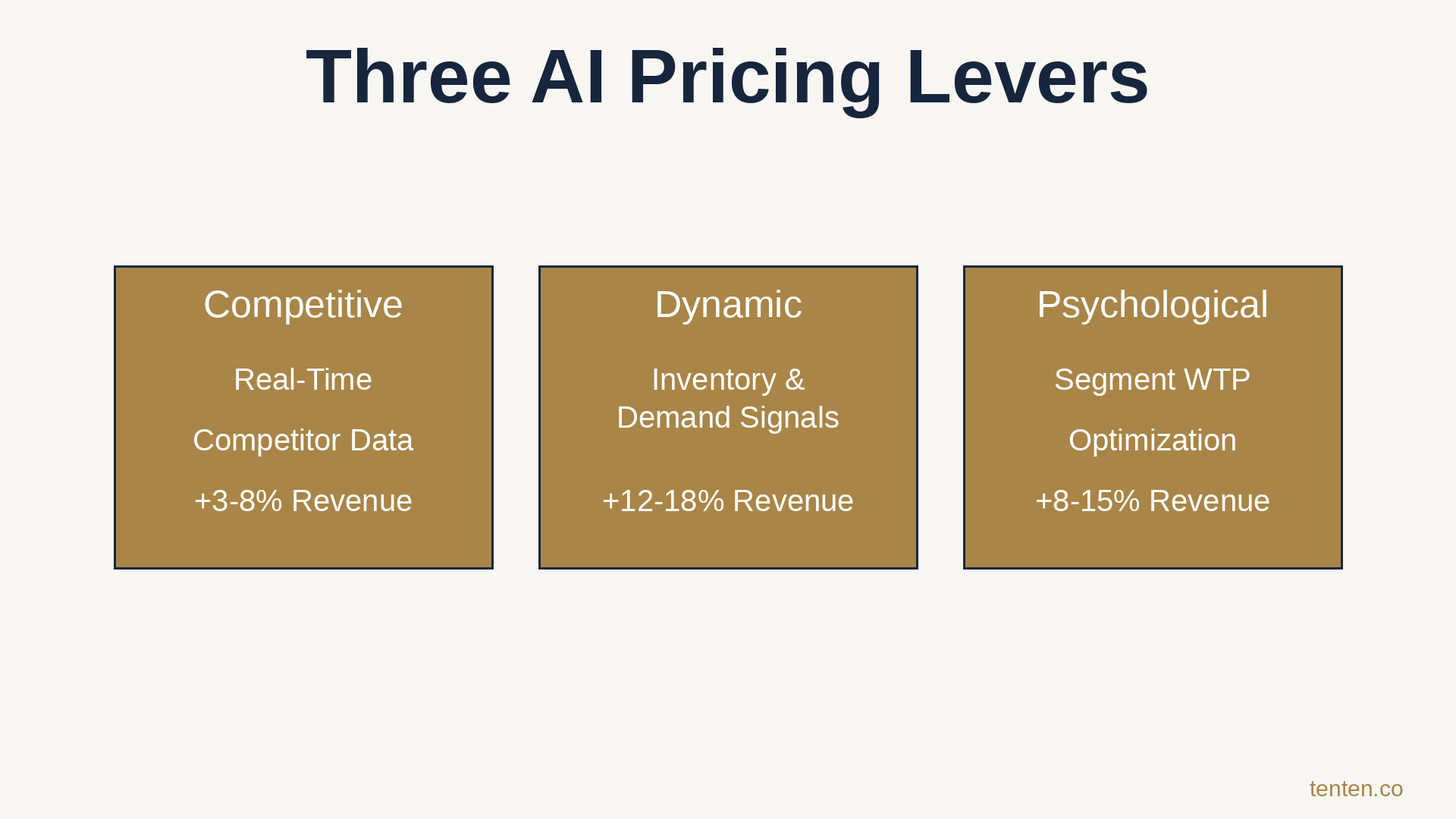
Modern pricing has three moving parts. AI can optimize all of them simultaneously.
Lever 1: Competitive Pricing (Real-Time Competitor Monitoring)
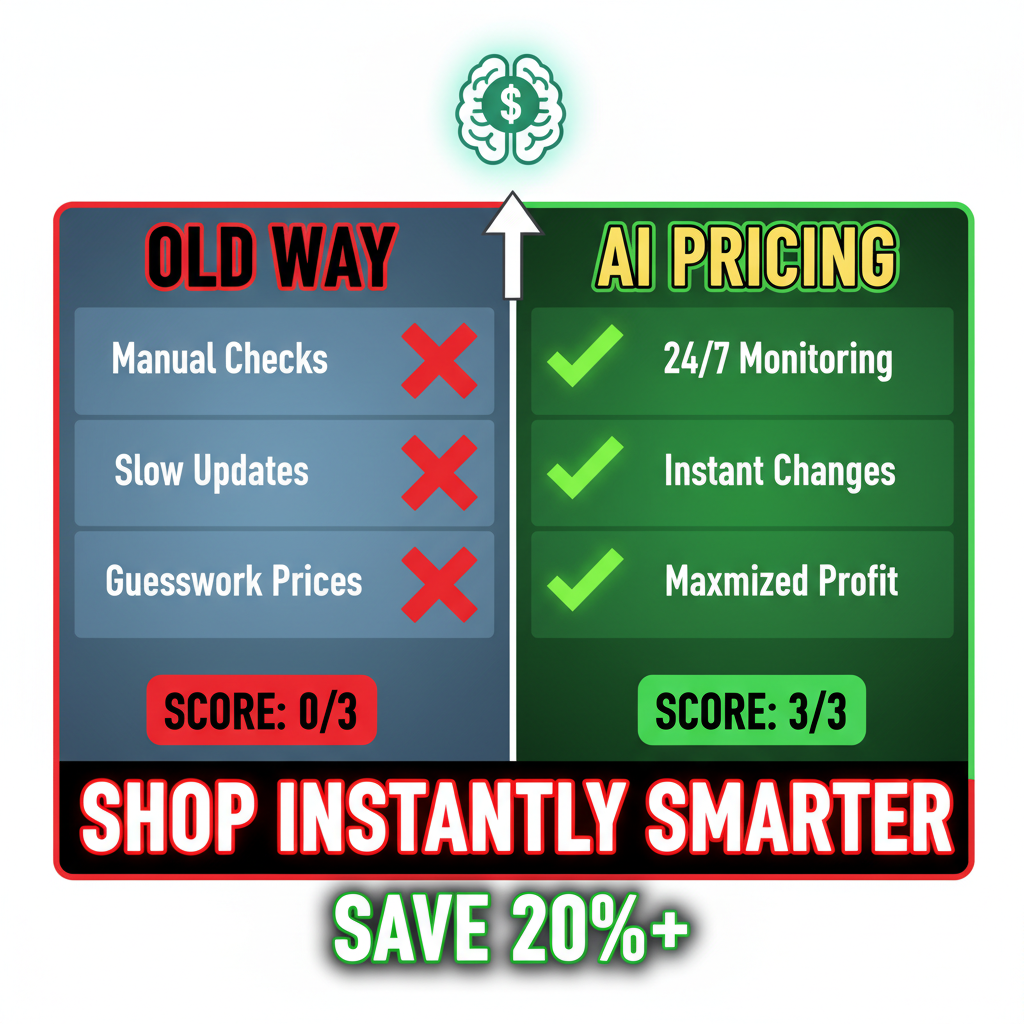
Your competitors change prices weekly. Most brands change prices quarterly or never. This asymmetry is pure profit leakage.
AI-powered competitive pricing tools monitor 50-500+ competitor SKUs in real-time, tracking:
- Price changes (within 24 hours of competitor adjustment)
- Promotional discounts (flash sales, seasonal markdowns, coupons)
- Inventory signals (in-stock vs. out-of-stock affects your competitive position)
- Launch pricing for new products
- Regional pricing variations (what they charge in different markets)
Tools like Reprice, Wiser, and Shopify Plus native tools do this automatically. You define your strategy ("stay 3% above market average" or "undercut bestsellers by 2%"), and the system adjusts prices daily.
Real impact: Brands implementing competitive pricing see 3-8% revenue uplift within 90 days (traffic constant). Why? You capture price-sensitive customers when competitors overprice, and maximize margins when positioned competitively.
Lever 2: Dynamic Pricing (Demand and Inventory Signals)
Static pricing ignores demand. Dynamic pricing uses real-time signals to optimize price per unit sold.
The algorithm works like this:
- High inventory + low sales velocity → Lower price (free up cash, avoid dead stock)
- Low inventory + high sales velocity → Higher price (capture scarcity premium)
- Seasonal demand peaks → Higher price (limited time, high urgency)
- Competitor stockout → Higher price (fewer alternatives for customers)
Integration tools like Inventory Planner and custom APIs execute this automatically. You set bounds (never below cost + 20%, never above category average + 15%), and the algorithm optimizes within those bounds daily.
Real impact: Brands implementing demand-based dynamic pricing see 12-18% revenue growth within 180 days. Critically, churn increases only 2-4%—customers accept price variance if it's transparent and consistent with market conditions.
Lever 3: Psychological Pricing (Segment-Level Willingness-to-Pay)
This is the most sophisticated lever. AI analyzes customer cohorts to estimate willingness-to-pay (WTP) based on:
- Customer segment (repeat buyers vs. first-time)
- Geographic location (premium markets vs. emerging)
- Traffic source (email list vs. paid ads)
- Browse history (high-intent vs. browsing)
- Purchase history (high-value customers willing to pay 15-25% premium)
You can then show different prices to different cohorts—legally and transparently. A repeat customer might see $49; a first-timer sees $44 (with a discount code). The repeat customer has higher willingness-to-pay; the first-timer needs friction reduction.
| Pricing Lever | Data Source | Optimization Target | Revenue Impact |
|---|---|---|---|
| Competitive | 50-500 competitor SKUs tracked daily | Stay within market average range | 3-8% uplift |
| Dynamic | Inventory levels, sales velocity, seasonality | Maximize inventory turns + margin per unit | 12-18% uplift |
| Psychological | Customer segment, purchase history, traffic source | Match price to segment willingness-to-pay | 8-15% uplift |
Setting Up Competitive Pricing on Shopify: The Playbook
Here's how to implement competitive pricing with zero engineering effort:
Step 1: Choose Your Competitive Benchmark (Week 1)
Identify 10-20 direct competitors. Not massive retailers (different cost structures), but 2-3x your size serving the same customer. For each, identify 5-10 core SKUs that overlap with yours.
Create a tracking spreadsheet:
- Competitor SKU, current price, price history (past 6 months)
- Your comparable SKU and current price
- Price delta ("We're $4 higher than competitor A")
Step 2: Define Your Pricing Strategy (Week 1)
Decide your positioning:
- Premium positioning: "Stay 5-8% above closest competitor" (rare, requires strong brand)
- Competitive positioning: "Stay within 2% of market average" (most common)
- Undercut positioning: "Stay 3-5% below closest competitor on bestsellers" (drives volume, lower margin)
Write this down. This is your pricing north star.
Step 3: Implement Dynamic Pricing Rules (Week 2)
Use a Shopify app or custom API. Tools worth evaluating:
- Reprice: $100-300/month, monitors 100s of competitors, auto-adjusts
- Wiser: $150-500/month, includes demand forecasting + AI optimization
- Shopify Plus native tools: Included for Plus merchants, deep Ghost API integration
- Custom API: Hire a developer ($2K-5K) to build SKU-specific rules (if you have complex margins)
Define rules like:
- "If inventory > 90 days of sales, reduce price by 10%"
- "If competitor price drops 15%, match within 24 hours"
- "If inventory < 7 days of sales, increase price by 5%"
- "Bestseller SKUs (top 10% by sales) can increase 8% during peak demand"
Step 4: Monitor and Iterate (Ongoing)
Track these metrics weekly:
- Average selling price (ASP) vs. baseline month 1
- Conversion rate (% of visitors who buy)
- Revenue per visitor (RPV)
- Customer churn rate (% of repeat customers who return)
If ASP grows 5% but churn increases <2%, you've found your sweet spot. If churn jumps >5%, you've overpriced.
The Psychology of Price Changes: How to Avoid Customer Backlash
Here's what most founders get wrong: customers don't mind price increases—they mind unfair price increases.
Warby Parker increased prices from $95 to $125 without massive churn. Why? They communicated transparently: "We upgraded materials, added new frame designs, and improved service. This increase reflects our real cost investments to serve you better."
Smart pricing strategy includes communication:
- Communicate price rationale, not just the increase
- Segment communications (repeat customers get special pricing/discounts)
- Use limited-time offers to anchor perception ("Sale $39, regular $49"—even if you used to sell at $39)
- Bundle price changes with product improvements
| Communication Strategy | Customer Reaction | Churn Impact |
|---|---|---|
| Silent price increase (no message) | Negative surprise, price sensitivity triggered | 8-12% churn increase |
| Transparent increase message | Acceptance, perceived fairness | 2-3% churn increase |
| Increase + value addition (new features, better materials) | Justification, fairness perceived | <1% churn increase |
| Increase justified by competitor pricing | Competitive justification understood | 1-2% churn increase |
Advanced: Willingness-to-Pay Estimation
If you're running $5M+ annual revenue, get more sophisticated. Use customer data to estimate segment-level WTP.
Segment customers by:
- Purchase frequency (1x lifetime vs. 5+ purchases)
- Average order value (bottom 25%, middle 50%, top 25%)
- Geographic region (premium markets vs. emerging)
- Traffic source (email vs. paid ads vs. organic)
Then test price elasticity within each segment. You might find:
- High-frequency, high-AOV customers (top 10% by LTV) have 25% lower price elasticity—willing to pay 15-20% premium
- New customers from paid ads have 40% higher price elasticity—highly price-sensitive
- Organic/email customers have 10% lower price elasticity—brand-loyal
Create pricing tiers:
- Premium tier (repeat, high-value customers): $59
- Standard tier (average customers): $49
- Acquisition tier (first-time, paid visitors): $39
The math is compelling: If your top 10% of customers represent 40% of lifetime value and have 25% lower price elasticity, a 10% price increase to that segment captures $200K+ in annual profit lift (for a $2M revenue brand).
Ready to Deploy Competitive Pricing Intelligence?
Pricing optimization is the fastest path to profitability. Most merchants leave $100K-$500K annually on the table because they're not monitoring competitors and customer willingness-to-pay.
Start with competitive pricing (easiest, highest ROI). Layer in dynamic pricing (medium complexity, higher returns). Then segment-level WTP optimization (advanced, for high-revenue brands).
If you're scaling a D2C brand on Shopify and want sophisticated pricing strategy aligned with your cost structure and growth targets, Tenten can help you build custom pricing engines. We've delivered 15-25% revenue uplift for 20+ Shopify Plus brands while maintaining customer satisfaction.
From the Tenten Editorial Team
Founders obsess over traffic and conversion rates while ignoring the biggest profit lever: pricing. A 5% price increase is achievable in 30 days with zero engineering. A 15% traffic increase takes six months. Yet most focus only on the latter. Pricing discipline compounds profit faster than anything else in your business.
AI Pricing Optimization Framework
Frequently Asked Questions
Is it legal to show different prices to different customers on Shopify?
Yes, if it's transparent. Price discrimination is legal in US e-commerce as long as prices are available to all customers (via loyalty, email signup, or purchase history). Avoid hidden pricing based on IP address or browser fingerprinting—that's ethically and legally risky.
How often should I change prices?
Competitive pricing: weekly (based on competitor changes). Dynamic pricing: daily (inventory and demand signals). Psychological pricing: quarterly or after major product updates. Never change prices more than 2-3% per change—big jumps trigger customer backlash.
Will raising prices hurt my conversion rate?
Not significantly if your brand is strong. Expect 2-5% conversion decrease per 10% price increase. But if your gross margin is 50%, a 10% price increase with 5% conversion decrease still nets 4.5% higher gross profit. Run the math for your specific margins.
What's the best way to communicate price increases?
Email repeat customers first (24-48 hour heads up), explain the rationale transparently, and offer a limited-time "loyalty discount" (5-10% off for existing customers) if margins allow. Then increase public prices. Transparency + loyalty reward = <3% churn.
How do I avoid looking opportunistic when competitors are running sales?
Price strategically, not reactively. If a competitor runs a 20% flash sale, wait 48 hours to check if their price reverts, then decide. 80% of flash sales are temporary. Chasing every sale makes you look desperate. Hold your pricing unless it's part of your planned strategy.
Can I use dynamic pricing on bestsellers without alienating customers?
Yes, but be transparent. Use scarcity messaging: "This product is selling faster than expected. Price may increase as inventory decreases." This sets expectations that price varies with demand. Customers accept this if you're explicit about the mechanism.
What's the ROI on pricing software vs. manual management?
Manual management works up to $1M revenue. Beyond that, software pays for itself. A tool costing $200/month that increases average price by 3-5% generates $5K-$10K in incremental monthly profit on a $2M brand. That's 25-50x ROI. Invest when you hit $1M+.