Shopify Flow reports that merchants using its automation platform process 27 billion automated actions per year. That's not a rounding error — it's a structural shift in how stores operate. The D2C founders still manually processing refunds, tracking inventory in spreadsheets, and copy-pasting order data into QuickBooks aren't just inefficient. They're building businesses that can't scale past themselves.
Here's the math that should keep you up at night: a 20-hour automation investment that saves 5 hours per week generates 260 hours of annual savings. That's the equivalent of a 0.125 FTE at $45,000/year — for roughly $8,000 in software costs. Most founders are tripling their operational workload because they haven't automated the right things. They optimize conversion rates by 0.3% while leaving 80 hours of manual labor on the table every month.
These 25 workflows are the ones that actually move the needle for D2C stores doing $500K–$10M in annual revenue.
The Five Automation Categories (And Where to Start)
Every Shopify automation falls into one of five operational buckets:
| Category | Workflows | Priority | Why Start Here |
|---|---|---|---|
| Order & Fulfillment | #1–5 | Highest | Fastest ROI, lowest complexity |
| Inventory Management | #6–10 | High | Prevents revenue loss from stockouts |
| Customer Communication | #11–15 | Medium-High | Scales support without headcount |
| Marketing & Retention | #16–20 | Medium | Compounds over time |
| Financial & Reporting | #21–25 | Medium | Eliminates data entry, improves visibility |
Most founders automate order fulfillment first — it's the easiest win with the quickest payback. Start there, then layer in inventory and communication.
Order & Fulfillment Automations (Category 1)
| # | Workflow | Manual Time/Month | Tools | Setup Time | Annual Savings |
|---|---|---|---|---|---|
| 1 | Auto-send order confirmation + tracking | 3 hrs | Shopify native | 1 hr | $1,800 |
| 2 | Auto-flag high-value orders for gift wrap | 4 hrs | Shopify Flow + Zapier | 3 hrs | $2,000 |
| 3 | Auto-send shipping notification with tracking | 2 hrs | Shopify + Printful | 2 hrs | $1,000 |
| 4 | Auto-create Stripe invoice for accounting | 5 hrs | Zapier + Stripe | 4 hrs | $2,500 |
| 5 | Auto-sync orders to inventory management | 6 hrs | Shopify API + Stitch | 8 hrs | $3,000 |
Workflow #1: Auto-send order confirmation (fastest to implement)
Enable Shopify's native "Order Confirmation" email template. Customize it with your brand colors, add an upsell section ("Complete this order with..."), and include a mini FAQ. One hour of setup. Done.
Annual savings: 3 hours/month × $50/hour = $1,800.
Workflow #4: Auto-create Stripe invoices for accounting
Every order currently requires manual data entry into your accounting spreadsheet or QuickBooks. That's 5 hours/month of soul-crushing copy-paste work.
The fix: Zapier trigger — "New Shopify order → Create Stripe invoice → Send to accountant's email."
Tools needed: Zapier ($20/month), Stripe connected.
Setup time: 4 hours.
Monthly time saved: 5 hours.
Cost: $240/year in software. Savings: $3,000/year in founder time.
Net ROI: 12:1.
Inventory Management Automations (Category 2)
| # | Workflow | Complexity | Tools | Impact |
|---|---|---|---|---|
| 6 | Auto-alert when stock drops below threshold | Low | Shopify + Slack | Prevent overselling |
| 7 | Auto-reorder from supplier at 30-day stock | Medium | Inventory Planner + Shopify | Maintain stock stability |
| 8 | Auto-disable product when out of stock | Low | Shopify native | Reduce refund requests |
| 9 | Auto-adjust price based on inventory level | High | Reprice + Shopify | Maximize margin |
| 10 | Auto-flag slow-moving SKUs for discount | Medium | Shopify + Klaviyo | Reduce dead stock |
Workflow #6: Auto-alert on low stock
Use Shopify's native inventory alerts or integrate with Slack via Shopify's notification system:
- If SKU stock < 20 units AND trending toward 0 in 7 days → Slack alert to operations
- If SKU stock = 0 → auto-disable product listing (prevent sold-out orders)
- If SKU stock > 200 units → send warehouse "overstock" alert
Time saved: 2 hours/month. Cost: $0 (Shopify native) or $10–20/month with Zapier.
Workflow #9: Dynamic pricing based on inventory (premium, high-ROI)
This is the automation most founders skip — and the one that generates the highest marginal revenue. Integrate Reprice or a custom Shopify API with your inventory feeds:
- 90+ days supply → reduce price 8% (move stale stock)
- 30–60 days supply → normal price
- 7–30 days supply → increase price 5% (capture scarcity premium)
- < 7 days supply → increase price 10% (near-sellout pricing)
Merchants running dynamic pricing consistently report 12–18% revenue uplift (Shopify Dev Blog, 2025). The cost is $150–300/month for pricing software, but the margin improvement pays for itself within the first week.
Customer Communication Automations (Category 3)
| # | Workflow | Channel | Tools | Monthly Volume |
|---|---|---|---|---|
| 11 | Auto-respond to FAQ questions (chatbot) | Chat | Shopify Sidekick | 1,000+ |
| 12 | Auto-send "thanks for feedback" + incentive | Klaviyo | 500+ | |
| 13 | Auto-send review request 7 days post-purchase | Smile.io or Shopify | 2,000+ | |
| 14 | Auto-send SMS 1 hour before abandoned checkout | SMS | Attentive or Klaviyo | 100+ |
| 15 | Auto-escalate urgent support to human team | Support | Zendesk + AI | 50+ |
Workflow #11: AI chatbot for FAQ questions (high impact, zero cost)
Shopify Sidekick (free, native) or a custom GPT integration handles 60–75% of customer inquiries instantly. Train it on product specifications, return policy, shipping times, and current promotions. The remaining 25–40% get routed to humans — but those humans are now handling only complex, high-value issues instead of answering "where's my order?" for the 200th time.
Time saved: 15–20 hours/month. Cost: $0.
Workflow #14: Abandoned checkout SMS (direct revenue recovery)
This is the single highest-ROI automation workflow for most D2C stores. Connect Klaviyo or Attentive to Shopify checkout.
Trigger: customer adds item to cart, doesn't complete checkout within 1 hour.
Message: "You left something behind — [item name] is only available for 24 more hours. Complete your order: [link]"
Conversion rate: 8–15% of recipients complete checkout.
Example math: 200 abandoned carts/week × 10% conversion × $85 AOV = $1,700/week recovered.
Annual impact: $88,000 in revenue recovered.
Setup time: 2 hours. Cost: $50–100/month for SMS platform.
Marketing & Retention Automations (Category 4)
| # | Workflow | Audience | Frequency | Expected Lift |
|---|---|---|---|---|
| 16 | VIP tier auto-enrollment | Top 10% spenders | Ongoing | 15–20% repeat rate lift |
| 17 | Winback campaign to lapsed customers | Inactive 90+ days | Monthly | 12–18% reactivation |
| 18 | AI cross-sell recommendations | All customers | Per-email | 8–12% CTR lift |
| 19 | Auto-segment by purchase behavior | All customers | Weekly | Better email targeting |
| 20 | Birthday/anniversary email with surprise offer | All customers | Annual | 35–40% open rate |
Workflow #16: VIP tier system (highest-ROI retention)
Shopify customer segments + Klaviyo tiers. Three levels:
- Casual ($0–$500 LTV): standard email cadence
- Regular ($500–$2K LTV): VIP emails with exclusive early access and preview events. Auto-apply 10% discount.
- Champion ($2K+ LTV): concierge support, personal recommendations, priority shipping. Auto-apply 15% discount + free shipping.
The data is clear: Tier 2 customers show 25% higher repeat purchase rates versus non-VIP. Tier 3 customers hit 40% higher repeat rates with 35% higher AOV. These aren't vanity metrics — they're the compounding engine that separates 7-figure stores from 8-figure ones.
Cost: $0 (Shopify native) + $200/month (Klaviyo for email tiers).
Workflow #18: AI cross-sell recommendations
Analyze past purchase patterns, then recommend complementary products in post-purchase emails and weekly "you might like" sends. Customer buys running shoes → recommend moisture-wicking socks, insoles, compression shorts.
Impact: 8–12% email CTR lift, 3–5% cross-sell conversion. Time saved: 10 hours/month eliminating manual product curation.
Financial & Reporting Automations (Category 5)
| # | Workflow | Frequency | Tool | Owner |
|---|---|---|---|---|
| 21 | Auto-export daily sales data to Google Sheets | Daily | Zapier + Shopify API | Accounting |
| 22 | Auto-calculate COGS and gross margin | Daily | Custom Sheets formula | Finance |
| 23 | Auto-generate monthly P&L report | Monthly | Notion + Zapier | CFO |
| 24 | Auto-reconcile Shopify revenue to Stripe payouts | Weekly | Zapier + Stripe | Finance |
| 25 | Auto-send weekly performance dashboard to team | Weekly | Google Sheets + Slack | Operations |
Workflow #21: Daily sales export (financial visibility)
Zapier trigger: "Shopify daily summary → Google Sheets row." Captures date, total sales, orders, AOV, traffic, top 5 products, refunds, and customer acquisition cost (if ads are connected).
Time saved: 3 hours/month. Cost: $10/month (Zapier) + Google Sheets (free).
The real value isn't the time savings — it's the visibility. When your finance team has daily data without asking anyone for it, they catch problems 3–5 days earlier. A $2,000 refund spike that goes unnoticed for a week becomes a $10,000 problem.
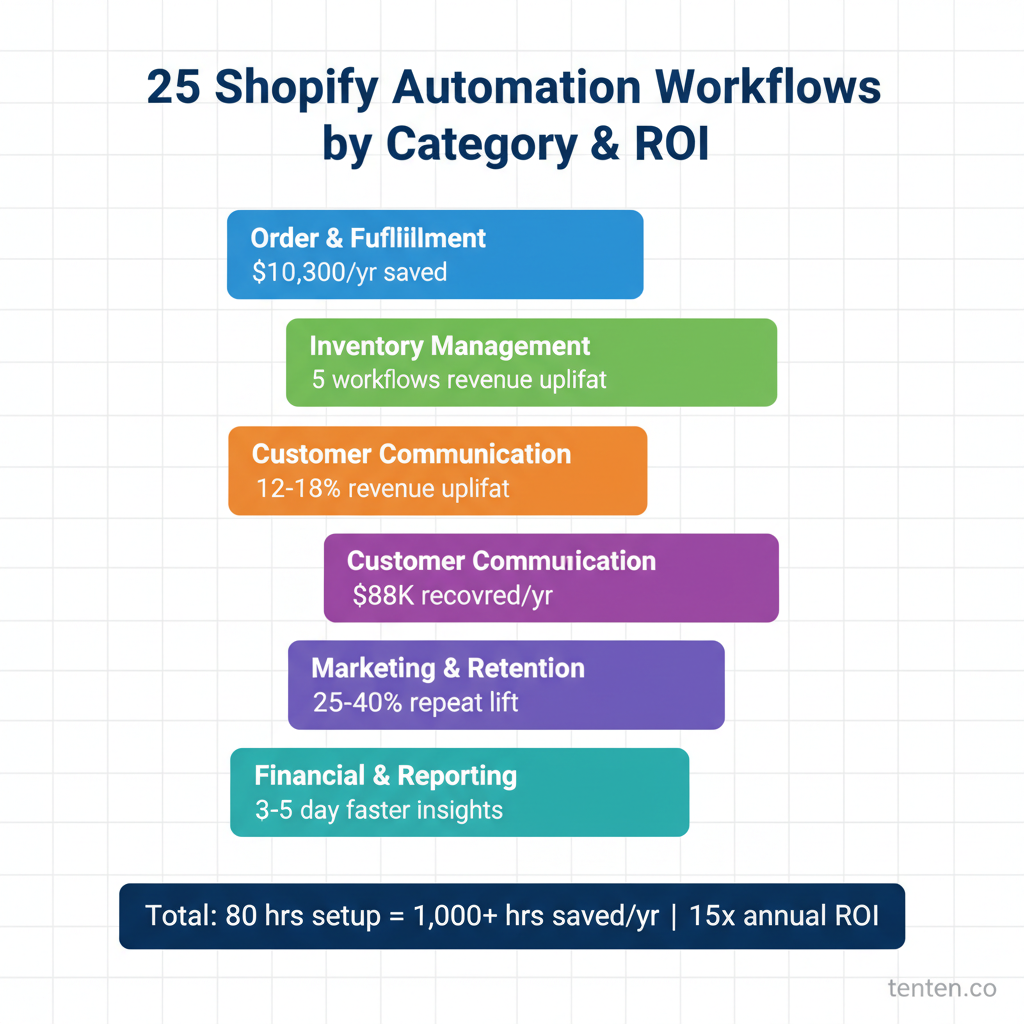
The Automation Prioritization Framework: Where to Start
Most founders feel overwhelmed by 25 automations. Don't try to build them all at once. Here's the phased approach:
Phase 1 (Month 1): Quick wins — Workflows #1, #6, #11, #21
- Time to implement: 8 hours total
- Monthly time savings: 25 hours
- Cost: $20–50/month
- ROI: 25x
Phase 2 (Months 2–3): Inventory & fulfillment — Workflows #4, #7, #8
- Time to implement: 12 hours total
- Monthly time savings: 18 hours
- Cost: $50–100/month
- ROI: 8x
Phase 3 (Months 4–6): Marketing & retention — Workflows #14, #16, #18
- Time to implement: 20 hours total
- Monthly time savings: 30 hours
- Cost: $100–200/month
- ROI: 5x
Full implementation (6 months): All 25 workflows
- Total time investment: 80 hours
- Monthly time savings: 80+ hours (1 FTE equivalent)
- Monthly cost: $350–500
- Annual ROI: ~15x
Ready to Automate Your Shopify Store?
Automation is the structural difference between a founder-dependent business and a scalable one. At $350–500/month in software costs and 80 hours of one-time setup, you're buying back 1,000+ hours annually. That's not an optimization — it's an operational transformation.
Start with Phase 1. Get those four automations live this week. Then layer in the rest over 6 months. By Q3, you'll be running a store that operates on autopilot while you focus on strategy, product, and growth.
If you want a customized automation strategy for your Shopify store — prioritized by ROI, implementation complexity, and your specific operational bottlenecks — talk to the Tenten team. We've built automation systems for 30+ Shopify stores, reducing operational overhead by an average of 60 hours/month.
From the Tenten Editorial Team
The founders who win aren't the ones who work 80-hour weeks. They're the ones who build systems that work while they sleep. Every hour you spend on automation setup today is worth $50+ in freed-up founder time annually. The only question is whether you'll invest those 80 hours now — or keep doing the same manual work for another year.
Frequently Asked Questions
What's the easiest Shopify automation to start with?
Workflow #1 — the order confirmation email. Takes 1 hour to set up, costs nothing, and saves 3 hours/month immediately. It's the confidence-builder that proves automation works before you invest in more complex workflows.
Can I automate my Shopify store on the Basic plan?
Yes, but with fewer native integrations. Start with Shopify's built-in automations (order emails, inventory alerts). Tools like Zapier and Klaviyo work across all plans. Once you upgrade to Shopify Plus, you unlock Shopify Flow and deeper API access for custom workflows.
How much does a full Shopify automation setup cost?
Software costs range from $350–500/month for the full 25-workflow stack. Setup time is approximately 80 hours (DIY) or $2,000–5,000 if you hire a Shopify agency. The ROI payback period is typically 1–2 months.
What's the biggest mistake founders make with automation?
Automating the wrong tasks. They spend a weekend building an automation for a 2-hour monthly task instead of tackling a 20-hour weekly task. Always audit your time first — track where you're spending 40+ hours/month, then automate those processes first.
Should I use Zapier, Make, or Shopify Flow?
Shopify Flow is free and deeply integrated — use it for anything Shopify-native (order routing, inventory alerts, customer tagging). Zapier is best for connecting Shopify to external tools (Stripe, Google Sheets, Slack). Make (formerly Integromat) offers more complex multi-step scenarios at lower cost than Zapier for high-volume stores.
How often do automations need maintenance?
Review quarterly. Check whether workflows are still firing correctly, look for new failure cases (especially after platform updates), and evaluate whether new automations would add value. Most workflows are maintenance-free after the initial setup, but switching tools (e.g., Klaviyo to Omnisend) will break Zapier connections — budget 2–4 hours for re-setup when you change major platforms.
What's the total annual ROI of automating all 25 workflows?
At full implementation: 80+ hours/month saved (1 FTE equivalent), $88,000+ in recovered abandoned cart revenue, and 12–18% revenue uplift from dynamic pricing. Total annual ROI is approximately 15x your software investment. The 80-hour setup investment pays for itself within the first month.