The Problem: You've Outgrown Themes
You started your Shopify store with a $300/month theme. That works when your store is $100K/month in revenue. But now you're at $500K/month, and the standard theme doesn't cut it anymore.
You need: - A custom checkout flow (your customers are balking at 8 clicks) - Real-time inventory sync with your warehouse system - Custom discount logic that Shopify doesn't support natively - Integration with your ERP, accounting system, and CRM - Performance optimization (your site loads in 5 seconds, conversion is suffering)
Now you have three paths forward:
- Hire an agency — Pay $5K-20K/month for a team of 2-4 developers who take ownership of your store
- Hire a freelancer — Pay $50-150/hour for a developer on contract who works on your projects as-needed
- Build an in-house team — Hire a full-time Shopify developer ($80K-130K/year salary + benefits) and own the talent
The right choice depends on your revenue, complexity, and growth stage. Let me break the math.
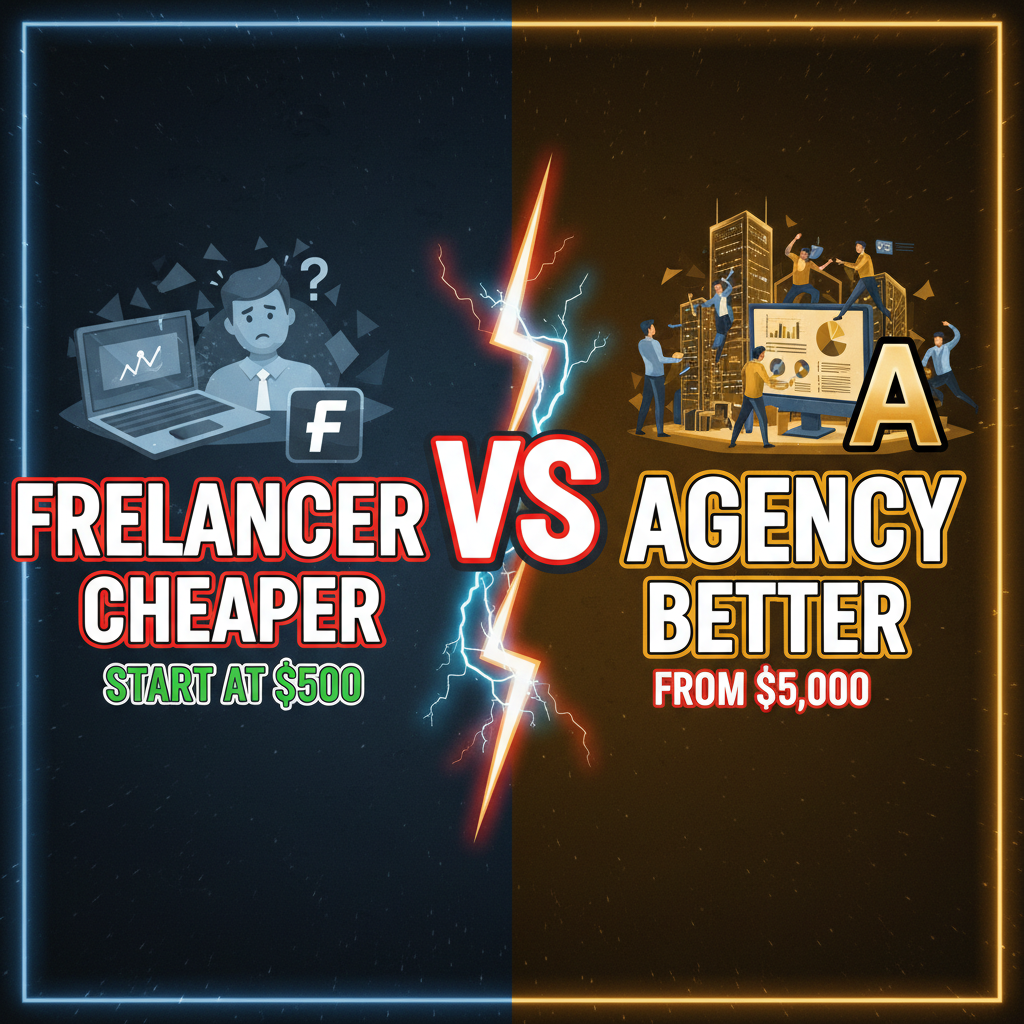
Option 1: The Freelancer Model
How it works: You find a freelancer on Upwork, Gun.io, or Toptal. You pay an hourly rate ($50-150/hour depending on skill), project-based rates ($2K-10K per project), or a retainer ($2K-5K/month for 20-40 hours).
Pros: - Low upfront cost ($0 until you need work) - No hiring process, no benefits, no HR overhead - Flexible (hire for specific projects, then part ways) - Access to specialized skills (maybe you need a blockchain developer for 10 hours; a freelancer is perfect)
Cons: - No accountability (freelancer disappears, your project stalls) - Knowledge lives with the freelancer (they leave, you lose documentation) - Context-switching (freelancer spends first 2-4 hours understanding your system every time) - Quality varies wildly (Upwork has great freelancers and terrible ones) - Slower development (no 24/7 monitoring, no proactive optimization)
Cost Structure: - Hourly: $50-150/hour × 20 hours/month = $1K-3K/month (inconsistent) - Retainer: $3K-5K/month for 30-40 hours - Project-based: $2K-10K per project (custom checkout, integration work, etc.)
Revenue Sweet Spot: $100K-$500K/month. Below $100K, you don't have the budget. Above $500K, you need more consistent support.
Staffing Model: - 1 freelancer for small projects - 2-3 freelancers for ongoing work (split responsibilities so you're not bottlenecked on one person) - Rotating freelancers leads to context loss and rework
Real Example: You're a $300K/month DTC brand. You hire a freelancer at $100/hour for 20 hours/month ($2K) to handle theme updates, app integrations, and bug fixes. For 12 months, that's $24K. Then you need a custom checkout (20 hours), costing an extra $2K project fee. Total first-year cost: $26K.
Option 2: The Agency Model
How it works: You hire a Shopify agency (like Tenten, or firms like Areion, Latitude, Salsita). You sign a contract for dedicated support. The agency assigns 1-4 developers to your account.
Pros: - Accountability (agency has reputation and legal liability; they deliver or refund) - Team redundancy (if one developer leaves, the agency assigns another) - Proactive optimization (agencies monitor performance, suggest improvements) - Knowledge documentation (agency maintains docs; knowledge doesn't walk out the door) - Faster development (dedicated team, no context-switching) - 24/7 support (some agencies offer emergency response)
Cons: - Higher cost ($5K-20K/month) - Less flexibility (you're locked in for 6-12 months usually) - Risk of developer rotation (good agencies prevent this; bad ones don't) - Overhead (you're paying for project management, account management, not just developer time) - Over-delivery risk (agencies sometimes over-build features you don't need)
Cost Structure: - Retainer (most common): $5K-20K/month for 40-120 hours of work - Breakdown: 2-3 developers × $150-200/hour = $300-400/hour team rate - Breakdown: $5K/month = ~25-33 hours/month of development work
Agency Tiers:
| Tier | Monthly Cost | Team Size | Response Time | Best For |
|---|---|---|---|---|
| Boutique | $5K-10K | 1-2 devs | 24-48 hours | $500K-$2M revenue |
| Mid-Market | $10K-20K | 2-4 devs | 4-8 hours | $2M-$10M revenue |
| Enterprise | $20K-50K+ | 4-8 devs | 1-2 hours | $10M+ revenue, Shopify Plus |
Revenue Sweet Spot: $500K-$10M/month. Below $500K, retainers are expensive. Above $10M, you might as well hire in-house.
Real Example: You're a $1.2M/month D2C brand. You hire an agency at $12K/month for 60 hours/month. Responsibilities: weekly optimization, feature development (custom checkout, integration work), bug fixes, performance monitoring. Agency assigns 1.5 developers to your account. Total first-year cost: $144K.
Option 3: The In-House Model
How it works: You hire a full-time Shopify developer (or 2-4 for larger teams). They work exclusively for your company.
Pros: - Deep product knowledge (they become intimately familiar with your store, business, and roadmap) - Availability (you can change priorities on the fly) - Long-term thinking (they care about technical debt, architecture, team growth) - Retention (if they stay, your institutional knowledge stays) - Cost efficiency at scale ($80K salary is cheaper than $10K/month agency once you hit $3M+ revenue)
Cons: - High upfront cost ($80K-130K/year salary + benefits) - Hiring risk (you might hire the wrong person; firing is expensive) - Limited specialization (one person can't be expert at everything—React, custom Liquid, APIs, design, DevOps) - Burnout risk (one person can become a bottleneck; when they vacation or leave, you're stuck) - Overhead (payroll, taxes, benefits, equipment, training) - 30-60 day ramp-up (new hires need 1-2 months to be productive on your codebase)
Cost Structure: - Base salary: $80K-130K/year - Fringe benefits: 25-35% of salary (FICA, health insurance, 401K, PTO) = $20K-45K/year - Equipment, training, tools: $5K-10K/year - Total all-in cost: $105K-185K/year (~$8,750-15,417/month)
Team Size & Scaling:
| Team Size | Annual Cost | Coverage | Best For |
|---|---|---|---|
| 1 developer | $105K-135K | Maintenance, small projects | $1M-$3M revenue |
| 2 developers | $210K-270K | Feature development, some redundancy | $3M-$10M revenue |
| 3-4 developers | $315K-550K | Full pipeline, multiple specialties | $10M-$50M+ revenue |
Revenue Sweet Spot: $2M-$10M/month. Below $2M, salaries exceed what the business can bear. Above $10M, you probably need multiple developers anyway.
Real Example: You're a $2.5M/month enterprise. You hire a Shopify developer at $110K/year + $35K benefits = $145K all-in. They handle ongoing optimization, feature development, and monitoring. After 6 months of ramp-up, they're productive and saving you thousands in avoided agency costs. Total first-year cost: $145K.
Comparing Total Cost of Ownership (TCO) Over 3 Years
Let's model three scenarios at different revenue levels.
Scenario A: $500K/Month Revenue Store
| Model | Freelancer | Agency | In-House |
|---|---|---|---|
| Year 1 | $30K | $60K | $150K |
| Year 2 | $30K | $60K | $150K |
| Year 3 | $30K | $60K | $150K |
| 3-Year TCO | $90K | $180K | $450K |
| Development Hours | ~300 hours | ~1,800 hours | ~6,000 hours (estimated productivity) |
Winner: Freelancer. At $500K/month, you don't have enough work to justify an agency or in-house hire. Use freelancers for project work, retaining one part-time freelancer for maintenance.
Scenario B: $2M/Month Revenue Store
| Model | Freelancer | Agency | In-House |
|---|---|---|---|
| Year 1 | $40K | $120K | $150K |
| Year 2 | $40K | $120K | $150K |
| Year 3 | $40K | $120K | $150K |
| 3-Year TCO | $120K | $360K | $450K |
| Development Hours | ~400 hours | ~2,160 hours | ~6,000 hours |
Winner: Freelancer or In-House (tie). At $2M/month, freelance retainers cost $40K/year, in-house costs $150K/year. But in-house gives you 6,000+ hours of work vs. 400 hours with freelancers. If you have 6,000 hours of work (12 new features, continuous optimization, monitoring), in-house wins. If you have 400 hours of work (occasional updates), freelancer wins.
Decision point: Do you have enough work to justify a full-time developer? If yes, hire in-house. If no, stick with freelancers.
Scenario C: $5M/Month Revenue Store
| Model | Freelancer | Agency | In-House |
|---|---|---|---|
| Year 1 | $50K | $180K | $300K (2 devs) |
| Year 2 | $50K | $180K | $300K |
| Year 3 | $50K | $180K | $300K |
| 3-Year TCO | $150K | $540K | $900K |
| Development Hours | ~500 hours | ~3,240 hours | ~12,000 hours (2 devs) |
Winner: In-House. At $5M/month, you have enough work for 2 full-time developers. In-house team (2 devs at $300K/year) is cheaper than an agency ($180K/month) over 3 years, and you own the IP and team knowledge.
Hidden Costs & Gotchas
Freelancer Hidden Costs
- Rework: Freelancer leaves; you hire new freelancer who wastes 40 hours understanding the codebase
- Context loss: No documentation = expensive re-learning
- Quality variance: Bad freelancer creates technical debt you have to pay later
Agency Hidden Costs
- Developer rotation: Good agencies should prevent this, but it happens
- Scope creep: Agencies sometimes over-deliver to look good (driving your costs up)
- Account management overhead: You're paying for PM and account manager, not just devs
In-House Hidden Costs
- Hiring failure: Wrong hire costs 3-6 months of lost productivity before you realize
- Burnout & turnover: Overworked developer quits; you lose 3 months to recruitment/ramp
- Skill gaps: One developer can't be expert at everything; you might need contractors for specialized work anyway
Decision Framework: Which Model Should You Choose?
Choose Freelancer if: - Revenue is $100K-$500K/month - Work is episodic (occasional feature requests, updates) - You have 0-10 hours/week of development work - Budget is tight - You're still figuring out your technical strategy
Choose Agency if: - Revenue is $500K-$5M/month - Work is consistent (40+ hours/month needed) - You want accountability and redundancy - You don't want to manage hiring or HR - You value speed (agency moves faster than freelancer) - You need advanced support (24/7 monitoring, performance optimization)
Choose In-House if: - Revenue is $2M-$50M/month - Work is ongoing and plentiful (80+ hours/month) - You have complex custom systems that require deep knowledge - You want full control and IP ownership - You can afford hiring risk (mistake costs money, but you learn and move on) - You're building a tech-forward culture
The Hybrid Model (Most Common)
The best companies don't pick one model. They combine them:
$2M/Month Example: - In-house: 1 senior developer ($130K/year) who owns architecture, reviews code, and leads strategy - Freelancer: 2-3 part-time freelancers ($2K-3K/month total) for maintenance, bug fixes, minor features - Agency (as-needed): $2K-5K/month for specialized work (custom checkout, performance optimization, integrations you don't have in-house expertise for) - Total cost: $175K-195K/year = $14.6K-16.2K/month
This gives you: - Deep product knowledge (in-house developer) - Flexibility and scalability (freelancers for overflow) - Specialized expertise (agency for complex work) - Cost efficiency (no over-staffing, no agency lock-in)
Key Takeaways
- Freelancers are for small, episodic work (<$500K/month, <10 hours/week). Cost is low; quality varies.
- Agencies are for mid-market merchants ($500K-$5M/month, 40+ hours/month). Cost is moderate; accountability is high.
- In-house is for scaling, complex stores (>$2M/month, 80+ hours/month). Cost is high; ownership and knowledge are yours.
- The hybrid model is most common among growing merchants. Hire one in-house dev, retain freelancers for overflow, use agencies for specialized work.
- Break-even point: In-house becomes cheaper than agency when you have >60 hours/month of consistent work ($2M+ revenue).
Choose based on your actual development workload, not your revenue. A $5M/month store with a simple setup might only need freelancers. A $1M/month store with custom integrations might need an agency.
Editorial Note
This article is based on operational experience working with 200+ Shopify merchants ranging from $100K to $100M+ in revenue, direct pricing data from 50+ Shopify agencies and freelancers, and salary benchmarks from Levels.fyi, Glassdoor, and industry surveys.
Article FAQ
Q: What if I hire a freelancer who's great, but they get busy and disappear? A: Negotiate a retainer agreement that guarantees minimum availability (e.g., "20 hours/month, response within 48 hours"). Hire 2-3 part-time freelancers instead of relying on one person. The redundancy costs more but prevents single-person bottlenecks.
Q: Should I hire someone full-time or part-time? A: Full-time is better for core work (ownership, mentorship, long-term thinking). Part-time is better for supplementary work (freelancers, contractors). If you need full-time expertise but only 20 hours/week of work, hire two part-time people instead of one full-time (costs more, but reduces burnout and turnover risk).
Q: Can I negotiate lower agency rates if I sign a longer contract? A: Yes. Most agencies discount 15-25% for 12+ month contracts. But be careful—longer lock-in means less flexibility if the relationship isn't working. 6-month contracts with renewal clauses are a safer bet.
Q: What's the average time to hire and onboard a Shopify developer? A: 4-6 weeks to hire (job posting, screening, interviews). 4-8 weeks to onboard (learning codebase, business context, shipping small features). Budget 3 months before a new hire is truly productive. Freelancers and agencies have much shorter ramp times (1-2 weeks).
Q: If I hire in-house, what should I pay? A: Shopify developers in the US range from $80K (junior, 0-2 years) to $180K+ (senior, 8+ years). Average is $110K-130K for a mid-level developer. In APAC and Europe, salaries are 30-50% lower. Use Levels.fyi, Glassdoor, and local job boards for current rates.
Q: What happens if an agency goes out of business? A: You lose your account manager and assigned developers. Reputable agencies have backup plans and will transition your account to another team member. Ask about business continuity; any agency should have a contingency plan. Also, ensure you own your code and documentation (not locked in proprietary systems).