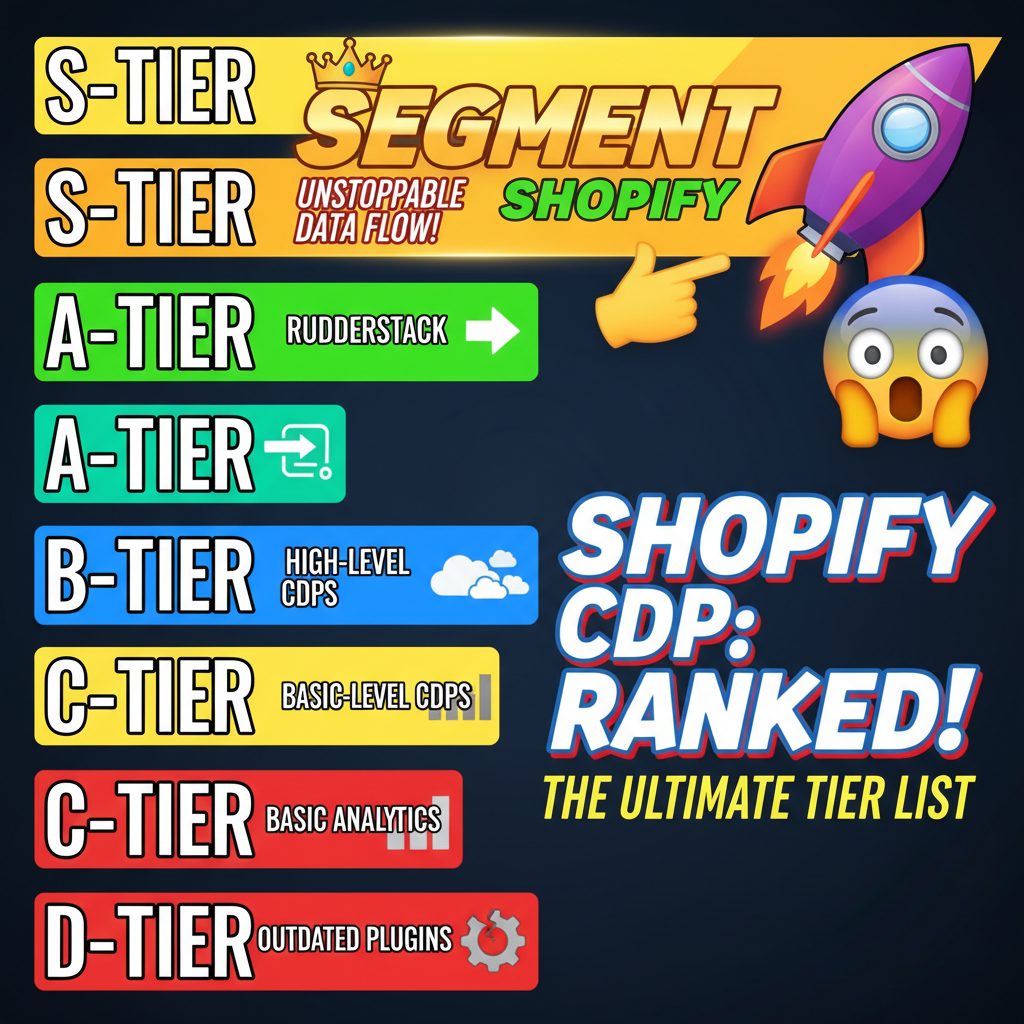
The CDP Problem: Shopify Data Lives in Silos
Shopify holds customer purchase data. Your email platform holds engagement data. Your analytics tool holds behavior data. Your ads platform holds impression data. None of them talk to each other.
A customer who bought twice on Shopify but unsubscribed from email won't reappear in your SMS segment. A high-lifetime-value customer from your website analytics won't automatically qualify for your VIP paid ads targeting. You're flying blind.
Customer Data Platforms (CDPs) solve this. They pull data from Shopify, email, analytics, payment systems, and ads—then create a unified view of every customer. That view feeds back to your marketing tools as segments, audiences, and triggers.
What Is a CDP, Exactly?
A CDP collects customer behavioral and transactional data from multiple sources, unifies it into a single customer profile, then activates that profile across marketing channels. Think of it as the "central nervous system" of your marketing stack.
Core functions: 1. Ingestion: Pull data from Shopify, Segment (events), email platforms, ad networks, analytics 2. Unification: Match customers across devices and channels using email, phone, or cookies 3. Segmentation: Build audiences based on purchase history, behavior, or custom attributes 4. Activation: Send segments to email, SMS, ads, or custom webhooks
For a $1M DTC brand, the ROI is significant. Segment customers by repeat purchase rate. Target non-repeaters with a $20 discount via email, SMS, and Instagram Ads simultaneously. Gong's 2023 Customer Data Study found that brands using CDPs see 35% higher repeat purchase rates.
Segment: The Market Leader
Segment powers 30,000+ businesses with 700+ integrations. Easiest setup for technical teams. Shopify source takes ~30 minutes.
Strengths: Pre-built Shopify integration, massive ecosystem, good for mid-market brands.
Weaknesses: Pricing scales with volume (expensive at $5M+), requires separate activation layer, limited GDPR automation.
Trade-off: Cheap until 50M events/month, then costs $5K+/month. By then, most teams have outgrown it.
Rudderstack: Open-Source Alternative
Self-hosted CDP with transparent pricing ($300–$1,500/month). You own your data, warehouse-first approach.
Strengths: Cost control, self-hosting option, data warehouse integration.
Weaknesses: Requires technical setup (2–4 weeks), smaller ecosystem (300+ destinations), minimal support.
Reality: Perfect for brands with in-house data teams. Bootstrapped brands should skip.
mParticle: Mobile + Offline Unification
Best for brands with iOS apps or physical retail. Unifies web, mobile, and POS data seamlessly.
Strengths: Mobile-first SDKs, POS integration, built-in GDPR/CCPA.
Weaknesses: Expensive ($3K+/month), requires development resources, overkill for pure e-commerce.
Best for: $10M+ revenue brands with apps and physical locations.
Tealium: Enterprise Option
Used by Nike, L'Oréal. Most sophisticated audience building and governance.
Strengths: Advanced algorithms, full compliance support, implementation services included.
Weaknesses: Prohibitively expensive ($50K+/year), overkill for brands under $10M.
Best for: Enterprise SaaS, large CPG, luxury e-commerce ($50M+).
Decision Matrix
| Revenue | Top Choice | Why |
|---|---|---|
| < $1M | Skip CDP | Use Shopify + Klaviyo |
| $1M–$5M | Segment/Rudderstack | Segment for simplicity, Rudderstack for cost |
| $5M–$20M | Rudderstack/mParticle | Rudderstack if CTO available, mParticle if mobile |
| $20M+ | mParticle/Tealium | Tealium for enterprise support, mParticle for flexibility |
The Activation Problem
Having unified data is useless if you can't activate it. Most CDPs collect—they don't activate.
Example: Segment gives you a "high-value repeat customers" segment. Sending to Google Ads requires manual mapping + custom integration + ongoing refresh. mParticle is better here—destinations are pre-built.
Best Practice: Start Small
- Start with Shopify native + Klaviyo (free/low cost)
- Month 6–12: Test Segment if running 3+ channels
- Month 12+: Migrate to Rudderstack/mParticle if costs exceed $2K/month
Most brands don't need complex CDP before $2M revenue. Implement too early and you'll abandon it.
FAQ
Q: Can I use Shopify alone without a CDP? A: Yes, up to $2M revenue. Shopify native + Klaviyo covers 80% of use cases. CDPs add 15% more revenue at 5+ channels.
Q: Does Segment own my data? A: No. You own all data; Segment stores it. But Segment sees raw events. Use Rudderstack self-hosted if concerned.
Q: Which CDP integrates best with Shopify? A: Segment (30-minute setup). Rudderstack and mParticle require more work. Tealium requires professional services.
Q: What's the difference between CDP and DMP? A: DMPs focus on audience building using third-party cookies. CDPs focus on customer unification with first-party data. You need a CDP for Shopify.
Q: How long does CDP implementation take? A: Segment: 2–4 weeks. Rudderstack: 4–8 weeks. mParticle: 8–12 weeks. Tealium: 3–6 months with services.
Q: Can multiple team members manage a CDP? A: Yes, but depends on platform. Segment/mParticle allow role-based access. Rudderstack requires API access. Tealium requires separate seats ($5K+/year).
Frequently Asked Questions
What's the cheapest CDP for Shopify?
Rudderstack at $300–$1,500/month (requires technical setup). Segment at $500–$2,000/month (simpler).
Should I buy a CDP if my store is under $2M?
No. Use Shopify segmentation + Klaviyo. CDPs are overhead until 5+ marketing channels.
Which CDP has the best Shopify integration?
Segment (pre-built, 30 minutes). Rudderstack and mParticle are close but require more setup.
How do I know if my data is safe?
Check SOC 2 Type II (all major CDPs have it), GDPR compliance, and data residency options. Rudderstack best because you can self-host.
Can I switch CDPs without losing customer profiles?
Yes. Expect 2–4 weeks for re-unification. Export customer file, reimport, let it re-match.