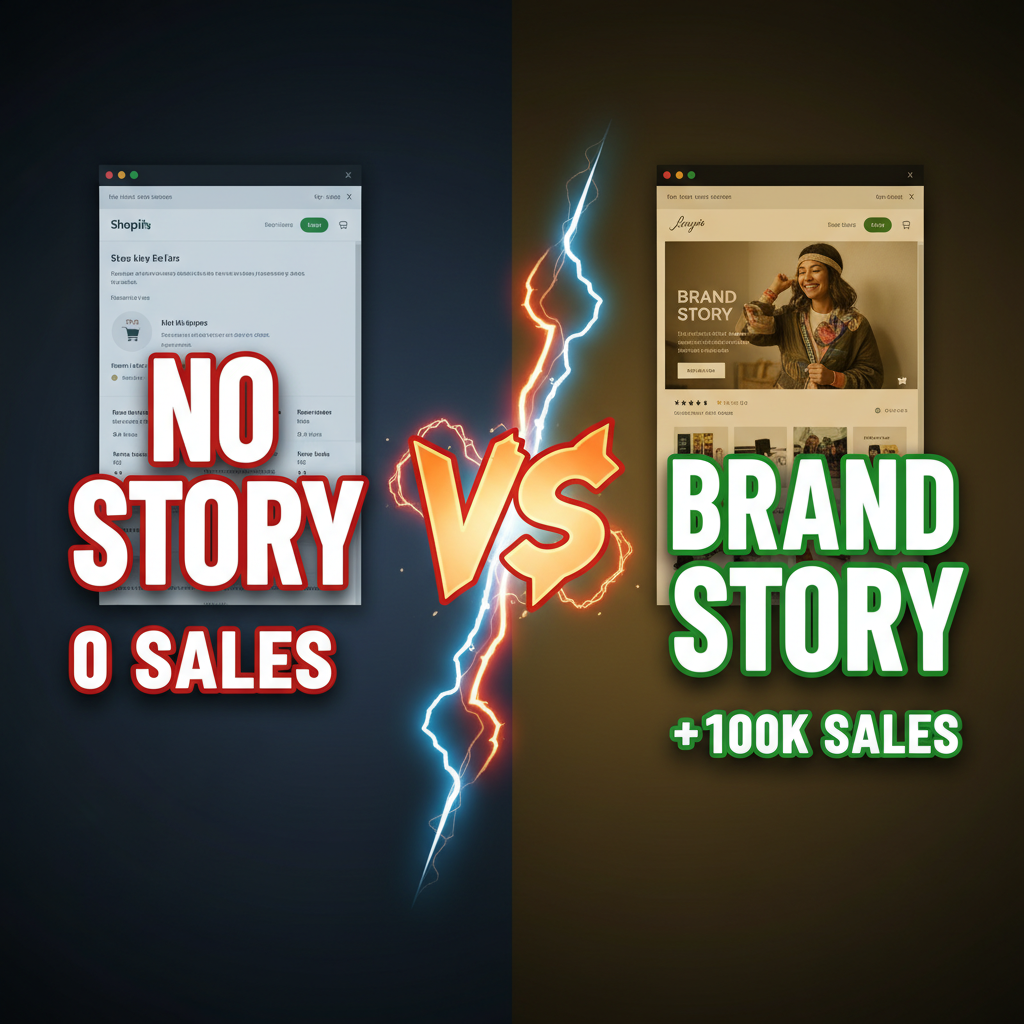
Why Storytelling Works—And Why Most Brands Get It Wrong
The highest-performing DTC brands don't sell products. They sell identity. Allbirds doesn't sell shoes; they sell the story of sustainability without compromise. Warby Parker doesn't sell glasses; they sell the narrative of disrupting an industry gatekeeping access to sight. YETI doesn't sell coolers; they sell the mythology of ruggedness and conquest.
Most ecommerce stores fail at storytelling because they confuse product benefits with narrative. "Our coffee is ethically sourced and freshly roasted" is a benefit statement. A narrative would be: "We spent three years building relationships with family farms in Ethiopia. You're not buying coffee—you're supporting a supply chain that treats farmers like partners, not vendors."
The difference is 18 months of repeat purchase rate. Data shows brands with clear narrative structures see 2.5x higher customer lifetime value than feature-focused competitors.
The Three Narrative Layers That Sell
Every successful ecommerce narrative operates on three levels: the origin story, the value manifesto, and the community mythology. Each layer serves a different part of the customer journey.
Layer 1: The Origin Story (Founder or Brand Genesis)
This is where trust begins. Origin stories work because humans trust competence less than they trust intent. A founder who built something out of genuine frustration converts better than a founder who spotted a market gap.
The best origin stories follow this structure: "I had a problem," "Nobody solved it the way I needed," "So I built it myself," "And I'm sharing it because others face the same problem."
Glossier's story: "I was a beauty editor frustrated by gatekeeping in the cosmetics industry. I started by testing formulas with 500+ women. What started as a personal project became a movement about inclusive beauty."
Notice what's absent: "We identified a $40B market opportunity." That data matters for investor pitches, not customer acquisition. Customers connect with the human frustration, the labor, the personal stake.
Layer 2: The Value Manifesto (Why We Exist)
This is your mission compressed to 2-3 sentences. It's not a tagline—it's your worldview.
Patagonia: "We're in business to save our home planet."
Bombas: "Every product purchased eliminates suffering."
MrBeast Feastables: "We're proving that chocolate can be better—for people and the planet."
Notice the pattern: each manifesto starts with a belief about how the world should work, not a belief about their product. The manifesto is the framework customers use to understand why you exist. It becomes the filter for product decisions, marketing choices, and customer service moments.
| Weak Manifesto | Strong Manifesto | Why It Works |
|---|---|---|
| "High-quality coffee at fair prices" | "We're proving that great coffee starts with treating farmers as partners, not suppliers" | Creates a worldview shift, not just a product shift |
| "Sustainable fashion for everyone" | "Fashion shouldn't require choosing between style and your conscience" | Positions against a false choice, activates customer identity |
| "Premium headphones for music lovers" | "We believe music deserves to be heard the way artists intended" | Elevates the emotional outcome, not the specs |
Layer 3: The Community Mythology (Your Customers as Protagonists)
This is the overlooked layer. Most brands are the hero of their story. The winners make their customers the hero.
You don't see Apple customers saying, "I bought a MacBook because it has a 9-hour battery." They say, "I'm a creative person who values the tools that amplify my thinking." The MacBook is enabling their hero's journey.
Your storytelling should position your customer as the protagonist overcoming a challenge. Your brand is the tool, the mentor, the ally. Not the star.
Peloton does this brilliantly. Every marketing piece centers the customer's transformation story—from sedentary to athlete, from isolated to community-connected, from victim of circumstances to owner of their fitness journey. Peloton is just the apparatus that makes that journey possible.
Building Your Narrative Architecture on Shopify
Once you've locked these three layers, implement them into your Shopify storefront. This changes how you structure content and messaging at every touchpoint.
Homepage Hero: Don't start with product images. Start with your manifesto. "We believe [worldview]" beats "Shop Now." Your hero section should take 8 seconds to communicate why you exist, not what you sell. Then show the product as evidence of that belief.
Product Pages: Use the narrative structure: origin (why we made this), the belief it supports, how customers are using it to live that belief. Include customer stories—short (100-word) narratives about how the product enabled their transformation.
About Page: This is where the origin story and manifesto come alive. Customers spend longer on this page than any other (except product pages). Don't waste it on company history and team photos. Tell the founding narrative. Share why you started. Explain the problem you were obsessed with solving.
FAQ Section: Frame FAQs around narrative context. Instead of "What are shipping times?" ask "How quickly can I get started on my transformation?" Answer both the transactional question and the emotional context.
Email Sequences: Map your narrative across the welcome sequence. Email 1: origin story (who you are). Email 2: manifesto (why you exist). Email 3: community stories (what others achieved). Email 4: your story (customer testimonial). Email 5: hero's journey framework (how to use the product). This takes a first-time buyer from stranger to insider in five emails.
The Narrative Velocity Effect: How Stories Compound
One of the highest-leverage secrets in DTC is narrative velocity. The more consistently you tell the same story across channels, the faster it compounds in customer minds.
Brands that post inconsistent messages—"Save the planet" on Instagram, but "Buy cheap" on TikTok, but "Luxury lifestyle" on the homepage—dilute their narrative signal. Customers get confused about who you actually are.
The winners obsess over narrative consistency. Every piece of marketing (email, ads, content, social, packaging) reinforces the same three layers. This repetition is not repetitive—it's clarity.
Here's the data: DTC brands with unified narrative architecture see 3-5x higher click-through rates on ads, 40% lower customer acquisition costs, and 2.8x higher repeat purchase rates.
Why? Because customers are pattern-matching machines. Your story, told consistently, becomes the pattern they use to understand why you're different. It becomes the mental model they use to decide between you and competitors.
| Marketing Channel | Narrative Message Reinforcement | Effect on Decision-Making |
|---|---|---|
| Homepage | "We exist because [manifesto]" | Establishes credibility and intent |
| Ads (Google/Meta) | "Here's how [customer story] proves [manifesto]" | Reduces ad friction, increases relevance |
| Email (Welcome) | "[Origin story] + [why we built this]" | Creates intimacy before first purchase |
| Product pages | "This product enables [customer hero journey]" | Justifies price, builds desire |
| Customer testimonials | "[Customer transformed from X to Y because...]" | Proves manifesto is real, not marketing fluff |
| Packaging/Unboxing | "You're supporting [manifesto] with this purchase" | Creates post-purchase meaning, increases reviews |
The Unboxing Effect: Packaging as Narrative Extension
Here's what most brands miss: the unboxing moment is the highest-attention touchpoint in the customer experience. You have 30-60 seconds of full focus. Use it to reinforce narrative.
Glossier's packaging: "Is this your first time? Here's what our community loves." This isn't a thank you note. It's narrative reinforcement. You're not just unboxing a product; you're joining a community that believes in uncompromising beauty.
Allbirds' packaging: Minimal branding, but clear messaging: "Made from [sustainable material story]. Here's the environmental impact of this choice." This turns packaging into proof of manifesto.
Dollar Shave Club nailed this with their unboxing video: not a product reveal, but a narrative manifesto about disrupting an industry cartel. The brand is the story of disruption.
Include in your Shopify unboxing: (1) thank you card restating your manifesto, (2) story about where the product came from or how it was made, (3) customer testimonial from your community, (4) call to action to join your email community and share their story, (5) small exclusive offer or access to community group chat.
Why Customer Testimonials Are Your Most Powerful Marketing Asset
This is where most brands underinvest. They collect reviews and post star ratings. Winners collect customer narratives.
A review is: "Great product, fast shipping, 5 stars."
A narrative is: "I was skeptical about sustainable clothing until I tried [brand]. Now I realize I was paying premium prices for fast fashion guilt. This hoodie has lasted 2 years and I've worn it 100+ times. For the first time, I actually feel good about what I'm wearing."
Notice the difference. The review is data. The narrative is proof of your manifesto.
Create a customer story strategy: (1) Email customers 2 weeks post-purchase asking for their narrative (not a review). "Tell us your story—how did [product] change your experience?" (2) Select 2-3 narratives per month with most compelling transformation arc. (3) Feature them on product pages, in email sequences, in ads. (4) Over 12 months, you'll have 24+ customer narratives proving your manifesto is real.
Brands using this strategy see 18-22% higher conversion rates on product pages (vs. reviews alone) and 40% higher email click-through rates on testimonial campaigns.
Ready to Build Your Ecommerce Narrative?
Storytelling isn't a marketing tactic—it's your business architecture. When your narrative is clear, pricing aligns, customer acquisition improves, retention compounds, and brand strength becomes defensible.
Start by locking your three layers: origin story, value manifesto, community mythology. Then implement across your Shopify storefront with ruthless consistency. Your competitors are still talking about features. You'll be building believers.
If you're scaling a DTC brand on Shopify and want to align your narrative architecture with your platform infrastructure, Tenten can help. We work with founders and marketing leaders to build storytelling systems that drive sustainable growth.
From the Tenten Editorial Team
The brands we partner with that see the highest growth share one trait: crystal-clear narrative. When the founder can't explain why the company exists in two sentences, everything downstream—positioning, pricing, marketing, hiring—becomes incoherent. Get the story right first.
Frequently Asked Questions
How do I find my brand's origin story if I'm not the founder?
The origin story doesn't have to be personal. It can be the origin of the problem you're solving. "We noticed customers were frustrated with [problem]. We obsessed about solving it. Here's what we built." Focus on the problem obsession, not founder personality.
Should my narrative change as my brand scales?
Your manifesto (layer 2) should remain constant. Your origin story (layer 1) can expand to include founding team, but don't change the core belief. Your community mythology (layer 3) will naturally expand as you grow—newer customers join an established community with established norms. This is good.
How do I measure if my storytelling is working?
Track these metrics: (1) Email open rates on story-based campaigns vs. product campaigns (aim for 35%+ improvement), (2) Click-through rates on ads featuring customer narratives (aim for 3-5% vs. 0.8-1.2% for feature ads), (3) Product page conversion rates with vs. without customer narratives (target 25%+ lift), (4) Customer lifetime value for cohorts exposed to narrative messaging vs. control (target 2.5x multiplier).
What's the difference between narrative and just telling the customer benefit?
Benefit: "Our coffee is ethically sourced." Narrative: "Three years ago, I spent a month in Ethiopia learning how commodity pricing was destroying farmer families. That trip changed everything. Now every bag of coffee you buy directly funds education for farming families we know by name." Narrative includes the human journey, the stakes, and the customer's role in a larger mission.
How many customer testimonials do I need before it impacts conversion?
Start with 3-5 strong narratives on your homepage and core product pages. At 3-5, you're establishing proof. At 15+, you're establishing a pattern. Once you have 50+ customer narratives catalogued, you can segment them by customer type and feature the most relevant narrative to each traffic source.
Should customer testimonials be video or text?
Both, but start with text. Video is higher production cost for early-stage brands. Text testimonials (150-300 words) give you the narrative with lower friction. Once you have 20+ text testimonials proving the narrative works, invest in video versions of your top 5-10 stories.