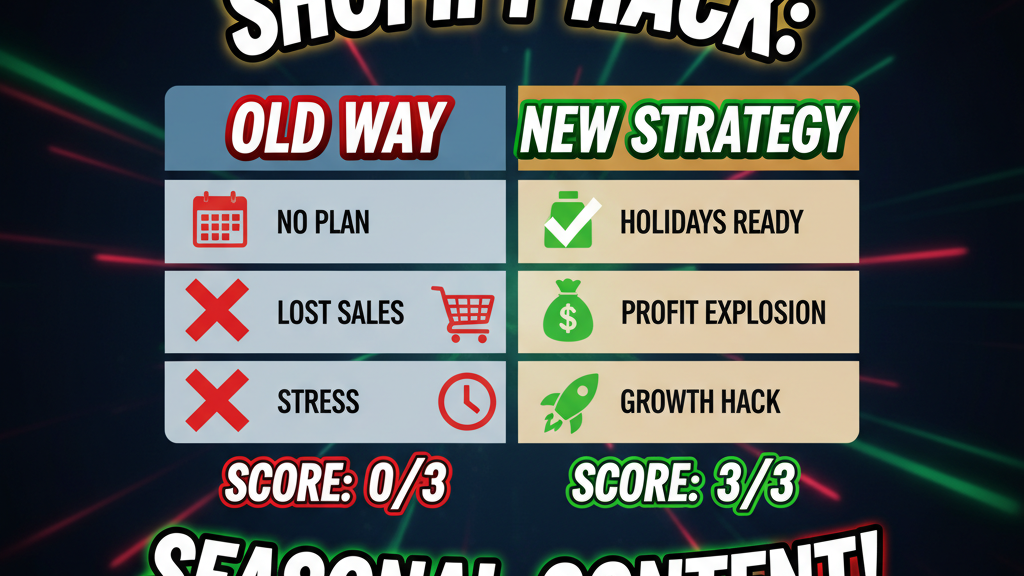
The Seasonal Revenue Pulse
Seasonal revenue isn't random. It follows predictable patterns—and predictability is opportunity.
Black Friday generates 20–30% of annual revenue for most retailers (Adobe data). Cyber Monday peaks on Monday but sells throughout the week. Back-to-school drives July–August spending. Holiday shopping (Oct-Dec) accounts for 25–35% of annual sales.
The merchants winning these peaks aren't scrambling in October. They're planning in July. They're creating content in August. By October, campaigns are live and optimized.
Here's the seasonal content playbook every Shopify merchant should follow.
The 90-Day Planning Cycle
Content planning must happen 90 days before the selling season. This gives you time to create, test, refine.
May–June: Black Friday/Cyber Monday Planning
- August–September: Content creation, email sequences, social ads
- October: Testing, optimization, final tweaks
- November: Run campaigns, gather data, iterate
April–May: Summer/Back-to-School Planning
- June–July: Content and creative production
- July: Early testing, refinement
- August–September: Full campaign launch
June–July: Holiday Season Planning
- August–September: Content production, email copy, visual design
- September–October: Campaign testing, early bird sales
- November–December: Full campaign running, daily optimization
Miss the 90-day window? You're reacting, not strategizing. Content gets rushed. Ads feel generic. Conversion lifts are 30–40% lower.
Seasonal Content Buckets
Seasonal revenue comes from five content drivers:
1. Educational Content (Problem-Solution)
"What to buy your (audience) for (holiday)?"
"How to choose the best (product category) for (occasion)"
Example headlines:
- "The Best Gifts for Remote Workers in 2026"
- "Stocking Stuffers Under $50: Tech Edition"
- "Back-to-School Gear: Supplies Your Child Actually Needs"
These drive awareness and research. They're not direct-sales content; they're discovery content. People research before buying.
Timeline: Publish 8–12 weeks before season.
ROI: High traffic, medium conversion. Funnel top.
2. FOMO/Urgency Content (Limited Time)
"Only X days until Christmas shipping deadline"
"These gifts ship in 2 days (only through Friday)"
"Stock is limited—99 remaining"
These convert. They create urgency. But overuse them and they lose power. Merchants who run "only 5 left" on every product look desperate.
Use sparingly: For genuinely limited inventory, genuine deadlines, and genuine flash sales.
Timeline: Run 2–4 weeks during peak season.
ROI: High conversion, drives impulse buys.
3. Comparison/Review Content (Decision Support)
"Luxury vs. Budget Gift Picks"
"The Best Stocking Stuffers by Category"
"Compare These Three (Product) for (Occasion)"
People buy when they feel confident in their choice. Comparison content removes doubt.
Timeline: Publish 6–10 weeks before season.
ROI: Medium-high conversion, mid-funnel.
4. Social Proof/User-Generated Content (Credibility)
Customer testimonials, unboxing videos, styling photos, reviews.
"See how real customers styled this for the holidays."
Before/after photos. Video testimonials. 5-star reviews highlighted.
Timeline: Gather year-round; compile and feature 8–12 weeks before season.
ROI: Medium traffic, high conversion lift.
5. Brand Story/Value-Aligned Content (Positioning)
Why you're different. Sustainability story. Craftsmanship. Local production. Ethical sourcing.
Example: A clothing brand might publish "How We're Reducing Packaging Waste for Holiday 2026" or "Our Supply Chain: Where Your Gifts Are Made."
This resonates with values-driven buyers and commands premium pricing.
Timeline: Publish 10–14 weeks before season.
ROI: Lower volume, premium conversion, higher AOV.
The Seasonal Content Calendar (Template)
Here's a master calendar for a typical retailer:
| Season | Weeks Out | Content Type | Topic | Format | Goal |
|---|---|---|---|---|---|
| Back-to-School | 14 | Educational | Packing lists by grade | Blog + Email | Awareness |
| Back-to-School | 12 | Comparison | Best backpacks: brands vs. price | Guide | Consideration |
| Back-to-School | 10 | UGC | Student styling photos | Instagram reel | Trust |
| Back-to-School | 8 | FOMO | "Shipping deadline: Friday" | Email + SMS | Urgency |
| Back-to-School | 6 | Sales | "20% off everything for 48 hours" | Paid ads | Conversion |
| ------- | ------- | ------- | ------- | ------- | ------- |
| Black Friday | 14 | Brand story | "Ethical Black Friday: Our commitment" | Blog | Positioning |
| Black Friday | 12 | Comparison | "Best deals: Which products are actually discounted?" | Guide | Consideration |
| Black Friday | 10 | Educational | "Black Friday Buying Guide" | Blog + Email | Awareness |
| Black Friday | 8 | UGC | Customer reviews, unboxing videos | TikTok, Instagram | Trust |
| Black Friday | 6 | Teaser | "Here's what's coming (sneak preview)" | Anticipation | |
| Black Friday | 4 | FOMO | "Deals live in 72 hours" | Paid ads | Urgency |
| Black Friday | 2 | Sales | Campaign live | Everything | Conversion |
| Black Friday | 0 | Optimization | A/B test, daily tweaks, upsells | Real-time | Maximize AOV |
| Cyber Monday | 0 | Continuation | "Last chance" messaging | Extend peak |
Content-to-Sales Mapping
Not all content converts equally. Seasonal content follows a funnel:
| Stage | Content Type | Example | Conversion |
|---|---|---|---|
| Awareness | Educational, storytelling | "The Ultimate Holiday Gift Guide" | Low (2–4%) |
| Consideration | Comparison, reviews, specs | "Luxury vs. Budget Gift Picks" | Medium (5–8%) |
| Decision | UGC, testimonials, urgency | Customer reviews + "Only 3 left" | High (10–15%) |
| Action | Sales, discounts, CTAs | "Buy now—48-hour deal" | Highest (20%+) |
Winners understand the funnel. They don't expect educational content to close sales. They use it to drive traffic, funnel users to consideration content, then close with urgency and UGC.
Seasonal Themes by Category
Different product categories peak at different times:
| Category | Peak Seasons | Key Angles |
|---|---|---|
| Apparel | Back-to-school (Aug), Holiday (Nov-Dec) | Trends, styling, gift guides |
| Home & Garden | Spring (Mar-May), Back-to-school (Aug) | Organization, new home, dorm |
| Electronics | Black Friday (Nov), Holiday (Dec) | Performance, deals, new tech |
| Beauty | Holiday (Nov-Dec), Valentine's (Jan-Feb) | Gifts sets, tutorials, trends |
| Sports/Outdoors | Summer (May-Aug), Holiday (Nov-Dec) | Gear guides, training, travel |
| Toys/Kids | Back-to-school (Aug), Holiday (Nov-Dec), Valentine's (Feb) | Age guides, STEM, trends |
| Food/Beverage | Holiday (Nov-Dec), Summer (Jun-Aug) | Recipes, gifting, entertaining |
Map your category to its peaks. Create content for those windows.
Email & SMS Sequences for Seasonal Peaks
Email drives 45% of holiday revenue for most retailers (Klaviyo data). Structure sequences like this:
Black Friday Email Sequence (8 emails over 2 weeks)
- Day 1: "Coming Friday—Our biggest sale" (teaser, build anticipation)
- Day 3: "Here's what's discounted (preview)" (curiosity, sneak peek)
- Day 5: "Sale starts in 48 hours" (last-minute urgency)
- Day 7: "It's live—your deals inside" (call to action)
- Day 9: "You have 48 hours left" (mid-peak reminder)
- Day 11: "Last chance tonight" (final urgency)
- Day 13: "Sale ends in 6 hours" (countdown)
- Day 15: Follow-up with abandoned cart recovery
SMS: 3–5 texts during peak (higher urgency tolerance on SMS).
Back-to-School Email Sequence (5 emails over 4 weeks)
- Week 1: "Prep Guide—What to buy" (educational)
- Week 2: "Shop by grade level" (product discovery)
- Week 3: "Early shoppers save 15%" (incentive)
- Week 4: "Shipping deadline alert" (urgency)
- Week 5: "We've restocked bestsellers" (retargeting)
Segment by customer type (returning vs. new) and audience (parents, students, teachers). Tailor messaging.
Inventory Planning Tied to Content
Content drives demand. Demand must match inventory.
Problem: You publish "Best Back-to-School Backpacks" featuring your top SKU. It ranks on Google. 10,000 people read it. 500 click through. 50 buy. You're out of stock in 48 hours.
Solution: Coordinate content calendar with inventory. Before publishing content featuring a product, confirm stock levels 4–6 weeks out. If a product is seasonal and you stock up, publish content to move it. If it's low inventory, don't feature it.
Work with your supply chain team. Content and inventory must align.
Seasonal Testing Plan
You can't optimize what you don't measure. Build a testing calendar:
6 Weeks Before Season:
- Test subject lines (seasonal vs. timeless)
- Test discount messaging ("20% off" vs. "Save $50")
- Test product recommendations (bestsellers vs. trending)
4 Weeks Before Season:
- Test email send times
- Test paid ad creative (carousel vs. static)
- Test landing page layouts (grid vs. list)
2 Weeks Before Season:
- Test urgency messaging ("Only 2 left" vs. "Ships before Christmas")
- Test CTAs ("Shop now" vs. "Complete your order")
- Finalize winning variants
During Season:
- Daily monitoring
- Real-time optimization (pause underperforming ads, boost top performers)
- Upsell testing (bundles, volume discounts)
Document results. Next year, start with winners.
Tools for Seasonal Content Management
| Tool | Use Case | Cost |
|---|---|---|
| Shopify Marketing | Campaign calendar, email sequences | Free (basic) |
| HubSpot | Multi-channel content calendar, templates | Free–$50/mo |
| Monday.com | Content planning, workflow, deadlines | $10–$25/month |
| Airtable | Custom content calendar, tracking | Free–$20/month |
| ContentStudio | Social posting, content library | $20–$99/month |
| Google Sheets | Collaborative calendar (free but limited) | Free |
Use one tool for the entire calendar. Share access with your team. Assign owners (copy, design, scheduling) and deadlines.
Common Seasonal Content Mistakes
Mistake 1: Starting Too Late
Publishing content 2 weeks before the season means no time to drive traffic, rank on Google, or refine. Start 10–14 weeks out minimum.
Mistake 2: Over-Relying on Discounts
Discount-focused content converts short-term but erodes brand value and trains customers to wait for sales. Mix in educational, storytelling, and full-price content.
Mistake 3: Recycling Last Year's Content Verbatim
Update data. New trends emerge. New products exist. Refresh content with current stats, new angles, new recommendations.
Mistake 4: Ignoring Mobile Experience
60%+ of holiday traffic is mobile (Shopify data). If your content isn't mobile-optimized, you're leaving conversions on the table.
Mistake 5: Not Segmenting Email
Sending the same "20% off" email to everyone (new customers, repeat customers, VIPs) leaves money on the table. First-time buyers respond to education; loyal customers respond to exclusivity.
2026 Seasonal Content Trends
Three shifts are happening:
AI-Generated Product Recommendations
Stores using AI recommendation engines are seeing 15–25% higher AOV during seasonal peaks. Personalization is table-stakes.
Video Over Static Content
Short-form video (Instagram Reels, TikTok, YouTube Shorts) drives 3x higher engagement than static images during seasonal peaks.
Sustainability Positioning
Eco-conscious consumers spend 25–30% more for sustainable products. Seasonal content emphasizing ethical sourcing, sustainable packaging, and local production commands premium pricing.
Ready to Plan Your Seasonal Content?
Seasonal revenue follows patterns. Plan 90 days ahead. Create content for awareness, consideration, and decision. Measure everything.
Get a seasonal content strategy for your store
Editorial Note
Seasonal content is predictable and repeatable. The merchants winning seasonal peaks aren't reacting in October—they're planning in July. This playbook works across all product categories.
Article FAQ
Q: When should I start planning seasonal content?
A: Start 12–14 weeks before the peak season. Weeks 12–10 for planning/strategy, weeks 10–6 for content creation, weeks 6–4 for testing, weeks 4–0 for launch and optimization.
Q: How many pieces of content do I need for a seasonal campaign?
A: 8–12 pieces minimum: 3–4 educational blogs, 2–3 comparison guides, 1–2 email sequences, 2–3 social media campaigns, 1 UGC compilation. More for larger budgets.
Q: What's the best time to start advertising seasonal content?
A: Email campaigns start 8 weeks before. Paid ads (Facebook, Google) start 6–8 weeks before for awareness, shift to urgency messaging 2–4 weeks before. SMS starts 4 weeks before.
Q: How much do I need to discount for seasonal sales?
A: 10–20% discounts drive volume without training customers to expect 50% off. Bundle deals (buy one, get X% off second) preserve margin better than blanket discounts.
Q: How do I know which seasonal content is working?
A: Track: traffic by content piece (Google Analytics), conversion rate by campaign, email open/click rates, paid ad ROI. Test variations (subject lines, CTAs, discounts). Double down on winners.
Q: Should I reuse seasonal content year-over-year?
A: Update it, don't recycle it. Refresh data, trends, product recommendations, stats. Last year's "best gifts" might not work this year if you have new products or audience shifts.