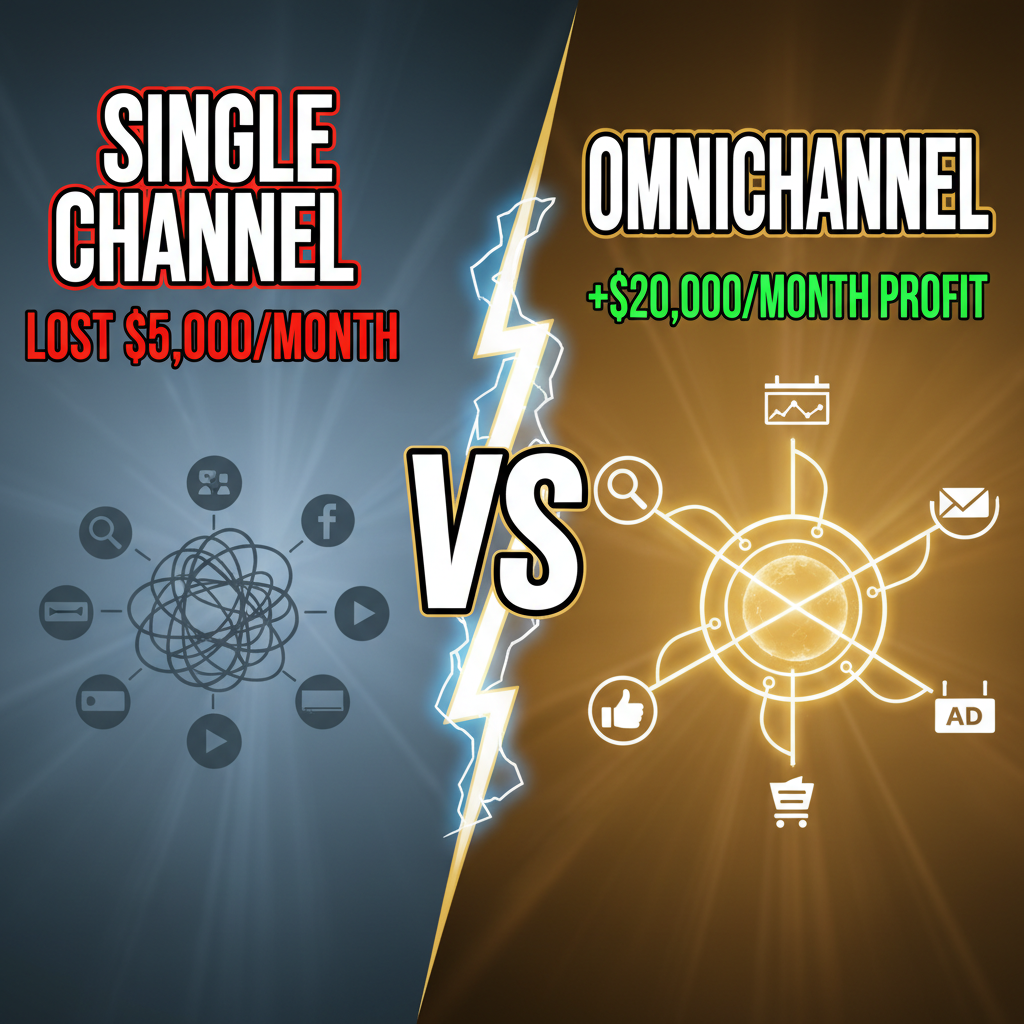
The Silo Problem
Your e-commerce team is fragmented. Paid search team owns Google Ads. Social media team owns Meta. Display team runs programmatic. Nobody talks to each other.
Customer journey: sees a Facebook ad, clicks, adds product to cart, leaves. Three days later, sees a Google search ad for the same product, buys.
Who gets credit? Both claim it. Your CMO has no idea what's actually driving return on ad spend (ROAS).
This is the omnichannel gap. Most Shopify brands optimize channels in isolation. Google Ads team chases keyword conversion volume. Meta team builds brand awareness. Display team retargets browsers. But they never coordinate—no shared KPIs, no budget allocation strategy, no unified creative message.
Result: wasted budget, inefficient customer acquisition, and conflicting narratives about what's working.
Real stat: Gartner's 2024 CMO benchmark found that brands with unified omnichannel advertising achieved 25% better ROI than multi-channel performers. The difference is coordination, not more spend.
This guide shows how to build unified paid media strategy on Shopify.
Part 1: The Omnichannel Advertising Model
Before you coordinate, understand the three channels and their roles.
Paid Search (Google Ads): Bottom-of-Funnel
- User actively searching for your product ("blue running shoes," "organic skincare products")
- High intent, ready to buy
- Typical ROAS: 3-6x (varies by category)
- Cost per click: $0.50 - $5+ (depends on keyword competition)
- Best for: Direct response, new customers with purchase intent, SKU-specific offers
Social Ads (Meta, TikTok): Mid-Funnel (Awareness + Consideration)
- User browsing feed, not searching for your brand
- Medium intent (interested but not decided)
- Typical ROAS: 2-4x
- Cost per click: $0.20 - $2
- Best for: Brand awareness, lookalike audiences, video storytelling, lifestyle positioning
Display/Retargeting: Top + Mid Funnel
- User visited your site, didn't convert, sees ads elsewhere
- Low intent initially, but high relevance (they know you)
- Typical ROAS: 1.5-3x (but crucial for cart abandonment recovery)
- Cost per click: $0.10 - $0.50
- Best for: Cart abandonment, repeat remarketing, frequency capping for non-converts
The Unified Model:
Awareness (Display, Social)
     ↓
Consideration (Social, Google Ads)
     ↓
Purchase (Google Ads, Retargeting)
     ↓
Retention (Email, SMS, Social)
Most customers see multiple touchpoints before buying. Your job is not to pick one channel—it's to coordinate so each channel plays its role and customers flow efficiently through the funnel.
Part 2: Budget Allocation Across Channels
The question: How do you split $100K across paid search, social, and display?
Framework 1: Category-Based
Different product categories have different customer behaviors.
Impulse / High-Volume Categories (fashion, home decor, beauty): Allocate 40% social, 40% search, 20% display
- Social: Brand discovery, lifestyle positioning ("See how our product fits in your home")
- Search: Capture high-intent buyers
- Display: Remind browsers who left
Real example: A home decor brand with $100K budget allocates:
- Social: $40K (awareness + lookalikes)
- Search: $40K (product-level keywords)
- Display: $20K (cart abandonment + similar audiences)
Result: 18% of revenue comes from social awareness, 65% from search, 17% from display retargeting. But social's awareness value is masked—many social-influenced conversions credit to search (last-click attribution). With cross-channel tracking, they see social actually influences 35% of customers (direct + assisted).
Considered / High-Price Categories (electronics, furniture, subscriptions): Allocate 20% social, 50% search, 30% display
- Search: Customers actively comparing options
- Display: Frequency-based retargeting (build comfort with price/feature set)
- Social: Top-of-funnel awareness (but smaller role)
Real example: A furniture brand selling $500+ sofas allocates:
- Search: $50K (high-intent searches like "luxury leather sofa")
- Display: $30K (multi-touch retargeting, frequency-capped)
- Social: $20K (lifestyle inspiration, comparison content)
Result: Search drives 68% of conversions (people actively shopping). Display drives 22% (second touch, reduces uncertainty). Social drives 10% (but influences many comparison decisions).
Framework 2: Stage-of-Business
Different growth stages call for different mix.
| Stage | Search | Social | Display | Rationale |
|---|---|---|---|---|
| Year 1 (Growth) | 30% | 50% | 20% | Build brand, customer acquisition |
| Year 2-3 (Scale) | 45% | 35% | 20% | Search intent grows; social awareness pays off |
| Year 4+ (Mature) | 50% | 25% | 25% | Search: high intent. Display: cart abandonment + retention. |
Rationale: Early stage, you have brand equity debt—nobody knows you. Social builds that. Mature brands reverse—search (high intent) becomes more efficient than social (fighting crowded feed).
Pro Allocation Tactic: Test & Adjust
Don't overthink the initial split. Allocate 40/40/20 (search/social/display). Run for 4 weeks. Measure ROAS by channel:
| Channel | ROAS | Efficiency Rank |
|---|---|---|
| Search | 4.2x | 1 (best) |
| Social | 2.8x | 3 (weakest) |
| Display | 3.1x | 2 |
Next month, shift $10K from social (weakest) to search (best). Monitor for 4 weeks. ROAS may flatten—search becomes expensive as you bid higher. That's equilibrium. Once all channels hit 3.5x ROAS, you've found balance.
Part 3: Creative Strategy Across Channels
Same product, same audience. But different channel = different creative.
Search Ads (Google Ads): Efficiency & CTR
- User is in a goal state (wants to buy)
- Copy should match their search intent precisely
- Lead with the benefit (cheapest, fastest, most reviews, etc.)
- Call-to-action is implicit ("Showing ads for blue running shoes you searched for")
Example: Keyword "orthopedic running shoes"
| Ad Headline | Description | CTA Button | Expected CTR |
|---|---|---|---|
| "Best Orthopedic Running Shoes 2026" | "Arch support that works. Recommended by 10K+ runners. Free shipping." | Learn More | 3-4% |
| "Orthopedic Running Shoes - $89" | "Clinically designed foot support. 30-day guarantee. Free returns." | Shop Now | 4-5% |
Winner: Second ad. Why? It leads with the price (search traffic is price-sensitive) and guarantees (de-risks the purchase).
Social Ads (Meta): Story & Emotion
- User is browsing, not searching
- Copy should stop them mid-scroll
- Lead with emotion (aspiration, problem-solving, curiosity)
- Video >image >carousel
Example: Same running shoes.
Ad Format: Video (8 sec) + Carousel
Frame 1 (video): Runner mid-stride, slow-motion (feel the motion)
Headline: "Stop Foot Pain. Start Running."
Copy: "It's not about working harder. It's about biomechanics. Our shoes are engineered for feet, not speed."
CTA: "Discover Now"
Expected CTR: 1.5-2.5% (lower than search because audience intent is lower, but audience is broader)
Reason: Social is storytelling. Video works because it shows motion (orthopedic support = performance). Copy is aspirational ("Stop foot pain") not rational.
Display Ads (Retargeting): Frequency & Nudge
- User already visited your site
- Creative should reinforce a familiar message
- Lead with visual recognition (your product, your branding)
- Frequency-cap at 3-5 impressions (more causes ad fatigue)
Example: Running shoes, retargeting users who viewed product but didn't buy.
Ad 1 (Days 1-3): Product image + "You viewed these shoes"
Ad 2 (Days 4-6): Testimonial + "10K+ runners agree"
Ad 3 (Days 7-10): Discount + "Claim 15% off today"
Frequency cap: 3 ads max. If user doesn't convert by ad 3, let them cool off.
Expected conversion: 1-3% (much higher than new-user display, because they know the product)
Part 4: Cross-Channel Measurement
The hardest part of omnichannel advertising: knowing which channel actually drove the sale.
Problem: Last-Click Attribution
Shopify's default attribution model credits the last click before purchase. Customer's journey:
- Sees Facebook ad → clicks → browse
- Next day, googles your brand → clicks Google Ads → buys
Attribution: Facebook and Google both claim credit. Shopify attributes 100% to Google (last click). Facebook thinks it had 0% impact.
Reality: Both touched the customer. But who deserves credit?
Solution: Multi-Touch Attribution
Use Shopify's built-in analytics + a third-party tool to understand assisted conversions.
| Tool | Cost | Capability | Best For |
|---|---|---|---|
| Shopify Analytics (free) | $0 | Last-click only | Basic tracking |
| Google Analytics 4 (GA4) | $0 | Last-click + assisted | Google/web ecosystem |
| Littledata | $300/month | Shopify + GA4 integration | Shopify-native tracking |
| Ruler Analytics | $900/month | Full omnichannel; offline+online | Mature operations |
| Triple Whale | $99-$600/month | Real-time ROAS by channel | E-commerce specific |
Recommended Setup for Shopify: GA4 (free) + Littledata integration ($300/month)
GA4 captures all touchpoints. Littledata syncs Shopify customer events back to GA4. You see:
- First-touch attribution: Which channel introduced the customer?
- Multi-touch attribution: Which channels influenced the journey?
- Assisted conversions: How many sales did social generate indirectly (via search)?
Example Report:
Channel Journey Analysis

Paths to Purchase:

Path 1: Facebook → (1 day) → Google Search → Purchase
  Frequency: 18% of conversions
  Attribution: 50% Facebook, 50% Google

Path 2: Google Search → Purchase (direct)
  Frequency: 45% of conversions
  Attribution: 100% Google

Path 3: Display → (2 days) → Facebook → (1 day) → Google → Purchase
  Frequency: 22% of conversions
  Attribution: 30% Display, 35% Facebook, 35% Google

Path 4: Facebook → Purchase (direct)
  Frequency: 15% of conversions
  Attribution: 100% Facebook
Insight: 37% of transactions involve multiple channels. Last-click attribution (Google credit) misses Facebook's role in 37% of sales. With multi-touch, you see Facebook assisted 55% of conversions (direct + assisted). That changes your budget allocation.
Pro Measurement Tip: Holdout Groups
To isolate channel impact, run a holdout test:
- Control group: See ads in all channels (Search, Social, Display)
- Test group: See ads in 2 channels (e.g., no Google Ads)
- Run for 2-4 weeks
Compare conversion rate between groups. The difference is Google's incremental impact.
Example:
- Control (all channels): 2.3% conversion rate
- Test (no Google Ads): 1.8% conversion rate
- Difference: 0.5% (Google's incremental lift)
This tells you: If you cut Google Ads, you lose 0.5% of conversions. Worth $X in revenue. Compare that to Google's cost. If Google costs $20K/month and generates incremental $60K in revenue, ROAS is 3x. Keep it.
Part 5: Coordination & Workflow
How do your teams actually work together?
Weekly Sync (30 min):
- Share last week's ROAS by channel
- Identify underperformers (below target ROAS)
- Brainstorm creative refreshes or bid adjustments
Monthly Budget Review (1 hour):
- Aggregate performance across channels
- Reallocate budget (move $5-10K from underperformers to winners)
- Test new audiences or creative angles
Quarterly Strategy Review (2 hours):
- Review year-to-date ROAS and CAC trends
- Adjust long-term budget split (maybe social underperforformed, search outperformed)
- Plan seasonal campaigns (holiday, back-to-school, etc.)
Shared KPIs:
- Target ROAS: 3.5x (all channels)
- Target CAC: < 20% of LTV
- Brand awareness lift: Quarterly surveys
- Customer acquisition cost trend: <5% quarterly growth
Unified Dashboard (Weekly Update):
Use a single source of truth. Options:
- Tableau / Looker (pull data from GA4 + Shopify + Ad accounts)
- Triple Whale (real-time, Shopify-native)
- Supermetrics + Google Sheets (DIY option)
Dashboard should show:
- ROAS by channel, daily
- Spend vs. budget (are you on pace?)
- Cost per acquisition by channel
- Conversion funnel drop-off (where are users leaving?)
Part 6: Creative Testing Framework
You have finite creative budget. Test systematically.
Test Cycle (4-Week Sprint):
Week 1: Launch 2-3 new creative variants
- Variant A: Current winning creative (control)
- Variant B: New visual style or copy angle
- Variant C: Different CTA or value prop
Week 2-3: Let ads run. Gather data.
Week 4: Analyze and decide.
- If B outperforms A by 15%+, make B the new control
- If C underperforms, pause it
- Create new variant for next cycle
Example (Social Ads):
| Creative | Theme | CTR | CPC | ROAS | Status |
|---|---|---|---|---|---|
| A (Control) | Product demo | 1.8% | $0.68 | 2.9x | Keep |
| B (New) | Customer testimonial | 2.3% | $0.61 | 3.4x | Win → Make new control |
| C (New) | Discount-led | 2.6% | $0.52 | 2.6x | Low ROAS, pause |
Decision: B wins. Launch 2 new variants against B for next cycle.
Testing Principles:
- Change ONE variable per test (copy OR visual, not both)
- Run minimum 1-2 weeks (enough impressions for statistical significance)
- Budget: Reserve 20-30% of ad spend for testing
- Rollout winners immediately (don't wait for "perfect" data)
Part 7: Seasonal Campaigns
Omnichannel is especially powerful for seasonal pushes (Black Friday, holiday, back-to-school).
Black Friday/Cyber Monday Example:
Timeline: 12 weeks out
Week -12 (9 weeks before): Teaser phase
- Social: Short videos building hype
- Display: Brand awareness (no discount mention)
- Search: Brand keywords only (hold discount budget)
Week -8 (5 weeks before): Warm-up phase
- Social: "Deals are coming" content
- Display: Countdown timer ads
- Search: Category keywords ("black friday running shoes")
Week -4 (1 week before): Pre-sale phase
- Social: Exclusive early access to email subscribers
- Display: "48 hours until sale" urgency
- Search: Ramp up budget on discount keywords ("50% off shoes")
Week 0 (Sale week): Full throttle
- All channels max budget
- Search: Maximum bid on product + discount keywords
- Social: Every angle—product, lifestyle, scarcity
- Display: Aggressive retargeting + lookalike audiences
Week +1 (Post-sale cleanup): Wind down
- Search: Maintain bids (inventory clearing)
- Social: Customer testimonials ("Best deal I found")
- Display: Retarget non-converters with extended return messaging
Budget Shift:
- Normal allocation: 40% search, 35% social, 25% display
- Black Friday allocation: 50% search, 30% social, 20% display
- Why: Hyper-high intent. Search dominates during sale week.
Ready to Coordinate Your Paid Media?
Omnichannel advertising isn't complicated. It's a framework: bottom-of-funnel search, mid-funnel social, always-on retargeting. Measure cross-channel impact. Shift budget to winners. Coordinate creative themes.
Most Shopify brands leave 20-30% of efficiency on the table by running channels in silos. A unified strategy isn't free—it requires process and tools. But the ROI is real.
Not sure how to structure your omnichannel approach? Our growth team has helped 100+ Shopify brands build unified paid media strategies. Let's talk at tenten.co/contact.
Editorial Note
The best omnichannel insight: Search and social aren't competitors. They're partners. Search captures intent that social created. Social builds awareness that search monetizes. Run them together or run them mediocre.
Frequently Asked Questions
Should every brand use all three channels?
Not necessarily. Low-price impulse purchases ($20-50) thrive on social + search. Premium products ($500+) might skip social initially and focus on search + display. Start with the two that make sense for your price point and customer journey.
How do I know if my omnichannel budget split is right?
Run it for 4 weeks. Calculate ROAS by channel. If all channels hit 3.5x ROAS within 10% of each other, you're balanced. If one channel hits 5x and another hits 2x, rebalance.
What if my social ROAS is lower than search?
That's normal. Social's role is often awareness + assisted conversion, not last-click conversion. Use multi-touch attribution to see social's true impact. If social genuinely drives no value, cut it and reallocate to search.
How often should I refresh creative?
Every 4 weeks minimum for social (feed ads get stale fast). Every 8-12 weeks for search (keyword ads age slower). Test new creative continuously—never stop innovating.
Can I run omnichannel with a small budget?
Yes, but small (<$5K/month). Allocate 50% search, 30% social, 20% display. As budget grows, optimize allocation. Don't spread thin across all channels if you can't sustain meaningful spend in each.