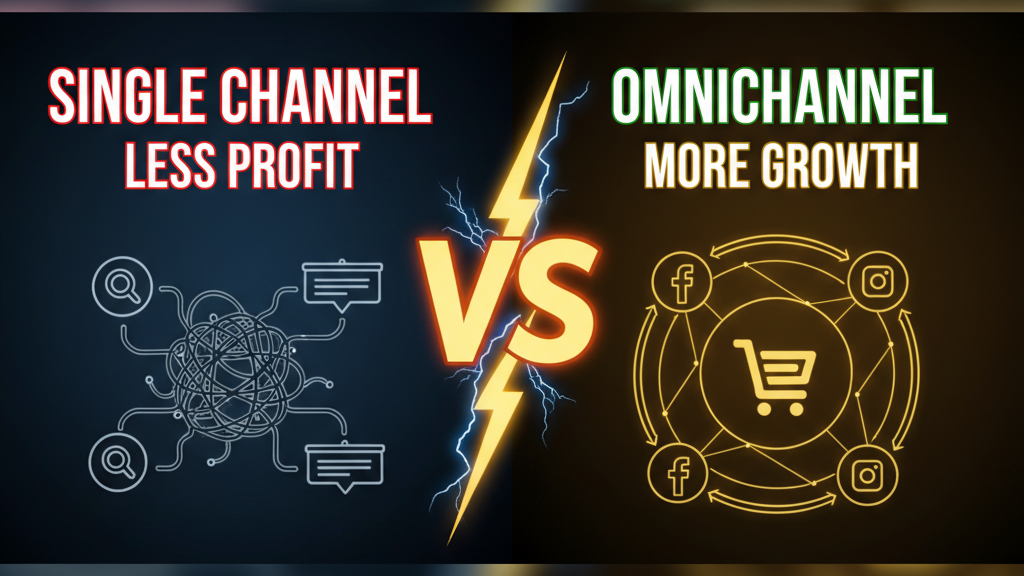
The Fragmentation Problem
A $10M Shopify store runs:
- Google Ads (60% of media budget): $300K/year
- Facebook/Instagram (25% of budget): $125K/year
- Pinterest (10% of budget): $50K/year
- TikTok (5% of budget): $25K/year
- Total: $500K annual ad spend
But the channels operate independently. Google doesn't know about Facebook audiences. Facebook doesn't coordinate with Pinterest. TikTok doesn't see what users did on Google.
Result: Overlap and waste.
User sees Ad A (Google search) → doesn't convert. User sees Ad B (Facebook) → doesn't convert. User sees Ad C (Pinterest) → converts. Attribution credits Pinterest, but the truth is: all three ads contributed to the conversion. Google's contribution is invisible.
This fragmentation creates three problems:
- Budget misallocation: If you over-attribute credit to Pinterest, you overfund it and underfund Google (even though Google deserves more).
- Frequency abuse: Users see your ad 6 times across channels. One creative, multiple platforms. Frequency-capped audiences don't cross platforms, so you're showing ads too often.
- Messaging inconsistency: Google shows one message. Facebook shows another. Pinterest shows a third. Brand message gets fuzzy.
Omnichannel advertising solves this by coordinating across channels: unified budget rules, audience sequencing, and attribution.
The Omnichannel Model
Think of omnichannel advertising as a customer journey across channels, not separate siloed campaigns.
Journey map:
Awareness → Consideration → Conversion → Loyalty

Google Search          TikTok            Facebook Retargeting
(High intent)          (Discovery)       (Abandoned cart)
"Shopify store setup"  "Cool D2C brands" "Complete your purchase"

Pinterest Collections  Google Ads        Email
(Inspiration)          (ROAS-focused)    (Post-purchase nurture)
"Home decor ideas"     "Shop clearance"  "Loyalty program"
The goal: move users through the funnel using the right channel at the right time.
- Awareness: TikTok, Pinterest, YouTube (wide reach, low intent)
- Consideration: Google search, Facebook carousel (mid-funnel, evaluating)
- Conversion: Google Shopping, Facebook retargeting (high-intent, ready to buy)
- Loyalty: Email, SMS, Facebook/Google retention ads (post-purchase)
Budget Allocation Framework
Instead of dividing budget by channel, allocate by objective. Here's how:
Step 1: Define objectives and their % of budget
| Objective | % of Budget | Timeline | Goal |
|---|---|---|---|
| Acquisition (new customers) | 50% | Ongoing | CAC < $35 |
| Reactivation (lapsed customers) | 15% | Ongoing | ROAS > 3x |
| Retention (existing customers) | 15% | Ongoing | LTV increase |
| Seasonal/Promo (Black Friday, etc.) | 15% | Concentrated | Peak ROAS |
| Testing/Experimentation | 5% | Ongoing | New channel validation |
Step 2: Assign channels to objectives
| Objective | Primary Channel | Secondary | Tertiary |
|---|---|---|---|
| Acquisition | TikTok, YouTube | Google Search | |
| Reactivation | Facebook/Instagram | Google Dynamic Retargeting | |
| Retention | Email (organic), SMS (organic) | Facebook/Instagram LTV | Google Remarketing |
| Seasonal | Google Shopping, Facebook | TikTok (if new audience) | Pinterest Ads |
| Testing | TikTok (new formats) | YouTube Shorts | Pinterest Collage Ads |
Step 3: Allocate budget to channels based on performance
For a $500K annual budget, example allocation:
Acquisition (50% = $250K)
├── TikTok: $120K (48%)
├── Google Search: $90K (36%)
└── Pinterest: $40K (16%)

Reactivation (15% = $75K)
├── Facebook Dynamic Ads: $45K (60%)
├── Google Remarketing: $20K (27%)
└── Pinterest: $10K (13%)

Retention (15% = $75K)
└── Organic (Email, SMS) — no paid spend

Seasonal (15% = $75K)
├── Google Shopping: $45K (60%)
└── Facebook Carousel Ads: $30K (40%)

Testing (5% = $25K)
├── YouTube Shorts: $15K (60%)
└── TikTok Commerce: $10K (40%)
This budget map ensures you're investing in the right channels for each objective, not spreading evenly across all channels.
Audience Sequencing
Frequency capping matters. If a user sees your ad 6 times on Facebook, they're annoyed. If they see 6 times across Facebook, Google, and Pinterest, they're extremely annoyed—and less likely to convert.
Solution: Audience sequencing with frequency caps across channels
Instead of capping frequency per channel, cap across all channels:
- Frequency cap: 3 impressions per user per week (total, all channels)
- Sequence: User sees Ad A (TikTok) → Ad B (Google) → Ad C (Facebook)
- Timing: 2-3 days between exposures
Platform support:
| Platform | Frequency Cap Support | Cross-Platform Capability |
|---|---|---|
| Facebook/Instagram | Yes (Campaign level) | Limited (first-party data only) |
| Google Ads | Yes (Campaign level) | No (Google ecosystem only) |
| TikTok | Limited | No |
| Yes (Creative level) | No |
Reality check: True cross-platform frequency capping requires a CDP (customer data platform) like Segment or mParticle. Most Shopify brands don't have this. Workaround: cap frequency per channel and increase creative rotation (show different ads).
Attribution and Measurement
The hardest part: who gets credit?
User journey:
Day 1: Sees Google Ad → clicks but doesn't buy
Day 2: Sees Facebook Ad → clicks but doesn't buy
Day 3: Sees Pinterest Ad → clicks and buys ($50)

Who gets credit for the $50 sale?
- Last-click: Pinterest (100%)
- First-click: Google (100%)
- Linear: Google 33%, Facebook 33%, Pinterest 33%
- Time-decay: Google 20%, Facebook 30%, Pinterest 50%
Different attribution models give different results. Last-click (default in most platforms) is the least accurate.
Shopify Attribution App + Shopify Audiences:
Shopify has built-in attribution that assigns credit across channels. The model: data-driven attribution using machine learning.
The app shows which channels contributed to conversions (not just last-click). This helps you reallocate budget to the most effective channels.
Setup:
- Ensure Google Analytics 4 is connected to Shopify
- Connect Shopify Analytics App
- Link Google Ads, Facebook, Pinterest, TikTok to GA4
- Review Assisted Conversions report (shows multi-touch attribution)
- Reallocate budget to highest-attributed channels
Interpreting the data:
If Google Search shows high assisted conversions but low last-click, it means Google drives consideration but not final clicks. This is valuable—don't cut Google budget even if last-click attribution suggests low ROI.
Creative Strategy Across Channels
Different platforms need different creative. TikTok users expect authentic, informal content. Pinterest users want curated, inspirational imagery. Google Search users respond to clear value propositions.
Creative guidelines by platform:
| Platform | Format | Tone | Best Practice |
|---|---|---|---|
| TikTok | 9-15 sec vertical video | Authentic, casual, fun | Show product in use, trend-jacking |
| High-res static image or video pin | Inspirational, curated | Show lifestyle context, clear CTA | |
| Facebook/Instagram | Static image, carousel, or video | Mix of lifestyle and benefit-driven | A/B test 3-5 creative versions |
| Google Search | Text ad + landing page | Direct, benefit-focused | Clear headline, strong CTA, mobile-optimized |
| YouTube | Skippable video (6-30 sec) | Entertaining or educational | First 3 sec must hook (before skip button) |
Asset reuse strategy:
You don't need separate creative teams per platform. A product video can be:
- Shortened to 6 sec for YouTube
- Re-edited to 15 sec for TikTok
- Extracted as static image + overlay text for Pinterest
- Used as carousel creative on Facebook
This is 20% of creative effort for 80% of reach.
Budgeting for Seasonality
Omnichannel budgets shift by season. Q4 (Black Friday, holiday) demands 3-4x the normal ad spend. Summer might see lower demand.
Seasonal allocation framework:
| Quarter | Demand | Budget Increase | Channels |
|---|---|---|---|
| Q1 | Normal (baseline) | 100% | All channels proportional |
| Q2 | Slightly elevated | 120% | TikTok, Pinterest (summer trends) |
| Q3 | Elevated (back-to-school) | 140% | Google Shopping, Facebook (high intent) |
| Q4 | Peak (Black Friday, holiday) | 300% | All channels, heavy Google Shopping |
For a $500K annual budget:
- Q1: $110K (baseline 25%)
- Q2: $110K (slightly elevated)
- Q3: $130K (elevated)
- Q4: $150K (peak season)
This matches demand and prevents overspending in slow seasons.
Common Omnichannel Mistakes
1. Assuming the cheapest channel is the best
TikTok CAC is $10. Google CAC is $30. You over-fund TikTok. But TikTok customers have 40% lifetime value. Google customers have 200% LTV. Google has better ROI when measured beyond CAC.
Solution: Measure ROAS (revenue/ad spend), not just CAC.
2. Not coordinating creative across channels
You run 15 different ads across 5 channels. Users get confused. Brand message is inconsistent.
Solution: Core message should be consistent. Adapt execution per platform.
3. Ignoring channel lifecycle
TikTok is growing. Pinterest is flattening. You allocate the same budget to both.
Solution: Redirect budget toward growing channels. Pinterest can be sustainable but shouldn't get new acquisition budget.
4. Over-testing and under-scaling
You test a new audience on TikTok (spending $1K/week). It works. You stay at $1K/week instead of scaling.
Solution: Successful tests should scale 2-3x. Move slowly, but don't leave money on the table.
5. Ignoring incrementality
You run a test and see 10% revenue lift. You assume the ads caused it. But 7% of the lift was organic (users would have converted anyway).
Solution: Run incrementality tests (treatment vs. control geography). Measure true impact.
Ready to coordinate your omnichannel advertising?
Fragmented channel budgets are leaving 30-40% of ad spend on the table. Coordinating across Google, Facebook, Pinterest, and TikTok with unified attribution and audience sequencing can improve ROAS by 20-40%.
We've helped D2C brands consolidate scattered advertising efforts into coordinated campaigns. The results: 25-35% improvement in blended ROAS, 15-20% reduction in CAC, and faster growth with lower spend.
If your ad spending is fragmented across channels with no coordination, let's audit your strategy.
Editorial Note
Omnichannel advertising requires discipline—unified budgeting, consistent measurement, audience sequencing. Most brands do channel-by-channel optimization (TikTok budget separately from Facebook, separately from Google). The winners coordinate. They treat advertising as one system, not five separate campaigns. That shift alone improves efficiency 20-30%.
Frequently Asked Questions
What's the ideal budget split across channels?
No ideal split. It depends on your audience and objectives. Start with 50% acquisition, 15% reactivation, 15% retention, 15% seasonal, 5% testing. Adjust monthly based on ROAS.
Should I use the same audience on all platforms?
No. Each platform has different audience targeting. Use platform-native audiences (Facebook Custom Audiences, Google Similar Audiences) rather than copying one audience across platforms.
How do I measure true attribution?
Use Shopify Attribution App + GA4 data-driven attribution. Or run incrementality tests (turn off ads in one geography, measure uplift in others). Last-click is misleading.
How often should I adjust budget allocation?
Monthly, after 2+ weeks of data. Don't adjust weekly (noise). Wait for statistically significant sample size.
What's the minimum budget to run omnichannel advertising?
$10K/month minimum. Below that, focus on one channel with highest ROI (usually Google Search or Facebook). Spread across channels below $10K/month creates operational overhead without enough volume.
How do I handle inventory constraints with omnichannel ads?
If inventory is limited, reduce budgets on all channels proportionally. Or pause specific products/variants in ads when out of stock. Use Shopify's inventory sync to ad platforms.