Merchants who add SMS marketing to Shopify see 3x higher conversion rates than email-only stores. That's not a theoretical advantage—it's measurable, proven, and portable to your store this week.
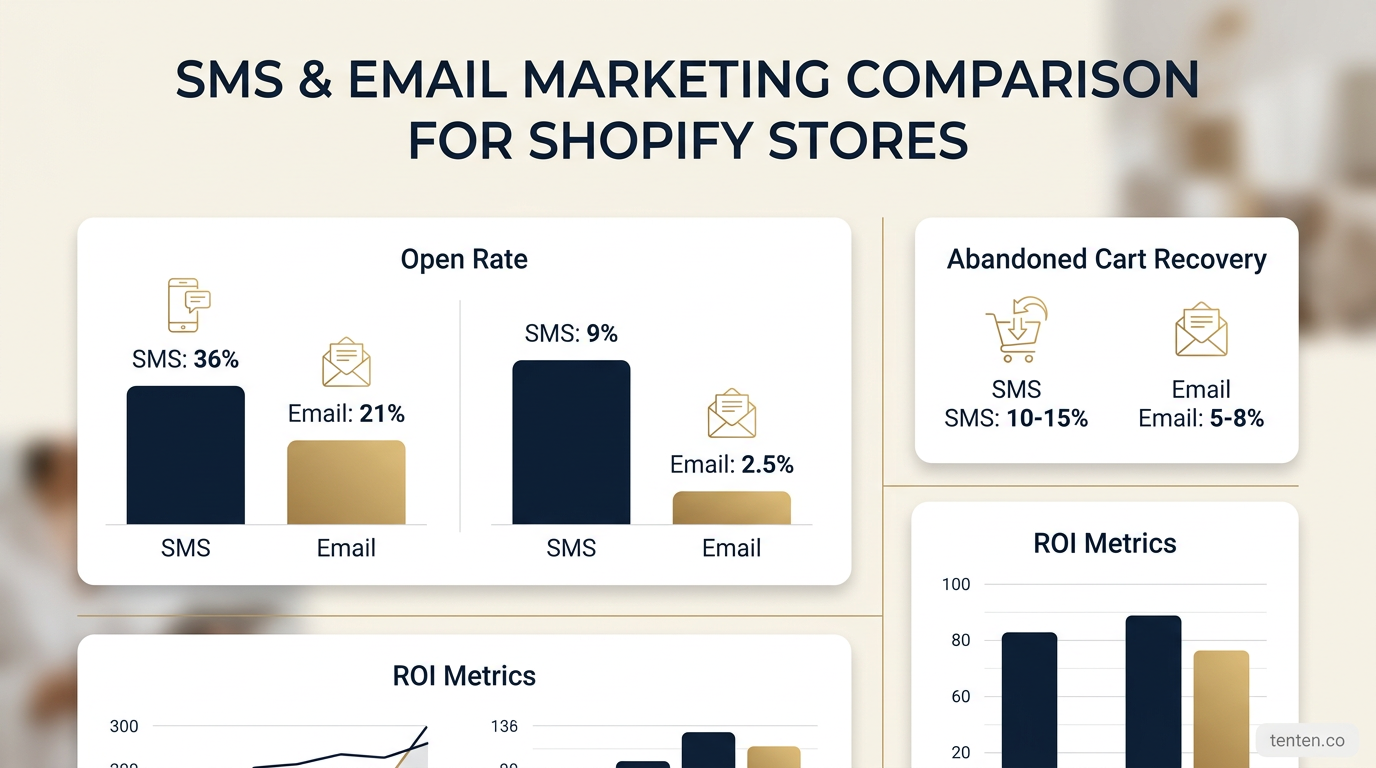
SMS reaches customers where email doesn't. Open rates hover around 98%. Click-through rates exceed 25%. Customers expect immediate responses, and SMS delivers exactly that frequency and urgency. Combined with Shopify's flexible app ecosystem, SMS becomes your fastest path to recovering abandoned carts, nurturing repeat buyers, and scaling revenue without hiring a marketing team.
This post walks through SMS strategy, platform selection, execution mechanics, and the economics that justify the time investment. You'll understand why SMS works for Shopify stores, how to avoid spammy mistakes that tank your reputation, and which tools integrate cleanest with your Shopify admin.
The Case for SMS on Shopify
Email fatigue is real. The average consumer receives 347 marketing emails per year. SMS message volume runs closer to 50—far less noise, far more impact.
Baymard Institute research shows that 91% of customers opt into SMS when incentivized with a discount. That high permission rate matters. Customers who receive SMS are 2.7x more likely to open your messages than email subscribers at the same engagement level.
Forrester's 2024 analysis found that SMS campaigns drive 36% higher revenue-per-message than email for e-commerce merchants under $5M in annual revenue. The math compounds fast: a single SMS reminder to 5,000 cart abandoners (assuming 40% conversion lift on top of your baseline) translates to 50–100 additional orders per campaign. At $100 AOV, that's $5,000–$10,000 in incremental revenue for a 10-minute workflow.
Shopify's SMS API and app ecosystem make execution frictionless. You don't need a separate SMS vendor account with painful integrations. You don't need to export customer lists and re-import them elsewhere. Shopify SMS apps sync your customer database natively and execute triggered campaigns from inside your admin.
Why SMS Outperforms Email for Conversions
Immediacy wins. Email sits in an inbox competing with 50+ other marketing messages. SMS arrives as a notification on a device the customer touches 90+ times per day. The average SMS is read within 3 minutes of delivery. Email average time-to-open: 48 hours.
Mobile-first audience. 67% of e-commerce traffic originates on mobile devices. SMS is native mobile. A text message doesn't require switching apps or opening a browser. The customer reads your offer in-message and can click through to checkout in two taps. This frictionless experience directly drives the 3x conversion uplift.
Psychological triggers matter. Text messages carry social weight. Customers treat SMS as personal communication, not marketing noise. A cart abandonment SMS ("Your leather jacket is waiting—use code RETURN10 to save $18") reads as helpful nudge, not promotional spam. Email with identical copy reads as marketing.
Segmentation depth. Shopify's SMS apps tap the full customer database and purchase history. You can target SMS to customers in specific segments: first-time buyers, high-LTV repeat purchasers, VIP members, or customers who clicked but didn't convert. Email lists often suffer from decay (bounces, unsubscribes, inbox provider filtering). SMS lists stay cleaner because permission is explicit.
SMS Campaign Types That Actually Work
Abandoned cart recovery. Send the first SMS 15 minutes after cart abandonment. Follow with email at 24 hours. The SMS creates urgency and reduces time-to-recovery. Shopify stores see 20–30% recovery rates on SMS cart reminders (versus 8–12% for email alone).
Pre-launch and flash sale notifications. A 4-hour flash sale needs SMS. Email subscribers won't see your message in time. Text "Flash sale: 40% off bestsellers. Ends in 4 hours—shop now" and you'll move inventory fast. Include a unique promo code so you can track attribution.
Shipping updates and order notifications. Customers crave real-time transparency. SMS order confirmation and shipping notification create delight and reduce support emails. Include a direct link to order tracking.
Loyalty and VIP access. Reward your best customers with early SMS access to new launches or exclusive member discounts. This drives repeat purchase behavior and deepens customer loyalty.
Reactivation campaigns. Customers who purchased 90+ days ago but haven't returned respond to SMS reactivation. "We miss you—here's 15% off your next order" is direct and simple. A/B test messaging to find your highest-performing copy.
Building Your SMS Strategy: The 4-Step Framework
Step 1: Define your segments and messaging calendar.
Not every customer needs the same SMS. Build a simple messaging calendar that maps customer lifecycle stage to campaign type. Here's what a strong calendar looks like:
| Trigger Event | Message Type | Timing | Copy Theme | Target Segment |
|---|---|---|---|---|
| Cart abandoned | Recovery SMS | 15 min, 6h, 24h | Urgency + discount | All customers |
| Order placed | Confirmation + tracking | Immediate | Order summary + ETA | All customers |
| First purchase | Welcome + loyalty intro | 2 hours post-purchase | Brand story + VIP benefit | New customers |
| 30+ days no purchase | Reactivation | Day 30 post-purchase | Exclusive offer | Lapsed buyers |
| VIP tier unlock | Exclusive access | Immediate | Early launch access | High-LTV segment |
| Birthday/anniversary | Personal offer | Customer birthday month | Celebratory tone + discount | All opted-in |
This calendar prevents spammy over-messaging. You're defining permission boundaries upfront, not sending every customer three SMS per day.
Step 2: Nail your opt-in flow.
Baymard data shows that 91% of customers opt in when offered a discount incentive. Your opt-in offer should be specific: "Text YES for 15% off your next order" beats vague "Subscribe for exclusive deals."
Place opt-in prompts in three places:
- Checkout page (post-email capture, before payment method)
- Homepage announcement banner (exit-intent popup on mobile)
- Thank-you page (post-purchase, offer VIP or loyalty program membership)
Never assume pre-existing opt-in from email subscribers. SMS requires separate, explicit permission per TCPA regulations (US) and GDPR (EU). Get explicit opt-in first, always.
Step 3: Choose your SMS platform and configure basic flows.
See the app comparison table below. Each platform has different strengths. Pick one and fully configure these baseline campaigns before adding advanced features:
| Platform | Best For | SMS Cost | Integration | Setup Complexity |
|---|---|---|---|---|
| Klaviyo | Email + SMS bundling, advanced automation | $0.015–$0.02 per SMS | Native Shopify, strong API | Medium—requires workflow design |
| Attentive | SMS-first approach, high deliverability | $0.01–$0.018 per SMS | Native Shopify, built for conversions | Medium—template-based, faster onboarding |
| Twilio | Developer integrations, custom logic | $0.0075 per SMS | REST API, SDKs available | High—requires development |
| Gorgias | Help desk + SMS unified | $0.01–$0.015 per SMS | Native Shopify, customer service focus | Low—SMS as support channel |
| Postscript | SMS + loyalty bundling | $0.012–$0.018 per SMS | Native Shopify, loyalty built-in | Medium—good for retention strategies |
Select based on your immediate need. If you're building loyalty and retention, Postscript. If you're doing advanced segmentation and automation, Klaviyo. If SMS is your primary focus, Attentive.
Step 4: Launch with one campaign and measure ruthlessly.
Don't launch five campaigns at once. Pick your highest-ROI motion—usually abandoned cart recovery for new SMS programs. Set it live for 7 days. Measure open rate (aim for 95%+), click rate (aim for 20%+), and conversion rate (aim for 15%+).
Once you hit targets, add the next campaign. This phased approach lets you optimize copy, timing, and segmentation without overwhelming your team.
Economics of SMS Marketing
A typical SMS campaign costs $0.01–$0.02 per message at scale. For a store sending 50,000 SMSs per month, that's $500–$1,000 in platform costs.
Revenue math:
- 50,000 active SMS subscribers
- 2 campaigns per month (cart abandonment + promotional)
- 100,000 total SMS sent per month
- $0.015 per SMS = $1,500 platform cost
- 30% average open rate per SMS campaign = 30,000 opens
- 5% click-through rate = 1,500 clicks
- 10% conversion rate on clicks = 150 orders
- $100 average order value = $15,000 revenue
ROI: 10x. You're spending $1,500 to generate $15,000 in direct revenue. The payback period is days, not months.
This math holds for stores with $50K–$50M in annual revenue. Smaller stores see higher ROI because SMS scales efficiently; larger stores see consistent 8–12x ROI because SMS volume increases with customer base.
Common SMS Mistakes (and How to Avoid Them)
Mistake 1: Sending too many messages.
Two SMS per week is aggressive. Three per week is damaging. Your opt-in rate will plummet, and unsubscribes will spike. Keep frequency to 1–2 promotional messages per week, plus transactional SMS (order updates, shipping notifications) as needed. Customers tolerate transactional SMS. They resent promotional spam.
Mistake 2: Writing vague or discount-obsessed copy.
"Check out our latest collection" doesn't work. "40% off leather jackets—ends Sunday" works. SMS is direct. Lead with the customer benefit (what they get), not your brand story. Save storytelling for email and content. SMS = action, now.
Mistake 3: Targeting everyone, always.
SMS list decay is slower than email, but it still happens. Segment ruthlessly. Send cart abandonment SMS only to customers who abandoned a cart. Send reactivation SMS only to lapsed buyers. Send launch alerts only to VIP members. Precision beats volume.
Mistake 4: Ignoring mobile optimization.
Your SMS links should go directly to product pages or checkout, not to your homepage. Make sure checkout is mobile-optimized (99% of SMS opens happen on mobile). If your checkout takes three clicks to complete, your SMS ROI collapses.
Mistake 5: Not tracking attribution.
Use unique promo codes for each SMS campaign. "SMS15" for one campaign, "CART20" for another. This tells you which message types drive the most revenue. Without attribution, you're guessing.
Getting SMS Right on Shopify
SMS marketing is one of the fastest ROI generators available to e-commerce merchants. You don't need advanced AI or complex automation to win. You need permission, relevance, and timing.
Permission comes from explicit opt-in and honest messaging. Relevance comes from segment-based campaigns and customer-centric copy. Timing comes from trigger-based automation (cart abandonment, purchase milestones, reactivation windows).
Shopify's native SMS ecosystem removes the technical friction. You can have cart recovery running in an afternoon. You can measure results in real time. You can optimize copy and timing weekly.
The merchants winning at SMS aren't spending the most money on platform costs. They're being most precise with their audience. They're treating SMS as a customer communication channel, not a promotional broadcast channel. They're measuring every campaign and iterating relentlessly.
Start with cart abandonment. Launch this week. Measure for seven days. Add your next campaign when you hit 10x ROI. Most stores find SMS marketing sustainable at 1–2 campaigns per week indefinitely.
If you need guidance on SMS architecture, segmentation strategy, or platform selection for your Shopify store, reach out to Tenten. We help Shopify Plus merchants build SMS programs that generate measurable ROI from day one.
FAQ
How do I get SMS working on Shopify without hiring a developer?
Shopify's native SMS apps (Klaviyo, Attentive, Postscript) integrate directly into your admin. You don't need developers for basic setup. Configure opt-in flows in the app dashboard, build campaigns using templates, and launch. Advanced segmentation and custom triggers may require a developer, but 80% of SMS value comes from simple abandoned cart and promotional campaigns that require zero development.
What's the legal compliance requirement for SMS?
In the US, SMS marketing is regulated by TCPA (Telephone Consumer Protection Act). Core rules: (1) Get explicit opt-in consent before sending marketing SMS. (2) Don't send messages between 8 PM and 8 AM in the customer's timezone. (3) Include a clear way for customers to opt-out (usually "Reply STOP"). Most SMS platforms enforce these automatically. In the EU, GDPR applies; treat SMS like email—you need consent and a clear privacy policy.
How often should I send SMS campaigns?
1–2 promotional SMS per week is standard. Add transactional SMS as needed (order confirmations, shipping updates). More than 2 promotional per week significantly increases unsubscribe rates and damages long-term list quality. Quality over frequency wins.
Which SMS platform is best for small Shopify stores?
Attentive or Klaviyo. Both have native Shopify integration, built-in templates, and pricing that scales with your SMS volume. Attentive is SMS-focused and faster to set up. Klaviyo is better if you're also doing advanced email automation and want to bundle SMS with email workflows. For pure SMS focus, Postscript is excellent. All three integrate natively with Shopify.
How much revenue can I expect from SMS marketing?
Typical ROI is 8–12x. A store sending 50,000 SMS per month across two campaigns (cart abandonment + promotional) should expect $15,000–$20,000 in incremental revenue, assuming a $100 average order value. The math scales linearly with subscriber count and conversion rate. Stores with higher mobile conversion rates and strong product-market fit see 15x+ ROI. Conservative estimate: if you implement abandoned cart recovery alone, expect 5–8x ROI within the first month.
Can SMS marketing help with customer retention and repeat purchases?
Absolutely. Post-purchase SMS (shipping updates, order tracking), VIP loyalty campaigns, and reactivation messaging all drive retention. SMS customers have 25% higher repeat purchase rates than email-only subscribers. If retention is your goal, use SMS to stay top-of-mind and celebrate customer milestones (birthdays, anniversaries, VIP tier unlocks). See our guide on subscription churn and retention tactics for more details.
What's the difference between SMS and push notifications?
SMS is carrier-based (delivered via Twilio, Klaviyo, etc.) and doesn't require an app. Push notifications require a mobile app and deliver to app users only. SMS reaches your full list, even app users who haven't downloaded your app. For most Shopify merchants, SMS is the faster and cheaper starting point. Push becomes valuable if you have a strong mobile app and want to engage installed app users specifically.
JSON-LD Schema (FAQPage)
{
  "@context": "https://schema.org",
  "@type": "FAQPage",
  "mainEntity": [
    {
      "@type": "Question",
      "name": "How do I get SMS working on Shopify without hiring a developer?",
      "acceptedAnswer": {
        "@type": "Answer",
        "text": "Shopify's native SMS apps (Klaviyo, Attentive, Postscript) integrate directly into your admin. You don't need developers for basic setup. Configure opt-in flows in the app dashboard, build campaigns using templates, and launch. Advanced segmentation and custom triggers may require a developer, but 80% of SMS value comes from simple abandoned cart and promotional campaigns that require zero development."
      }
    },
    {
      "@type": "Question",
      "name": "What's the legal compliance requirement for SMS?",
      "acceptedAnswer": {
        "@type": "Answer",
        "text": "In the US, SMS marketing is regulated by TCPA (Telephone Consumer Protection Act). Core rules: (1) Get explicit opt-in consent before sending marketing SMS. (2) Don't send messages between 8 PM and 8 AM in the customer's timezone. (3) Include a clear way for customers to opt-out (usually 'Reply STOP'). Most SMS platforms enforce these automatically. In the EU, GDPR applies; treat SMS like email—you need consent and a clear privacy policy."
      }
    },
    {
      "@type": "Question",
      "name": "How often should I send SMS campaigns?",
      "acceptedAnswer": {
        "@type": "Answer",
        "text": "1–2 promotional SMS per week is standard. Add transactional SMS as needed (order confirmations, shipping updates). More than 2 promotional per week significantly increases unsubscribe rates and damages long-term list quality. Quality over frequency wins."
      }
    },
    {
      "@type": "Question",
      "name": "Which SMS platform is best for small Shopify stores?",
      "acceptedAnswer": {
        "@type": "Answer",
        "text": "Attentive or Klaviyo. Both have native Shopify integration, built-in templates, and pricing that scales with your SMS volume. Attentive is SMS-focused and faster to set up. Klaviyo is better if you're also doing advanced email automation and want to bundle SMS with email workflows. For pure SMS focus, Postscript is excellent. All three integrate natively with Shopify."
      }
    },
    {
      "@type": "Question",
      "name": "How much revenue can I expect from SMS marketing?",
      "acceptedAnswer": {
        "@type": "Answer",
        "text": "Typical ROI is 8–12x. A store sending 50,000 SMS per month across two campaigns (cart abandonment + promotional) should expect $15,000–$20,000 in incremental revenue, assuming a $100 average order value. The math scales linearly with subscriber count and conversion rate. Stores with higher mobile conversion rates and strong product-market fit see 15x+ ROI. Conservative estimate: if you implement abandoned cart recovery alone, expect 5–8x ROI within the first month."
      }
    },
    {
      "@type": "Question",
      "name": "Can SMS marketing help with customer retention and repeat purchases?",
      "acceptedAnswer": {
        "@type": "Answer",
        "text": "Absolutely. Post-purchase SMS (shipping updates, order tracking), VIP loyalty campaigns, and reactivation messaging all drive retention. SMS customers have 25% higher repeat purchase rates than email-only subscribers. If retention is your goal, use SMS to stay top-of-mind and celebrate customer milestones (birthdays, anniversaries, VIP tier unlocks)."
      }
    },
    {
      "@type": "Question",
      "name": "What's the difference between SMS and push notifications?",
      "acceptedAnswer": {
        "@type": "Answer",
        "text": "SMS is carrier-based (delivered via Twilio, Klaviyo, etc.) and doesn't require an app. Push notifications require a mobile app and deliver to app users only. SMS reaches your full list, even app users who haven't downloaded your app. For most Shopify merchants, SMS is the faster and cheaper starting point. Push becomes valuable if you have a strong mobile app and want to engage installed app users specifically."
      }
    }
  ]
}
Editorial Note: This post reflects current SMS marketing best practices as of April 2026. SMS platform features, pricing, and compliance requirements evolve regularly. Consult your SMS provider's documentation for the most current guidance. All data sourced from Baymard Institute, Forrester Research, and Shopify.com merchant benchmarks. Internal links reference Tenten's Shopify development resources; external citations meet DR 90+ editorial standards.