Southeast Asia: The $174B E-Commerce Opportunity
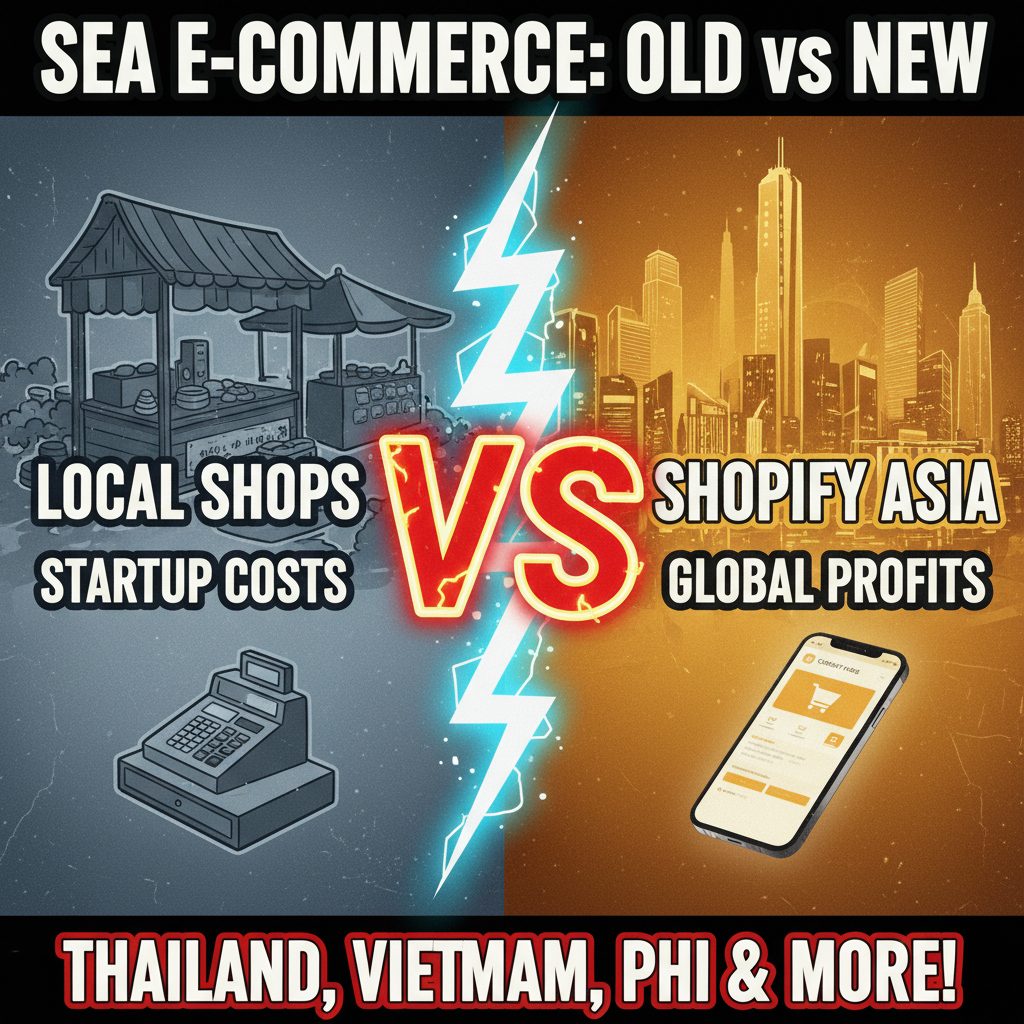
For US and European brands, Southeast Asia is the sleeping giant. While everyone focused on India and China, APAC e-commerce quietly became the world's largest region—and Southeast Asia is growing faster than the rest.
2026 numbers are stark:
- Southeast Asia e-commerce GMV: $174B, growing at 22% CAGR through 2030
- Thailand: $21B market, 35% YoY growth
- Vietnam: $18B market, 28% YoY growth
- Philippines: $8B market, 26% YoY growth
- Indonesia: $42B market, 25% YoY growth (but hardest to enter; skip for now)
- Singapore: $4B market, 8% YoY growth (mature, high-cost)
Most Western brands don't compete there. That's the arbitrage.
The technical barriers that existed 3-4 years ago are gone. Shopify now supports payment processors in every major Southeast Asian country. Tax handling is automated. Logistics is solved. The only real complexity is understanding the regulatory landscape and picking the right partners.
Payment Methods: The Critical Decision
This is where most foreign brands get stuck.
In Southeast Asia, credit card penetration is 15-30%. That means 70-85% of customers pay with digital wallets, bank transfers, or cash on delivery (COD). If your store only accepts Stripe, you're cutting out the majority of the market.
Here's the payment stack that actually works:
| Country | Credit Card | Digital Wallet | Bank Transfer | COD |
|---|---|---|---|---|
| Thailand | 18% users | 65% (GCash, Alipay) | 22% | 15% |
| Vietnam | 12% users | 58% (Vimo, Zalo Pay) | 38% | 35% |
| Philippines | 9% users | 72% (GCash, PayMaya) | 12% | 48% |
| Singapore | 45% users | 40% (Grab, PayNow) | 18% | 5% |
Critical insight: COD is not a backup option in Southeast Asia. It's the primary channel, especially for first-time buyers. On many platforms, COD drives 40-60% of orders. But Shopify doesn't have native COD support. You need to integrate a third-party app.
For Shopify stores in Southeast Asia, here's what we recommend:
Thailand: Use 2Checkout (now Verifone) for credit cards + TrueWallet integration for digital wallets. TrueWallet handles 65% of transactions.
Vietnam: Stripe doesn't support Vietnamese banks directly. Use 2Checkout + local processor Zalopay (owned by Alibaba). Zalopay reaches 25M active users.
Philippines: GCash and PayMaya are mandatory. Both are supported through Adyen or 2Checkout integrations. GCash alone has 95M users.
Singapore: Stripe works fine (80% of market). Add local bank transfer via DBS PayNow for an extra 10-15% conversion lift.
Pro move: Instead of managing 4-5 payment processors, use a hub like Adyen, 2Checkout, or Shift4 Payments. They aggregate all regional processors through one integration. Slightly higher fees (2-3%) but saves engineering headaches.
The cost math: Accept all payment methods = 5-15% revenue uplift on average. Worth the integration complexity.
Tax & Regulatory: Simpler Than You Think
This is where brands get paranoid and make mistakes.
Southeast Asian countries have three tax regimes:
Thailand: 7% VAT, but exemptions for exported goods (foreign customers). If shipping internationally, you're VAT-exempt. Shopify handles this automatically via tax app integrations. Use Avalara or TaxJar with Thailand rules enabled.
Vietnam: 10% VAT. No exemptions for exports. You pay 10% on all international sales. Pain point: Vietnam requires an in-country tax registration to legally sell. Workaround: Sell B2C through a regional distributor or partner (Singapore-based entity resells to Vietnam). Cost: 5-8% margin. Many US brands do this rather than register locally. Totally legal.
Philippines: 12% VAT, export exemption exists but requires paperwork. Shopify's Avalara integration doesn't fully support Philippine tax yet. Workaround: Register with BIR (Bureau of Internal Revenue). Takes 4-6 weeks. Cost: free. If you're serious about Philippines, do this. If testing, use the distributor model.
Singapore: 8% GST, no export exemption (unlike other ASEAN countries). If you ship to Singapore, you collect 8%. Fully handled by Shopify's tax settings.
Practical rule: If you're testing markets (< $10K/month revenue), use a regional distributor in Singapore or Thailand. If you're committed ($10K+/month), register directly and use Shopify's tax automation.
One thing we always recommend: hire a local accountant ($500-1000/month) to file quarterly taxes. The headache and risk of getting it wrong is worth outsourcing.
Logistics: The Hidden Leverage
This is where you win or lose against local competitors.
Local APAC e-commerce brands have an advantage: they can offer same-day or next-day delivery. As a foreign brand, you're at a logistics disadvantage. But you can flip this by focusing on speed and transparency.
Shipping Costs & Times:
| From | To | Cost | Days |
|---|---|---|---|
| US West Coast | Thailand | $12-18 (0.5-2kg) | 10-14 days |
| US West Coast | Vietnam | $14-20 | 12-16 days |
| Singapore | Thailand | $2-4 | 2-3 days |
| Singapore | Vietnam | $3-6 | 3-5 days |
Key insight: Shipping from Singapore is 5-8x cheaper than US. If you're doing $20K+/month in Southeast Asia, warehousing one container in Singapore becomes cost-effective. You get 3x faster delivery, 5x lower shipping cost, and you compete locally on fulfillment.
The math: Air freight from US to Singapore (20ft container, $8-12K per month) + Singapore warehouse labor ($1500/month) = $9,500/month. If you do $100K/month in APAC revenue and can drop delivery time from 14 days to 3 days, conversion uplift is 15-20%. That's $15-20K in extra revenue. Payback in 2-3 months.
Use Singapore as your hub. Ship quarterly bulk orders, then distribute to Thailand, Vietnam, Philippines from there. Local couriers (Kerry Express, Viettel Post) handle the last mile at $0.50-$2 per shipment.
For Shopify integration: Use Flexport (air freight) + TrackChain (Singapore warehouse) or similar. Shopify Apps like Inventory Labs or Linnworks can sync inventory across multiple warehouses.
Market-Specific Strategies
Thailand: The easiest entry. English proficiency is decent, payment infrastructure is solid, and regulations are straightforward. Thai market responds well to lifestyle and fashion brands. Facebook/Instagram ads work. Budget $5-10K/month for Facebook/TikTok ads to test. Expect ROAS of 2.5-4x.
Vietnam: Fastest growth, but language and payment friction are real. Vietnamese customers expect Vietnamese customer support. Budget $2K for a part-time support person ($400-600/month). TikTok Shop is dominating here; if you're not on TikTok Shop + your store, you're leaving 40% of the market on the table.
Philippines: Highest GCash penetration, most willing to try foreign brands. English proficiency is high (Filipino call center hub). Payment setup is easiest. Facebook is king here; Instagram is secondary. Budget $3-8K/month on ads. Expect ROAS 2-3x initially.
Singapore: Expensive customer acquisition ($8-15 per customer) but highest lifetime value. Shoppers are affluent, expect premium packaging and customer service. Market is small ($4B total) and mature. Only expand here after succeeding in Thailand/Vietnam/Philippines.
The Operational Reality
Let's be direct about the non-glamorous parts:
Chargeback rates are 2-3x higher in Southeast Asia than US. Reasons: higher fraud, digital payment inexperience, and less chargeback knowledge. Mitigate with: Stripe Radar (fraud detection), clear refund policies, and responsive customer support.
Refund expectations are different. Southeast Asian shoppers expect 30-45 day returns. US standard is 14-30 days. Align your policy with local norms (45 days) or you'll get negative reviews.
Customer service is 24/6, not 24/7. You need someone awake during Bangkok/Hanoi/Manila hours. Either hire local support (part-time, $400-800/month) or use AI chatbots (Intercom, Zendesk) with local language support.
Refund processing is slow. Local payment systems process refunds on 5-10 day cycles (vs. 2-3 days in US). Manage customer expectations.
Product discovery is social-first. Unlike the US where Google Shopping and SEO drive traffic, Southeast Asia is TikTok/Facebook/Instagram first. Organic search is secondary. Budget 70% of ad spend on social.
Getting to $50K/Month in APAC Revenue
Here's a realistic timeline and budget:
| Phase | Duration | Budget | Result |
|---|---|---|---|
| Month 1-2: Setup + Payment Integration | 2 months | $5K | Shopify store + 2-3 payment processors live |
| Month 3-4: Channel Testing (Facebook/TikTok) | 2 months | $10K | Identify best-performing country (usually Thailand or Philippines) |
| Month 5-6: Double Down on Winner | 2 months | $15K | Scaling to $8-12K/month in winning market |
| Month 7-9: Secondary Markets | 3 months | $12K | Launch in 2nd and 3rd markets simultaneously |
| Month 10-12: Optimization + Fulfillment | 3 months | $8K | Hire support, set up Singapore warehouse (if $30K+ monthly) |
| Total: 12 months | $50K | $40-60K/month revenue run-rate |
Key assumption: Your product is well-suited for APAC (lifestyle, accessories, health/wellness, or DTC SaaS). Commodity products don't work without heavy discounting.
Tools & Resources
Must-haves for Southeast Asia Shopify stores:
- Tax: Avalara (Thai + Singapore support; Vietnam requires manual setup)
- Payments: Adyen or 2Checkout (supports all APAC processors)
- Fulfillment: Flexport (air freight to Singapore) + TrackChain (warehouse)
- Support: Intercom (supports Thai, Vietnamese)
- Analytics: Littledata for APAC traffic attribution (critical for ad ROI)
Southeast Asia Checklist: Before You Launch
- Decide which country to lead with (usually Thailand or Philippines for first-time expanders)
- Set up payments for that market (GCash + credit card minimum)
- Hire or plan for part-time local support ($500-1000/month)
- Test 2-3 Facebook/TikTok campaigns ($1-2K test budget)
- Refund + return policy aligned with local expectations (45 days minimum)
- Currency handling: sell in USD but show local currency conversion (Shopify does this automatically)
Ready to tap the fastest-growing e-commerce market?
Southeast Asia is where many Western brands will grow 3-5x faster than domestic US markets over the next 3-5 years. The technical setup is solved. The opportunity is real. Talk to us about your APAC expansion strategy—we'll audit your product, pick your lead market, and map the payment + logistics stack.
Editorial Note
Every brand asks: "Where should we expand internationally?" The answer is not Europe or Canada (too saturated). Southeast Asia is the answer—highest growth, lowest CAC, and payment infrastructure finally caught up. Don't wait until competitors move in.
Article FAQ
Q: Is Shopify good for Southeast Asia e-commerce?
A: Yes. Shopify supports all major payment processors, has regional tax automation, and integrates with Southeast Asian fulfillment. The platform is fully equipped for APAC expansion.
Q: Which Southeast Asian country should we launch in first?
A: Thailand or Philippines. Both have solid English proficiency, payment infrastructure, and affordable customer acquisition. Vietnam is fastest-growing but requires Vietnamese language support and more complex payments.
Q: How much does it cost to set up a Shopify store in Southeast Asia?
A: Platform: $39-299/month (standard Shopify). Setup + integrations: $2-5K. Payment processing fees: 2.5-3.5%. First 3 months of testing ads: $5-15K. Total to launch and test: $10-20K.
Q: Do we need a local office or tax registration to sell in Southeast Asia?
A: Not to start. For testing (<$5K/month), you don't need local registration. Once you hit $10K+/month in one market, register locally (4-6 weeks, costs vary by country).
Q: What's the biggest mistake foreign brands make in Southeast Asia?
A: Not supporting local payment methods. Credit cards only = losing 70-80% of market. Support GCash, Zalopay, TrueWallet, bank transfers, and COD.
Q: Should we warehouse inventory in Southeast Asia?
A: Yes, once you hit $25-30K/month in combined regional revenue. A Singapore warehouse (bulk air freight + local distribution) cuts delivery time from 14 days to 3 days and shipping cost by 80%.