The MENA e-commerce market crossed $40 billion in 2025. Saudi Arabia's online retail is growing at 25%+ CAGR. UAE's digital payment penetration hit 60%. And yet, most Western DTC brands entering the Middle East still treat localization like a translation project — swap English for Arabic, flip the CSS, done. That approach costs them 30-50% of their potential conversion rate.
Here's what actually separates brands that succeed in MENA from brands that burn through their launch budget: payment method coverage, RTL implementation depth, and cultural localization that goes beyond Google Translate. This is the technical playbook.
Why the GCC Is the Highest-ROI Expansion Market Right Now
Six countries — Saudi Arabia, UAE, Kuwait, Bahrain, Qatar, Oman — make up the GCC. Together they represent one of the fastest-growing e-commerce regions on the planet. The numbers tell the story:
| Metric | GCC 2025 | US (Comparison) |
|---|---|---|
| E-commerce CAGR | 25%+ | 9-11% |
| Mobile commerce share | 75%+ | 58% |
| Average order value | $50-$120 | $80-$130 |
| Cash on delivery usage | 35-55% | Near 0% |
| Facebook/Instagram CPC | $0.30-$1.50 | $1.50-$3.50 |
Two things stand out. First, ad costs are 40-60% lower than US markets. Second, cash on delivery dominates — and most Shopify setups don't support it out of the box. That gap between market demand and platform defaults is where brands either win big or fail fast.
RTL Is Not a CSS Toggle — It's a Full UX Overhaul
English reads left-to-right. Arabic reads right-to-left. Sounds like a single CSS property change: direction: rtl. In practice, half-done RTL breaks everything.
Navigation menus appear backward. Product images float to the wrong side of text. Form inputs show cursors on the opposite end. Numbers in prices display right-to-left, which confuses customers even though Arabic numerals technically read left-to-right. Buttons and CTAs land in the wrong visual hierarchy.
A major US fashion brand learned this the hard way when they launched in Saudi Arabia with "RTL support" that hadn't been tested on forms. Their checkout had text fields aligned left-to-right while labels read right-to-left. Customers couldn't figure out how to fill their address. Conversion rate dropped 45%.
Here's what a proper RTL implementation actually requires:
| Element | LTR (English) | RTL (Arabic) | Shopify Support |
|---|---|---|---|
| Text direction | left-to-right | right-to-left | Native (via language settings) |
| Margins/padding | margin-right | margin-left | Requires custom CSS |
| Flexbox layouts | flex-direction: row | flex-direction: row-reverse | Supported |
| Form inputs | text-align: left | text-align: right | Requires testing |
| Navigation | hamburger right | hamburger left | Requires custom CSS |
| Product images | image left, text right | image right, text left | Requires testing |
| Button alignment | CTA right | CTA left | Requires custom CSS |
Shopify Liquid supports Arabic natively, but custom theme CSS needs explicit RTL testing. Most themes default to LTR. You have three options:
Option 1: Arabic-ready premium theme. Higher upfront cost, less customization, faster to deploy.
Option 2: Conditional CSS on your existing theme. Requires developer time but scales well. Top performers use this approach — one base theme with parallel CSS for LTR and RTL.
Option 3: Shopify Babel apps that auto-flip layouts. Easiest implementation, least control over edge cases.
For brands doing $500K+ in MENA revenue, Option 2 pays for itself. The developer investment is $3,000-$8,000 upfront, and you maintain full control over the checkout experience where conversion actually happens.
Payment Methods: The #1 Conversion Killer
Payment method support determines whether your Middle East store converts or hemorrhages abandoned carts. Over 60% of MENA customers will abandon checkout if their preferred payment method isn't available. That's not a small leak — that's a structural failure.
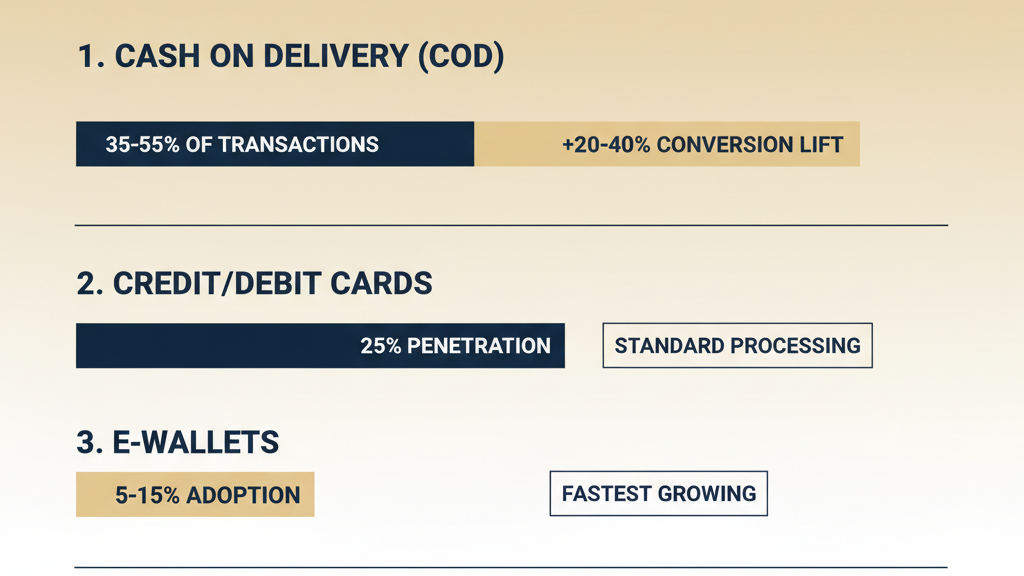
The payment mix looks nothing like the US:
Credit/debit cards reach about 25% of the population. Visa and Mastercard work everywhere, but penetration is limited compared to Western markets.
E-wallets (Apple Pay, Google Pay) are growing at 5-15% adoption. They're the fastest-growing segment but still a minority of transactions.
Cash on delivery (COD) is king. In Saudi Arabia, COD accounts for 35-45% of all e-commerce transactions. In UAE, it's 25-35%. Shopify doesn't natively support COD. You need a third-party payment app.
| Payment App | Countries | Methods | Commission | Setup Effort |
|---|---|---|---|---|
| 2Checkout | UAE, Saudi, Egypt | Cards, e-wallets, bank transfer | 2-3% + fee | Medium |
| Telr | GCC countries | Cards, e-wallets, COD | 2-2.5% | Medium |
| Hyperpay | Saudi, UAE, Kuwait | Cards, e-wallets, bank transfer | 1.5-2% | Medium |
| Arab Fintech | Egypt, Saudi | Cards, e-wallets, bank transfer | 2-3% | High |
| Local bank integrations | Country-specific | Varies | 1-3% | Very High |
The math on COD is counterintuitive. A $100 order costs roughly the same to process whether the customer pays by card ($97.50 after 2.5% fee) or COD ($98 after 2% fee plus backend collection). The margin difference is negligible. But enabling COD typically increases conversion rate by 20-40% because you're no longer excluding the majority of your addressable market.
For a store generating $1M/year with a 60% card + 40% COD mix, that conversion lift translates to $200K-$400K in incremental annual revenue.
Local Currency Pricing: The 8-15% Conversion Lift Most Brands Miss
Most global merchants display USD and let currency conversion happen at checkout. For the Middle East, this is a measurable mistake.
When a Saudi customer sees $99.99 vs. SAR 375, conversion psychology shifts. Local currency feels trustworthy. Foreign currency feels risky. The data backs this up: Shopify merchants enabling local currency pricing see 8-15% higher conversion rates in regional markets.
Shopify supports multi-currency natively. Three approaches:
Fixed exchange rate: You set the USD-to-SAR rate manually. Simple setup, full margin control, but you absorb exchange rate risk.
Dynamic exchange rate: Shopify pulls real-time rates from OANDA or OER. Your margins stay protected, but customers see fluctuating prices.
Manual local pricing: You set SAR prices per product. Maximum control, best for psychological pricing ($99 vs. SAR 375 vs. SAR 349). Most complex to maintain.
The winning strategy: manual pricing for your top-20 products (highest volume) and fixed exchange rates for the long tail. One US beauty brand doing $2M/year enabled SAR pricing for Saudi Arabia. Conversion improved 12%. AOV improved 6% from psychological pricing. That's roughly $240K in additional annual revenue for zero marginal cost.
VAT, Compliance, and the Regulatory Speed Bumps
VAT is 5% across most GCC countries. It's mandatory, non-negotiable, and the most common compliance failure for Western merchants entering the region.
Shopify's tax system supports GCC VAT, but the setup needs to be deliberate. Enable automatic tax calculation in Shopify admin (Settings > Taxes & Duties > Automatic taxes), verify your tax ID is registered in the country of sale, test checkout to confirm VAT calculation, and ensure your accounting system captures VAT as a separate line item. Many merchants skip this, add VAT manually, and create accounting problems that compound over time.
On privacy: while GDPR is EU-specific, Middle East merchants should follow similar practices — clear Arabic privacy policy, explicit email marketing consent, accessible contact info on all pages. Shopify's GDPR compliance framework provides a solid starting template.
The regulatory environment varies by country. Saudi Arabia enforces VAT and consumer protection but keeps e-commerce regulations light. UAE has a strong e-commerce framework with mandatory 14-day returns. Egypt has emerging regulations with mandatory tax compliance. Kuwait, Bahrain, and Oman maintain light regulatory burden with mandatory VAT.
One operator-level insight: countries in this region change regulations fast. If you're generating 20%+ of revenue from a single MENA country, subscribe to local business news or budget $2,000-$5,000/year for a local compliance consultant. The cost of a surprise regulatory change is far higher.
Cultural Localization: Where Translation Ends and Conversion Begins
Translation is baseline. Localization converts. The difference is worth 20-40% in conversion rate for brands that get it right.
| Element | Why It Matters | Common Mistake |
|---|---|---|
| Color schemes | Red/green carry different cultural meaning | Using US color psychology directly |
| Imagery | Model diversity, clothing, lifestyle context | Stock photos with Western models only |
| Pricing language | "Sale" and "limited time" translate oddly | Literal translations that signal low quality |
| Holidays/seasonal | Ramadan and Eid drive massive shopping spikes | Missing the biggest marketing windows of the year |
| Currency symbols | SAR, AED aren't universally recognized | Generic $$ symbols that confuse customers |
| Phone numbers | Format begins with +966, not 1 | US format phone validation that rejects local numbers |
| Address format | City, postal code, district structure differs | US address form layout that doesn't match local conventions |
Here's a story that illustrates the stakes: a luxury brand launched in UAE with "Sale" messaging. In Arabic culture, heavy discounting signals lower quality. Local merchants use "Special Edition" or "Exclusive Release" instead. The translated campaign underperformed by 40% until they reframed their messaging.
Budget $5,000-$10,000 for professional localization with a native Arabic speaker and local e-commerce consultant. It pays back within 6 months through improved conversion rates.
Payment Gateway Integration: The Step-by-Step Setup
Here's the actual workflow for adding Middle East payment support to a US Shopify store:
Step 1: Choose your payment processor. Want simplicity? 2Checkout supports 195+ countries with easy Shopify integration. Want lower fees? Telr or Hyperpay offer MENA-specific rates at 1.5-2%. Need COD? Telr or Arab Fintech are mandatory.
Step 2: Create your merchant account. The processor requires business registration, tax ID, and a bank account. Setup takes 5-10 business days for verification. No upfront cost, but wire transfer fees apply ($10-30 per withdrawal).
Step 3: Install on Shopify. Most processors offer a direct Shopify app (30-minute setup), API integration (2-4 hours with a developer), or a hosted payment page (least customization).
Step 4: Test checkout end-to-end. Test with real payment methods — credit card, e-wallet, bank transfer. Verify currency displays correctly. Confirm order confirmation emails send in the correct language. Check tax calculation accuracy.
Step 5: Go live and monitor. Enable in customer-facing checkout. Monitor the first 100 transactions for errors. Set up alerts for payment failures and declines.
Typical timeline: 2-4 weeks from processor signup to first live transaction.
Customer Acquisition: MENA Ad Economics Favor New Entrants
Payment setup is step one. Customer acquisition is where the ROI math gets interesting.
| Channel | Penetration | Cost Per Click | Notes |
|---|---|---|---|
| Google Ads (Search/Shopping) | High (80%+) | $0.50-$2.00 | Works but less targeted than social |
| Facebook/Instagram Ads | Very High (90%+) | $0.30-$1.50 | Primary channel, lowest CPC |
| TikTok Ads | Growing (50%+) | $0.20-$0.80 | Fastest growth, lowest CAC |
| Snapchat Ads | Moderate (30%+) | $0.40-$1.20 | High youth penetration |
| Local influencers | High (varies) | $500-$5K per post | UGC creators highly effective |
For a US brand entering the Middle East, Facebook and Instagram are the safest starting point. Ad targeting is precise, CPC runs 40-50% below US markets, and conversion rates are often comparable.
Typical unit economics: $15-$40 customer acquisition cost, $50-$120 average order value, 25-35% repeat purchase rate within 6 months. Those ratios are better than what most US DTC brands see domestically.
The 90-Day Launch Checklist
| Week | Task | Owner | Notes |
|---|---|---|---|
| 1-2 | Choose payment processor + locale setup | Product team | Telr or 2Checkout recommended |
| 2-3 | Implement RTL CSS + Arabic language pack | Dev team | Conditional CSS or theme builder |
| 3-4 | Localize product descriptions + landing pages | Content + dev | Native speaker review mandatory |
| 4-5 | Set up multi-currency (SAR, AED minimum) | Finance + dev | Test exchange rates |
| 5-6 | Install payment processor + sandbox tests | Dev + payments | 50+ test transactions |
| 6-7 | Soft launch to internal team + beta customers | QA + product | Collect UX feedback |
| 7-8 | Fix feedback + retest | Dev + QA | Focus on payment edge cases |
| 8-9 | Go live to public + monitor | Operations | Alert setup, conversion monitoring |
| 9-12 | Analyze data + optimize | Analytics + product | Pricing, messaging, offers |
Pre-Launch Testing: What Usually Breaks
Before going live, test these scenarios on real devices:
Checkout flow: Add a product, navigate to checkout in Arabic, verify form fields populate correctly (Arabic text doesn't overflow), test every payment method you offer, and confirm order confirmation emails send in Arabic.
Inventory and returns: UAE requires 14-day returns by law. Test the full return flow in Arabic — RMA request, label printing, refund processing with local payment methods.
Mobile experience: 75%+ of MENA e-commerce is mobile. Test on both iPhone and Android. RTL layout commonly breaks on mobile hamburger menus. Verify touch targets are appropriately sized.
Payment fallback: If the primary payment method fails, does the customer see alternatives? Does error messaging appear in Arabic?
Ready to Launch in the Middle East?
The technical setup for MENA expansion is straightforward if you follow the checklist. The real work — and the real competitive advantage — is in localization depth: cultural sensitivity, payment method coverage, and regulatory compliance that most competitors skip.
Tenten has helped 15+ brands expand into GCC markets with Shopify localization, payment integration, and regional growth strategy.
Talk to our team about your MENA expansion — we'll audit your current setup and tell you exactly what needs to change.
Editorial Note: We worked with a luxury beauty brand expanding into Saudi Arabia last year. The single biggest conversion lever wasn't the Arabic translation or the RTL CSS. It was adding cash on delivery as a payment option. COD increased their conversion rate by 38% in month one. The entire localization project paid for itself in 60 days.
Frequently Asked Questions
Do I need separate Shopify stores for each MENA country?
No. A single Shopify store with multi-currency and multi-language support works for most brands. Use Shopify Markets or geolocation rules to auto-select the correct language and currency for each visitor based on their IP address.
What's the best payment gateway for a Middle East Shopify store?
It depends on your COD requirements. Telr is the strongest option if you need cash on delivery support across GCC countries. 2Checkout offers the simplest setup with broad country coverage. For the lowest processing fees, Hyperpay serves Saudi Arabia, UAE, and Kuwait at 1.5-2%. Test with a small traffic segment before committing.
How much does Arabic localization cost for a Shopify store?
Budget $5,000-$15,000 for a complete localization that includes RTL CSS implementation, Arabic content translation, cultural adaptation, and payment gateway integration. Professional native-speaker review adds $2,000-$5,000. The investment typically pays back within 3-6 months through improved conversion rates.
How long does it take to launch a Shopify store in the Middle East?
Plan for 8-12 weeks using the 90-day checklist. The longest lead time is payment processor verification (5-10 business days) and professional localization (2-4 weeks). If your theme already supports RTL or you use a pre-built Arabic theme, you can cut 2-3 weeks from the timeline.
Do I need separate tax IDs for each MENA country?
Not necessarily, but VAT compliance is per-country. Most GCC countries charge 5% VAT. For multi-country operations with significant revenue, consider hiring a local accountant who understands cross-border VAT filing requirements. Shopify's automatic tax calculation handles the customer-facing side.
Is Cash on Delivery worth the operational complexity?
Yes — for most MENA markets, COD is non-negotiable. In Saudi Arabia, 35-45% of e-commerce transactions use COD. Skipping it means excluding your largest customer segment. The operational overhead (collection logistics, return handling) is real, but the 20-40% conversion rate lift more than compensates. Start with a third-party COD fulfillment provider to minimize your operational burden.
Can I use Google Ads to acquire customers in the Middle East?
Google Ads works for search intent capture, but Facebook and Instagram deliver better results for most e-commerce brands entering MENA. CPC on Meta platforms runs 40-60% below US rates with comparable conversion. Use Google for branded and high-intent search queries, and Meta for discovery and prospecting campaigns.