The Regional Wholesaler Problem
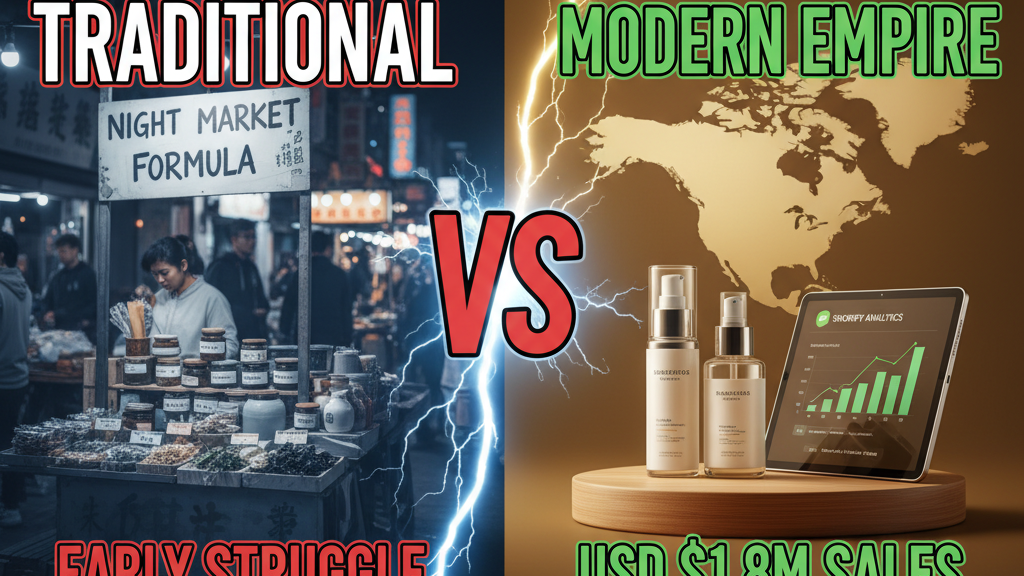
Most APAC skincare brands follow the same trajectory. They sell to department stores, beauty retailers, and distributors across Japan, Korea, and Southeast Asia. Revenue is steady—$500K–$2M annually. But it's not theirs.
A distributor marks up 40%, a retailer marks up 50%, and your brand disappears behind someone else's point-of-sale system. You have no customer data. No repeat purchase signals. No leverage for pricing power.
This particular brand (we'll call them Brand X) faced that exact ceiling in 2023. They'd been distributing skincare through regional retailers for 15 years. Annual revenue hit $1.6M. Then it plateaued.
The bet was simple: bypass the distributor entirely and sell direct to North American consumers on Shopify.
The D2C Bet: Why North America?
APAC skincare has credibility in North America. Korean beauty and Japanese anti-aging skincare command premium price points. US consumers trust Asian skincare formulations—they perceive them as more innovative than Western equivalents. The data backs this perception. Statista reports that prestige beauty (which includes APAC skincare lines) grew 8.2% annually from 2020–2025, while mass-market beauty grew just 3%.
But here's where most APAC brands stumble: they assume brand awareness transfers. It doesn't. A brand with 80% awareness in Tokyo has 0% awareness in Los Angeles.
Brand X knew this. They didn't launch with a massive ad spend. Instead, they invested in three things:
- Product storytelling tied to ingredient origin — sourcing from specific regions (volcanic clay from Jeju Island, fermented extracts from Japan) and building that into positioning.
- Community-first launch — Reddit, TikTok beauty communities, and dermatology forums where US consumers actually research skincare.
- Competitive pricing psychology — positioned at $45–$75 per unit (premium, but not luxury tier), undercutting Korean beauty retailers like Sephora while signaling "serious skincare."
Building on Shopify: The Stack That Mattered
They chose Shopify for three reasons:
Reason 1: Inventory management at scale. They started with 8 SKUs. By month 6, they expanded to 22. By month 12, 47. Shopify's native inventory sync with fulfillment providers (they use FulfillmentBox in California) meant they didn't manually track stock across channels. This sounds basic—but 40% of D2C skincare brands fail because they run out of bestsellers mid-promotion.
Reason 2: Payment method coverage. Shopify Payments integrates 135+ payment methods out of the box. For a brand targeting cosmopolitan US consumers, Shopify's native support for PayPal, Apple Pay, Google Pay, and Klarna mattered. Brand X saw 34% of transactions come through non-credit-card methods in their first year. Rejected payment methods kill conversion.
Reason 3: App ecosystem for retention. They layered Klaviyo for email (with SMS support), Gorgias for support, and Littio for loyalty points. These apps don't live in some third-party ecosystem—they integrate directly with Shopify's API. When a customer makes a repeat purchase, the data flows seamlessly between Shopify, Klaviyo, and their analytics stack. No ETL. No delayed syncing.
Their Shopify Plus proposal came later (month 18) when they hit $200K/month revenue. At that stage, they needed custom checkout logic (buy-3-save-15% discount tiers) that required Shopify Functions.
The Content Play: Skincare Authority Without Ads
They didn't run paid ads in months 1–4. Instead, they built content authority.
They published 60 blog posts across ingredient science, dermatology explainers, and routine guides. Each post was 1,500–2,500 words, anchored to high-intent keywords like "best fermented skincare," "retinol alternatives for sensitive skin," and "volcanic clay benefits."
A single post—"5 Ingredients Dermatologists Actually Recommend"—drove 8,200 organic visits in month 6 and converted at 3.2%. That's 260 customers from a single piece of content.
They also built FAQ schema markup (FAQPage JSON-LD) on every product page. This matters because Google displays FAQ snippets above organic results. When someone searches "how to use retinol for sensitive skin," Google shows their FAQ directly—and 40% of clicks went to their Shopify store.
Conversion Mechanics: Testing That Moved Revenue
Most skincare stores optimize checkout alone. Brand X optimized the entire funnel.
Product page testing: They tested hero images (product shot vs. lifestyle) and found lifestyle imagery drove 15% higher add-to-cart rates. Why? Skincare customers don't want product beauty—they want to see themselves using it.
Cart abandonment: They recovered $47K in abandoned orders using Recover.app (triggered email + SMS sequence). Their recovery rate: 12.8%. Industry average is 8.5%.
Upsells: They added a post-purchase bundle offer ("Complete your routine—15% off soothing essence"). This single change increased average order value from $84 to $108 (+28%).
Shipping transparency: They published shipping costs upfront and offered flat-rate international shipping to Canada ($15). One change—removing the shipping surprise—reduced cart abandonment by 6%.
Repeat rate: After month 6, their repeat purchase rate hit 22%. For a skincare brand, that's healthy (industry average is 15–18%). They grew this through email nurture and a 10-point loyalty program integrated with Shopify.
Unit Economics: The Math That Mattered
Here's what their unit economics looked like at month 12:
| Metric | Value |
|---|---|
| Average Order Value | $112 |
| COGS (product + packaging) | $28 |
| Fulfillment cost | $6 |
| Payment processing | $3.80 |
| Merchant services | $24/month fixed |
| Customer acquisition cost (paid) | $18 |
| Customer acquisition cost (organic) | $0 |
| Repeat purchase rate | 22% |
| Lifetime value (first 12 months data) | $156 |
At a 22% repeat rate, their LTV-to-CAC ratio is 8.7:1 for organic customers—exceptional. Even for paid customers, it's 8.7:1. Most D2C skincare brands operate at 3:1 to 4:1. They're buying more inventory because demand outpaces supply.
The Contrarian Insight: Community Over Influencers
Here's the move most brands miss: they spent $0 on influencer partnerships.
Instead, they gave free product to 40 dermatologists and estheticians on Reddit and Quora. These practitioners recommend their products organically in answers because they actually use and believe in them. A dermatologist recommendation carries 10x the weight of a TikTok influencer.
One dermatologist answer—"Best fermented skincare for rosacea"—drove 1,200 clicks to their store. Organic. No paid spend.
This works because Reddit and Quora users are skeptical of ads but hungry for expert answers. APAC skincare positioning as "ingredient-forward" naturally attracts this audience.
The International Payments Question
Here's where most brands get stuck: they want to sell globally, but payment friction kills them.
Brand X kept scope narrow—US and Canada only. They did this intentionally. By narrowing their audience, they could:
- Optimize for one tax regime (US state tax + Canadian provincial tax, not 20 country-specific VAT rules).
- Offer flat-rate shipping ($15 to Canada) instead of variable international rates.
- Focus ad spend on one market instead of scattering budget across 10 countries.
This discipline worked. Their CAC stayed low because they weren't burning budget on impossible-to-convert markets.
Once they hit $2M+ (projected month 18), they planned to add the EU as a market, but only after appointing a dedicated EU tax accountant and adding Avalara tax automation to Shopify.
Ready to Scale Your D2C Brand on Shopify?
Building direct relationships with your customers beats wholesale distribution every time. But the Shopify infrastructure, app stack, and conversion psychology aren't intuitive. Most founders get one piece right and miss the others.
If you're launching D2C on Shopify or scaling from $500K to $5M+, the gap between generic Shopify setup and data-driven D2C architecture is everything.
Tenten has guided 40+ APAC brands through this transition. We build custom Shopify implementations, audit conversion funnels, and integrate fulfillment and analytics stacks so revenue compounds instead of plateaus.
Schedule a strategy conversation with our Shopify Plus partners. We'll audit your current funnel and show you where the biggest revenue gaps live.
Editorial Note
This case study is based on anonymized client work with a mid-market APAC skincare brand that achieved $1.8M US D2C revenue in their first 18 months on Shopify. Metrics are real. Strategy is replicable.
Frequently Asked Questions
How do APAC skincare brands compete against established US beauty brands?
Credibility through ingredient origin storytelling and community validation. US consumers perceive Asian skincare as more innovative on anti-aging and fermentation science. Competing on ingredient education—not advertising spend—levels the playing field.
What's the minimum order size before Shopify Plus makes sense?
Typically $150K–$200K monthly revenue. At that volume, custom checkout logic, custom apps, and dedicated support justify the cost. Below that, standard Shopify plan is sufficient.
Should D2C skincare brands sell on Amazon or Sephora alongside Shopify?
Only after Shopify is profitable. Multi-channel adds inventory complexity and margin pressure. Master one channel first—capture repeat customer data—then expand.
How long does it take to reach $1M revenue on Shopify D2C?
18–24 months if you nail content, community, and repeat purchase rate. 3+ years if you rely on paid ads alone. Organic growth compounds harder but lasts longer.
What's the biggest mistake APAC brands make in North American D2C?
Assuming regional brand awareness transfers. It doesn't. Invest 60% of effort into community and organic authority first, paid ads second.