Shopify Plus vs Adobe Commerce: The Enterprise Platform Decision
Choosing an enterprise e-commerce platform is one of the highest-impact decisions you'll make. It affects your technical flexibility, team structure, hosting costs, and ability to innovate.
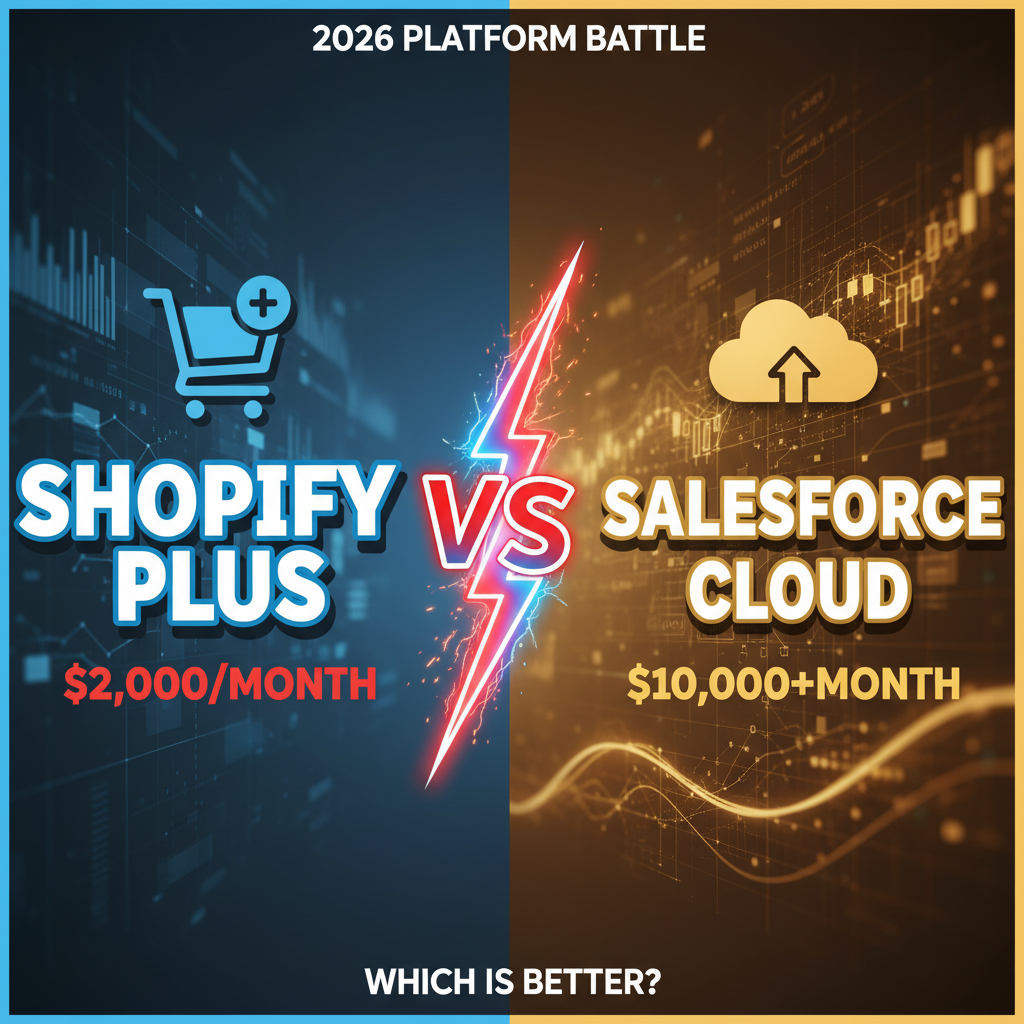
Two platforms dominate the enterprise space: Shopify Plus (SaaS-based) and Adobe Commerce/Magento (self-hosted or managed cloud). Many merchants treat this as a pure technical decision. It's not. It's a business model decision.
Here's the practical breakdown.
The Core Difference: Managed vs. Self-Managed
That's where the distinction starts.
Shopify Plus = Managed SaaS: - Shopify operates infrastructure, servers, uptime, backups, security - You focus on business logic: features, customization, merchant experience - Platform updates automatic; you don't deploy code - Cost: $2,000–$40,000/month depending on revenue
Adobe Commerce = Self-Managed (or managed cloud): - You (or your agency) manage servers, uptime, scaling, security patches, backups - You control everything; you're responsible for everything - Updates require active deployment (or using Adobe's managed cloud service, which costs extra) - Cost: $20,000–200,000+/year depending on infrastructure + team costs
This distinction cascades through everything else: flexibility, team structure, time-to-market, reliability.
Comparison Matrix: Feature, Cost, and Operational Requirements
| Dimension | Shopify Plus | Adobe Commerce |
|---|---|---|
| Monthly Cost (SaaS) | $2K–$40K | $0 (self-hosted) + $50K–150K/year infrastructure + team |
| Flexible Customization | Moderate (Liquid, theme customization, apps) | High (full PHP codebase, no limits) |
| Time to Launch | 3–6 months (managed, predictable) | 6–12 months (custom, variable) |
| App Ecosystem | 7,000+ apps in Shopify App Store | 1,000+ extensions, less mature ecosystem |
| Hosting/Infrastructure | Shopify-managed (99.99% SLA guaranteed) | Self-managed or third-party cloud ($50K+/year) |
| Scaling Capability | Automatic (Shopify handles scaling) | Manual (requires DevOps investment) |
| Security & Compliance | Shopify-managed (PCI DSS, compliance built-in) | Your responsibility (PCI DSS audits, patching) |
| Team Requirements | 2–3 devs (Liquid, JavaScript, theme customization) | 5–10 devs (PHP, MySQL, DevOps, release management) |
| Headless Commerce Ready | Yes (Hydrogen + Storefront API) | Yes (GraphQL API, Magento PWA Studio) |
| Managed Support | Included (dedicated account manager) | Paid (Adobe support tier, or agency) |
| API Quality | Excellent (modern REST + GraphQL) | Good (REST + GraphQL, older design) |
When to Choose Shopify Plus
Scenario 1: You value speed and predictability
Shopify Plus is for merchants who want to launch fast and iterate. 3–6 month launch timelines are standard. You get a working platform in weeks, then layer on customization.
Example: A DTC beauty brand with $20M revenue wants to launch a B2B2C portal for retailers. Shopify Plus Hydrogen + Draft Orders API = 4-month build. Adobe Commerce custom portal = 8+ months + ongoing infrastructure management.
Scenario 2: You have a small technical team
If your technical team is 2–4 people, Shopify Plus is the right choice. You don't need DevOps engineers, infrastructure architects, or database administrators. Shopify ops is your team's team.
Scenario 3: You want a robust app ecosystem
If you want to leverage third-party integrations (email, SMS, shipping, marketing automation, payment processors), Shopify's 7,000+ app ecosystem is mature and battle-tested. Adobe's ecosystem is smaller and less standardized.
Scenario 4: You're selling B2C (or B2B with simple requirements)
Shopify Plus is optimized for B2C. If your model is straightforward (direct-to-consumer, single catalog, standard checkout), Shopify Plus is highly efficient. B2B quote builders, approval workflows, and complex catalog management require custom development on any platform—but Shopify makes simple B2C fastest.
Scenario 5: You don't want infrastructure headaches
If you don't want to manage server uptime, security patches, or database scaling, Shopify Plus handles all of it. 99.99% uptime SLA is guaranteed.
When to Choose Adobe Commerce (Magento)
Scenario 1: You need extreme customization
If you need deep platform changes (custom checkout, proprietary payment flows, unique business logic), Adobe Commerce's open PHP codebase gives you unlimited flexibility. You can modify anything.
Example: A luxury goods retailer needs a custom "personal shopper" matching engine + custom fraud detection + proprietary inventory rules. Shopify Plus would require custom apps or workarounds. Adobe Commerce = native database queries, custom modules, full control.
Scenario 2: You have a large technical team
If you have 5+ developers, a DevOps engineer, and a product architect, Adobe Commerce's complexity is manageable. Your team can own the infrastructure, manage deployments, and customize deeply.
Example: A $200M CPG brand with 12 engineers and a DevOps team. They can run Adobe Commerce self-hosted, own the codebase, and customize at will.
Scenario 3: You have complex B2B requirements
If your business model requires custom quote management, approval workflows, tiered pricing by customer segment, or complex catalog rules, Adobe Commerce's extensibility is an advantage.
Example: An industrial supplier with 500+ wholesale customers, each with custom pricing tiers and approval workflows. Adobe Commerce's modular architecture supports this. Shopify Plus would struggle without extensive custom app development.
Scenario 4: You want to avoid SaaS lock-in
If you're philosophically opposed to SaaS platforms or want to own your codebase, Adobe Commerce (self-hosted) gives you complete control. You own the data, the code, and the infrastructure.
Scenario 5: You have specific compliance or data residency requirements
If your industry (healthcare, finance) or country (EU, China) has strict data residency rules, Adobe Commerce (self-hosted) lets you run on your own infrastructure in your own jurisdiction. Shopify Plus is US-hosted (or EU for EU accounts), which may not meet requirements.
Hidden Costs: The Real Budget
Shopify Plus total cost of ownership (TCO): - Platform fee: $2K–$40K/month - Customization (internal team): $200K–500K first year, $50K–150K ongoing - Apps/integrations: $5K–30K/year - Total Year 1: $350K–700K - Total Year 2+: $150K–350K/year
Adobe Commerce total cost of ownership: - License fee: $0–$50K/year (self-hosted) or included in managed cloud - Infrastructure (managed cloud): $50K–150K/year - Team (5–8 devs): $400K–800K/year salary - Integrations (custom): $100K–300K/year - Total Year 1: $600K–1.2M (includes team) - Total Year 2+: $600K–1M/year (ongoing team + infrastructure)
The hidden insight: Shopify Plus is cheaper per-transaction and scales with revenue. Adobe Commerce is cheaper only if you have in-house development teams already.
If you're comparing SaaS platform cost to infrastructure cost (excluding team), Shopify wins. But if you're comparing Shopify to Adobe's team cost, it's closer.
Migration Complexity
Shopify → Adobe Commerce: Hard. You're moving from Liquid (proprietary) to PHP. Data migration is complex. Typically 6–9 months.
Adobe Commerce → Shopify Plus: Very hard. You're moving from custom modules to apps. You might lose custom features or need to re-architect. Typically 4–8 months.
Within Shopify Plus (e.g., theme upgrade): Easy. Shopify manages backward compatibility. 1–2 weeks.
Within Adobe Commerce (version upgrade): Moderate. Requires careful testing. 1–3 months.
Growth Scenarios: Which Platform Scales Better?
| Revenue Tier | Best Platform | Why |
|---|---|---|
| $1M–$20M | Shopify Plus | Fast setup, manageable customization, low operational overhead |
| $20M–$100M | Either | Shopify Plus if you value simplicity + speed. Adobe if you need extreme customization |
| $100M+ | Adobe Commerce | Custom features become ROI-positive. Team scale justifies infrastructure investment. Magento's flexibility becomes necessary for differentiating features |
Decision Framework: Which Should You Choose?
Ask yourself these questions:
- Do I have a technical team of 5+ people? Yes → Consider Adobe. No → Shopify Plus.
- Do I need custom business logic beyond standard e-commerce? Yes → Adobe. No → Shopify Plus.
- Do I want to launch and iterate quickly? Yes → Shopify Plus. No → Adobe (longer build, more control).
- Am I comfortable with infrastructure management? Yes → Adobe. No → Shopify Plus.
- Is my business model complex B2B? Yes → Adobe. No → Shopify Plus.
If 4+ answers are "Yes/Adobe," choose Adobe. If 4+ are "No/Shopify," choose Shopify Plus.
Ready to Grow Your Shopify Store?
Shopify Plus and Adobe Commerce both work. The choice depends on your team size, technical ambition, and business model complexity. Many fast-growing DTC brands start on Shopify Plus, then migrate to headless architecture (Hydrogen + Shopify API) rather than switching platforms entirely.
Tenten advises on platform selection, migration planning, and Shopify Plus customization strategy. We've guided merchants through both platforms and know the hidden trade-offs.
Next steps: Assess your team size, customization needs, and growth timeline. If Shopify Plus fits 80% of your requirements and you can build the remaining 20% with apps, choose Shopify. If you need 100% custom, Adobe is the play. Let's discuss which is right for you.
Editorial Note The Shopify Plus vs. Adobe Commerce debate often becomes religious (which platform is "better"), but it's actually practical. Shopify Plus wins if you value speed, simplicity, and low ops overhead. Adobe wins if you need extreme customization and have technical depth. There's no universal winner—just the right fit for your situation.
Frequently Asked Questions
Can I use Shopify Plus for enterprise B2B?
Yes, but with caveats. Shopify Plus supports B2B order management, custom pricing, and approval workflows through custom apps. However, complex multi-tiered pricing and approval workflows require custom development. Adobe Commerce has native B2B features. Choose Shopify Plus if B2B is secondary; Adobe if it's primary.
What's the hosting cost for Adobe Commerce?
If self-hosted: $5K–20K/month (infrastructure, backup, security). If managed cloud (Adobe Commerce Cloud): $50K–150K/year (roughly). Plus team costs (DevOps, development), which dwarf hosting costs.
Can I migrate from Shopify Plus to Adobe Commerce?
Yes, but expect 6–12 months and $200K–500K in migration costs. You're rebuilding themes, custom features, and integrations from scratch. Avoid if possible. Choose right the first time.
Is Shopify Plus good enough for $100M+ revenue?
Yes—but it depends on your customization needs. If your competitive advantage is in marketing/product/content, Shopify Plus is sufficient. If it's in proprietary technology (custom recommendations, fraud detection, demand forecasting), Adobe Commerce may be better positioned for deep technical customization.
What's the best way to future-proof my platform choice?
Go headless (decouple storefront from backend). Shopify Plus has Hydrogen + Storefront API. Adobe Commerce has PWA Studio. Headless lets you change frontends without re-platforming, insulating you against future platform changes.