
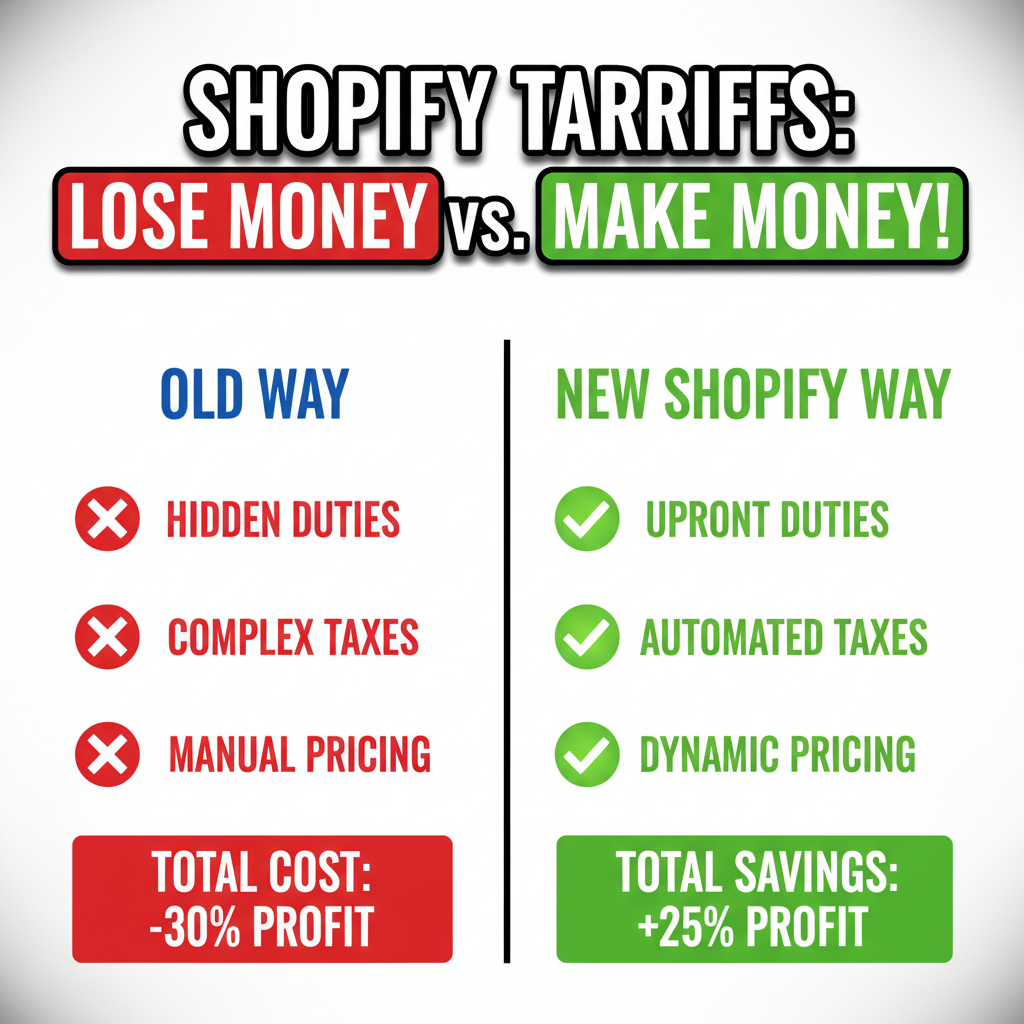
The Hidden Tariff Tax on Your Shopify Store
Most Shopify merchants ignore tariffs until their first international order lands. Then reality hits: a $100 product suddenly carries $15-25 in duties that either crush your margin or shock your customer at checkout. Tariffs and import duties are reshaping cross-border e-commerce economics, and 2025 brought new complexity with multiple countries implementing tariff hikes and renegotiated trade agreements.
The underlying mechanics are straightforward, but the execution is messy. Tariff rates vary by product classification, country of origin, and destination market. A leather handbag from Vietnam faces a 20% duty entering the US. Electronics from China face 25% tariffs under current trade policy. The same product from a tariff-advantaged country (think Mexico under USMCA) pays zero.
Here's the counterintuitive insight: tariff avoidance through supply chain optimization beats pricing around them. Most merchants just raise prices to cover duties. Smart operators source from tariff-advantaged regions, negotiate landed costs with suppliers, or restructure fulfillment to shift duty burden. That's where real margin recovery happens.
Understanding Tariff Basics: Classification, Origin & Rates
Tariffs start with product classification. The US uses the Harmonized Tariff Schedule (HTS), a 10-digit code system. Every product has one. A men's cotton t-shirt is 6204.62.20. A plastic toy is 9503.00.50. The HTS code determines the duty rate.
Tariff rates for the same product vary dramatically by origin. US-Vietnam trade has a baseline Most Favored Nation (MFN) rate—Vietnam's standard rate to the US is 25% for many goods. But Vietnam signed the CPTPP (Comprehensive and Progressive Agreement for Trans-Pacific Partnership), which gives it preferential rates with some partners. Tariff preference matters: Vietnam-Australia trade gets 0% on certain goods. Vietnam-US trade gets 25%. Same factory. Same product. Different cost structure.
Mexico under USMCA gets preferential access to the US market. Many goods from Mexico face 0% duty if they meet USMCA rules of origin. Clothing, footwear, automotive parts—USMCA members get lower tariffs than competitors. That's why brands source from Mexico despite higher labor costs: total landed cost is lower because tariffs are zero.
Country of origin is determined by where the product was manufactured, not where it's shipped from. A t-shirt made in Vietnam and shipped through Singapore is still Vietnamese-origin. Tariffs apply to origin, not the transit point. This creates opportunities: consolidate your sourcing in tariff-advantaged regions (Mexico, USMCA partners, India for some goods).
| Product Category | US Tariff Rate (MFN) | Mexico (USMCA) | Vietnam | Key Threshold |
|---|---|---|---|---|
| Apparel (cotton t-shirts) | 16-25% | 0% | 25% | USMCA origin |
| Electronics (phones, laptops) | 0-25% | 0-25% | 25% | Origin certification |
| Footwear | 8-48% | 0% | 25-35% | USMCA advantage |
| Leather goods | 8-20% | 0-5% | 20% | Supply chain choice |
| Home goods (ceramics, furniture) | 0-40% | 0-15% | 15-25% | Tariff shopping |
The MFN (Most Favored Nation) rate is the default rate applied to countries without preferential agreements. China pays MFN rates on most goods entering the US, which are substantially higher than USMCA rates. Your tariff cost depends on where you source.
Calculating Landed Cost: The Real Price You Pay
Landed cost = Product cost + Freight + Tariffs + Broker fees + Insurance.
Most Shopify merchants track product cost and freight, but skip tariffs entirely in their unit economics. That's the mistake.
Let's model a real scenario. You import apparel from three sources:
Vietnam factory, FOB $8 per unit: - Product: $8.00 - Ocean freight (per unit): $0.50 - Tariff (25%): ($8 + $0.50) × 0.25 = $2.13 - Customs broker fee: $0.25 - Landed cost: $10.88 - Retail price: $39.99 (4.2x markup) - Gross margin before overheads: 72.7%
Mexico factory, FOB $9.50 per unit: - Product: $9.50 - Ocean freight (per unit): $0.50 - Tariff (0% USMCA): $0 - Customs broker fee: $0.15 (faster clearance) - Landed cost: $10.15 - Retail price: $39.99 (same as Vietnam sourcing) - Gross margin: 74.6%
Same retail price. Different margin. Mexico source costs $0.73 less per unit. For a 10,000-unit order, that's $7,300 in extra margin—just from switching sourcing countries. Scale that to 100,000 units, and you recover $73,000 annually. Tariff arbitrage is a real lever.
The problem: your spreadsheet probably doesn't calculate this. Most merchants source from whatever factory is cheapest on FOB price, ignoring landed cost entirely. The tariff hit happens after you've already committed to the purchase.
Pricing Across Borders: Duty Pass-Through vs. Absorption
Once you land the goods, you face a pricing decision: who bears the tariff cost?
Option 1: Absorb tariffs in your pricing. Set one global price ($39.99) and accept that US customers carry 25% tariff while EU customers carry 5%. Your margin on US orders is lower. This works if your customer base is global and you can average margins.
Option 2: Calculate duty and add it at checkout. Show the customer the duty cost separately. Risk: cart abandonment spikes when buyers see $10 in surprise duties on a $40 item. Baymard Institute found that adding taxes/fees at checkout increases abandonment by 22%. Duties are worse because they're unexpected and feel punitive.
Option 3: Source from tariff-advantaged regions. Import from Mexico, India, or other low-tariff origins and keep margins consistent. Higher upfront factory cost, zero duty = competitive advantage.
Option 4: Use Shopify Markets for duty handling. Shopify Markets automates duties and taxes at checkout for many markets. The system calculates duty, adds it transparently, and handles remittance. This requires proper product classification and HS code setup in Shopify. If your HS codes are wrong, you'll either overcharge customers (and lose sales) or undercharge (and lose margin).
| Pricing Strategy | Margin Impact | Customer Experience | Complexity |
|---|---|---|---|
| Global absorption | Negative (high-tariff markets subsidize low-tariff) | Clean checkout, no surprise fees | Low |
| Duty pass-through | Neutral | Cart abandonment risk (+22%) | Medium |
| Tariff-advantaged sourcing | Positive (higher upfront, zero duty) | Competitive pricing, higher margin | High |
| Shopify Markets auto-duty | Depends on execution | Transparent, region-specific pricing | Medium-High |
The smartest approach combines multiple tactics: source 60% from Mexico (zero duty), 40% from Vietnam. Calculate average landed cost. Price globally but set region-specific pricing in Shopify Markets for high-tariff zones. This distributes duty burden and maximizes margin.
Compliance & Tariff Traps: HS Codes, Origin Certification & Duties
Tariff compliance has three components: correct product classification (HS code), origin certification, and duty payment.
HS Codes (Harmonized System codes) determine your tariff rate. The US uses 10-digit HTS codes. A mistake here can cost thousands. Misclassify a cotton/poly blend shirt as 100% cotton, and you've used the wrong rate. The importer—that's you—is liable for the difference plus penalties.
How do you find your HS code? Start with the USITC (US International Trade Commission) website. Search your product. But be specific. "Apparel" is too broad. "Men's cotton woven shirts" is precise enough. Verify with a customs broker. This should cost $50-200 per product category, but it saves tens of thousands in tariff liability.
Origin certification proves where your product was made. For USMCA goods, you need a USMCA origin declaration from your Mexican supplier. This document certifies the product qualifies under USMCA rules and deserves the 0% duty rate. Without it, even Mexican goods pay MFN rates.
Duty payment happens at port of entry. Your customs broker (who you hire) enters the goods, pays duties, and handles documentation. Most Shopify stores use standard brokers ($100-300 per shipment) but large importers negotiate better rates. At scale (50+ containers annually), you can hire a dedicated broker for $3,000-5,000/month and recover costs in tariff savings and faster clearance.
The tariff trap: incorrect HS codes get you fined. Shopify merchants often leave HS codes blank in their product taxonomy. This creates friction when you ship to Shopify Markets customers—the system can't calculate duties correctly. Fix this: populate HS codes for every SKU. Shopify has a metafield for this. Update it now.
International Trade Policy: USMCA, Section 301 Tariffs & Future Shifts
US tariff policy changed dramatically under Section 301 investigations and recent bilateral negotiations. Understanding the landscape helps you source strategically.
USMCA (United States-Mexico-Canada Agreement) replaced NAFTA in 2020. It reduced duties on qualifying goods from Mexico and Canada to 0% or near-zero. This is why smart brands source apparel, footwear, and leather goods from Mexico despite higher factory wages. The tariff advantage offsets labor cost.
Section 301 tariffs on China added 25% duties on hundreds of product categories (electronics, machinery, home goods) in 2018. These tariffs remain in effect. Chinese sourcing became expensive. Brands shifted to Vietnam, India, and Mexico.
Recent tariff announcements (2024-2025) increased duties on EVs, semiconductors, and steel. India signed preferential trade agreements reducing tariff rates on textiles. These shift constantly. Your sourcing strategy needs flexibility.
The second-order effect: tariff shifts create supply chain opportunities. When tariffs on Chinese electronics spike, Vietnam and India gain competitiveness. Suppliers in those countries expand capacity. Your costs drop if you switch early. Conversely, if you're locked into Chinese sourcing, tariff increases hit directly.
For Shopify merchants: monitor bilateral trade policy. Join trade associations (American Apparel & Footwear Association, National Association of Manufacturers) that lobby for lower tariffs and provide intelligence. Read USITC reports. They're public. They tell you which categories face tariff hikes next.
Shopify's International Tools: Markets, Global Payments & Duty Automation
Shopify Markets automates much of the tariff complexity—but only if you configure it correctly.
Shopify Markets lets you create region-specific storefronts with local pricing, currency, and duties. When a customer in Germany visits, they see EUR prices and EU VAT calculated at checkout. When a US customer visits, they see USD prices and US tariffs (if applicable).
Here's the catch: tariff calculation requires correct HS codes in your product data. If you don't populate HS codes, Shopify Markets can't calculate duties. The customer sees no duty estimate, pays at checkout, then receives a surprise customs bill weeks later. Bad experience.
Shopify Global Payments handles multi-currency processing. But it doesn't solve tariffs directly—that's Shopify Markets' job.
The workflow:
1. Populate HS codes for all products (metafield: harmonized_tariff_schedule)
2. Set tariff costs per region in Shopify Markets settings
3. Define pricing by region (USD for US, EUR for EU, etc.)
4. At checkout, Shopify calculates duties transparently
5. Duties are collected and remitted to customs authorities (varies by region)
The operational reality: most Shopify Plus merchants use third-party tariff platforms (AnyTrack, TradeShift) because Shopify Markets doesn't handle complex scenarios well. If you're importing goods with origin certification requirements or managing multiple suppliers with different duty rates, third-party tools add precision.
For DTC brands under $10M revenue: Shopify Markets is usually sufficient. Set it up correctly, audit quarterly, move on.
Ready to Optimize Your Tariff Strategy?
Tariffs hit e-commerce margins harder than most merchants realize. A 3-5% tariff difference between sourcing regions translates to $50,000+ in annual savings for a $5M revenue store. The fix requires three steps: audit your sourcing country, calculate true landed cost, and configure HS codes in Shopify.
We've helped DTC brands recover $100K+ in annual margin by restructuring their supply chain to exploit tariff advantages and automating duty calculations on cross-border orders. If you're shipping internationally and ignoring tariffs, you're leaving money on the table.
Let's audit your tariff exposure.
Editorial Note
Tariff economics are non-obvious because the costs are buried in supply chain data, not in your Shopify dashboard. Most merchants see "tariff cost" only when goods arrive at port. By then, you've already negotiated with the factory and locked in FOB pricing. The margin-recovery move is upstream: optimize sourcing country, negotiate landed cost, then set Shopify prices accordingly. It's operational rigor, not pricing tricks.