Why AI Shopping Agents Are About to Disrupt Your Sales Funnel
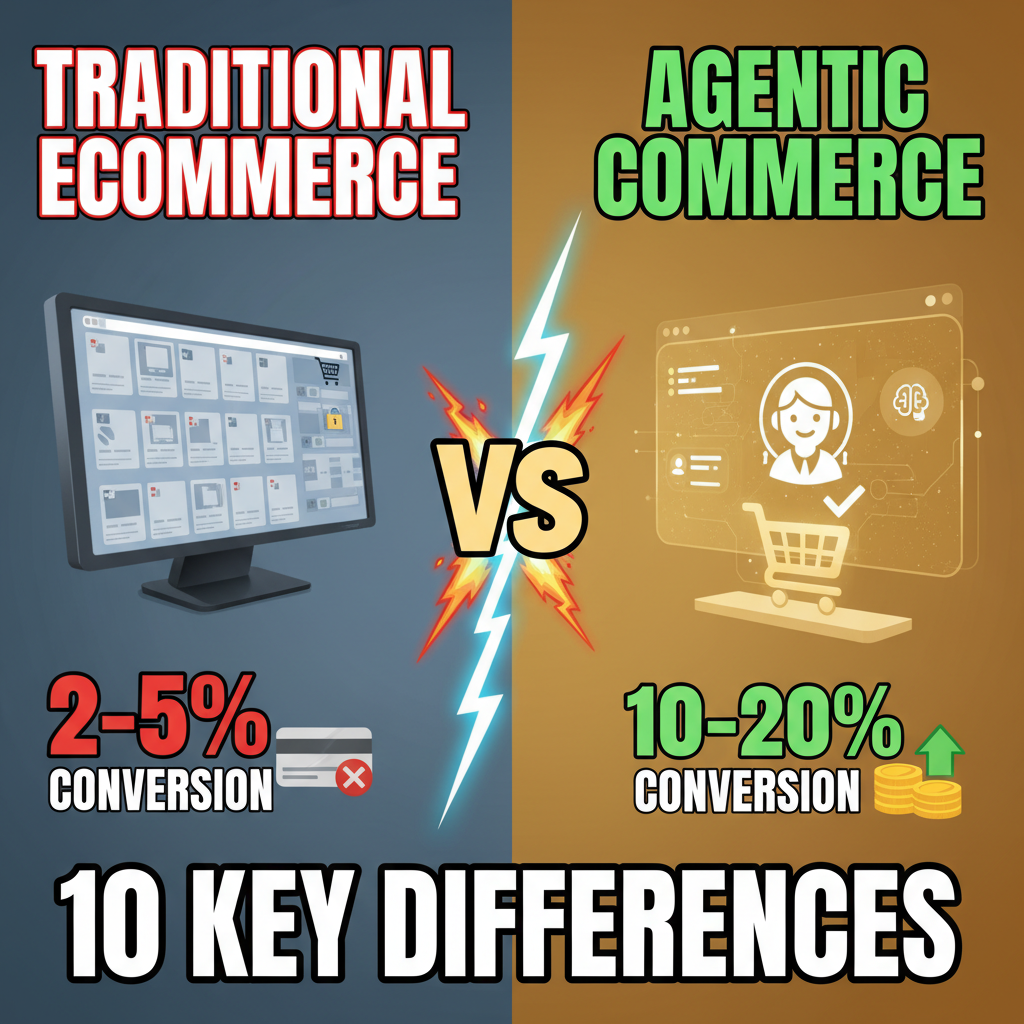
AI shopping agents are no longer science fiction. They're live in ChatGPT, Claude, and enterprise procurement systems right now. An agent isn't a chatbot that answers questions—it's an autonomous system that can search for products, compare prices, read reviews, and execute purchases on behalf of users.
The shift matters because your traditional e-commerce funnel (SEO → click → browse → convert) is breaking. If an AI agent is making the purchase decision, visibility in Google is less important than visibility to the agent's decision logic. Agents don't click ads. They parse structured data, evaluate trust signals, and route transactions to suppliers that match user intent and business rules.
Most Shopify stores still optimize for human browsers. The next wave of e-commerce winners will optimize for agent systems. This isn't a future problem—it's happening now.
The Agency Problem: Why Agents Won't Trust Your Store
AI agents operate under strict constraints: they prioritize accuracy, transparency, and risk mitigation. If your Shopify store sends conflicting signals (metadata claims one price, the actual product page shows another; inventory says "in stock" but checkout fails; shipping costs appear only at the final step), agents will flag you as unreliable and route transactions elsewhere.
Here's the uncomfortable truth: agents are more skeptical than humans. A person browsing your site might tolerate friction. An agent simply rejects it.
The audit usually goes like this: 1. Agent fetches product metadata via structured data (JSON-LD, OpenGraph, Schema.org) 2. Agent extracts SKU, price, availability, shipping rules, return policy 3. Agent compares against user constraints (budget, delivery timeline, brand preferences) 4. Agent validates against third-party trust signals (Trustpilot ratings, return history, BBB status) 5. Agent checks for conflicts between advertised and actual data 6. If conflicts exist → agent rejects store → user sees "not available" → you lose the sale
Most Shopify stores fail at steps 2 and 5. Their JSON-LD is incomplete, prices aren't synchronized in real-time, and metadata is generic. Agents see noise.
Pillar 1: Structured Data Architecture — Make Your Store Machine-Readable
Agents consume data through structured formats. If your Shopify store doesn't emit clean, complete JSON-LD, agents can't reliably index you.

Schema.org essentials for agent readiness:
| Schema Element | Agent Requirement | Shopify Native Support | Implementation |
|---|---|---|---|
| Product.name | Exact match to listing title | ✓ Automatic | Use clear product titles |
| Product.price | Real-time pricing data | ✓ Automatic | Sync dynamic pricing via API |
| Product.priceCurrency | USD (required for US agents) | ✓ Automatic | Verify currency setting |
| Product.availability | InStock / OutOfStock status | ⚠ Partial | Use Shopify inventory sync + API updates |
| Product.inventoryLevel | Exact quantity available | ✗ Not native | Requires custom API endpoint |
| Offer.shippingDetails | Calculated shipping costs | ✗ Not native | Use ShopifyPlus shipping API or custom sync |
| Product.reviews | Aggregate rating + review count | ⚠ Partial | Install review app that emits Schema.org |
| Organization.trustSignals | BBB, Trustpilot links | ✗ Manual | Add custom meta tags in code injection |
Action items:
1. Audit your store's JSON-LD output: Inspect → Network → Search for "@context": "https://schema.org" in page source
2. If JSON-LD is missing or incomplete: Use Shopify's built-in JSON-LD generator (Settings → Sales Channels → Online Store → Product JSON) or install a structured-data app
3. For real-time inventory: Set up a webhook that fires whenever inventory changes, updating a public JSON API at /api/inventory.json that agents can poll
4. For shipping data: Calculate all-in shipping costs (including tax) and expose via Storefront API so agents see true total cost before checkout
Common gaps agents detect: - Price in JSON-LD doesn't match checkout price (agents reject immediately) - Inventory says "in stock" but checkout fails due to pre-order logic (agent loses trust) - No shipping cost disclosed until final step (agents flag as hidden cost) - Multiple currencies on page without clear primary (agents default to reject)
Agents are deterministic. They won't forgive inconsistency.
Pillar 2: Real-Time Inventory Synchronization — Prevent Ghost Sales
One of the fastest ways to burn an agent's trust is to confirm a sale that can't be fulfilled. Agents check inventory, find the product available, and initiate checkout. If your system confirms the order but inventory was actually depleted, the agent flags your store as unreliable.
This is more common than you'd think. Most Shopify stores have a 15–60 minute lag between when inventory is decremented in your backend and when JSON-LD updates. During that window, agents can fetch "in stock" data and attempt a purchase that fails.
Solution: Real-time inventory exposure
- Enable Shopify's Storefront API (Shopify Plus / advanced plans)
- Create a custom
/inventory-sync.jsonendpoint that returns current stock status for all active SKUs:
{
  "last_updated": "2026-04-08T14:23:00Z",
  "products": [
    {
      "sku": "BLUE-WIDGET-M",
      "available": true,
      "quantity": 47,
      "reserved_for_orders": 3,
      "net_available": 44
    }
  ]
}
- Set up inventory webhooks so every stock change triggers an API call that updates agent-accessible data within seconds
- Add inventory buffer logic: If you sell 10 units/hour on average, and agent checkout takes 5 minutes, reserve inventory headroom to prevent overselling during agent transactions
The goal: An agent can fetch inventory status at T0, execute checkout at T0+30 seconds, and have 95%+ confidence the order will succeed. That confidence = trust = agent routing more transactions to you.
Pillar 3: Pricing Transparency and Dynamic Discounting
Agents are trained to optimize for user value. If your store applies hidden fees, geography-based pricing, or surprise discounts at checkout, agents will perceive you as unreliable and penalize your ranking in agent decision logic.
Here's the problem: Most Shopify stores calculate final price too late in the funnel. Agents want to see all-in cost (product + tax + shipping + discount) before they initiate checkout.
Create a pricing endpoint that agents can query:
POST /pricing-calculator
{
  "items": [
    { "sku": "BLUE-WIDGET-M", "quantity": 2 }
  ],
  "shipping_address": {
    "country": "US",
    "postal_code": "94105"
  },
  "promo_code": "AGENT10",
  "customer_type": "new"
}

// Response
{
  "subtotal": 198.00,
  "tax": 17.82,
  "shipping": 12.50,
  "discounts": -20.00,
  "total": 208.32,
  "currency": "USD",
  "expires_at": "2026-04-08T14:35:00Z"
}
Agents will check this endpoint, confirm the all-in price matches user budget constraints, then proceed. If your final checkout price differs, agents flag it as a bait-and-switch.
Discount strategy for agents:
- Offer agent-specific discount codes (e.g., AGENT10 for 10% off, no minimum)
- Agents love deterministic pricing. A 10% discount beats a "surprise 20% off" that only appears at checkout
- Publish your coupon rules in robots.txt comments or a dedicated /discounts.json so agents understand what's available
Pillar 4: Trust Signals and Verification
Agents operate in an adversarial environment. They know stores can fake reviews, lie about shipping times, and claim certifications they don't have. To filter signal from noise, agents check for third-party validation.
Install trust signal infrastructure:
| Signal | Agent Weight | Implementation |
|---|---|---|
| Trustpilot reviews (4.5+ stars) | High | Embed Trustpilot widget, expose rating in JSON-LD |
| SSL/HTTPS certificate | High | Verify green lock in browser (Shopify handles this) |
| Return policy clarity | High | Publish explicit return window (e.g., "30-day returns, free return shipping") |
| Shipping tracking | High | Enable Shopify's native tracking + carrier integration |
| Money-back guarantee | Medium | Advertise prominently; agents cite this as trust factor |
| Years in business | Medium | Add founding year to site footer + Schema.org |
| BBB/Business Bureau membership | Medium | Link to BBB profile; agents verify |
| Privacy policy + GDPR compliance | Medium | Publish clear policy; agents check for data protection |
| Support contact availability | Low-Medium | Expose email + phone in footer; agents verify responsiveness |
Action items: 1. Audit your current trust signals: Does your store expose Trustpilot rating in JSON-LD? Do you link to your BBB profile? 2. If missing: Install a review aggregation app that syncs third-party ratings (Trustpilot, Google Reviews) into your product JSON-LD 3. Test: Use an AI agent (ChatGPT, Claude) to query your store. Can it extract your trust signals automatically?
Pillar 4B: Handling Returns and Refunds — Agent-Style
Agents are trained to evaluate risk. If your return policy is unclear, buried in 9-point gray text, or differs from industry standards (30-day returns), agents will rate you as high-risk and prefer competitors.
Clear returns policy = agent trust = higher volume. It's that simple.
Minimum agent-ready return policy: - 30-day returns (standard for US e-commerce; 14-day minimum for EU) - Free return shipping for defects; customer pays for change-of-mind returns - Clear timeline: "Refunds processed within 5–10 business days of return receipt" - Explicit exclusions: List what's non-returnable (final sale items, custom orders) upfront
Expose this in two places:
1. Product JSON-LD: Add returnPolicyUrl pointing to full policy
2. Checkout: Show return window in order summary (agents check this before finalizing)
Pillar 5: API Readiness — Direct Agent Integration
The ultimate optimization is to become a direct integration partner for agent systems. Major platforms (OpenAI, Anthropic, Google) are building agent infrastructure that lets third-party services plug in.
Shopify Plus customers can achieve this by: 1. Building a custom Actions/Tools endpoint that agents can call 2. Exposing key operations: search products, fetch pricing, initiate checkout, track orders 3. Using OAuth to securely authenticate agent requests 4. Logging agent interactions separately (they behave differently than humans)
Example: An agent queries your /products/search endpoint with filters (budget, color, size), receives a ranked list, then calls /quote to get final pricing, then calls /checkout/init to start transaction flow.
This requires development effort, but Shopify Plus partners (like Tenten) can build this infrastructure to give you a competitive moat. Agents will prefer your store because the integration is optimized—lower latency, higher reliability, better pricing.
The Metrics That Matter: Agent-Specific KPIs
You're optimizing for agents, so track agent-specific metrics:
| Metric | What It Means | Target |
|---|---|---|
| Structured Data Completeness | % of products with full JSON-LD | 95%+ |
| Inventory Sync Latency | Delay between stock change and API update | <30 seconds |
| Agent-Initiated Checkout Rate | % of agent queries that proceed to payment | 70%+ (humans ~2%) |
| Agent Order Fulfillment Rate | % of agent orders that ship on-time | 98%+ |
| Agent Return Rate | % of agent orders returned | <5% (agents are accurate) |
| Trust Signal Exposure Rate | % of products with extracted third-party ratings | 80%+ |
Measurement: Use your Shopify Storefront API logs + custom server-side logging to isolate agent traffic (user agent strings like "GPT-4", "Claude") from human traffic. Analyze separately.
Ready to Grow Your Shopify Store?
AI agents represent the next major shift in e-commerce logistics. Stores that optimize for agent systems—transparent pricing, real-time inventory, clear trust signals—will capture the highest-intent, fastest-converting traffic. The next 18–24 months will separate winners from the rest.
At Tenten, we're building agent-ready infrastructure for Shopify Plus partners. If you're operating at scale and want to prepare your store for autonomous commerce, reach out to discuss your e-commerce strategy and agent readiness.
Editorial Note
The shift from human-driven to agent-driven commerce is happening faster than most realize. Every week, new AI agent frameworks launch with e-commerce integrations. Stores that are merely "optimized for Google" won't compete. The real moat is transparency—clean structured data, real-time inventory, honest pricing. Agents reward this. Humans do too.
Frequently Asked Questions
What's the difference between an AI chatbot and an AI shopping agent?
A chatbot answers questions. An agent executes actions—it can search products, compare prices, read reviews, and complete purchases autonomously without human confirmation at each step.
Will AI agents replace human shoppers?
No—they'll coexist. High-involvement purchases (luxury goods, clothing) will remain human-driven. Routine replenishment (supplies, software) will increasingly flow through agents. Agents handle ~20-30% of B2B procurement today; expect 40%+ of B2C in 2-3 years.
Do I need Shopify Plus to optimize for agents?
Most basics (JSON-LD, inventory sync, returns policy) work on any Shopify plan. Advanced integration (custom API endpoints, direct agent partnerships) requires Shopify Plus or custom development. Tenten can build this.
How do I test if my store is agent-ready?
Use ChatGPT with web search enabled or Claude with web access. Ask it to find a product on your store, compare prices, and simulate checkout. If the agent gets confused or encounters missing data, you've found gaps.
Should I change my pricing or discounts for agents?
No—keep pricing consistent across all channels. Agents detect and penalize dynamic pricing based on user type. What you should do: offer straightforward agent discounts (e.g., 10% off for automated orders, no minimum) and publish discount rules transparently.