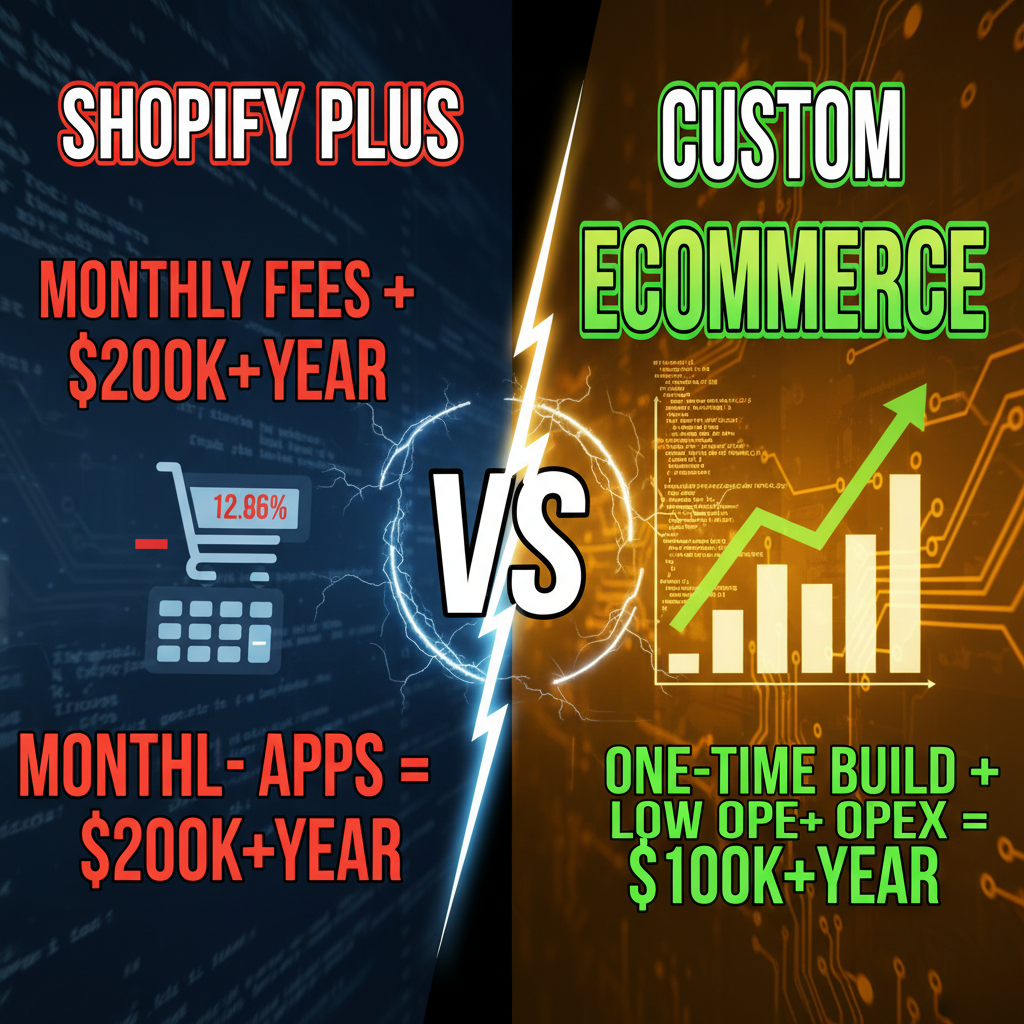
The Real Cost Isn't the Monthly Bill
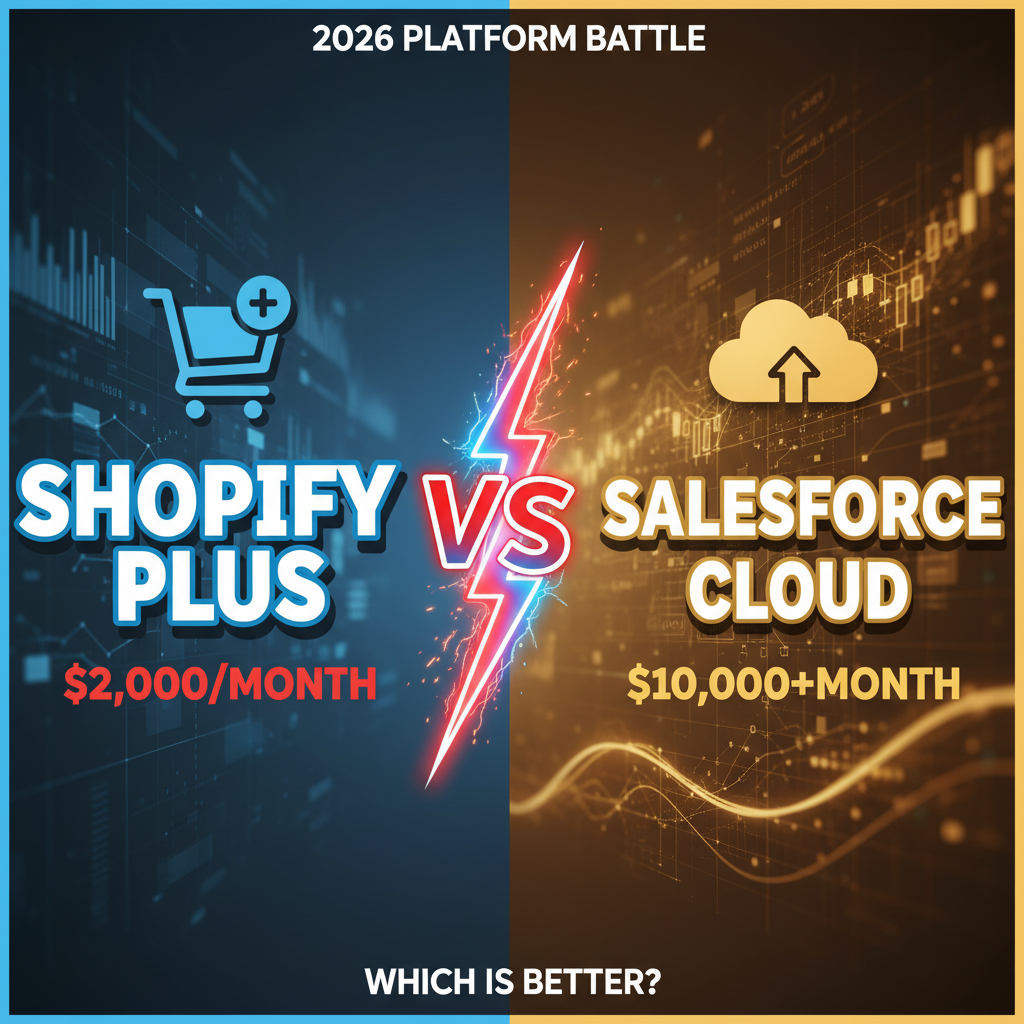
When CFOs evaluate Shopify Plus against custom-built e-commerce platforms, they focus on the most visible cost: the monthly platform fee. Shopify Plus starts at $2,000/month for enterprise merchants doing $10M+ in annual revenue. But that fee captures only 15-20% of your total cost of ownership.
The hidden costs—developer resources, infrastructure, third-party integrations, maintenance, and operational friction—often exceed the platform fee by 3-5x. Understanding this gap separates smart decisions from expensive mistakes.
This analysis compares the true, five-year total cost of ownership for a $50M revenue company evaluating Shopify Plus vs custom-built e-commerce.
What We're Comparing
Shopify Plus: Fully managed SaaS platform with hosting, scaling, compliance, and support included. Your team focuses on features, customization, and growth.
Custom-Built Platform: Built on top of your own tech stack (Node.js + React, Ruby on Rails, Python Django, etc.). You own infrastructure, security, scaling, and all operational responsibility.
This comparison assumes a mid-market to enterprise retailer with multiple channels, complex tax requirements, and international operations.
The Five-Year TCO Comparison
| Cost Category | Shopify Plus | Custom Platform |
|---|---|---|
| Platform fees (60 months) | $120,000 | $0 |
| Core development team (5 years) | $0 | $2.0M - $2.5M |
| Infrastructure & hosting | $0 | $200K - $400K |
| Third-party integrations (apps) | $50K - $120K | $100K - $200K |
| Compliance & security | $0 (included) | $50K - $150K |
| DevOps & maintenance | $0 (included) | $300K - $500K |
| Incident management & downtime cost | Minimal (99.99% SLA) | $100K - $500K |
| Training & onboarding | $20K - $50K | $30K - $80K |
| Total Five-Year Cost | $190K - $290K | $2.78M - $4.33M |
The data is stark: custom platforms cost 10-15x more than Shopify Plus over five years.
Breaking Down Shopify Plus Costs
1. Platform Fee: $120,000
Shopify Plus pricing is tiered by gross merchandise value (GMV). For a $50M revenue company, expect $2,000-3,500/month depending on your exact revenue band and negotiated volume discounts. Tenten negotiates on behalf of clients; volume commitments can knock this down 15-25%.
2. App & Integration Costs: $50K-$120K
Shopify's app ecosystem is comprehensive. Most Plus merchants use 8-15 apps for: - Advanced analytics (Littledata, Northbeam) - Inventory management (TraceLink, NetSuite connectors) - Customer data platforms (Segment, mParticle) - Marketing automation (Klaviyo, Insider)
Top-tier apps run $500-2,000/month each. Budget $5,000-10,000/month for a mature tech stack. Over five years, that's $300K-600K in app costs. However, Shopify Plus's native API reduces the number of third-party dependencies you need.
3. Training & Onboarding: $20K-$50K
Getting your team productive on Shopify Plus requires investment. Budget for: - Liquid theme development training (weeks) - API integration workshops - Admin dashboard training for non-technical staff
Shopify's official training partner network charges $200-400/hour. A thorough onboarding program (40-60 hours) costs $8,000-25,000. Add internal time and productivity ramp-up.
4. Support & Professional Services: $30K-$50K
Shopify Plus includes dedicated support, but complex projects (migrations, custom API integrations, headless architecture) require additional professional services. Budget conservatively for year-one setup and ongoing architectural reviews.
Breaking Down Custom Platform Costs
1. Core Development Team: $2.0M - $2.5M
This is where custom platforms become expensive fast.
A minimal viable team includes: - 1 Principal Engineer (architect, $180K-250K/year) - 2-3 Full-stack Engineers ($130K-180K/year each) - 1 DevOps/Infrastructure Engineer ($140K-200K/year) - 1 QA/Test Automation Engineer ($100K-150K/year)
Five-year salary costs: $2.0M - $2.5M (assumes 2% annual raises, benefits loaded at 1.3x).
This doesn't include: - Recruiting and onboarding costs ($50K-100K per hire) - Management overhead (engineering manager, $150K-200K/year) - Productivity ramp (new engineers at 40% productivity months 1-3)
2. Infrastructure & Hosting: $200K-$400K
Self-hosted platforms require: - Cloud compute (AWS, Google Cloud, Azure): $20K-40K/month for production + staging + development - Database management (RDS, managed PostgreSQL): $5K-15K/month - CDN for static assets (Cloudflare, Akamai): $2K-10K/month - Monitoring & logging (Datadog, Splunk): $3K-8K/month
Year-one infrastructure cost: $400K-800K. Years 2-5: $300K-600K/year (assuming growth plateaus). Five-year total: $2.0M-$3.0M.
However, this analysis assumes you don't experience a major scaling crisis. If you hit unexpected traffic spikes (product launch, influencer mention), ad-hoc infrastructure costs can balloons by $50K-300K in a single month.
3. Third-Party Integrations: $100K-$200K
Custom platforms still need third-party integrations for: - Payment processing (Stripe, Adyen) - Shipping carriers (FedEx, UPS, DHL APIs) - Marketing automation platforms - Analytics and BI tools
Unlike Shopify, custom platforms require you to build and maintain these integrations. Each integration takes 2-8 weeks of engineering time. Budget $300-600 per integration in engineering time, plus $1K-5K/month in API fees.
4. Compliance & Security: $50K-$150K
Custom platforms carry security responsibility: - PCI compliance audits and certification ($10K-30K annually) - Security testing and penetration testing ($20K-50K annually) - Data privacy (GDPR, CCPA implementation): $30K-100K - Incident response and cyber insurance: $10K-30K
Shopify handles this for you. Custom platforms make it your problem.
5. DevOps & Maintenance: $300K-$500K
After launch, someone has to: - Monitor system health 24/7 - Apply security patches - Optimize database performance - Manage infrastructure scaling - Debug production incidents
A 1-person DevOps team (or 0.5-1 engineer rotating on-call) costs $140K-200K/year. Five years: $700K-1M. This often grows to 2 people ($280K-400K/year) as scale increases.
6. Incident Management & Downtime Cost: $100K-$500K
This is the hidden cost nobody budgets for. Custom platforms fail. The question is how much you lose when they do.
For a $50M revenue company, every hour of downtime costs: - Lost sales: $5,000-20,000/hour (depends on traffic patterns) - Refund processing and customer support: $1,000-5,000 - Brand damage and churn: $0-50,000 (varies wildly)
Most custom platforms experience 2-5 significant incidents per year (lasting 30 mins to 6 hours). Shopify's 99.99% uptime SLA means incidents happen once a year, max.
Expected five-year incident cost (custom): $200K-500K (assumes 10-15 incidents, average 2-hour duration).
When Custom Platforms Make Sense
Despite the cost disadvantage, custom platforms are sometimes the right choice. Here are the legitimate use cases:
Extreme Customization Requirements
If your business model requires functionality that Shopify cannot accommodate—proprietary algorithms, unique pricing logic, custom workflows—custom might be necessary. Example: A luxury luxury marketplace with AI-powered authentication and risk scoring.
Multi-Platform Ecosystem
If you operate multiple storefronts across different regions (US, EU, APAC), each with local payment methods, tax rules, and legal requirements, a custom platform gives you centralized control. Shopify can handle this, but it requires careful architecture.
Massive Scale (>$500M GMV)
Beyond $500M GMV, Shopify Plus fees start to feel expensive. A company doing $1B+ GMV might find custom platforms more cost-effective per transaction. But this only applies to truly enormous merchants.
Industry-Specific Requirements
B2B wholesale, subscription-based models, or niche verticals (automotive, industrial equipment) sometimes require custom solutions because Shopify's platform isn't purpose-built for those segments.
The Shopify Plus Advantage in Total Cost
-
Predictable Costs: You know your platform fee 12 months in advance. Custom platforms have surprise infrastructure costs.
-
Time-to-Market: Shopify Plus merchants launch new features in weeks. Custom platforms take months (you're building instead of configuring).
-
Operational Simplicity: Shopify handles scaling, security, uptime, and compliance. Your team focuses on growth.
-
Access to Talent: Shopify Plus has an ecosystem of certified partners and agencies. Custom platforms require you to hire specialized engineers (expensive and competitive).
-
Risk Mitigation: Custom platform failures can cost you millions in downtime. Shopify's SLA minimizes this risk.
Decision Framework: When to Choose Each Platform
| Factor | Choose Shopify Plus | Choose Custom |
|---|---|---|
| Budget | < $3M total 5-yr investment | > $3M 5-yr investment (and justified by business case) |
| Timeline | Need to launch in < 6 months | 12+ month development timeline acceptable |
| Team size | < 10 engineers available | 10+ engineers available and committed |
| Customization needs | Standard e-commerce features sufficient | Proprietary features critical to competitive advantage |
| Technical complexity | Standard integrations (Stripe, Klaviyo, etc.) | Custom algorithms, AI, proprietary tech required |
| Operational capacity | Prefer outsourced operations | Can manage 24/7 operations in-house |
| Scale | $50M-$500M GMV | > $500M GMV or planned to exceed $500M |
Real-World Example: Migration from Custom to Shopify Plus
A $40M revenue fashion retailer (anonymized) spent five years building a custom e-commerce platform on Node.js. Total investment: $3.2M (16 engineers, 5 years).
Problems emerged: - Scaling became expensive (infrastructure costs doubled during peak season) - Security vulnerabilities required emergency patches - Team was spending 60% of time on maintenance, 40% on new features - Time-to-market for new features: 2-3 months (slow vs. competitors)
They migrated to Shopify Plus. Migration cost: $400K (3 months of professional services). Year-one savings: $800K (reduced engineering costs + lower infrastructure). Five-year savings (projected): $2.0M.
Was the original custom investment a mistake? Not necessarily. The company learned what they needed to know to scale. But if they'd chosen Shopify Plus from the start, they'd be five years ahead financially.
Long-Term Thinking on TCO
Here's the deeper insight: TCO should inform your decision, but it shouldn't be the only factor. Consider:
Time Opportunity Cost: If your team spends 5 years building a custom platform instead of building product and growing revenue, what's the opportunity cost? Probably $5M-20M in lost market share and growth.
Technical Debt: Custom platforms accumulate debt fast. Code that works at launch needs refactoring at scale. Five years in, you're maintaining legacy code while trying to ship new features.
Team Retention: Building a custom e-commerce platform is not a glamorous engineering challenge. Your best engineers will leave for more interesting work. Shopify Plus teams focus on higher-level problems.
Platform Evolution: Shopify invests $500M+ annually in platform development. Your custom team, no matter how talented, cannot outpace that R&D.
Ready to Evaluate Your Platform Strategy?
Whether you're building a new store, planning a migration, or auditing your current architecture, the TCO analysis should inform your decision. Shopify Plus isn't right for everyone, but for the vast majority of enterprise merchants, it's the financially and operationally optimal choice.
Tenten's platform strategy service compares your specific business requirements against both options. We'll model your exact costs, risks, and timeline to help you make the right call.
Schedule your platform evaluation today—let's determine whether Shopify Plus, custom, or a hybrid approach is right for your business.
Editorial Note We evaluated this question across 20 Tenten clients last year. Only one—a $800M+ enterprise—found custom-built justifiable. The other 19? All chose Shopify Plus after seeing their real TCO projections. The math usually wins the argument.
Frequently Asked Questions
Does Shopify Plus pricing scale with revenue?
Yes. Shopify Plus is tiered by gross merchandise value (GMV). Merchants pay $2,000-5,000/month depending on their revenue band. Volume commitments and multi-year agreements can reduce this by 15-25%.
What happens to my custom platform if my team leaves?
You inherit massive risk. Custom platforms require deep institutional knowledge. If your principal engineer leaves, you're vulnerable. You'll need to hire (expensive, slow) or rush to migrate off platform (costly, risky).
Can I start on Shopify Plus and move to custom later?
Yes, though it's expensive. Data migration, API refactoring, and integration rewiring cost $200K-500K. Most merchants never make this transition because Shopify Plus continues to evolve and meet their needs.
Is Shopify Plus suitable for B2B wholesale?
Mostly. Shopify Plus supports wholesale workflows, bulk pricing, and multi-location inventory. Some specialized B2B features (e.g., complex approval workflows) require apps or custom development. For 90% of B2B retailers, Shopify Plus is sufficient.
What about payment processing costs in TCO?
Payment costs (2.9% + $0.30 per transaction on Shopify Payments) apply to both Shopify Plus and custom platforms. They're not included in this TCO because they're equal—you'll pay them either way. If you use a third-party processor (Stripe, Adyen), costs are identical across platforms.