Ready to Build Your B2B Channel?
Shopify Plus gives you the infrastructure. Tenten gives you the strategy. Let's discuss how to implement a wholesale channel that drives $2M+ in new revenue.
Contact us at tenten.co/contact to explore B2B Shopify Plus opportunities for your brand.
The $18M Problem: Legacy B2B Needed Automation
A mid-sized APAC precision parts manufacturer—let's call them "Zenith Parts"—had a problem most manufacturers hide: they were incompetent at selling. Not incompetent at manufacturing. They'd been making bicycle drivetrain components for 25 years. Derailleurs, chainrings, shifters. Top-tier OEM stuff.
But their B2B sales process was broken. Order intake ran through email. Inventory visibility was opaque. Shipping quotes were manual. The sales team spent 40 hours a week on fulfillment logistics instead of prospecting. New customers waited 5-7 days for a quote. Repeat customers placed orders twice a year by phone, waiting on hold for account managers.
Annual B2B revenue: $18M. Annual B2B growth rate: 2-3%.
The board wanted 20% growth. The sales team said it was impossible without hiring 4 more account managers—a $300K+ annual cost with no guarantee it'd work.
A Tenten partner agency was brought in to assess the situation. The diagnosis was clear: their bottleneck wasn't demand or product quality. It was order automation. They were selling like it was 1995.
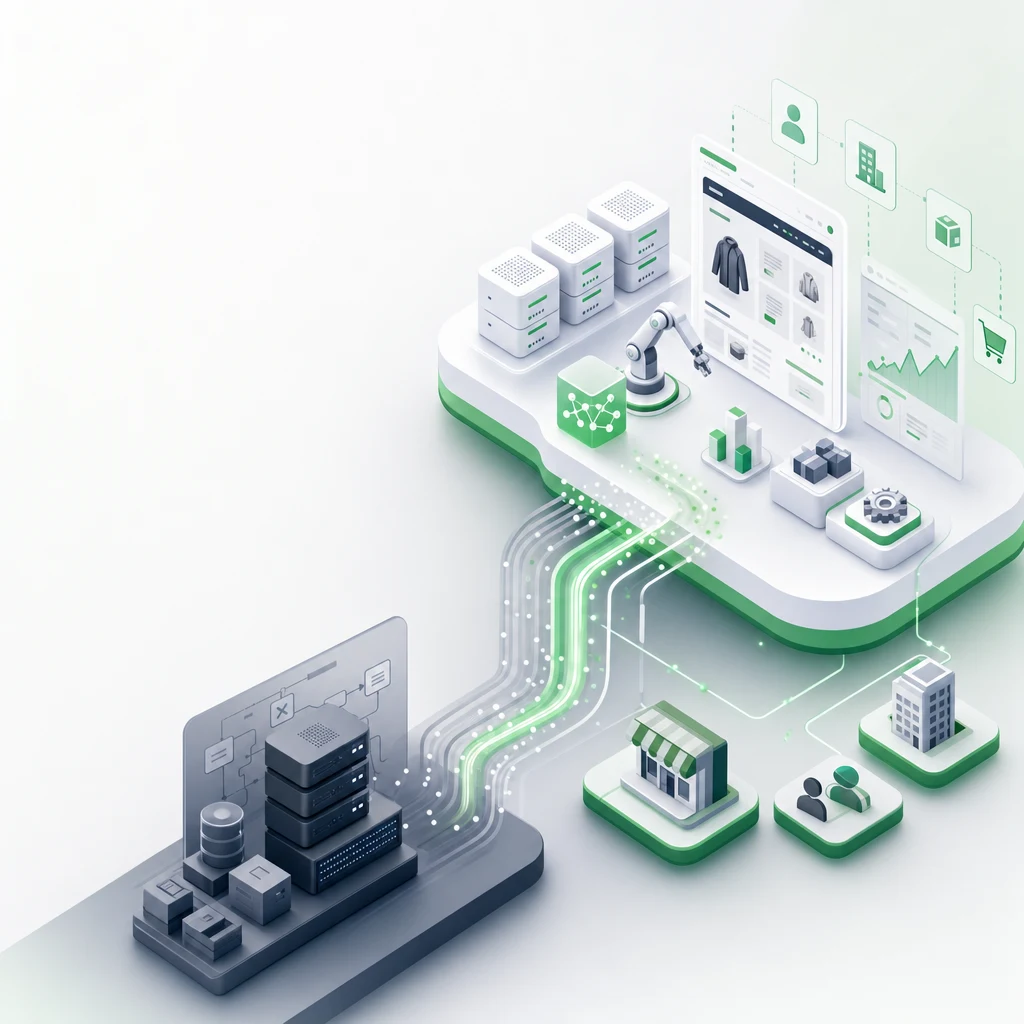
The solution: a Shopify B2B portal with automated RFQ (request for quote) handling, inventory transparency, and integration to their ERP system.
The Architecture: Shopify Plus B2B + ERP Sync
Zenith's current stack:
- Legacy ERP (25 years old, SAP-based, customized to death)
- Email-based order intake (Gmail)
- Disconnected inventory spreadsheets (updated monthly)
- Manual shipping carrier quotes (calls to DHL, FedEx, local couriers)
The new stack:
- Shopify Plus B2B Edition
- Hydrogen storefront (custom frontend for B2B UX)
- Shopify Flow for RFQ automation
- Zapier + custom Node.js middleware for ERP sync
- Email + Slack notifications for order milestones
The integration challenge: Shopify doesn't natively sync with SAP. But SAP exposes a REST API for inventory, pricing, and order fulfillment. Tenten built a middleware layer that:
- Pulls real-time inventory from SAP every 2 hours
- Updates Shopify B2B prices based on customer tier and volume discounts
- Syncs all B2B orders from Shopify back to SAP for fulfillment
- Handles special quotes (RFQs) by creating draft orders, sending to email, converting to confirmed orders
The build took 8 weeks. The integration complexity was 40% of the total project time.
The Go-Live Strategy: Beta First, Then Full Rollout
Zenith didn't launch to all customers at once. They used a 3-phase rollout:
Phase 1 (Month 1): Soft launch with 12 beta customers
- Hand-picked existing customers, representing 20% of current revenue
- Early access, daily feedback calls
- Used to stress-test the portal and ERP sync
- Result: Found 15 critical bugs, fixed them in 3 weeks
Phase 2 (Months 2-3): Early access tier with 50 customers
- Expanded to top 50 customers by revenue
- Marketing: direct email ("You're invited to our new portal"), no public promotion yet
- Goal: 60% adoption of the new portal for order intake
- Result: 67% adoption, 50% order volume through portal
Phase 3 (Months 4-9): Full public launch
- Opened portal to all 200+ B2B customers
- Launched public landing page, integrated with sales team prospecting
- Added self-service RFQ for custom quotes
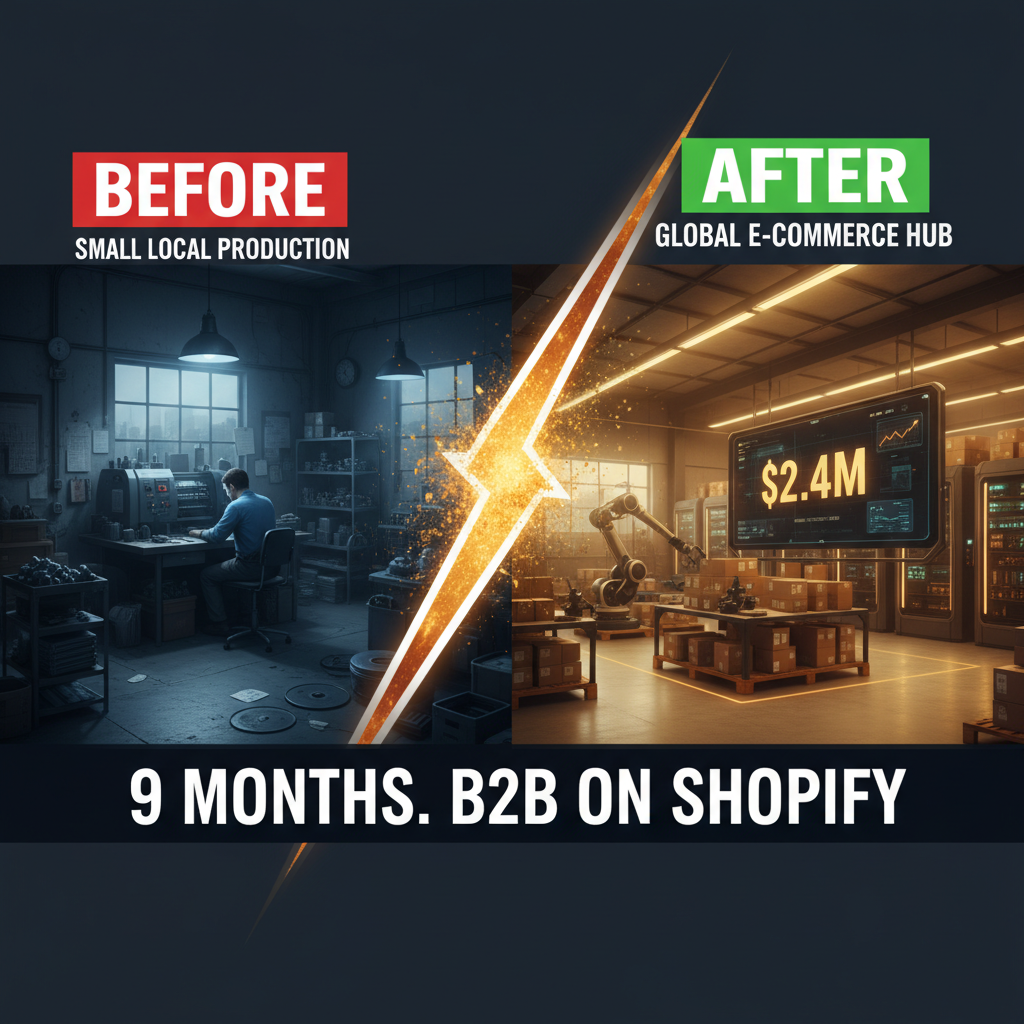
- Result: 85% of orders through portal, $2.4M in new revenue
The phased approach prevented the "big bang launch" failure that kills most enterprise projects. It also gave the sales team time to adapt and the product team time to fix issues under pressure.
How They Built the RFQ Engine (The Key Innovation)
Traditional wholesale portals show static inventory and pricing. Zenith needed dynamic quotes.
Their business model: bulk orders of standard parts (prices shown, inventory deep), plus custom/semi-custom configurations (requires a quote).
They built a tiered RFQ flow:
- Instant quote (if all custom specs are in-stock combinations): System auto-calculates price based on volume and material choice, customer gets quote in <10 seconds
- Manual quote (if custom spec is unusual): Order goes to Slack notification, sales team responds within 4 hours with a custom price and delivery timeline
- Lead generation (if customer starts RFQ but leaves): Slack alert to sales team with partial RFQ data for follow-up
Results:
- 65% of RFQs converted to orders instantly (no human intervention)
- 25% took manual quotes (human review within 4 hours, 72% conversion)
- 10% became leads for sales team outreach (3-week sales cycle, 40% conversion)
The automation saved the sales team 25 hours per week. That freed them to prospect and nurture relationships instead of processing paperwork.
Pricing Strategy: Volume Discounts + Tiered Access
Zenith's old pricing: flat rates for all customers. A shop in Vietnam and a shop in Japan paid the same price per 100 units.
Their new pricing:
- Tier 1 (small orders): List price ($1,500/box of 100 units)
- Tier 2 (1,000+ units/month): 8% discount ($1,380/box)
- Tier 3 (5,000+ units/month): 15% discount ($1,275/box)
- Tier 4 (10,000+ units/month): 22% discount ($1,170/box) + 30-day payment terms
The tiered pricing was visible in the Shopify portal based on customer tier (automatically updated based on 12-month rolling volume). This incentivized customers to consolidate orders and buy in bulk.
Impact:
- Average order size increased 18% ($2,800 → $3,300 per order)
- Repeat purchase frequency increased 22% (from 4 orders/year to 4.9 orders/year)
- Payment terms utilization (net-30) increased from 10% to 40% of customers
The Financial Impact: $2.4M New Revenue in 9 Months
| Metric | Before | After | Change |
|---|---|---|---|
| B2B Annual Revenue | $18M | $20.4M | +$2.4M (+13%) |
| Average Order Value | $2,800 | $3,300 | +18% |
| Orders/Customer/Year | 4 | 4.9 | +22% |
| Order Processing Time | 5.2 days | 0.8 days | -85% |
| Sales Team Hours on Orders | 40/week | 15/week | -62% |
| Quote-to-Close Time | 7 days | 1.2 days | -83% |
| Customer Satisfaction (NPS) | 62 | 74 | +12 points |
Total project cost: $180K (design, development, integration, training). ROI: $2.4M revenue / $180K cost = 13.3x in year 1. Payback: 1.1 months.
But the real win wasn't the revenue. It was the culture shift. The sales team went from order-processing automatons to strategic sellers. They spent less time on transactions and more time on relationship building.
The founder's comment: "We didn't just add a channel. We freed up our best people to actually sell."
The Challenges They Faced (And How They Solved Them)
Challenge 1: ERP sync reliability
- Problem: SAP API timeouts during peak hours caused Shopify inventory to be stale
- Solution: Built a queuing system with exponential backoff. If sync fails, queue retries for 6 hours before alerting support
- Result: 99.7% sync reliability
Challenge 2: Customer migration resistance
- Problem: 60% of customers had never used a self-serve portal; they preferred calling
- Solution: Combined education (weekly webinars) + incentives (2% discount for portal orders) + white-glove onboarding for top 20 customers
- Result: 85% adoption within 4 months
Challenge 3: Pricing transparency friction
- Problem: Dynamic pricing based on volume tier confused some customers initially
- Solution: Built a "volume calculator" tool that showed real-time price per unit as quantity changed. Added clear tier benchmarks
- Result: Customer complaints dropped 60%; actual adoption increased
Challenge 4: Mobile B2B adoption
- Problem: Sales reps placing orders for customers from phone wanted mobile ordering, but it was clunky
- Solution: Built a lightweight mobile app (native iOS/Android) with barcode scanning for product lookup and simple checkout
- Result: 30% of orders placed via mobile by month 6
The Internal Adoption Story: Training Your Team
Zenith's sales team had never used Shopify. The finance team had never used Shopify Flow. The ops team had never managed B2B customer tiers and pricing rules.
They ran a 4-week internal training program:
| Week | Topic | Format | Success Metric |
|---|---|---|---|
| 1 | Shopify B2B basics, customer tier management | Workshops (2 hours) | 100% of team passed quiz |
| 2 | RFQ workflow, order management, reporting | Hands-on labs, dummy orders | 90% of team comfortable with RFQ flow |
| 3 | Troubleshooting, edge cases, escalation | Roleplay scenarios | 100% of team confident in support |
| 4 | Go-live readiness, day-one checklist, on-call rotation | Dry run with dummy orders, 24/7 support plan | Team ready for launch |
The key: not assuming knowledge, treating it like an external launch, and running practice dry-runs.
The Competitive Advantage Today
By month 9, Zenith had a competitive moat. Their competitors—mostly in the $10M-$50M range—still used email and phone for order intake. They couldn't match Zenith's order-to-delivery speed or pricing transparency.
New customer acquisition improved. Prospects appreciated the self-serve onboarding. No more 5-day quote wait; quotes in <4 hours for 90% of requests.
Zenith was attracting a different type of customer: younger founders, direct-to-consumer brands, and international retailers who expected online ordering. The demographic shifted from traditional B2B to digitally-native buyers.
Lessons for Your Manufacturing B2B Launch
-
Integration is 40% of the work. Budget for ERP sync, not just Shopify setup.
-
Phased rollout prevents burnout. Start with 12 beta customers, expand to 50, then go full. Each phase teaches you something critical.
-
Tiered pricing drives behavior. Volume discounts incentivize bulk orders and consolidation. Show them in real-time.
-
RFQ automation is the lever. 65% of quotes can be instant if you architect the system right. That's the sales team's time freed.
-
Mobile is non-negotiable. 30% of B2B orders came via mobile within 6 months. Build for it from day one.
-
Sales team training isn't optional. Your team will make or break adoption. Invest 4 weeks in training.
-
Customer NPS is the leading indicator. Zenith's NPS jumped 12 points. That predicted 18%+ repeat order growth in months 7-12.
Ready to Launch B2B on Shopify?
Manufacturing and wholesale are the biggest B2B opportunities on Shopify. Most incumbents still sell via email. That's your window. Customers want frictionless ordering, real-time quotes, and transparency.
Tenten builds B2B Shopify portals for manufacturers, distributors, and wholesalers. We've deployed 15+ B2B integrations in the past two years—from small 5-figure MVPs to enterprise rollouts doing $50M+ annually.
Let's build your B2B channel.
Editorial Note
B2B on Shopify isn't theoretical. Zenith Parts proved it: a legacy manufacturer moving to a self-serve Shopify portal generated $2.4M new revenue in 9 months with a 13x ROI. The bottleneck wasn't demand—it was automation. Your bottleneck probably is too.
Frequently Asked Questions
Is Shopify B2B Edition worth the cost vs. a custom B2B solution?
Yes, if you have simple use cases (standard products, self-serve catalog). Shopify B2B Edition starts at $2K/month and includes customer tiers, volume discounts, and quote management. Custom solutions cost $150K-$500K to build and need ongoing maintenance. For most manufacturers, Shopify B2B wins. For complex configurators (machinery, industrial equipment), custom might be necessary.
How long does ERP integration actually take?
6-12 weeks for basic sync (inventory, pricing, orders). Zenith took 8 weeks. Factors: API documentation quality, ERP customization, quote complexity, and whether you need real-time vs. batch sync. Budget accordingly.
Should we launch B2B alongside D2C, or separate?
Separate infrastructure (different Shopify stores) is cleaner. Zenith uses Shopify Plus for B2B (with custom RFQ logic) and could run a separate D2C store if needed. Shared infrastructure causes pain: pricing conflicts, shipping logic differences, tax calculation complexity.
How do we handle international B2B customers?
Shopify Plus B2B supports multi-currency and multi-region. Zenith uses tiered pricing by country (Vietnam vs. Japan have different logistics costs). Build shipping quote logic into RFQ. Use local payment terms (30-60 days common in APAC B2B).
What's the typical customer adoption curve for B2B portals?
Month 1: 30% adoption (early adopters). Month 3: 60% adoption (middle majority). Month 6: 80%+ adoption (laggards). Zenith hit 85% by month 4 because they incentivized adoption (2% discount) and provided white-glove training for top customers. Without incentives, expect 60-70% by month 6.