Why Shopify Plus ROI Is Harder Than It Looks
Shopify Plus looks expensive. The platform base is $2K–$40K monthly depending on sales volume. Implementation costs $100K–$300K. Apps and integrations add another $500–$3K monthly.
Most CFOs see those numbers and say no.
But that's incomplete analysis. The real question: what does Shopify Plus enable that your current platform doesn't? And what's that capability worth?
We've helped dozens of brands build the Plus ROI case. The structure is always the same, but the numbers vary wildly by use case.
The Three ROI Drivers for Shopify Plus
Driver 1: Revenue Lift from Capabilities You Don't Have
- Faster checkout → Lower cart abandonment
- Headless commerce → Better mobile performance → Higher conversion
- Custom metafields → Personalization → Higher AOV
- B2B tools → Unlock wholesale channel
- Subscription apps → Recurring revenue
Driver 2: Cost Reduction from Efficiency
- Self-serve infrastructure vs. DevOps team
- Bundled payment processing (Shopify Payments) vs. custom integrations
- Built-in compliance (tax, privacy) vs. manual overhead
- Faster custom feature deployment vs. consulting hours
Driver 3: Risk Mitigation
- Platform stability (99.99% uptime) vs. legacy platform reliability
- Regulatory compliance (GDPR, CCPA, PCI) built-in
- Security updates + PCI compliance automatic
- Dedicated Shopify support team included
Most brands focus only on Driver 1 (revenue lift). The real ROI often comes from Drivers 2 & 3.
The ROI Calculator Framework
Here's how to build your Shopify Plus business case. We'll use three example scenarios.
Setup:
- Calculate your current annual costs (platform, DevOps, integrations, security, compliance, support)
- Add new Shopify Plus costs (platform, implementation, ongoing apps, support)
- Subtract old costs
- Estimate revenue lift from new capabilities
- Calculate payback period
Scenario 1: $20M Revenue DTC Brand (Current: Self-Hosted Platform)
Current state: Running on custom platform (Rails/Django). Been operating for 6 years.
| Cost Category | Annual Cost |
|---|---|
| Platform hosting (AWS, infrastructure) | $180K |
| DevOps team (2 engineers) | $400K |
| Payment processing integration | $80K |
| Security audit + compliance | $60K |
| Custom integrations (3rd party tools) | $45K |
| Total current annual cost | $765K |
Shopify Plus:
| Cost Category | Annual Cost |
|---|---|
| Shopify Plus platform fee | $120K (typical for $20M revenue) |
| Implementation ($250K one-time / 3 years) | $83K |
| Custom apps + integrations | $35K |
| Shopify Plus support (included) | $0 |
| Total Plus annual cost | $238K |
Savings from migration:
- Eliminate 2 DevOps engineers: +$400K (redeploy team)
- Reduce hosting costs: $180K saved
- Payment processing simplified: $45K saved
- Security audits automated: $40K saved
- Custom integration complexity down: $20K saved
- Total cost savings: $685K annually
Revenue lift:
- Faster custom feature deployment (Shopify Plus dev speed vs. custom platform)
- Headless commerce reduces bounce rate by 2% → 2% of $20M = $400K incremental revenue
- B2B wholesale capability unlock → $150K first year (conservative)
- Subscription upsell opportunities → $80K first year
- Total revenue lift: $630K year one (diminishes to $400K steady-state)
First-year ROI:
- Savings: $685K
- Revenue lift: $630K
- Less: Shopify costs: -$238K
- Net benefit: $1.077M
- Payback period: 2.8 months
This scenario wins Shopify Plus. Cost reduction alone justifies the move. Revenue lift is bonus.
Scenario 2: $8M Revenue DTC Brand (Current: Shopify Standard)
Current state: Running on Shopify Standard ($299/month). Growing 40% YoY. Bottleneck: API rate limits, complex integrations straining platform.
| Cost Category | Annual Cost |
|---|---|
| Shopify Standard plan | $3.6K |
| Payment processing (3% + 30¢) | $145K |
| Custom apps (Klaviyo, Yotpo, Bold) | $18K |
| Contracted developer (10 hrs/week) | $65K |
| Third-party integrations | $12K |
| Total current annual cost | $243.6K |
Shopify Plus:
| Cost Category | Annual Cost |
|---|---|
| Shopify Plus platform fee | $60K (typical for $8M revenue) |
| Implementation ($180K one-time / 3 years) | $60K |
| Custom apps + integrations | $25K |
| Shopify Plus support (replaces contractor) | Included |
| Total Plus annual cost | $145K |
Savings:
- Contractor hours redirected (10 hrs/week): $65K
- API rate limiting → custom features faster: $20K (opportunity cost of slower features)
- Bundled payment processing slightly better: $8K
- Total savings: $93K annually
Revenue lift:
- Headless commerce (currently can't do on Standard): enables mobile app → 3% revenue lift = $240K
- B2B wholesale launch: $100K new revenue
- Subscription model unlock: $50K
- Total revenue lift: $390K first year
First-year ROI:
- Savings: $93K
- Revenue lift: $390K
- Less: Shopify Plus additional cost: -$145K + $243.6K old cost = -$98.6K net new
- Net benefit: $384.4K
- Payback period: 3.1 months
This scenario also wins Plus, mainly on revenue lift from new capabilities.
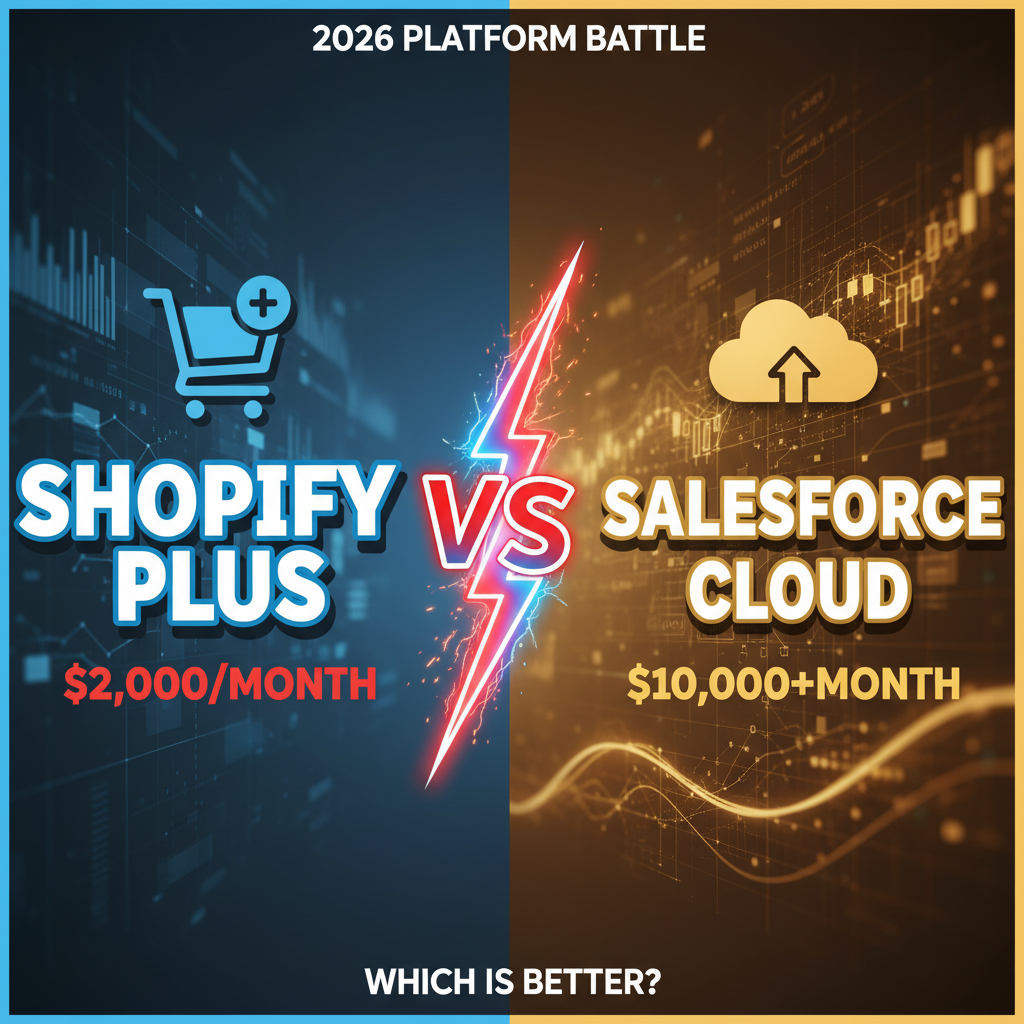
Scenario 3: $15M Revenue B2B Wholesale Brand (Current: Shopify Plus Competitor)
Current state: Running on SFCC (Salesforce Commerce Cloud). Cost structure heavy. Want to evaluate moving to Shopify Plus.
| Cost Category | Annual Cost |
|---|---|
| SFCC platform fee | $240K |
| Professional services + integrations | $180K |
| Payment processing | $55K |
| Salesforce CRM integration | $95K |
| Support + consulting | $70K |
| Total current annual cost | $640K |
Shopify Plus:
| Cost Category | Annual Cost |
|---|---|
| Shopify Plus platform fee | $90K (for $15M) |
| Implementation from SFCC → Plus | $120K one-time / 3 years = $40K |
| B2B apps + integrations | $35K |
| Payment processing | $48K |
| Shopify Plus support | Included |
| Total Plus annual cost | $213K |
Savings:
- SFCC licensing vs. Plus: $150K
- Professional services (Salesforce partners expensive): $140K
- Support costs: $70K
- Total cost savings: $360K annually
Revenue impact:
- Faster feature deployment: +$50K incremental
- Improved mobile performance: +$100K
- Fewer platform outages → reduced lost sales: +$30K
- Total revenue lift: $180K
First-year ROI:
- Savings: $360K
- Revenue lift: $180K
- Less: Migration costs + new Plus costs: -$40K - $213K + $640K old = $387K net new... wait, this inverts. Let me recalculate.
Old cost: $640K. New cost: $213K. Net savings: $427K. Plus revenue lift: $180K. Migration one-time: $120K (3-year amortization = $40K year one).
Net Year 1: $427K - $40K + $180K = $567K benefit. Payback: immediate.
This scenario strongly favors Shopify Plus on cost alone. Migration is risk, but payback is fast.
The Risks & Hidden Costs
Most brands underestimate these:
-
Migration complexity — Moving product data, inventory, customer history, and integrations from platform A to Plus takes 12–16 weeks. During migration, engineering is offline (can't build features). Cost: $100K–$300K in lost feature velocity.
-
App rebilling — Your current tools might cost $3K/month. Shopify Plus equivalents might be $5K/month (better features, but you didn't budget for it). Surprise cost: $24K–$50K annually.
-
Transaction processing costs — Shopify Plus handles higher volumes. Payment processing fees stay ~2.9%, but absolute dollars are higher. If you scale from $10M to $15M, processing cost goes from $75K to $112.5K (+$37.5K).
-
Custom feature complexity — On your old platform, a feature took 3 weeks. On Plus (with Shopify constraints), it might take 4 weeks. You gained API stability but lost custom flexibility. This rarely shows up in ROI calcs.
-
Team retraining — Your developers know your old platform. Shopify Plus requires different mental models (metafields, webhooks, Liquid). Training + ramp-up: $40K–$80K in lost productivity.
When Shopify Plus Has Negative ROI
Be honest: Plus doesn't make sense if:
-
You're below $5M revenue — You don't need the scale. Shopify Standard + focused execution beats Plus every time.
-
Your growth is slowing — If you're flat or declining, new platform won't fix it. ROI assumes revenue lift; if revenue isn't growing, you're just spending more.
-
Your current platform works — Running custom Rails? If it's stable and fast, staying put often has higher ROI than migrating.
-
You only need simple features — If your store is: product catalog, checkout, email. Shopify Standard is cheaper and simpler.
-
You haven't maxed out your current platform — Many brands move to Plus because they feel constrained, not because they've actually hit API limits or feature walls. Validate the constraint before migrating.
The Real Question: Feature or Scale?
Here's the decision tree:
| Scenario | Platform | Reasoning |
|---|---|---|
| <$5M revenue, simple DTC | Shopify Standard | ROI negative. Not enough scale to offset Plus cost. |
| $5M–$15M, DTC with growth | Shopify Plus | Revenue lift from new capabilities > cost. |
| $10M–$30M, B2B + D2C hybrid | Shopify Plus | B2B tools alone justify cost. |
| $20M+, custom/complex | Shopify Plus or custom platform | At this scale, either works. Plus is easier; custom is more flexible. |
| <$20M, SFCC/Oracle/SAP | Shopify Plus | Cost reduction from legacy platform licensing justifies migration. |
| >$100M, multiple brands | Enterprise (Plus doesn't scale) | Consider headless + custom infrastructure. |
How to Get Started
-
Audit your current costs — List everything: platform, people, integrations, infrastructure. Don't omit anything.
-
Estimate Shopify Plus cost — Use Tenten's pricing guide or request Shopify Plus demo (they'll quote).
-
Identify ONE growth lever Plus enables — Headless? B2B? Subscriptions? Be specific. Quantify the revenue opportunity.
-
Calculate payback period — (Total Plus cost - Total current cost) / Annual revenue lift. If < 12 months, strong case. If > 24 months, weak case.
-
De-risk the migration — Plan 16-week project, hire an agency, allocate internal engineering time. Underestimating timeline kills ROI.
-
Track post-launch metrics — Measure actual revenue lift vs. projections. Most brands hit 70–80% of projected lift (reality is messier). Build contingency.
Article FAQ
Q1: At what revenue level should I move to Shopify Plus?
The answer: revenue itself is less important than capability needs. We've seen brands do great on Standard at $12M and brands that needed Plus at $6M. The question is: which features are you missing that Plus unlocks? Start there, not from revenue.
Q2: How long is the migration typically?
12–16 weeks for a typical $10M–$20M brand. Factors: data complexity (variants, inventory), integration count, and testing rigor. Expect your engineering team to be 60% occupied during migration. Bad migrations take 6+ months.
Q3: Is Shopify Plus cheaper than a custom platform?
Usually yes, but not always. A custom platform can cost $50K–$200K/year to maintain (just hosting + DevOps). Shopify Plus starts at $60K/year. But if your custom platform is well-built and stable, the switching cost (migration + retraining) often exceeds 5-year savings.
Q4: What if I migrate and regret it?
Possible but rare. Migrations lock you in by nature—going backwards requires rebuilding. Before migrating, do a 2-week "Plus trial" with Shopify's team: assess features you actually need, talk to customer support, ask about migration support depth. De-risk the decision.
Q5: Does Shopify Plus solve slow checkout?
Partially. Plus gives you headless capability (custom frontend). If your checkout is slow, it's usually frontend performance (images, JS, third-party tags), not platform. Shopify Plus helps by enabling a fast headless frontend, but you still have to build it.
Q6: Will Plus help us scale to $100M revenue?
Yes, but with caveats. Shopify Plus handles up to ~$1B annual revenue. But at $100M+ scale, you probably need headless architecture (custom frontend + Shopify backend). That requires custom development and DevOps, which Plus enables but doesn't provide.
Q7: What's the most common ROI miss we see?
Brands assume revenue lift without estimating execution cost. "Plus will let us launch B2B in 6 weeks" becomes "Plus will let us attempt B2B; launch still takes 16 weeks and $120K in consulting." Overestimating speed undercuts ROI.