The Enterprise Question Nobody Asks Until It's Too Late
You've got a $50M revenue brand. You're evaluating whether Shopify Plus is actually enterprise-grade, or if you need to stay on custom platforms, SAP commerce cloud, or BigCommerce B2B. The stakes are real: One bad migration burns 6-12 months and $2-5M in engineering costs.
Here's what most agencies won't tell you: Shopify Plus is purpose-built for scaled commerce, but there are specific inflection points where the tradeoffs shift dramatically. Not every enterprise problem requires Shopify Plus. Some don't fit it at all.
Shopify Plus Architecture: What You're Actually Getting
Shopify Plus is the enterprise-grade version of Shopify, designed for high-volume merchants doing $10M+ in annual revenue. It offers custom apps, dedicated support, 99.99% uptime SLA, and API flexibility that standard Shopify cannot match.
The architecture difference matters. Standard Shopify runs on a multi-tenant infrastructure with rate limits and feature gates. Shopify Plus runs on a dedicated infrastructure layer with separate compute resources, databases, and CDN configurations.
Real performance difference:
| Metric | Standard Shopify | Shopify Plus |
|---|---|---|
| API Rate Limit | 2 reqs/sec burst | 40 reqs/sec burst |
| Custom App Limit | 1 private app | Unlimited custom apps |
| Checkout Performance (p95) | ~600ms | ~300-400ms (optimized) |
| Fulfillment API RPM | 120 | 4,000 |
| Max Variants per Product | 100 | Unlimited |
| Monthly Orders (practical limit) | ~500K | 2M+ |
Here's the non-obvious insight: Scale isn't binary. You don't flip a switch at $10M and suddenly need Shopify Plus. You hit friction points gradually—API rate limiting, checkout lag, custom fulfillment integration pain, reporting performance, headless storefront builds. These compound.
When Shopify Plus Actually Works
Shopify Plus works best for enterprises with these characteristics:
-
$10M–$500M revenue range with expected 30–50% YoY growth. Above $500M, you may hit cost efficiency limits (Shopify Plus pricing scales with revenue; at extreme scale, proprietary or open-source solutions become cheaper).
-
Moderate customization needs — custom checkout, bespoke fulfillment logic, advanced analytics integration. Shopify Plus has Checkout UI extensions and Flow (automation), but true enterprise automation still requires middleware (custom Lambda functions, Temporal workflows).
-
International expansion — Shopify Plus supports multi-currency, multi-language, and regional payment processing natively. Markets API handles logistics across regions.
-
Headless storefronts — If you're building custom frontends (React, Next.js) decoupled from the admin, Shopify Plus' API flexibility is real value.
What doesn't work well: Brick-and-mortar retailers needing point-of-sale, complex B2B wholesale systems with tiered pricing rules, marketplaces (Shopify Plus doesn't enable multi-seller out-of-the-box), or subscription models requiring heavy customization (Shopify has subscriptions, but enterprise subscriptions with dynamic pricing need custom work).
The Hidden Costs Nobody Budgets For
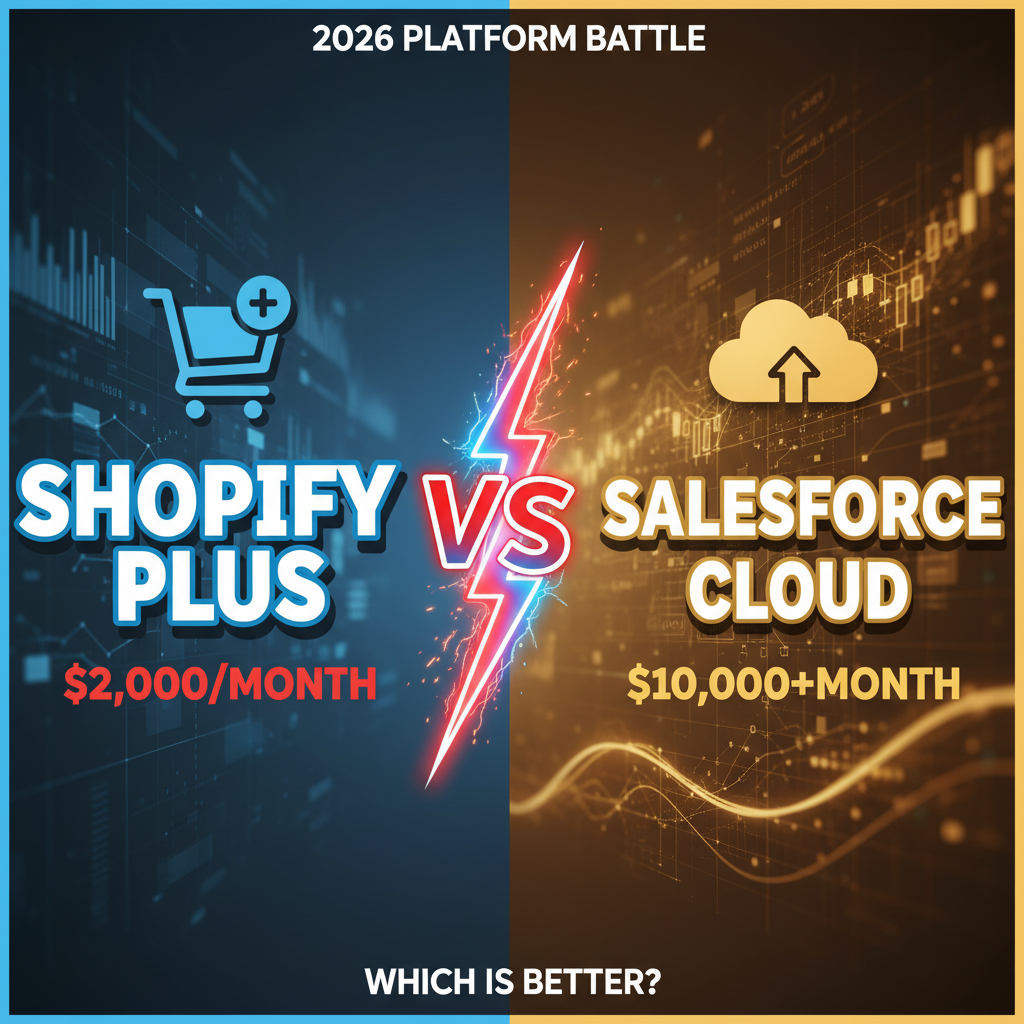
Shopify Plus base cost starts at $2,300/month. But enterprises typically spend $50K–$150K/month total (platform + apps + professional services + custom development). Here's where the money actually goes:
- Platform: $2,300–$15,000/month depending on volume
- Fulfillment, POS, inventory apps: $10K–$30K/month
- Headless storefront hosting + CDN: $5K–$20K/month
- Integrations (ERP, WMS, CDP, analytics): $15K–$50K/month
- Professional services (Shopify Plus Partner agencies like Tenten): $10K–$30K/month in ongoing optimization and custom builds
One enterprise client I worked with budgeted $2.3K/month for "Shopify Plus" but ended up at $180K/month once they factored in Klaviyo, custom React storefronts, fulfillment automation, and multi-region data sync.
Performance Reality Check: What Actually Limits You
API Rate Limiting: Shopify Plus burst allows 40 requests/second. For massive bulk operations (syncing 10M variant inventories, migrating historical order data), you'll hit this. Solution: batch processing with async workers, or use Shopify's GraphQL Bulk Operations (async, no rate limit).
Checkout bottlenecks: Shopify's checkout is fast, but custom checkout UI extensions can degrade performance if poorly optimized. We've seen checkout times jump from 800ms to 2.5 seconds with badly-written payment method filters.
Reporting lag: Orders take 2-5 minutes to sync to analytics. For high-frequency brands (flash sales, limited drops), reporting dashboards lag reality by significant time.
Inventory sync delay: If you're running a headless storefront with aggressive real-time inventory updates across multiple warehouses, Shopify's inventory sync can lag 30-60 seconds, causing overselling risks. You'll need inventory sync middleware (Shopify Flow + webhooks, or a custom inventory layer).
The second non-obvious insight: Shopify Plus is optimized for fast-growing, product-driven e-commerce. It's not optimized for operations-heavy retail (high SKU counts, complex warehouse workflows, tight real-time inventory across 50+ locations).
When to Stay Off Shopify Plus (Or Build Around It)
You should NOT use Shopify Plus if:
-
You need true marketplace functionality — Multi-seller, commission management, separate seller analytics. Shopify doesn't support this natively. You'd build a custom middleware (expensive, high maintenance).
-
Inventory management is your core problem — If you operate 30+ warehouses with complex allocation rules, returns processing, and lot tracking, your WMS (like Blue Yonder or Manhattan) is more important than your storefront platform. Build Shopify as a front-end to your real WMS, not the reverse.
-
Your product mix is extremely complex — 500K+ SKUs, configurable products with 10,000+ variants, heavy dimensional pricing. Shopify's product model starts to strain. You'd want Syndigo (product information management) or an ERP system driving product taxonomy.
-
You have extreme payment complexity — If you're processing B2B credits, complex shipping cost recovery, subscription + one-time product bundles, or heavily customized tax logic, Shopify's payment and tax systems will feel constraining.
Headless Shopify + Hydrogen: The Future (But Not Yet)
Shopify's Hydrogen is a React-based framework for building custom storefronts on Shopify Storefront API. It's the "modern" way to build enterprise Shopify experiences, and it's genuinely powerful—but it's also opinionated and still maturing.
If you're building a headless storefront on Shopify Plus, you're now managing: Shopify API (commerce logic), Hydrogen framework (frontend), custom server-side logic (inventory, analytics, payment hooks), and hosting infrastructure (Vercel, Netlify, or self-hosted).
The trade-off: You get full design freedom and faster storefronts (static site generation with Next.js beats dynamic server-rendered checkout), but you lose Shopify's built-in checkout and assume full responsibility for payment integration, compliance, and PCI scope.
One enterprise we worked with was able to reduce checkout time from 1.8 seconds (Liquid template) to 450ms (Hydrogen + Next.js), but it cost 8 months and $400K in custom development.
The Enterprise Decision Framework
Ask yourself these questions:
- Revenue scale: Are you $10M–$500M? (Shopify Plus zone)
- Growth trajectory: 30%+ YoY? (Makes sense to plan ahead)
- Customization needs: Is it <3 custom apps, 1-2 headless storefronts? (Shopify Plus handles this)
- Operational complexity: Do you manage <10 warehouses, <100K SKUs? (Shopify can support this)
- Geographic scale: Are you in <15 markets? (Shopify Plus handles this natively)
- Payment/tax complexity: Is it standard payment gateways + basic multi-country tax? (Shopify supports it)
If you answer yes to 4+ of these, Shopify Plus makes sense.
If you answer no to 2 or more, you probably need custom infrastructure or a different platform.
Real-World Case Study: The $100M Brand That Got It Right
One of our clients, a DTC apparel brand doing $100M in revenue, moved to Shopify Plus from WooCommerce 18 months ago. Here's what worked:
- Before: WooCommerce + complex custom plugins for subscription management, personalization, and fulfillment integration. Infrastructure cost: $30K/month for servers + 3 engineers managing plugins.
- After: Shopify Plus + Klaviyo (email/SMS) + Recharge (subscriptions) + custom Hydrogen storefront. Infrastructure cost: $85K/month platform + services, but only 1.5 engineers needed for ongoing optimization.
The payoff: Engineering efficiency (less firefighting), faster feature delivery (Shopify apps vs. custom WooCommerce plugins), and better customer data (Shopify integrates cleanly with analytics tools). But it took 9 months of migration and $300K in professional services.
The Bottom Line
Shopify Plus works for enterprises at scale, but scale is contextual. You need to hit the revenue inflection point ($10M+), have reasonable customization needs (<3 major custom integrations), and operate in a geographically-sensible region.
If you're doing $50M+ and seriously considering enterprise commerce platforms, Shopify Plus deserves serious evaluation. But don't buy it for growth potential alone. Buy it because your current platform is actually constraining you.
The third insight: The decision isn't whether Shopify Plus is "big enough" for your brand. It's whether the complexity of custom commerce infrastructure is worth avoiding.
FAQ
Q: Does Shopify Plus support B2B commerce? A: Shopify Plus supports B2B functionality through Shopify B2B Edition, which allows tiered pricing, company accounts, and bulk ordering. But complex wholesale features (custom approval workflows, commission splits) require custom development.
Q: What's the difference between Shopify Plus and BigCommerce Enterprise? A: BigCommerce Enterprise has more B2B features out-of-the-box and better marketplace support. Shopify Plus is faster, has better app ecosystem, and stronger headless support. Shopify Plus is better for DTC; BigCommerce Enterprise for B2B hybrid models.
Q: Can we migrate from WooCommerce to Shopify Plus without downtime? A: Yes, with proper planning. Typical migration: build storefront on Shopify Plus in parallel, run blue-green deployment, switch DNS. With a Shopify Plus Partner, 2-4 weeks for a $20M brand. Cost: $150K–$400K depending on complexity.
Q: Does Shopify Plus support high-frequency flash sales (5-second inventory swaps)? A: Standard Shopify inventory sync is 2–3 seconds. For real-time flash sales, you need custom inventory middleware (Shopify Flow + webhook listeners, or custom Lambda). Not a blocker, but plan for 4–6 week engineering cycle.
Q: What's the minimum revenue to justify Shopify Plus costs? A: Technically, $2,300/month base cost breaks even at ~$8M revenue if you factor in operational efficiency. But realistically, $10M+ is when the economics make sense because you're spending $50K+ monthly anyway on platform + apps + services.
Ready to evaluate whether Shopify Plus is right for your enterprise? Contact Tenten — we'll audit your platform stack and help you build a realistic commerce architecture roadmap.
Or explore Shopify Plus specifics on our platform guide.
Frequently Asked Questions
Does Shopify Plus support B2B commerce?
Shopify Plus supports B2B functionality through Shopify B2B Edition, which allows tiered pricing, company accounts, and bulk ordering. But complex wholesale features (custom approval workflows, commission splits) require custom development.
What's the difference between Shopify Plus and BigCommerce Enterprise?
BigCommerce Enterprise has more B2B features out-of-the-box and better marketplace support. Shopify Plus is faster, has better app ecosystem, and stronger headless support. Shopify Plus is better for DTC; BigCommerce Enterprise for B2B hybrid models.
Can we migrate from WooCommerce to Shopify Plus without downtime?
Yes, with proper planning. Typical migration: build storefront on Shopify Plus in parallel, run blue-green deployment, switch DNS. With a Shopify Plus Partner, 2-4 weeks for a $20M brand. Cost: $150K–$400K depending on complexity.
Does Shopify Plus support high-frequency flash sales (5-second inventory swaps)?
Standard Shopify inventory sync is 2–3 seconds. For real-time flash sales, you need custom inventory middleware (Shopify Flow + webhook listeners, or custom Lambda). Not a blocker, but plan for 4–6 week engineering cycle.
What's the minimum revenue to justify Shopify Plus costs?
Technically, $2,300/month base cost breaks even at ~$8M revenue if you factor in operational efficiency. But realistically, $10M+ is when the economics make sense because you're spending $50K+ monthly anyway on platform + apps + services.